Your video is good. The edit holds, the voice sounds right, the topic deserves attention. And retention collapses before the tenth second. Almost every time, the content is not the problem. The opening is. These video hook examples all deal with the same three seconds, the ones where a viewer decides to stay or to keep scrolling.
A hook is not a magic sentence you copy at random. It is a writing decision: what you show first, what you hold back, and what the picture says while the voice talks. Below are seven angles that genuinely hold those three seconds, written to be spoken out loud. If you publish mostly vertical video, our 51 hooks sorted by niche give you wording you can adapt straight away.
The short answer
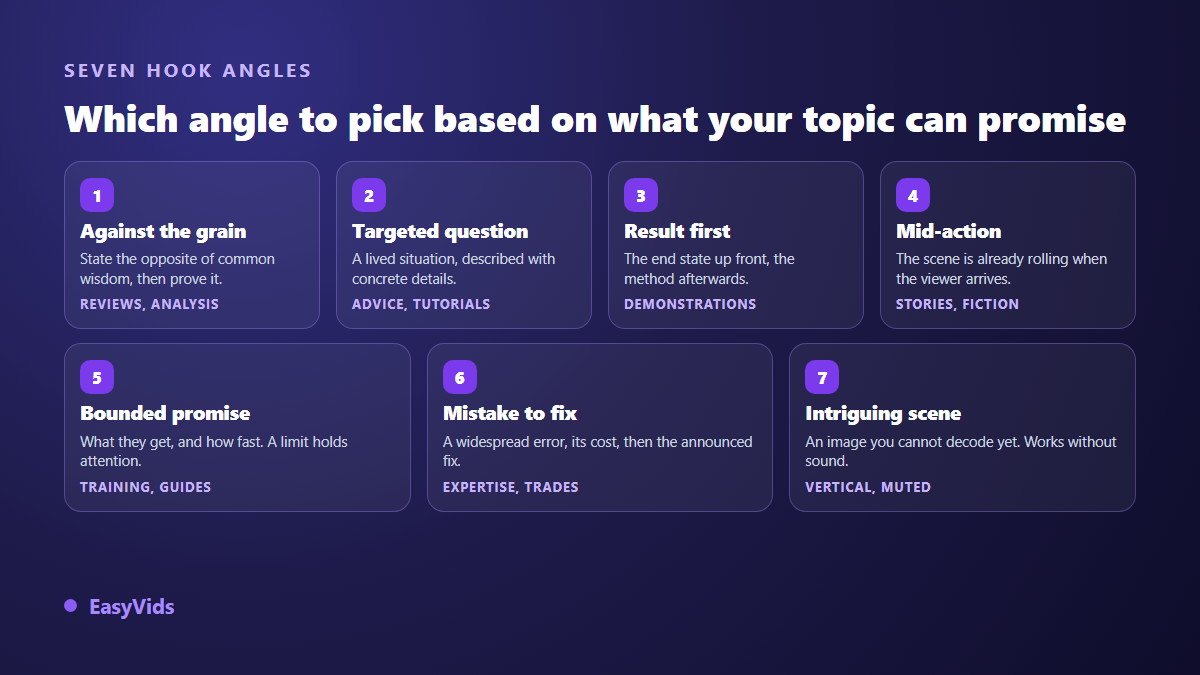
A working hook does three things at once: it raises a stake the viewer recognises, it promises a resolution, and it shows something that is not ordinary. Seven families do this reliably: the contrarian statement, the narrow question, the result shown first, the mid action opening, the bounded promise, the mistake to fix, and the intriguing setting. None of them rescues a flat first frame, and none survives a promise the rest of the video cannot keep.
What a viewer really decides in three seconds
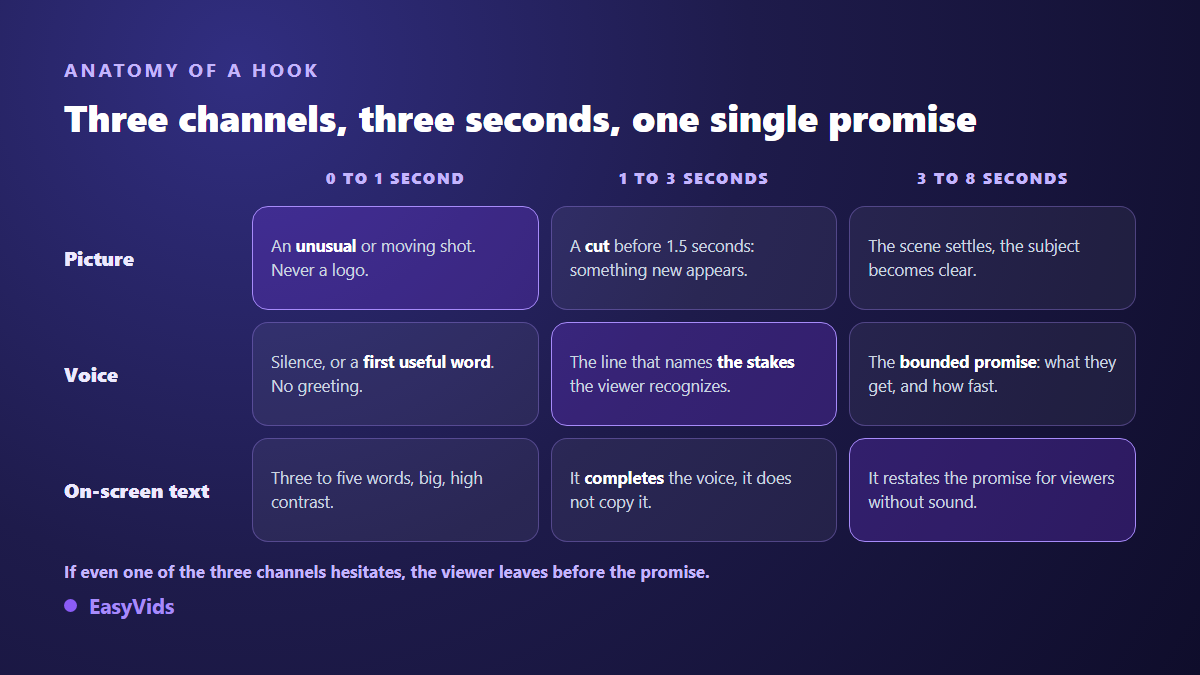
Viewers do not judge your video. They estimate the cost of staying. Three seconds are enough, based on three signals: the first frame, the first word, and the perceived pace. When all three tell the same story, they stay. When one of them hesitates, they leave, and they will never know the best moment was coming at second thirty.
That moment is visible in your analytics, provided you look in the right place. According to the YouTube help centre, the audience retention report in YouTube Studio draws a curve that starts at the very beginning of the video and shows exactly where viewers drop off. A sharp fall in the first seconds does not condemn your topic. It condemns your intro, and an intro can be rewritten in five minutes.
Seven video hook examples that hold attention
These seven angles are not lines to recite. They are attack points: pick the one your topic can support, then write it in your own words. Every example below is written for the ear, because a hook is judged out loud long before it is judged on the page.
1. The contrarian statement
You claim the opposite of what your audience takes for granted, then commit to proving it. Stop posting every day. That habit is what is smothering your channel. The tension does the work: viewers stay to argue with you. The limit is real. If the rest of the video does not honestly defend the claim, you lose trust, and an audience that feels tricked does not come back.
2. The narrow question
A general question holds nobody. A question describing a lived situation does. Your video gets a thousand views, your neighbour gets a hundred thousand, and you cover the exact same topic? Replace every vague word with a concrete detail: an order of magnitude, a place, a time of day. The narrower the question, the better it catches the right person.
3. The result shown first
Open on the finished state, never on the preparation. The plated dish, the renovated room, the completed painting. The voice rides the image without describing it: That is the result. Now back to the beginning. This angle works especially well for demonstrations and tutorials, where the promise is seen faster than it can be explained. It does require a genuinely attractive final shot.
4. The mid action opening
Screenwriters call it starting in medias res: the scene is already running when the viewer arrives. Four minutes before closing, and the parcel is still sitting on the counter. No introduction, no context, a situation in progress. It is the strongest angle for storytelling and the most demanding one, because the rest has to light the scene without rewinding thirty seconds to explain everything.
5. The bounded promise
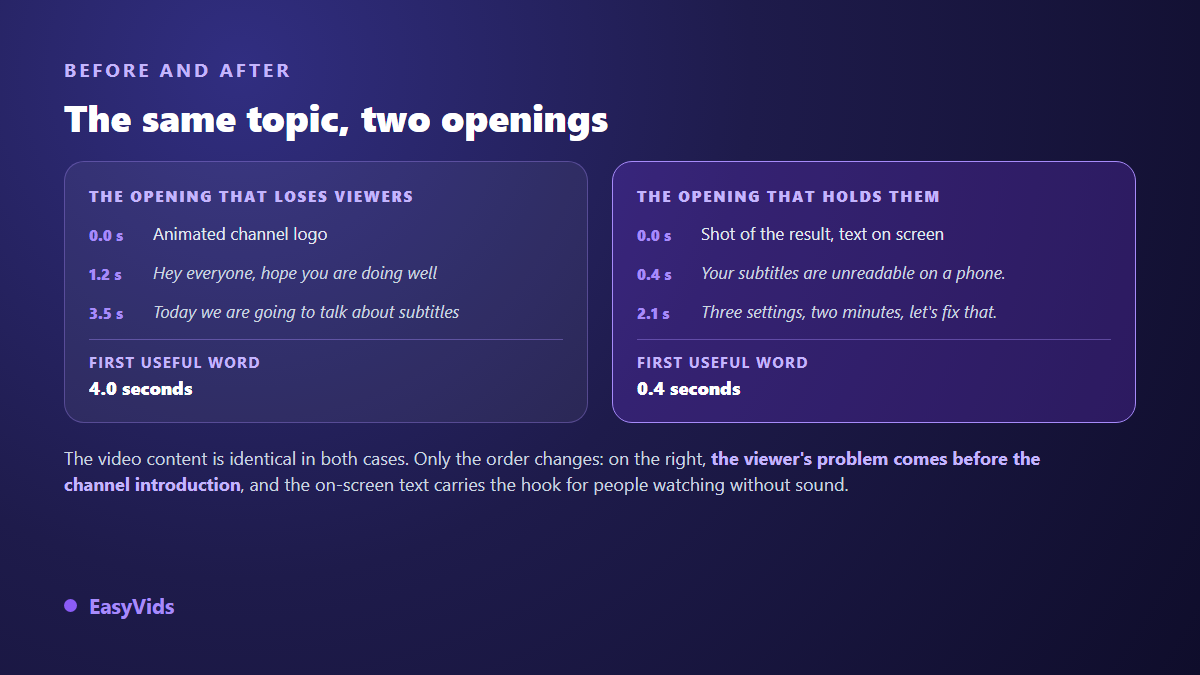
You state exactly what the viewer gets, and how long it takes. Three settings, two minutes, and your captions become readable on a phone. The boundary reassures and gives a reason to stay to the last shot. It also commits you: a promise delivered halfway through empties the room halfway through. Write this one last, once the content exists.
6. The mistake to fix
Name a common mistake, show what it costs, announce the fix. This framing mistake is invisible on a desktop and ruins the video on mobile. It works because fear of getting it wrong moves people more than the wish to get it right. One precaution: aim at the mistake, never at the person. A hook that humiliates a viewer does not keep them.
7. The intriguing setting
A hook does not have to be verbal. An object out of place, unexpected light, a camera move that reveals something: the viewer stays to work out what they are looking at. It is the best angle for silent viewing, and it combines with the other six, since it occupies the visual channel while the voice works the verbal one.
Write the hook last, never first
The most effective writing order surprises people. Write the body of the video first, find the strongest passage in that text, then build the hook out of it. A hook invented before the content promises what the video does not have. A hook extracted from the content promises what already exists, and the difference is audible by the second sentence. Our guide to writing a video script walks that method through a full script.
In the EasyVids studio, the writing page starts from a one sentence idea and returns a text built for the ear, with a hook placed in the opening seconds by default. You set the tone, the language and the target length in minutes of voice over rather than in words. A personal instructions field, saved on your account, lets you impose your own hook style on every future draft. A multi pass writing mode adds a critical review and corrections before the text comes back to you.
Opening mistakes that empty a video
They come back with striking regularity, experienced creators included. None of them takes talent to fix, only a little discipline in the edit.
- The polite introduction. Hey everyone, hope you are doing well burns three seconds before the first useful word.
- The animated logo up front. Keep the branding for later: it sells your channel to people who have not stayed yet.
- The vague promise. One precise thing holds better than seven vague benefits in a row.
- A static, dark first shot. Movement and light carry attention before words do.
- Unreadable on screen text. Too long, too small, or dropped on a busy area of the frame.
- A hook that lies. A mass exit at second ten costs more than having no hook at all.
- The same hook on every video. The effect wears out fast on a loyal audience.
Picture and sound carry half the hook
A hook plays on three simultaneous channels: what the viewer hears, what they see, and what they read on screen. The three must converge without copying each other. If the on screen text repeats the voice over word for word, you waste a whole channel. If your hook lives only in the narration, it disappears for everyone watching with the sound off.
Two settings matter more than the rest. Cutting first: inside the opening three seconds, a shot lasting more than a second and a half without revealing anything new feels endless. Sound next: bring the music in after the first line, never before, or it flattens the hook instead of supporting it. In the online editor you can add captions, animated text and sound effects to those first seconds alone, leaving the rest of the edit untouched.
Measure the hook instead of guessing
Intuition is unreliable here, because you already know how the video continues. Measurement is not. Publish, wait until the curve settles, then look only at the stretch from zero to ten seconds. That segment tells you about the hook; everything after it is about the content. Change one thing at a time between two videos of the same series, and the gap you measure is yours to trust.
Adapting the hook to format and platform
The principle never changes, the time budget does. On short vertical video the decision happens inside the first second and on screen text becomes mandatory. On long horizontal video you have five to eight seconds, which leaves room for a two part hook: one line that stops the scroll, one line that promises. On an advertising video, the product or the benefit has to appear in the first three seconds, with no brand introduction in front of it.
One last point about symmetry. A strong hook increases the number of viewers who reach the end, so the end has to earn the trip. The 21 call to action formulas we collected deserve the same care as the first line: they are the two ends of the same video.
Frequently asked questions
How long should a video hook be?
The first signal lands inside the first second, and the full promise closes around second eight. Past ten seconds it is no longer a hook, it is an introduction, and introductions lose impatient viewers.
Do I need a different hook for every platform?
The angle can stay the same, the pace must change. A hook written for short vertical video tightens to one line and leans on on screen text. The same idea, on a long horizontal video, unfolds across two lines with a wider opening shot.
Can AI write a video hook?
Yes, on one condition: give it the content of the video first, otherwise you get generic promises. Ask for several variants of the same idea, read them out loud, keep the one that does not stumble. That is exactly what our writing page does when you hand it your idea and your personal instructions.
My retention still drops at second five, what now?
Look at what happens just before the drop. Usually the hook worked but the promise takes too long to materialise: the viewer waits for the announced content and does not see it coming. Move the first useful piece of information earlier, even if a transition has to go.
The best hook is not the most spectacular one, it is the one your video can keep. Write the content, find the strongest passage, move it to the front, then check that the picture and the on screen text say the same thing as the voice. To write your scripts and hooks, split them into scenes and edit them in one place, creating an account opens the full studio, no bank card required.