Most people looking for ElevenLabs alternatives start from the same place. The name has become the reference point of the category, so it gets tried first, often before anyone has decided what they actually need from a voice. The real questions arrive later. Does the voice hold up on your script, the one with proper nouns, acronyms and long sentences? Is cloning available right away, or gated behind an approval process? And does the audio land inside your video, or do you export it and stitch it back somewhere else?
This comparison covers seven options, judged by ear, using a protocol you can rerun yourself in a few minutes. No rigged benchmark, no invented ranking: where a claim comes from a vendor, the sentence says so. If the field is new to you, our complete guide to AI voice over sets out the vocabulary and the mechanics shared by every tool here.
The short answer
There is no single alternative to ElevenLabs, there is one per use case. For long form narration, pick an engine that swallows a whole script without manual splitting and lets you set the pace. For a recurring brand voice, cloning decides everything: sample length required, turnaround, and whether the voice can be reused across your formats. For video, the right answer is almost never a standalone voice generator but a studio that chains script, voice, visuals and editing without shuttling files around. Price should never be your first criterion, because a voice that misreads your script is expensive at any rate.
Why people go looking in the first place
The reasons repeat with striking consistency, and none of them is a glaring technical fault. They are friction points. An engine that dazzles on a demo sentence can be exhausting across a real thirty minute project, simply because everything around the synthesis was designed for a different job.
- Per character billing, which makes budgets unpredictable as soon as you produce long narration.
- Cloning restricted to higher tiers, or subject to a verification step that takes days.
- Decent intonation on short sentences that stiffens on lists, numbers and acronyms.
- Having to export an audio file, then reimport it elsewhere to marry it with picture.
- A huge voice library of which only a small share truly reads your language well.
The listening protocol
Comparing voices on vendor demo clips is wasted effort. Those clips are chosen to flatter the engine: short sentences, plain vocabulary, no traps. The only test that informs you uses your own text, the one you will actually publish, with its names and its figures.
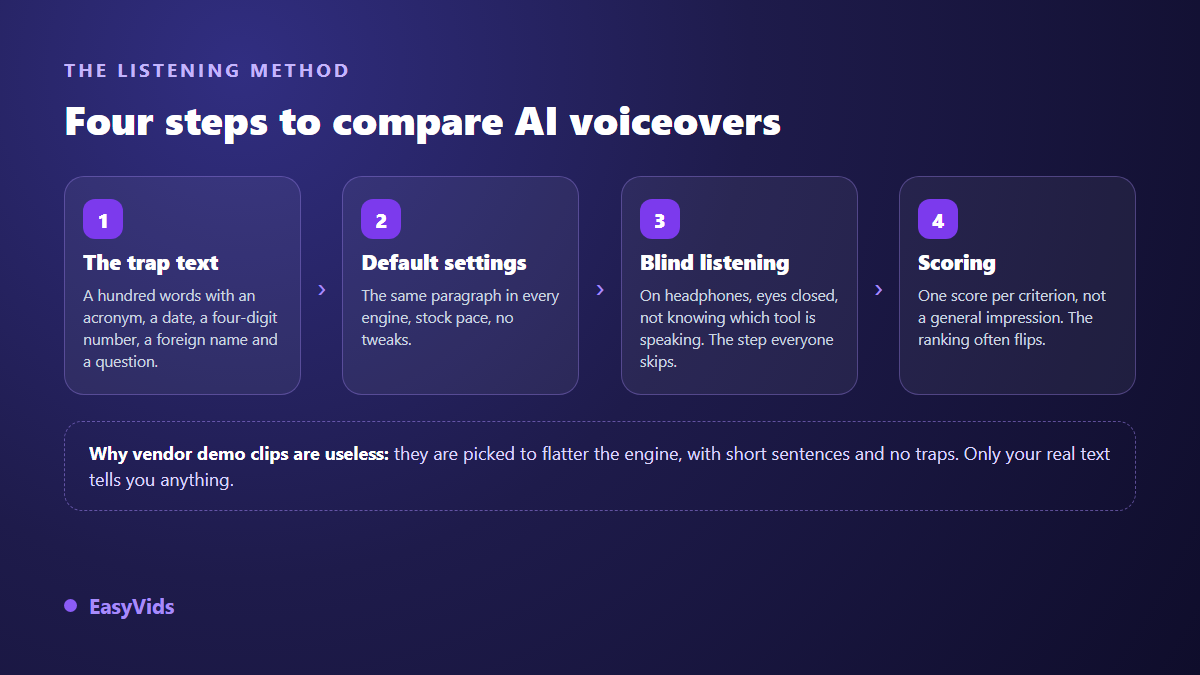
Write a hundred word paragraph that deliberately carries the hard parts: an acronym, a date, a four digit number, a foreign proper noun, a question, and one sentence longer than thirty words. Run that same paragraph through every engine at default speed, untouched. Then listen on headphones, eyes closed, without knowing which tool is speaking. The blind ranking never matches the ranking you would have given while reading the brand names.
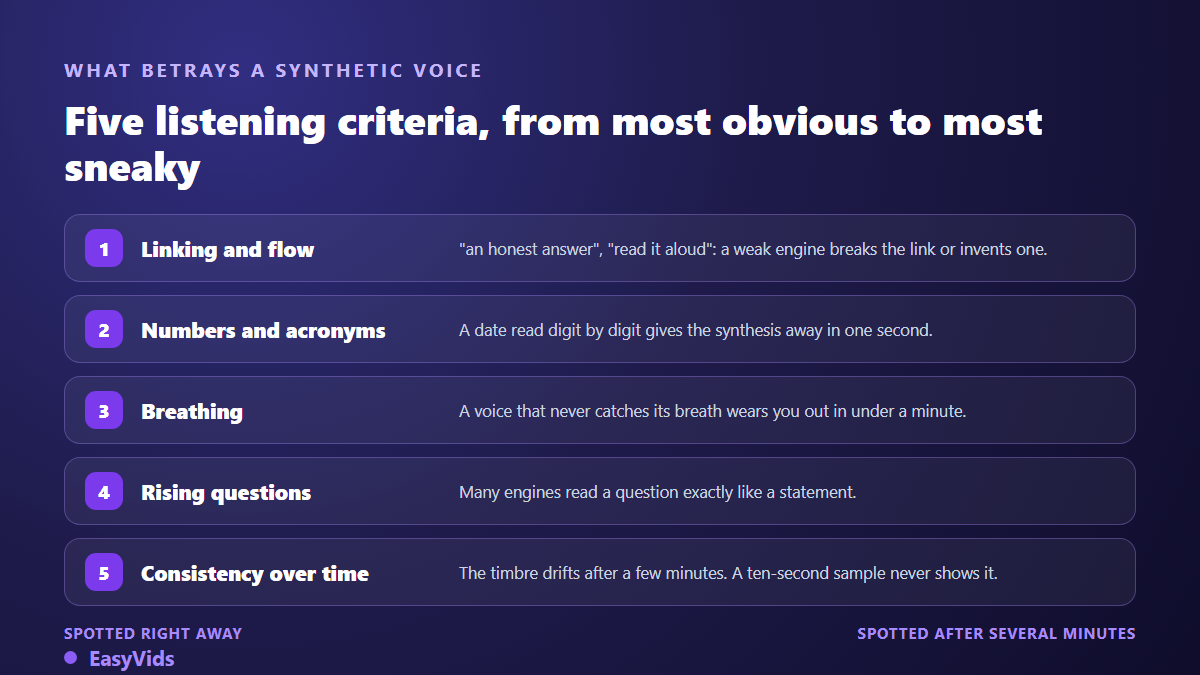
- Liaison and flow between words: weak engines either miss them or invent them.
- Numbers and acronyms: a date read digit by digit gives the synthesis away instantly.
- Breathing: a voice that never takes a breath tires the listener inside a minute.
- Question intonation: many engines read a question exactly like a statement.
- Consistency over time: timbre sometimes drifts after several minutes, which a ten second clip never reveals.
The seven options, and what they really cover
Here is what each one does, based on its public pages and on real usage. Vendor claims are flagged as such. If your comparison goes beyond voice and takes in visuals, writing and editing, our comparison of AI tools for content creators widens the frame.
1. ElevenLabs, the benchmark
It deserves its reputation on expressiveness. According to the vendor's public pages, the offer rests on multilingual models covering dozens of languages, fast cloning from a short sample, a more demanding professional cloning path, and a voice marketplace. People leave for other reasons: billing that climbs with volume, and the fact that the voice stays a file you must retrieve, place and synchronise yourself.
2. Murf, built for presentations
Murf presents itself as a voice over studio aimed at business and training teams. Its distinguishing feature is the editor, where the voice locks onto slides and sequences. That suits training modules and product demos. For a narrative channel or a long story, the same logic becomes a constraint, because it pushes you to think in screens rather than in scenes.
3. Play.ht, the developer route
Play.ht foregrounds conversational voices and a programming interface. That is a good sign if you plan to wire synthesis into your own product, and a bad one if you simply want to paste text and collect a file. Ask yourself one question: are you going to write code? If not, an API first platform charges you in complexity for the flexibility it offers.
4. Speechify, reading before producing
Speechify made its name as a reader: an app that speaks articles, documents and books aloud so you can get through text faster. A studio offer exists for production, but the product's origin still shows in the ergonomics. If your real need is listening to documents rather than building a publishable soundtrack, it may be the only tool here that answers your actual question.
5. Fliki, voice bundled with video
Fliki belongs to another family, text to video. The voice over sits inside a chain that splits your text into scenes, assigns a visual to each and assembles the result. That is an advantage whenever the voice is only a means to get a video. The limit sits on the picture side, often drawn from a stock library, which our detailed review of Fliki examines closely. The principle matters more than the brand: once your end product is a video, comparing standalone voice generators means comparing the wrong thing.
6. Amazon Polly and Microsoft Azure, the cloud route
Both cloud giants have offered neural voices for years, finely controlled through SSML markup: pauses, forced pronunciation, emphasis, rate. Quality is solid and steady, without the theatrical edge of the newest models. Cloning, however, is gated: under the limited access policy published by Microsoft, creating a custom neural voice requires an application and a responsible use commitment. These are engineering services, suited to a team that integrates, not to a creator who wants to publish tonight.
7. EasyVids, several voice ranges inside a full chain
Our approach differs, and it is worth explaining rather than selling. The studio offers several voice ranges. The first gathers eighteen voices and accepts a reading style written in plain language, for instance "read like a storyteller, warm and unhurried": the instruction goes to the engine, is remembered on your account and applies to every voice over afterwards. Another range offers system voices for narration and anchoring.
Two details matter more than catalogue size. You can preview a voice before generating, so you never pay to discover it does not fit. And a script of one hundred thousand characters goes through in one submission, roughly an hour and forty minutes of audio: past three thousand characters the text is split automatically, the parts run in parallel, and they are merged in order into a single MP3. That is exactly where many tools stall, leaving long narration to be stitched together by hand.
What actually gives a synthetic voice away
After playing the same paragraph to listeners who knew none of the tools, one finding keeps returning. Timbre is rarely the giveaway, rhythm is. A slightly artificial timbre goes unnoticed when the breaths land in the right places. A perfectly realistic voice that runs three sentences together without pausing is spotted within seconds.
The practical consequence holds for every engine on this list: punctuation is your main control. Synthesis engines read commas and full stops the way an actor reads a score. Splitting a forty word sentence into two twenty word sentences does more for naturalness than any change of tool.
Cloning is where the offers really separate
This is the widest gap between vendors, and also where promises get vaguest. The word cloning covers two different things. Instant cloning builds a voice from a short sample in minutes, close but not identical. Professional cloning wants a long clean recording, takes longer, and returns a far more faithful voice. A separate piece covers what cloning a voice without paying allows, and where it stops.
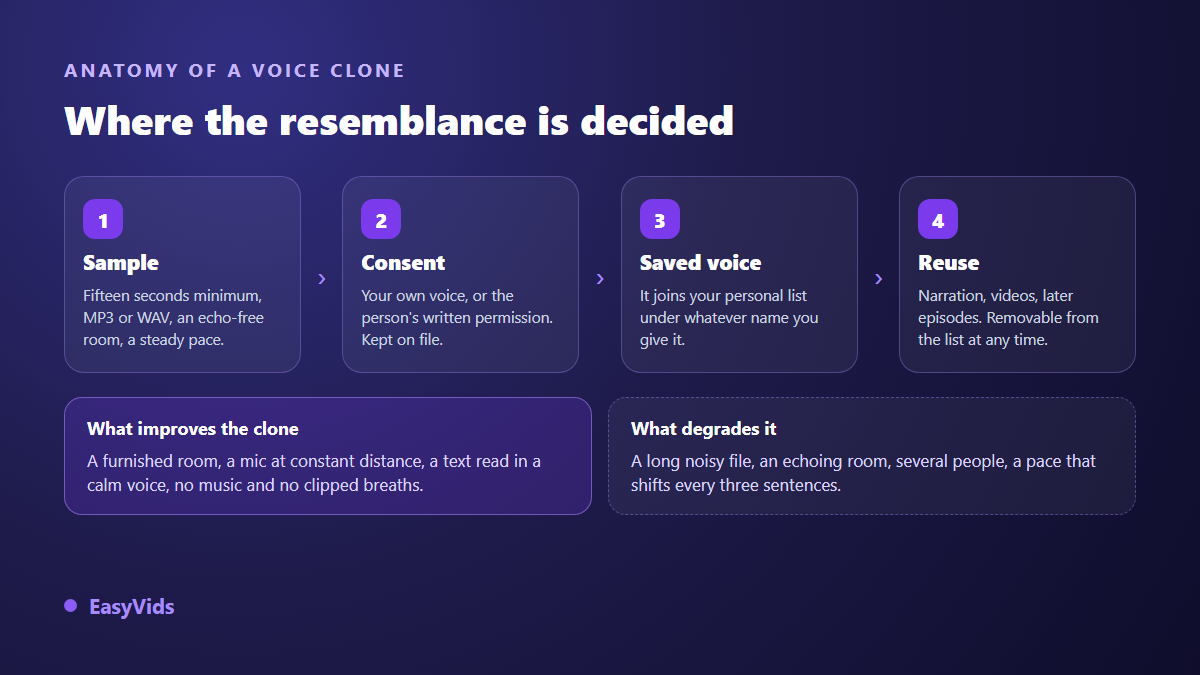
One technical point applies everywhere: clone quality depends mostly on the sample. A few dozen seconds recorded in a room without echo, no background music, at a steady pace, beats a long noisy file every time. Most tools recommend a sample of at least fifteen seconds, in MP3 or WAV, and the resulting voice usually becomes reusable across your projects, video narration included. A reputable service also lets you remove it from your list once it has served its purpose.
Consent and rights, the part you cannot improvise
Cloning your own voice raises nothing. Cloning someone else's raises everything. French law, article 226-8 of the penal code, penalises publishing an edit made with a person's words or image without their consent when the edit is not obviously one or is not disclosed. The European regulation on artificial intelligence adopted in 2024 adds a disclosure duty for generated or manipulated content that could pass for genuine. Two habits cover you: get written permission before cloning a voice that is not yours and keep it, and label a synthetic voice whenever confusion is possible. Reputable services require a consent certification before the sample is even uploaded, which is not decoration. Our analysis of the legality of voice cloning walks through the permitted and forbidden cases.
Which tool for which job
Rather than a general ranking that means nothing, here is the grid that actually decides.
- Long form narration: choose a tool that accepts the whole script and assembles the file for you.
- A recurring brand voice: cloning is the only criterion that counts, along with reuse across formats.
- Training and presentation: an editor that syncs voice to screens saves real time.
- Short advertising: look for expressiveness and the ability to rerun several versions of the same line quickly.
- A complete video: compare studios, not voice generators, or you will buy the editing twice.
- Embedding in your own product: an API first platform stays the rational choice.
Budget, without the numbers
Rates move too fast for an article to freeze them. What matters is the billing shape, which drives your real cost far more than any headline figure. Per character billing rewards short texts and punishes long narration. A monthly quota rewards steady output and wastes quiet months. A credit system, the one we use, lets you arbitrate element by element. One reflex avoids nasty surprises: count the cost of the whole chain, not of the voice alone. We put those orders of magnitude side by side in our analysis of what an AI video really costs, and the detail of our plans lives on the pricing page, with free credits on signup so you can test before deciding.
Frequently asked questions
Which ElevenLabs alternative is best?
The one matching your use case, and the blind test above will tell you inside ten minutes. For long narration destined to become a video, a studio that also handles visuals and editing saves more time than a standalone voice engine, however good it sounds.
Can I clone my voice for free?
Some free tiers allow a trial clone, almost always with a restriction: limited duration, an audio watermark, non commercial use only, or a voice deleted after a few days. Check that before you record, because redoing a clean sample is the tedious part.
Do platforms accept AI voices?
Yes. What platforms penalise is repetitive mass produced content with no contribution of your own, not speech synthesis itself. A carefully written narration, read by a synthetic voice and edited with intent, sits within the rules. Disclosure of synthetic content is still expected in some cases, depending on each platform's policy.
How many characters can be read at once?
It depends entirely on the tool, and it is the criterion people forget to check. Many engines cap at a few thousand characters per request, which forces you to split and stitch. In our studio a hundred thousand character script goes through in one submission, with splitting and merging handled automatically.
Do I need a microphone?
Not for synthesis, which starts from your text alone. Yes for cloning, and a phone held at a sensible distance in a quiet room is plenty. Recording cleanliness matters far more than the gear.
The useful reflex is not to hunt for a replacement brand, but to start from what you produce: a long script, a recurring voice, a full video, or an application to feed. Run your own paragraph through two or three candidates, listen blind, and the decision makes itself. To try our ready to use voice-overs on your own text, creating an account opens the studio with no bank card, and the EasyVids studio then keeps voice, visuals and editing in one place.