Your book is written. The chapters hold together, you like the cover, the file is ready. Then the Amazon KDP upload screen arrives with one question that stops you: do you have to say an artificial intelligence took part? Plenty of authors answer at random, afraid of losing their account. That fear is aimed at the wrong place, because the real trouble almost never comes from that box.
The rule itself is short. Amazon does not ban books written with AI: it asks you to say so. What costs people their account are the other rules, the ones nobody reads, about quality, rights and publishing pace. This guide walks the official text, the line between generated and assisted content, then an honest way to judge what sells on the store in 2026. If your manuscript does not exist yet, our complete guide to creating an ebook with AI covers the step before this one.
Amazon KDP AI books: the short answer
Publishing a book written with artificial intelligence on Amazon KDP is allowed. At upload, the platform asks whether your content is AI generated, and the question covers three things: text, images and translation. Content you wrote yourself and then had corrected or reworded is AI assisted and does not need to be declared. According to the Kindle Direct Publishing content guidelines updated in September 2023, a text that came out of a model stays generated even after heavy rewriting on your side. Answer plainly: Amazon states it does not show that answer to shoppers, and a false declaration exposes you far more than the truth does.
What the disclosure box actually covers
The question appears when you create a title, and it comes back on every significant update. It is not limited to the manuscript. A cover produced by an image generator counts. A translation handed to a model counts too, even when the source text is entirely yours. That last case catches out many authors who publish their own book in several languages and assume, in good faith, that they stay in assisted territory.
The disclosure is not a confession. It does not change your royalty rate, your eligibility for platform programmes, or where your book lands in results. It exists for Amazon, which wants to know what circulates in its catalogue. What the store penalises sits elsewhere entirely: in the real value of the book for the person who buys it.
Generated or assisted: the line that decides everything
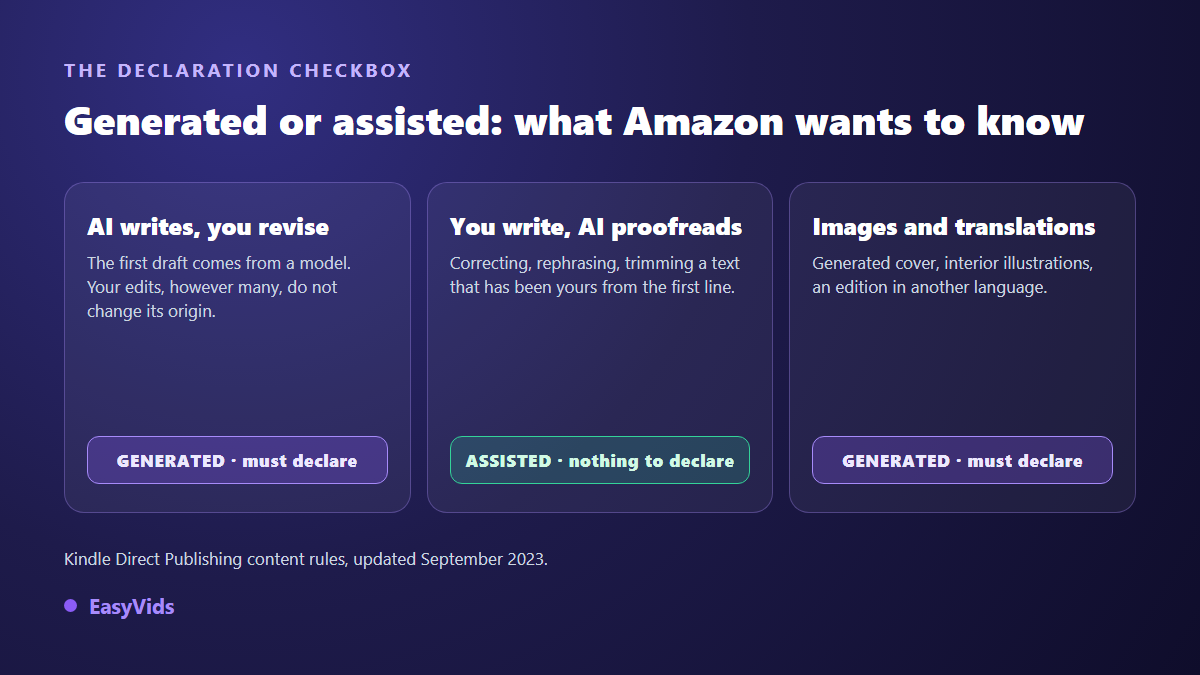
The word that traps everyone is substantial. Authors reason like this: I rewrote half the sentences, so my book is no longer generated. Amazon's text says the opposite. The criterion is not how much editing you did afterwards, it is where the first draft came from. The cases below cover almost every real situation.
- The tool produced the text and you corrected and enriched it: generated, disclose it.
- You wrote the manuscript and a tool proofread, reworded or tightened it: assisted, nothing to declare.
- You supplied a very detailed outline and the tool wrote the chapters: generated.
- Interior illustrations or the cover came from an image generator: generated, even when the text is yours.
- The Spanish edition came from machine translation: generated for that edition.
When in genuine doubt, disclose. The declaration does not penalise your book, while a false answer breaches the terms of service. Breaches stack up against an account rather than a single title, and that accumulation is what eventually takes everything down.
The rules that really close accounts
The shutdowns discussed in author forums rarely come from the disclosure. They come from volume and quality. Since September 2023, Kindle Direct Publishing caps uploads at three new titles per day per account, a measure announced publicly to slow mass publishing. An author who works on their books never meets that ceiling. A title factory meets it on day one.
The content guidelines then target what they call a disappointing customer experience: a book that misleads about its contents, that reuses public domain text without adding anything, or that exists only to push readers somewhere else. None of those bans mention artificial intelligence. All of them land first on books produced fast and uploaded unread.
- The same book uploaded several times under a different cover: duplicate, likely removal.
- A cover promise the content does not keep: buyer reports, then a review of the account.
- Public domain text copied with no contribution of your own: rejected unless genuinely differentiated.
- Rights you do not hold, cover image included: grounds for suspension.
- A burst of near identical titles in one week: the single most watched signal.
Copyright on a text written by a machine
This is the question that worries authors most, and it is not settled at Amazon's level. In the United States, the guidance published by the Copyright Office in the Federal Register on 16 March 2023 holds that material produced solely by a machine is not protectable, and that an applicant must disclose generated material once it goes beyond the trivial. The January 2025 report on copyrightability sharpens the reasoning: a written prompt, however long and refined, does not make you the author of the output, while your selection, your arrangement and your own written contributions remain protected.
In practice, a book built on an outline you designed, fed with your examples, reorganised and rewritten by you carries an identifiable human share. A book ordered in one sentence and uploaded untouched carries almost none. The European regulation on artificial intelligence has added transparency obligations since August 2026, but they fall first on system providers and certain public uses, not on the author filling in an upload form. The same logic runs through other media, as what you are allowed to publish with generated music shows.
File format, where most uploads go wrong
A finished manuscript is not prepared the same way for every store. According to the KDP help pages on manuscript formats, the Kindle store expects a reflowable file whose text adapts to screen size and to the reader's font setting: a word processor document, an EPUB file, or the file produced by Amazon's own layout tool. Paperback asks for the opposite: a PDF composed at the exact dimensions of the book, with margins that depend on the page count.
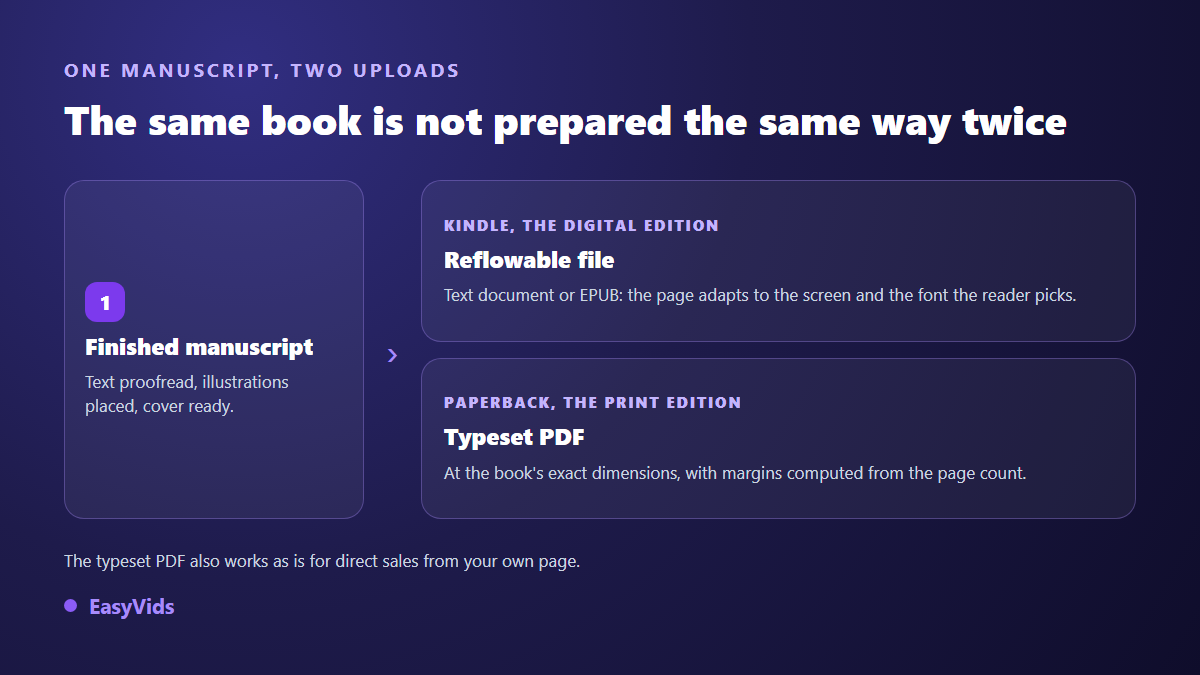
This is the most common source of trouble for an illustrated book. The images still have to sit properly inside the layout, which our guide to getting a fully illustrated ebook walks through. A beautiful PDF sent to the Kindle store gives frozen pages, unreadable on a small screen, and a wave of unhappy returns. Plan two preparations from the same text: a reflowable version for digital, a composed version for print and for direct sales from your own page. Check as well that your chosen size appears in the list of formats the platform supports, because a file composed to the wrong template comes straight back.
What actually sells on KDP in 2026
First precaution: nobody knows Amazon's sales except Amazon. The revenue rankings by category that circulate on social media are estimates, usually rebuilt from the sales rank displayed on each product page. That rank is public and free to consult. It is your only honest source, and it is more than enough to decide.
The method takes three moves. Open the category you are aiming at and note what the top twenty titles promise. Then open three listings at random and read only the negative reviews: they tell you exactly what the market is missing. Finally, count how many covers are genuinely well made. A category where everyone publishes fast is a category where careful work stands out at once.
A few families of books hold up better than others when production leans on AI, for structural reasons rather than fashion.
- The guide that answers one precise query: the title carries the question buyers type.
- The journal or planner, where value comes from structure and layout rather than word count.
- The illustrated children's book, provided the character keeps the same face from page to page.
- The series: three short volumes for one audience build loyalty better than a single standalone book.
- Your own book translated into another language, which opens a whole store with no new writing.
- The narrow professional manual aimed at one trade, where competition is thin and the buyer is in a hurry.
The broad shelves on easy money, productivity and personal development, by contrast, overflow with mass produced titles. That is not a ban, it is arithmetic: your book will sit beside hundreds promising the same thing. If the subject matters to you, find the narrowest audience you can genuinely serve. Other ways to make digital content pay are covered in our overview of income streams built with AI.
The listing does half the work
On Amazon, search is shopping search. Nobody types the name of your book: people type a problem. The title and subtitle carry the query, without turning into a string of glued keywords. At upload you also fill in keywords and categories: these are the only free levers you get, and most authors rush them in thirty seconds.
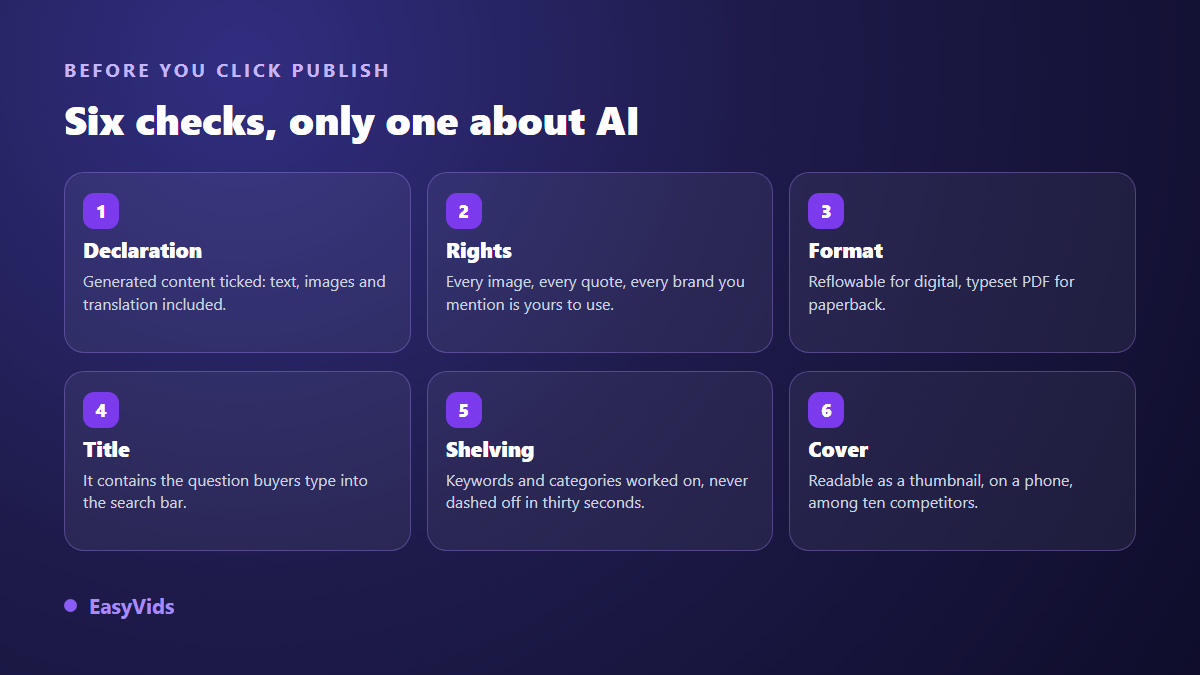
Then comes the cover, judged as a thumbnail, on a phone, among ten rivals. A busy visual disappears at that size. A readable title, a simple image and firm contrast are enough. If you produce it yourself, our guide to AI image generators covers the settings that keep an image from going soft once it fills a full page.
Where a writing workshop stops and you take over
A serious production tool leaves the decisions to you where they matter. In our book workshop the angle is chosen against the clichés of the field, the outline is handed to you before a single line is written, your edits to chapter titles are respected word for word, then chapters are written one at a time. You pick the language, the writing universe, the number of images per chapter, the author signature printed on the rights page, and a white page background when the book is meant for print.
Two points of honesty belong here. The book comes out as a composed PDF, full page cover and paginated contents included: that file suits direct sales as it stands and serves as the base for a printed edition, but it needs conversion before a Kindle store upload. And a book produced this way is generated content in Amazon's sense: tick the box without hesitating. Our plans are detailed on the pricing page.
Frequently asked questions
Does Amazon ban books written with AI?
No. The Kindle Direct Publishing content guidelines do not prohibit the use of artificial intelligence. They require you to disclose generated content at upload, and they reject books with no value for the buyer, whatever produced them.
Do I have to disclose an AI generated cover?
Yes. Since the September 2023 update, the question asked at publication covers text, images and translations. A cover from an image generator falls under generated content, even when the manuscript is entirely your own writing.
How many books can I publish per day on KDP?
Three new titles per day per account, according to the limit Amazon announced in September 2023. That ceiling never bothers an author who works on their books. It exists to stop bulk uploads, and an abnormal pace remains the first signal that triggers a review.
Is an AI written book protected by copyright?
Not in its purely generated part, at least in the United States, where the Copyright Office guidance of March 2023 reserves protection for human contribution. Your choices, your structure, your written passages and your examples stay protected. Status differs by country: check the market you sell in.
Can I upload my PDF straight to the Kindle store?
Several formats are accepted, but a PDF gives a frozen page that readers cannot resize or reflow comfortably on an e reader. Prepare a reflowable file for digital. Keep the composed PDF for print and for sales from your own page.
Publishing on Amazon KDP with AI calls for neither cunning nor excessive caution: tick the box honestly, respect the upload pace, prepare the right format, then spend your energy on the only thing that decides sales, the real value of the book for the person who opens it. Practical answers about our tools are gathered on our questions page, and creating an account opens the workshop so you can build your first outline today. The book, its cover and its promotional visuals come out of the same EasyVids studio.