The phrase turns up in every video that promises passive income, and it sounds shadier than it is. A cash cow channel is a YouTube channel where the owner never appears on camera, where every episode follows the same format, and where most of the production is handed to tools instead of a crew. French creators call the same thing a dark channel. The label changes, the model does not.
Most of these channels stall, and rarely for the reason people assume. The model is usually taught backwards: automation before the niche, volume before the writing. This guide covers it the way it actually works, from picking a subject to the monetisation rules, with no income promises attached. If the vocabulary is still new to you, our definition of the faceless format sets the scene in a few minutes.
The short answer
A cash cow channel is a faceless channel, produced in series on a niche chosen for its demand, and built with tools that write, illustrate, narrate and edit on your behalf. Nothing in YouTube's rules forbids the model, the anonymity or the use of AI. What gets penalised is mass produced content with nothing of your own in it. The difference has little to do with your software and everything to do with what you add: an angle, a piece of writing, an art direction and a review pass.
Where the name comes from, and what it does not mean
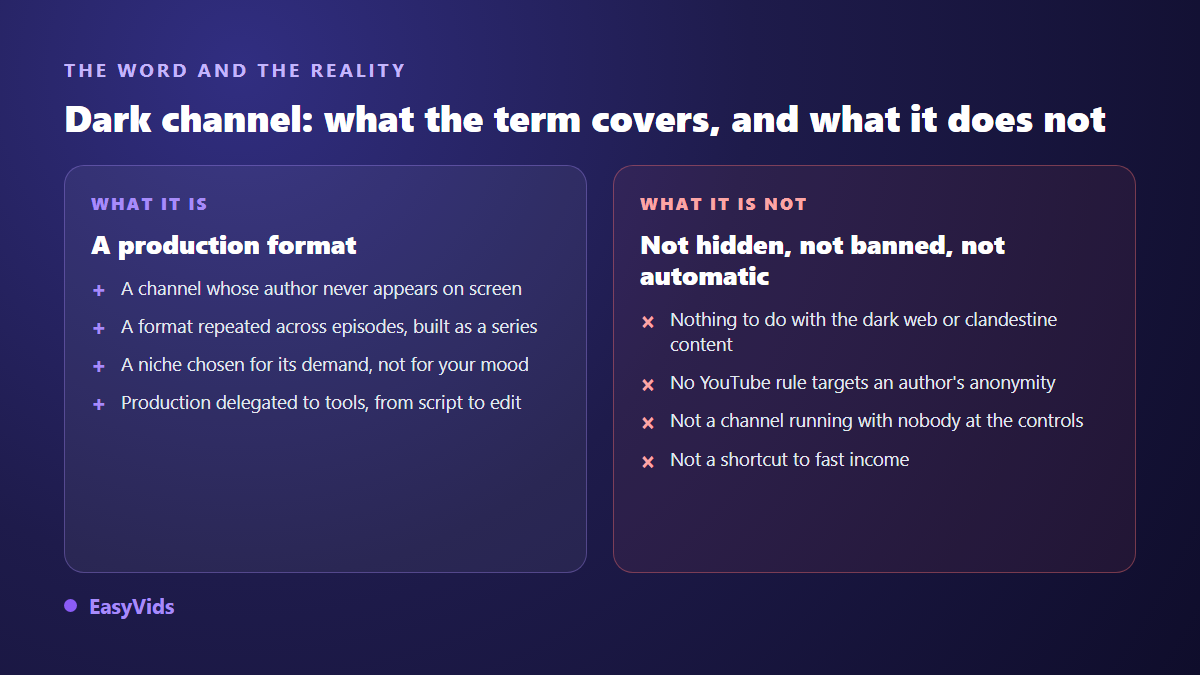
The origin is plain enough. On a classic channel, a person is the product. On these, the person disappears behind the format. Nothing about it is hidden or off limits: an owner can publish under a real name, run a contact page and answer comments, and the channel is still a cash cow channel in the jargon.
The confusion is expensive, because it suggests a grey area and pushes people to hide. That instinct is wrong. A channel that states its subject, its promise and its owner passes every review more easily, human or automated. The second myth is more dangerous still: this format does not mean nobody at the controls. A channel left on autopilot produces exactly the kind of content platforms filter out.
The four pillars of the model
Remove any one of them and the channel stops after a handful of episodes. They hold each other up, and the order matters.
- A niche with real demand: the subject has to interest a wide audience, renew itself endlessly and lend itself to visuals.
- A repeatable format: same promise, same length, same structure, episode after episode. That is what a subscriber comes back for.
- An identity that replaces the face: one voice, one palette, one intro, one thumbnail template. Without it nothing makes you recognisable in a feed.
- Delegated production: script, visuals, narration and editing handed to tools, so an episode costs hours instead of days.
The fourth pillar is the one that moved. Not long ago a faceless channel needed a stock library, a decent microphone and editing software. Much of that work now happens in one pass, which pushes the effort back to where it decides everything: the subject you pick and the quality of the text.
The niche is the only choice you cannot easily undo
You can change voice, visual style or publishing rhythm without much damage. Changing niche means starting from zero, because the audience you built does not follow, though the production skills transfer intact if you ever decide to film paid videos for brands as a UGC creator. Take that decision slowly, before the first video goes out.
The families that work without a camera are well known: stories and narration, documentary, education, true crime, motivation, relaxation. Each one dictates its tone, its length and how much research it swallows. Emotionally charged niches also demand precise writing, because the effect rests entirely on the narration, as our guide to an AI horror channel shows in detail.
- Demand already exists: other channels live off this subject. A total absence of competition signals an absent audience, never an opening.
- The subject renews itself: if fifty titles do not come to you within an hour, the niche is too narrow.
- The subject carries images: a theme with no obvious visual becomes painful to watch, however good the script is.
The channel bible: what you decide only once
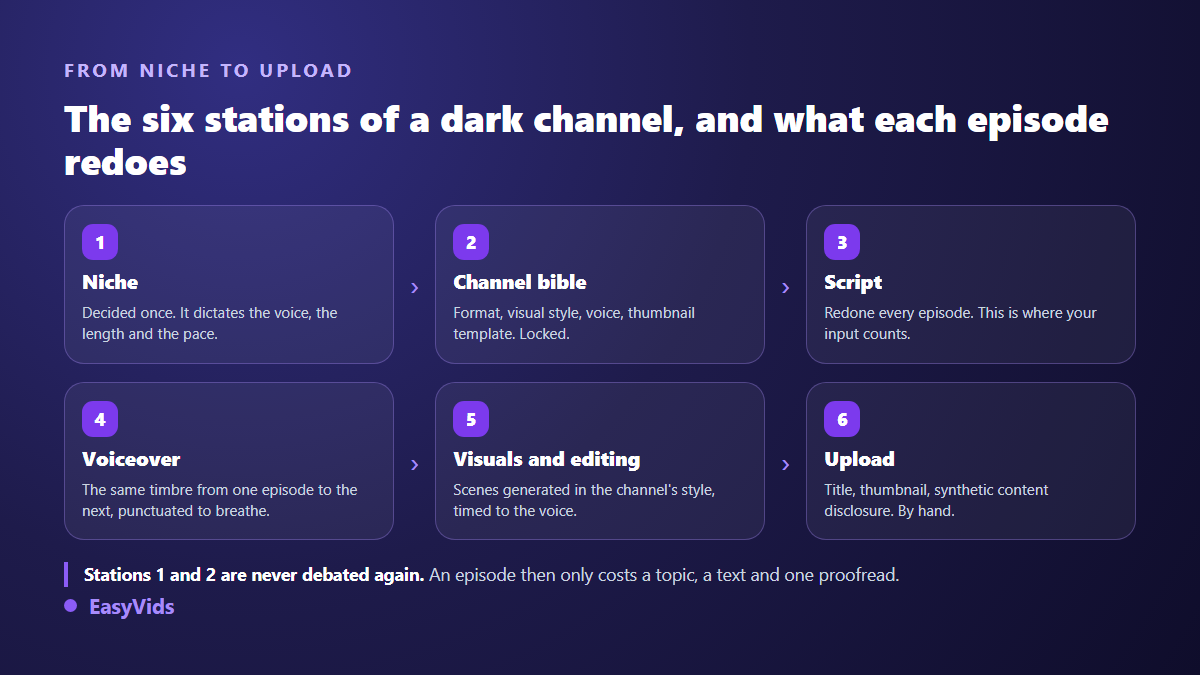
Creators who last split their work into two columns. On the left, everything fixed once for the whole channel. On the right, everything redone for each episode. As long as the left column stays open, every video is a new project, and that is what burns people out.
That single page holds the format and target length, the chosen voice, the visual direction, the recurring characters or settings, the thumbnail template and the opening structure. Once those are locked, you stop relitigating them every week. As a bonus, it is exactly what creates the series effect that brings a subscriber back.
Building the production line with AI
An episode always follows the same path: a subject, a script written for the ear, a split into scenes, a narration, visuals, an edit. Each of those steps exists separately in specialised tools, which means juggling accounts and re importing files between services. The full path is laid out in our guide to AI video generators.
In EasyVids that path lives in one place. You give the subject and your instructions, the tool writes the script, splits it into scenes, generates every shot in the chosen style, lays the voice over and syncs the edit to the real length of the narration. Aspect ratio is decided up front, 16:9 for a long video or 9:16 for a vertical cut, and held all the way to export. You keep control shot by shot: a scene that misses can be regenerated on its own, without rebuilding the episode.
The rest of the chain sits alongside it. Thumbnails are generated in the studio, music and atmospheres come from the dedicated music studio, captions are transcribed in the online editor, and exports carry no watermark. One thing does not exist, and it is better to know before you plan around it: no tool uploads to YouTube for you. Publishing, the title, the description and the synthetic content disclosure stay manual. Your spending level is set by the models you pick, scene by scene, and the plans themselves are listed on the pricing page.
Work in batches, not episode by episode
A channel is not won on the first video, it is won on the hundredth, and organisation decides that more than talent. Write four subjects in a row, launch the four productions, review the four. Your attention switches mode once instead of four times, and the rendering runs while you do something else. Generations launched in automatic mode keep running on the server with the page closed, so you come back to a finished batch. Build a buffer of a few episodes before your first upload: without it, consistency breaks during the first busy week.
What YouTube actually penalises
This is the question that worries people most, and it deserves a precise answer rather than a reassuring one. According to the YouTube help centre, access to ad revenue requires 1,000 subscribers plus 4,000 valid public watch hours over the past twelve months, or 10 million valid Shorts views over the past ninety days. Those thresholds are identical for a channel filmed in a studio and one produced entirely by computer. Our detailed reading of the monetisation rules for AI content covers the full set of conditions.
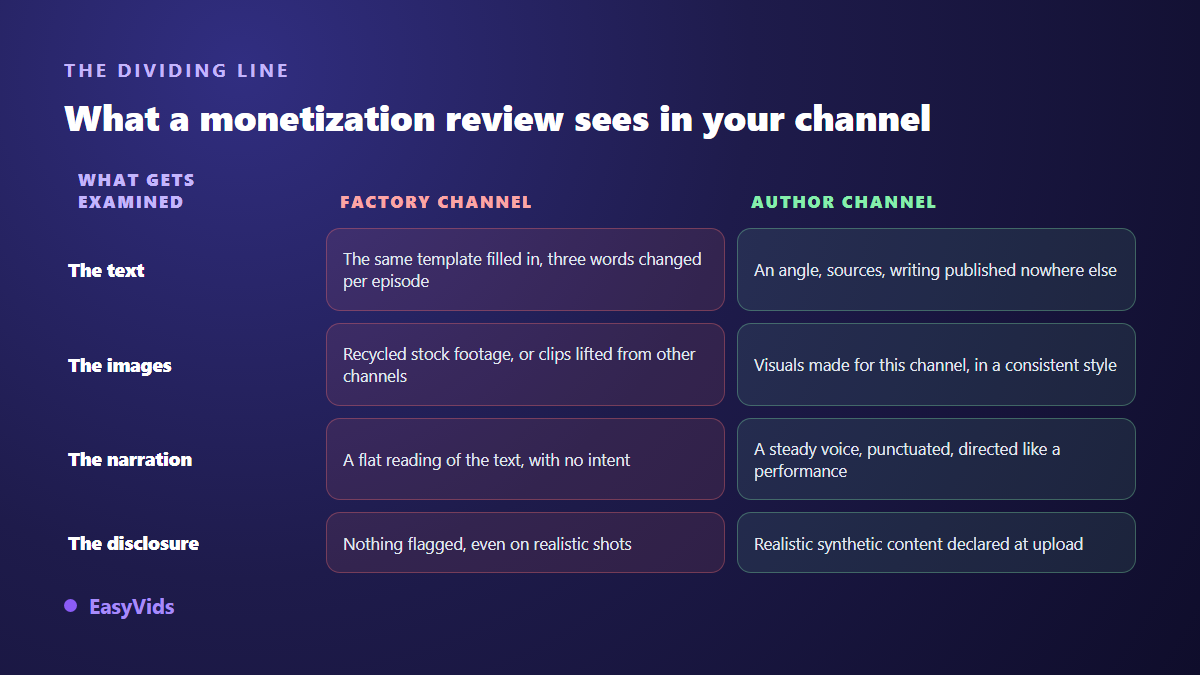
Then comes the rule that really decides the fate of these channels. On 15 July 2025, YouTube renamed the repetitious content section of its monetisation policies to inauthentic content. The page mentions neither generation nor artificial intelligence: it targets mass produced or repetitive content with no contribution of its own. Two channels built with identical tools can therefore land on opposite sides of that line depending on method, as our reading of the inauthentic content rule explains.
A separate rule closes the loop, and it takes three seconds to respect. YouTube asks you to disclose altered or synthetic content that looks realistic enough for a viewer to mistake it for reality. Ticking that box does not cut monetisation and does not reduce reach. Skipping it on realistic footage exposes you to a penalty nothing justifies.
The mistakes that stall these channels
- Picking the niche for its income promise rather than for what you can write about a hundred times.
- Publishing with no buffer: consistency breaks during the first complicated week.
- Changing voice, style or length every five episodes, which prevents any recognition.
- Letting a script through without reading it aloud: that is where manufactured text gives itself away.
- Confusing volume with audience: thirty videos a month move you no closer to any threshold if nobody watches to the end.
- Copying a working channel shot for shot, believing the resemblance protects you.
Frequently asked questions
Are cash cow channels allowed on YouTube?
Yes. No YouTube rule requires you to show your face or publish under your legal identity. The term describes a production format, not a special status. The same community guidelines and monetisation policies apply, with no favour and no penalty attached to anonymity.
Can a channel produced with AI be monetised?
Yes, provided you can show a contribution of your own. According to the YouTube help centre, no rule forbids monetising a video made with artificial intelligence. The most common refusal is still mass produced, repetitive content with no angle and no writing behind it.
Do I need to use my own voice?
No, a synthetic voice works well, as long as you keep the same timbre from episode to episode. Consistency matters more than absolute realism, and on a narrative format that rests entirely on the ear, directing a narrator and building the sound bed sets out the settings worth copying. Recording yourself remains an option: it simply costs time, a quiet room and steady delivery.
How long does one episode take?
Once the channel bible is written, most of the time goes into choosing the subject and writing it, not into production. Allow an evening for a short narrative episode including review, and noticeably less per episode once you work in batches of four.
Can I run several channels at once?
Yes, but rarely at the start. Open the second one when the first runs without asking you for new decisions every week. Two channels launched together almost always end up stealing each other's writing time, which is the only truly limited resource.
There is nothing mysterious about the model: a niche you hold, a format that repeats, a recognisable identity and an organised production line. The rest is authorship, and that is precisely what platforms reward. To build your first episode straight away, creating an account opens the full studio, and the EasyVids studio brings script, voice, visuals and editing together in one place.