You have a case that will not leave you alone, a voice that carries, and zero interest in appearing on camera. Good news: a faceless true crime channel needs nothing from your face. It runs on narration, a source file and illustrative visuals. Bad news: it is one of the most closely watched niches on the platform, because it deals with real people, real families, and cases that are not always closed.
This guide is not a pitch for the niche. It is the demanding version: where to find defensible facts, how to write without convicting anyone, how to illustrate a case without a single real photograph, and which rules decide whether your episode earns or vanishes. Production is now the easy part, since an AI creation studio builds the voice, the shots and the edit. The research does not get delegated.
The short answer
A faceless true crime channel stands on four pillars. Primary sources you can name. Careful writing that respects the presumption of innocence and the actual legal status of every person mentioned. Fabricated visuals that expose no identifiable face. And open compliance with platform rules on sensitive content and AI generated media. The narrator stays anonymous, the story stays checkable, the case keeps its weight. Format, pace and revenue follow from those four points, never the other way round.
Why the niche works, and why it punishes fast
True crime combines three attention drivers that rarely sit together: a puzzle, an emotion and a possible resolution. Viewers stay because they want to know. Watch time climbs, comments pile up, recommendation follows. A story carried by a voice suits a faceless channel perfectly, because attention lands on the case rather than on the person telling it.
The downside arrives just as fast. The niche is crowded with channels recycling the same articles, laying a synthetic voice over borrowed archive footage and shipping ten episodes a week. Since July 2025, YouTube renamed its repetitious content rule to inauthentic content, specifically to target mass produced material made with little original input. That content was never eligible for ad revenue; the new name simply says so plainly. What the rule actually covers, and what a reviewer looks at on an AI assisted channel, is set out in our breakdown of inauthentic content on YouTube. Your edge will not be speed. It will be rigour: one case per episode, named sources, narration that is yours. The same rigour carries every narration led niche, as our guide to a Christian YouTube channel shows, where respect for the subject weighs as much as the storytelling.
Find facts, not summaries
The beginner reflex is to read three news articles, blend them and call it research. The trap is mechanical: those three articles often copy each other, they trace back to a single wire report, and the original mistake travels intact into your voice over. A serious channel climbs one level up, towards the documents those articles were written from.
- Published court decisions, where the jurisdiction makes them available, and hearing reports.
- Public registers: civil records, official gazettes, expert reports entered into the public record.
- Reports from public bodies, commissions of inquiry or administrative inspections.
- Dated and bylined press archives, read at source rather than as an anonymous screenshot.
- Interviews you conduct yourself, with recorded consent from the person speaking.
- Academic databases and criminology research, useful for statistical context.
Fact checking happens before the writing
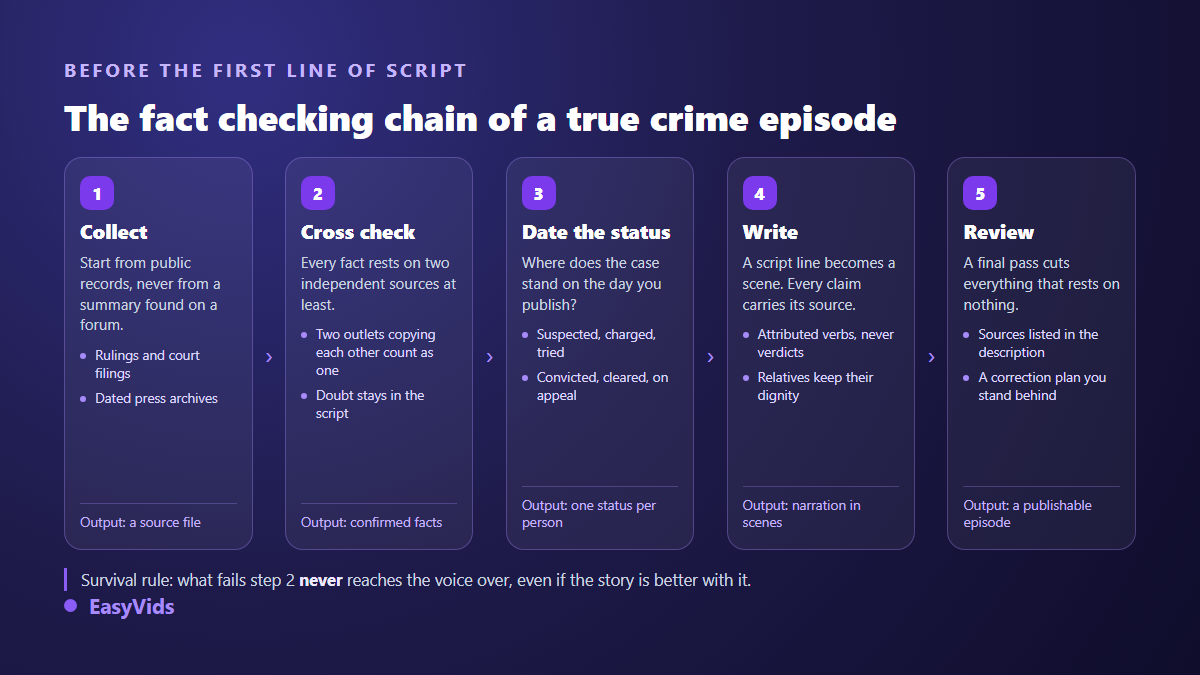
Verification is not a final proofread, it is a production stage placed before the script. A fact you cannot support costs five minutes to drop. The same fact removed after the edit costs a whole episode and a public correction. Treat every claim like evidence: it enters the story, or it stays outside.
- Two independent sources per fact, minimum. Two outlets quoting each other count as one.
- A dated legal status for every named person: suspected, charged, tried, convicted, acquitted, under appeal.
- Doubt kept in the script rather than smoothed away. “Still unknown” strengthens a narration.
- Dates checked twice: one broken timeline discredits an entire episode.
- Quotes reproduced word for word, never paraphrased and then placed inside quotation marks.
- A source list published in the description, in the order they appear in the episode.
This discipline pairs well with a writing tool as long as you keep control of the substance. Our script studio offers an optional web research pass for factual subjects, but it produces a draft, never a truth. You read it, you cut, you confirm every claim. The full production chain, from script to finished file, is described in our AI video generator guide.
Writing without convicting anyone
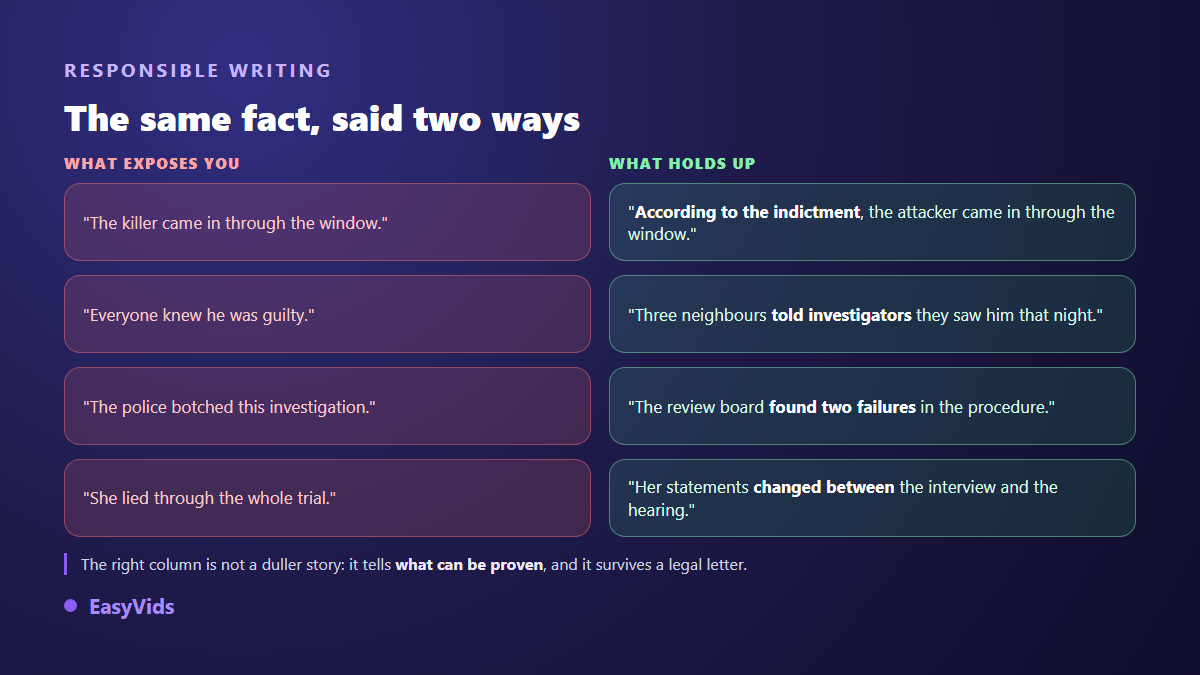
Article 11 of the Universal Declaration of Human Rights states that anyone charged with an offence is presumed innocent until proved guilty according to law. That principle is not aimed only at courts: it sets the vocabulary you use. Until a final decision exists, nobody is a murderer in your voice over, whatever your personal conviction.
- “According to the indictment”, “per the first instance judgment”, “the report states that”.
- “Named as a suspect”, “charged with”, “convicted at first instance”, rather than “guilty” or “the killer”.
- State the current outcome: an acquittal or an overturned conviction belongs in the episode.
- Label hypotheses as hypotheses, and say clearly when a theory was never accepted by a court.
- Skip press invented killer nicknames: they turn a person into a character.
- Never tie a cleared suspect back to the acts they were cleared of, not even as context.
A simple test before recording: read your script imagining that the accused person, their lawyer and the victim's family are reading it at the same time. Any sentence you would not defend in front of those three readers gets rewritten or cut. That filter costs half an hour per episode and prevents almost every problem.
Victims and families are not set dressing
This is where most channels lose their footing, and where respectable work separates itself from grief mining. A victim is not a plot device. Their relatives are alive, they use the internet, and they will find your episode. Write as though they open it in the first hour, because that is what happens.
- Name the victim as a person, with what they did with their life, not only how they died.
- Skip clinical injury detail: it adds nothing to the story and a great deal to the pain.
- Remove anything that exposes relatives: address, employer, children's school, licence plate.
- Protect minors, including those now adult, and do not reopen an identification a court closed.
- Publish a contact address and answer removal requests before a legal letter arrives.
- Drop a case when the family has publicly asked people to stop covering it. The niche is wide.
This is not only about ethics. YouTube privacy guidelines let a uniquely identifiable person, or their representative, request removal of content that exposes them, and the platform weighs public interest, newsworthiness and consent. An episode built on public records and sober writing clears that filter. An episode spreading the private life of an uninvolved relative does not.
Narration that holds a long episode
With no face on screen, everything rests on voice and structure. A reliable arc runs in five movements: a factual hook that sets the puzzle in seconds, context that establishes people and place, the timeline of events, the investigation and its dead ends, then the legal outcome and what remains open. Each movement ends on a question that earns the next minute. That voice can be your own, cloned once and reused on every episode, provided you gather the amount of audio a voice clone needs before you start.
Write for the ear. One line of script becomes one scene: short sentences, one subject, one verb, one fact. Our studio shows a duration cue while you write, roughly 110 characters for six seconds of French voice over, about 120 for eight seconds and 150 for ten. That cue forces you to split, and splitting creates rhythm. Tone, pace and breathing settings are covered in our natural AI voice over guide. On sound, one rule holds: music must never tell viewers what to feel in place of the facts. A quiet bed is enough, and silence remains your best dramatic effect. That is the dividing line with fiction niches, where the soundscape is part of the deal with the viewer, as our AI horror channel guide explains. At the far end of that spectrum, a motivation channel made without a camera does the opposite on purpose: the music carries the emotion and swells exactly on the key line of the speech.
Illustrating a real case without a real photo
Here is the actual craft of the niche. You have to fill twenty to forty minutes of screen without a victim, without crime scene photographs, and without lifting press images you have no rights to. The answer is to generate. An image studio produces neutral establishing shots, consistent with each other, that belong to nobody and expose nobody.
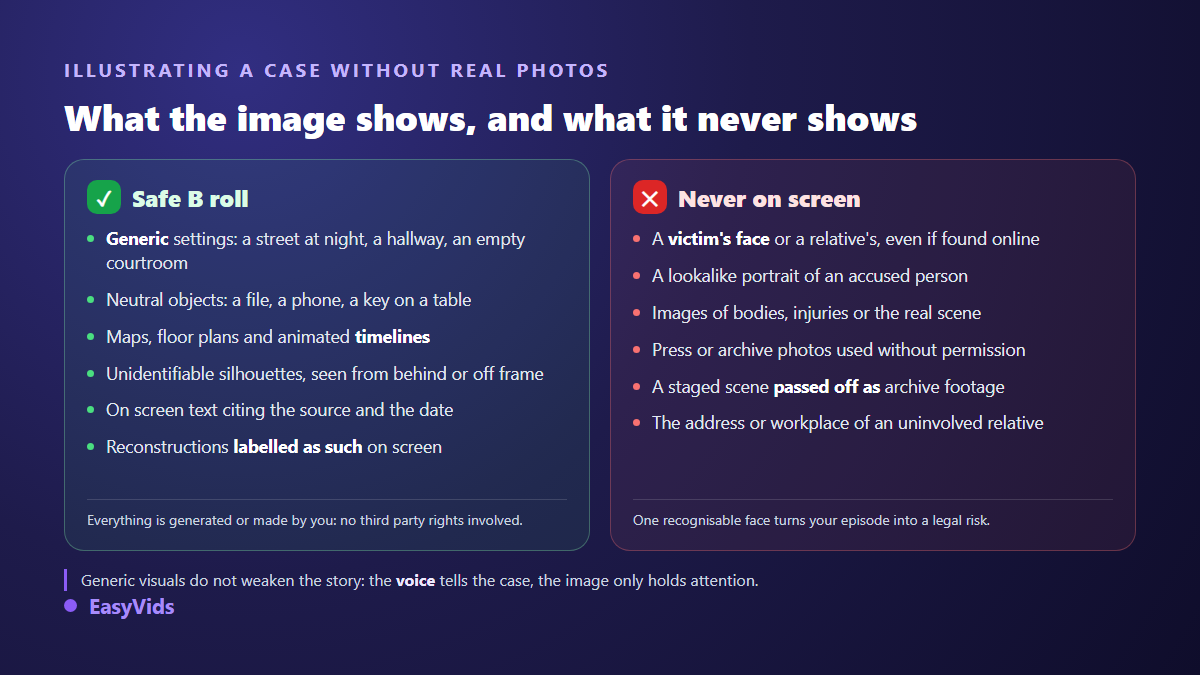
- Generic settings: a wet street at night, a station corridor, an empty courtroom, a forest at dawn.
- Neutral objects that carry the story: a closed file, a phone on a table, a key, a notebook.
- Maps, floor plans and animated timelines, which genuinely help the viewer follow along.
- Unidentifiable silhouettes, from behind, backlit or off frame, never a recognisable portrait.
- On screen text citing the source and the date, a far better choice than a fake archive image.
- Reconstructions clearly labelled as such, on screen and in the narration.
Two production modes suit this niche in particular. Images only returns a consistent storyboard, one image per scene, with no video pass: fast, economical, and enough for a narrative episode where the voice carries everything. Video mode animates the shots when you want movement. In both cases the editing workspace lets you regenerate a single failed scene, add or remove scenes, then assemble the whole thing into a final file in landscape or vertical.
Platform rules on sensitive content
True crime is not banned, it is conditional. The YouTube advertiser friendly content guidelines state that context decides nearly everything: content focused on blood, violence or injury with no further purpose is unsuitable for advertising, while an educational, documentary or news treatment can remain eligible. Those guidelines also define sensitive events and remove monetisation from content that exploits a tragedy or sensationalises victims. A second rule decides the fate of channels assembled from existing material, and our guide to reused content on YouTube sets out what a reviewer expects from an episode built on archives and press reports.
Second obligation, very concrete for a channel that generates its own visuals: synthetic content disclosure. YouTube asks creators to flag realistic content created or altered with AI at upload, in the video attributes, and then shows a label to viewers. Clearly stylised images and minor edits are out of scope. Ticking that box does not limit your audience or your eligibility to earn. Forgetting it can cost you the video.
Monetising without betraying the subject
A well run true crime channel has several revenue streams that do not all depend on advertising: memberships, partnerships with brands compatible with the subject, audio platforms for the podcast version, and long form episodes sold separately. Production stays the most compressible cost, since voice, images and editing are generated. Our plans are listed on the pricing page and we do not repeat them here, because they change.
- Publish less often with a properly documented case: value per episode beats volume.
- Reuse every episode as audio, as vertical short form and as a long article on a site.
- Refuse partnerships that clash with the subject: a badly placed ad on a grief heavy episode costs more than it pays.
- Build a constant sonic identity: that is what brings people back, not the thumbnail.
- Keep two or three verified episodes in reserve so you never publish under pressure.
Frequently asked questions
Can a true crime channel work without ever showing your face?
Yes, and it is the dominant format in the niche. Viewers come for a case and a voice, not for a presenter. What you do need is a recognisable sonic identity, a steady narration pace and visuals that stay consistent from one episode to the next.
Do I need permission from families to cover a case?
No permission is legally required to report facts that are already public and documented. But a family can request removal of content exposing their private life, and the platform arbitrates by weighing public interest. Telling the family where possible, answering quickly and cutting an unnecessary detail all cost far less than a dispute.
Can a true crime channel be monetised?
Yes, provided the treatment is documentary or journalistic rather than centred on horror. Advertising rules exclude content that exploits tragedy but leave room for stories that inform and contextualise. Title, thumbnail and description weigh as much as the video itself in that assessment.
Can I illustrate a real case with generated images?
Yes, as long as those images imitate no real person and never pose as archive footage. Stay on settings, objects and silhouettes. Label reconstructions on screen, and disclose the content as AI generated when it is realistic.
How often should I publish?
One solid episode a week or a fortnight beats five recycled ones. The inauthentic content rules explicitly target mass production with no original input, and the niche is already crowded with interchangeable channels. Your schedule has to match your real capacity to verify.
A faceless true crime channel is won on the case file, not on the microphone. Build your source list before you write, date the legal status of every person, refuse any image that exposes someone, and tick the disclosures the platform expects. The rest, voice, shots, edit and export, is built in one session inside the EasyVids studio. Pick a case you can document all the way through, then create your account and write the first episode you can defend line by line.