You have spotted the niche and it keeps pulling you back. A faceless horror channel gets watched late at night, gets shared, and holds a viewer far longer than a tips video ever will. The trouble is that you have no camera, no wish to show your face, and no haunted house nearby. So the real obstacle is not equipment. It is something more interesting: how do you build fear out of a script, a voice and generated images?
The answer surprises most beginners. Horror is not built with blood, it is built with timing. One shot held too long, one sentence too many, one sound effect in the wrong place, and the tension collapses. This guide walks the whole chain: writing a story that holds, pacing the narration, picking a voice, layering the sound, choosing the visual direction, and staying inside the rules YouTube actually applies to disturbing content.
The short answer
A faceless horror channel rests on four pillars: a short story written for the ear, slow controlled narration, sound built in separate layers, and dark imagery that suggests instead of showing. Each episode is assembled like a small film: the script is split into scenes, every scene gets its visual, the voice over is timed against it, and the whole thing is rendered into one file. That is the standard path through an AI video creation studio, with one extra demand: every choice you make, from the lighting to the silence, has to pull in the same direction.
Why horror works so well without a face
The format lives on absence. Seeing a presenter instantly breaks the illusion that this happened to someone, somewhere, one night. An invisible narrator can be anyone: a night guard, a nurse, a taxi driver. The viewer fills in the rest, and that mental work is exactly what keeps them watching.
The niche has three other rare qualities. Episodes get watched to the end, because a well told story is hard to abandon. The catalogue ages well: a story published two years ago is still worth watching, while a news reaction dies within a week. And the audience is global, provided you publish in your target language. A horror channel is built like a library, not like a feed. The rest of the publishing workflow is covered in our step by step guide to a YouTube video.
Writing a story that holds
A good horror episode does not describe a monster. It describes an ordinary routine that cracks. The most reliable structure has five beats, and it works for a three minute story as well as for a twenty minute one.
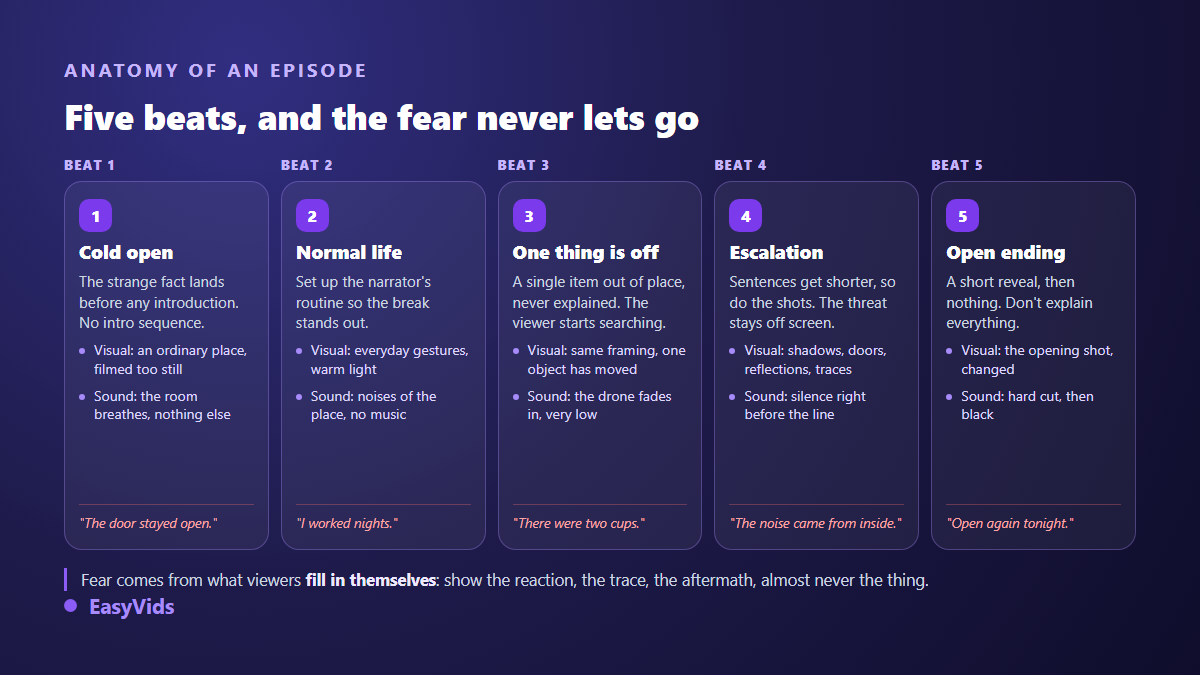
Three decisions matter more than the rest. First the point of view: write in the first person, past tense, like a reported account. Second, restraint: what you leave out frightens more than what you describe. Third, the ending: keep it short and open, and do not close every door. A story that explains its whole mystery never gets shared.
- Open on the wrong thing, never on a channel introduction: the first seconds decide everything.
- Ground the story in an ordinary, dated place: a hospital car park, a petrol station at three in the morning, an office block on a Sunday.
- One anomaly per episode. Two mysteries stacked together cancel each other out.
- Describe physical sensations, cold, smell, the position of a body: they travel better than adjectives.
- Cut every word that comments on fear. The narrator never says he is scared, he says what he did.
- End on an image, never on a moral.
Pacing is decided before you record
Horror narration is slow, but the edit is not. That apparent contradiction is the whole trick. The voice takes its time, leaves silences, lets a sentence breathe, while the picture changes often enough that the eye never wanders. A shot that sits still for fifteen seconds kills a good line.
In practice the script is split into segments of a few seconds of speech, and each segment gets its own visual. That split is adjustable: shorter segments make a sharper edit. For horror, an average of five to eight seconds works well, with two deliberate exceptions. Hold one shot longer at the moment the narrator notices the detail that does not belong, and cut hard right after the reveal. Keep a reserve of silent shots too: three seconds of empty corridor often beats one more sentence.
The voice is your only face
On a faceless channel the voice is the brand. It has to be recognisable from one episode to the next, so choose it once. For horror, look for something low, dry and slightly tired, a voice that does not perform. The classic mistake is a theatrical delivery that oversells the dread: it announces the fear instead of installing it, and viewers leave before the second minute. That shift from picture to sound runs through every anonymous format, and our guide to the invisible creator covers the other ways to run a whole channel without ever stepping in front of a lens.
The setting that changes everything is the reading style: a free text instruction sent along with the script, such as read like a documentary narrator, low and mysterious, or read slowly and quietly, like someone recalling an unpleasant memory. The same voice with two different instructions gives you two narrators. Save yours once in your account preferences and every episode keeps the same colour. The settings that stop narration sounding synthetic are gathered in our guide to natural sounding AI voice over.
If your own voice suits the format, it is still the best option. Voice cloning lets you reuse it across the whole series without recording each episode, and a reputable service keeps a cloned voice private to the account that created it. It usually asks you to confirm at cloning time that the voice is yours or that you have permission. Never clone a well known narrator: that shortcut costs entire channels.
Sound does half the work
Mute a horror film and it turns comical. The soundtrack of an episode is built in four distinct layers, each with its own level. Mixed at the same volume they turn to mush and nothing frightens anyone.
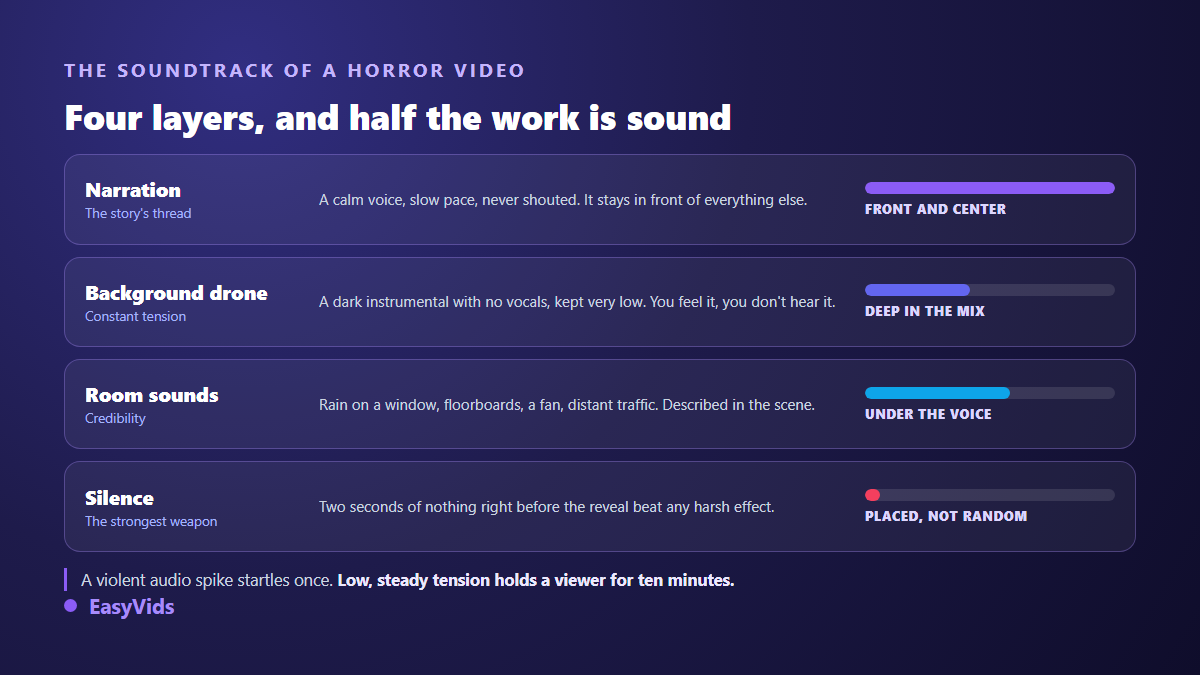
Two things are worth spelling out. Video models generate sound along with the picture, so the audio has to be specified: describe a sober environment that matches the location, and explicitly ask for no background music. Music added automatically to every shot produces a patchwork that cannot be edited together. Lay the music once, underneath the finished narration.
And that bed does not need to be a song. A dark instrumental with no vocals, composed from a short description of the mood, is enough. Sitting well below the narration it creates a continuous tension the viewer never consciously notices. The opposite reflex, a loud sting on every cut, exhausts the ear within two minutes and turns fear into irritation. A bed composed for the series also spares you the automatic claim that hits commercial tracks, and what you are allowed to publish with generated music comes down to a handful of rules worth knowing before your first upload.
Dark visuals without falling into gore
The most common mistake is believing horror has to be visible. The images that genuinely frighten are almost always calm ones: an empty corridor, a door left ajar, a shape outside the torch beam, an object that moved between two shots. The threat is inferred, not displayed.
- A disciplined palette: cool dominant, deep blacks, one light source per shot.
- One colour grade applied across the whole edit, dark cinema or black and white, so episodes look related.
- A little grain: an image that is too clean reads as fabricated.
- Almost no movement: a very slow push holds tension better than a restless camera.
- Off screen as a rule: show the trace, the reaction, the consequence, rarely the creature.
- Vertical for short clips, wide for long episodes, decided before you generate anything.
This aesthetic is practical as well as tasteful. Image and video generators apply strict safety filters: a scene described with blood, a wound or a weapon aimed at someone is refused outright and the generation is wasted. A well written prompt transposes the same beat into a suggested version, with shadows, witness reactions and clean consequences. The constraint pushes you towards the better result, because it is what horror cinema has always done.
What YouTube actually allows on disturbing content
Here is the part many creators discover only after a strike. The platform does not ban horror fiction, it bans certain images and certain intentions. Its violent or graphic content policy targets material meant to shock or disgust, gratuitous violence shown for its own sake, and suffering staged without context. A story that suggests passes easily. A mutilated body, even fully generated, does not.
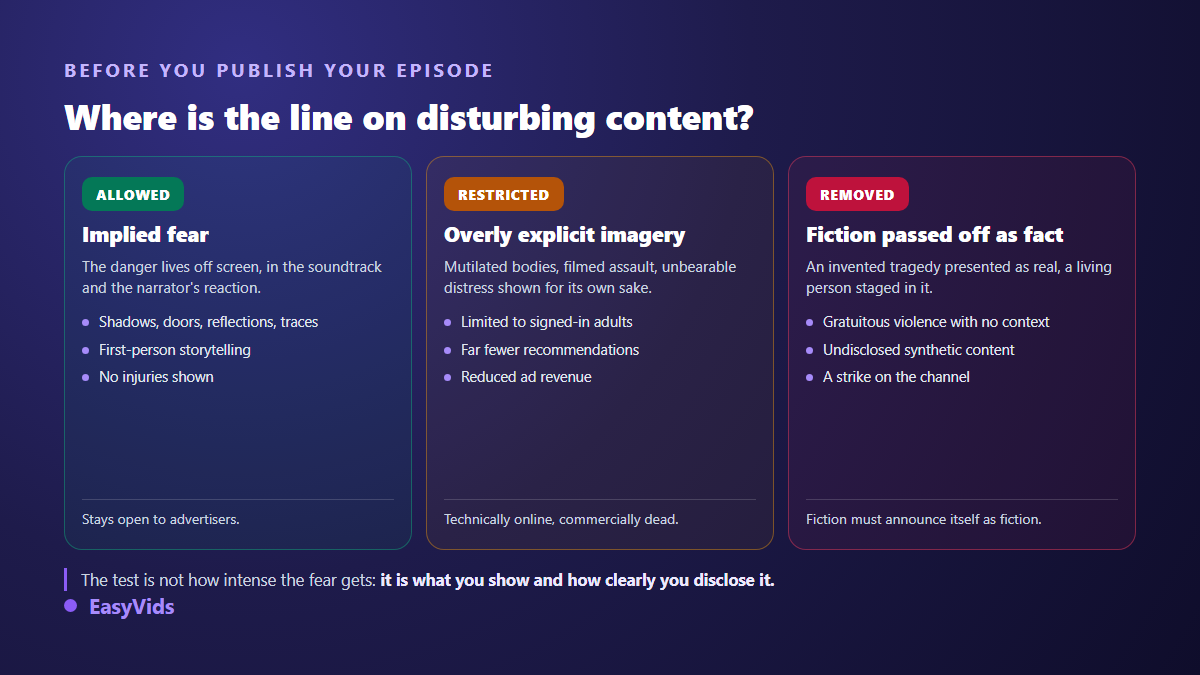
Monetisation follows a second, stricter grid. YouTube's advertiser friendly content guidelines place shocking content among the categories that limit or remove ad revenue, which means a video can remain visible while earning nothing at all. A third filter waits for channels produced in series, the reused content rule, and what gets an automated channel refused for monetisation rests on precise criteria worth knowing before the tenth episode goes up. Three habits keep you clear of trouble. Label fiction as fiction, in the title or in the opening seconds, and never present an invented story as a real case. Never use the name, face or voice of a real person. And disclose synthetic material: YouTube asks creators to flag realistic altered or synthetic content in the video settings at upload.
Publishing on a schedule without burning out
A horror channel is judged on the series, not on a single episode. A viewer who enjoyed one story looks for a second within the minute, then subscribes if a third exists. Rhythm therefore matters more than the perfection of any given shot, as long as you never publish below your own standard. The method that survives is batching: write four stories in one session while you are in the right frame of mind, then generate the visuals for all four, then the voices, then the edits. Generations run on the server and keep going after you close the page, so you can start a batch in the evening and collect it the next day. One nuance matters: batching is not mass production. The platform's inauthentic content rule targets series whose episodes differ only on the surface, and what that rule expects from a channel produced with AI is worth reading before you launch a first batch.
What a horror channel earns, and on what conditions
Revenue arrives late and rarely from one source. Advertising assumes you have passed the partner programme thresholds and stayed inside the advertiser guidelines. Then come affiliate deals, merchandise, podcast adaptations and sometimes the sale of your own stories. Vertical clips cut from your episodes open one more counter, and the nine ways to earn money on TikTok separate the ones that need an established audience from the ones open to a brand new account. Those sources stack rather than replace one another, and our overview of ways to earn from work made with AI sets out what each one asks for before it pays anything. None of it exists without a steady catalogue. One condition outranks the others: originality. Monetisation programmes exclude channels that republish existing material without adding value, and a video recycling someone else's text under a synthetic voice sits squarely in that category. What you generate on EasyVids belongs to you and stays usable commercially; the plans are detailed on the pricing page, and every creation tool runs from the EasyVids studio.
Frequently asked questions
Do I need frightening images for a horror video to work?
No, usually the opposite. The videos that hold attention longest show ordinary places filmed a little too calmly and keep the threat off screen. A frightening image releases tension; a calm one sustains it. Keep a single striking reveal per episode, at the very end.
How long should an episode be?
Start short, around three to six minutes of narration, while you find your voice and your tempo. Longer compilation episodes come later: they demand stronger writing, because a flat two minute stretch is paid for immediately in drop off.
Can a synthetic voice carry a horror story?
Yes, provided it is low and understated and you give it a precise reading instruction. The problem is rarely the voice, it is the text: long sentences punctuated like a news article read mechanically no matter which voice speaks them. Read your script aloud before you generate it.
Can I tell a real crime story?
Be careful. A real case involves real people and sometimes their families, and it commits you to accuracy as well as to respect for victims. Name nobody, reconstruct no crime, and never illustrate a tragedy with the face of an existing person. A distant inspiration clearly reworked into fiction is safer and usually more effective.
Can an AI made horror channel be monetised?
Yes. What counts is not the tool but the originality of the content, compliance with the disturbing content rules and the disclosure of realistic synthetic material. A channel that writes its own stories, stages them and publishes on a schedule sits in the same position as one shot on camera. Common questions about using the studio are answered in the FAQ.
A horror channel that works is not the one that shows more, it is the one that holds better. Write first, tighten second, and let sound do half the journey. Pick a voice, a grade and a thumbnail style you will keep for fifty episodes, then publish without missing a week. To test the method on a first story tonight, creating an account opens the studio: an idea, a writing style, a voice, and your first episode exists before the evening is over.