You have stories that unsettle people, and one simple wish: to tell them on YouTube without ever showing your face. A faceless horror channel is one of the rare formats where that constraint works in your favour. Fear does not come from a presenter. It comes from a text, a voice, a silence placed at the right moment, and an image you half see.
The real obstacle sits elsewhere. It is not the idea, it is the repetition: one episode a week for six months, at the same level, with no team. This guide walks the whole chain, from choosing a sub-niche to hitting publish, with the decisions you make once and never revisit. If the faceless model itself is new to you, our overview of the faceless format sets the scene before we get into horror specifically.
The short answer
A horror channel rests on five decisions and one routine. The five decisions: a sub-niche, a fixed episode shape, a narrator voice, a sound identity, a colour palette. The routine is the same production chain repeated weekly: script, shot list, visuals, voice, ambience, edit. What keeps a horror channel alive is not the scariest episode, it is the twentieth episode published. Everything below exists to make that twentieth episode possible.
Why horror works so well without a face
A voice without a body unsettles more than a face does. The viewer cannot reassure themselves by reading the eyes of the person speaking. They only have the story and their own imagination. The oldest forms of the genre already work this way: the tale told in the dark, the late night radio show, the anonymous account. Staying off camera is not a technical compromise, it is a convention the audience already accepts.
The second reason is industrial. A horror episode needs no actor, no set, no filming permit. It needs a text, a narration, a run of atmospheric shots and sound work. Those are exactly the four things an AI creation studio produces on demand, in series, with no location or weather to manage. Few niches automate this cleanly.
Choose your sub-niche before writing a single line
Horror is not a niche, it is a genre. Inside it, audiences do not mix: someone who came for first person accounts will not stay for a creature legend, and the reverse holds too. YouTube learns who to show your videos to from what your first viewers watch. A channel that switches registers takes months to be understood, if it ever is.
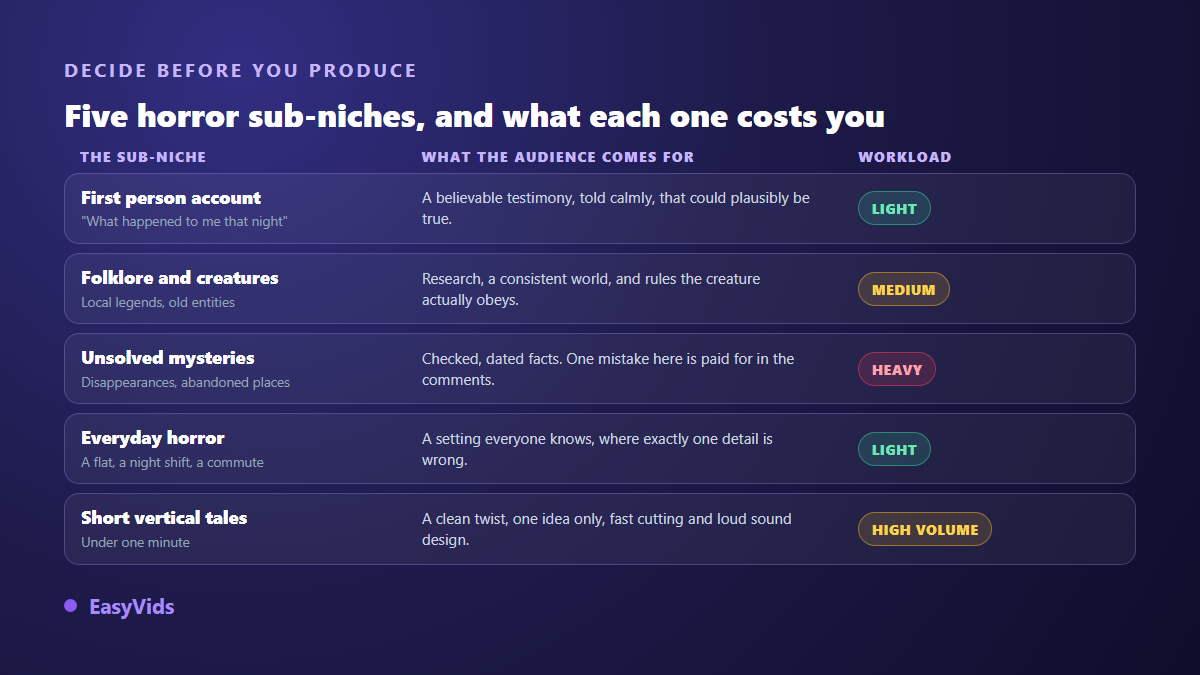
Pick on workload rather than taste. Unsolved mysteries demand documentary level checking, a single factual slip is paid for in the comments, and the subject sometimes touches real people: the precautions described for a faceless true crime channel apply word for word. First person accounts, by contrast, ask only for writing. That is the sanest door in when you start alone.
- Can you write thirty episodes? If thirty ideas do not come in one evening, the sub-niche is too narrow to last a year.
- Does the audience already exist? Check that channels have lived off this register for over a year. An empty niche is rarely an opportunity.
- Does the format fit in one sentence? "Accounts from people who work night shifts" sticks. "Weird stories" does not.
- Can the visuals be produced? A forest, a corridor, an empty house are easy. A recurring, recognisable character needs extra consistency work.
- Can you hold it in your own language? Horror lives in phrasing and rhythm. Translation comes later, never at launch.
The anatomy of an episode that gets watched through
The most common mistake on new channels is scaring people too early and too often. An episode is not a run of jump scares, it is a curve. Tension builds by accumulation, releases once, then leaves a question open. Two peaks close together cancel the first one out.
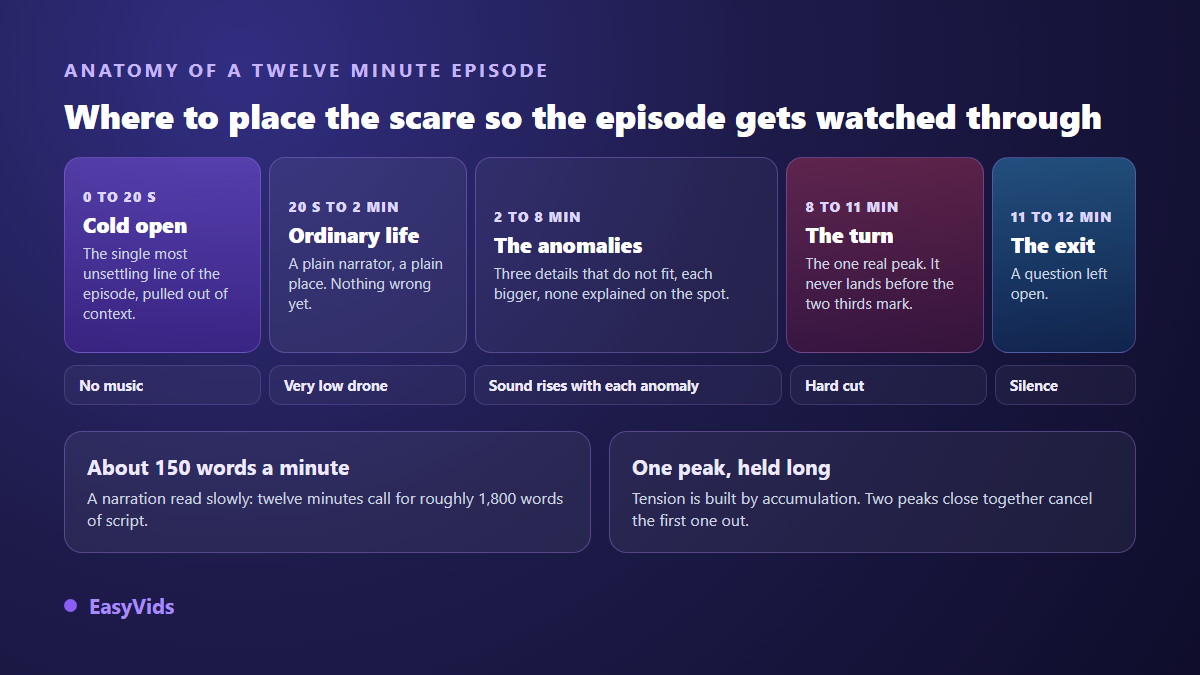
The cold open deserves real care. Take the most unsettling line in your text, pull it out of context, and drop it in the first twenty seconds, before the channel name even appears. The viewer stays to find out where it came from. At a slow reading pace, count roughly 150 words a minute: a twelve minute episode needs about 1,800 words of script, which is worth knowing before you write.
Writing the story: the rule of three anomalies
One simple structure works across almost every sub-niche. Put an ordinary narrator in an ordinary place, then introduce three anomalies, each bigger than the last, and explain none of them on the spot. The first is barely noticed. The second is uncomfortable. The third makes the situation impossible. Only then does the turn arrive. To practise on ready made outlines, thirteen short horror stories written to be narrated show the mechanism in full.
Resist the closing explanation. A story that explains everything closes, and the viewer moves on. A story that leaves one thing unresolved lives in the comments, which is worth more than a tidy ending.
The narrator voice is your channel's only face
Horror audiences recognise a channel by its voice before they recognise its thumbnail. Choose one, keep it on every episode. The traits that work are counterintuitive: slow pace, low volume, clean articulation, no emphasis at all. The narrator does not act frightened, they report facts. The discomfort comes from the gap between the calm delivery and the abnormal content.
A synthetic voice holds that role perfectly, provided you direct it. Write short sentences, punctuate hard, and write the silences into the text instead of hoping the model adds them. The settings that make narration believable are the same as for any other format: our advice for natural sounding AI voice over applies here too, with one extra requirement, slowness.
Sound design does half the work
Mute a horror film and it stops being frightening. Sound is the most neglected layer on new channels and the one that pays back fastest. Three layers are enough. A low drone, almost inaudible, that rises from one anomaly to the next. Space sounds, rain, a corridor, a fan, that give the story a place. And rare punctuations, two or three per episode at most.
Silence stays the most powerful tool, and the only free one. A second and a half of full silence before a line doubles its weight. A permanent sound bed, on the other hand, stops meaning anything: the ear adjusts within a minute. Producing your own ambience instead of pulling from a library everyone uses also gives the channel a signature people recognise in seconds.
A dark look that stays readable
The beginner move is to darken everything. On a phone, in daylight, an over darkened image is simply a black rectangle. Work the contrast rather than the gloom: one light source in frame, plenty of shadow around it, a subject that stays identifiable. The strongest shots are often empty ones, a corridor, a road, a window, with nothing in particular to look at. The narration fills the frame.
Lock a palette and keep it. Three dominant colours, the same grain, the same shot format from one episode to the next. That consistency works as branding: after ten videos a viewer recognises your channel without reading the name. Avoid nervous cutting, which belongs to another genre. Long shots and slow moves make the eye search the frame for what is wrong.
The production chain, one typical week
Building an episode always splits the same way. That regularity is not an organisational detail: it is what lets you work in batches, and therefore hold a publishing rhythm without giving up every evening.
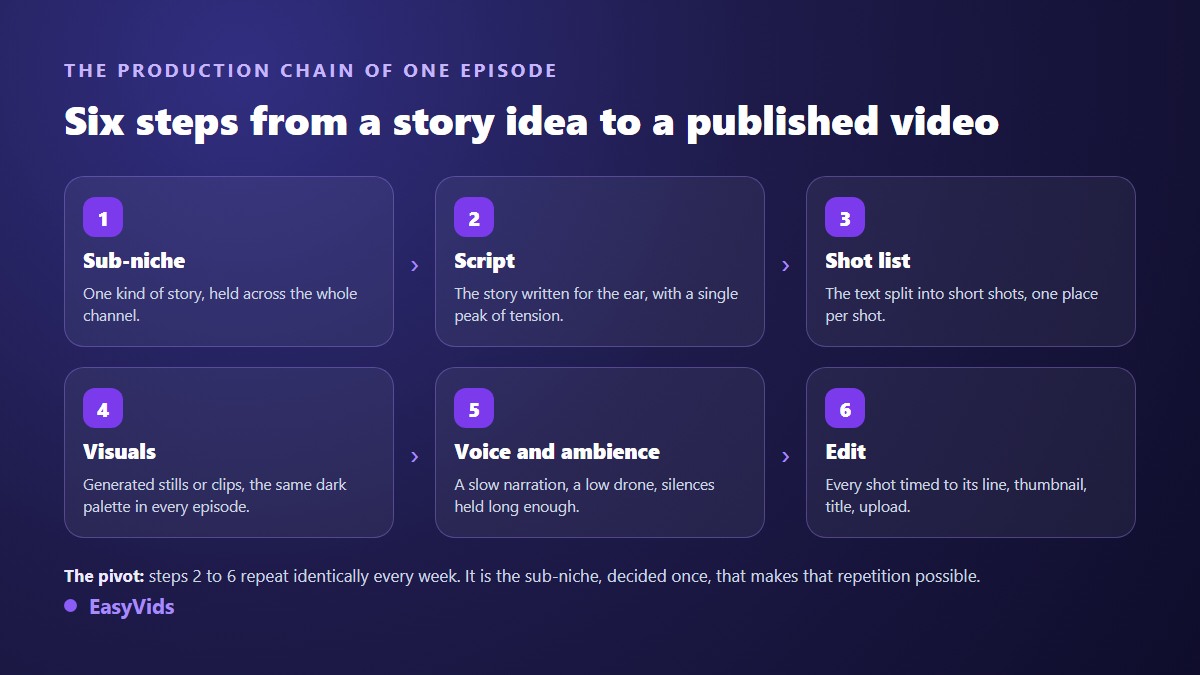
The real time saving comes from batching: write four scripts in a row, then produce the visuals for all four episodes, then record the four narrations. You switch task three times instead of twelve, and your writing keeps the same register across the batch. A studio that chains text, images, voice and editing in one place also removes the round trips between tools, and the EasyVids platform was built around that chain.
- Monday. Pick the ideas and write the batch of scripts, four at a time.
- Tuesday. Break each script into shots, one place per shot, and write the image descriptions.
- Wednesday. Produce the visuals for all four episodes and drop anything that breaks the palette.
- Thursday. Record the narrations, lay the drones and mark the silences.
- Friday. Edit, build the thumbnails, write titles and descriptions.
- The rest of the week. Publish on your fixed day, answer comments, note the ideas that come.
What YouTube allows, and what kills your revenue
The genre is allowed, its imagery has limits. YouTube's violent or graphic content policy, published in the community guidelines, separates what serves the story from what exists only to shock. Gratuitously bloody imagery can earn an age restriction, a removal, or the loss of ads: the advertiser friendly content guidelines list shocking content among the categories with limited monetisation. A channel built for the long run suggests more than it shows, for economic reasons as much as artistic ones.
The second watch point is automation. Since 15 July 2025, the partner programme rule that targeted repetitious content is called inauthentic content, and it targets mass produced material with nothing of your own in it. An original story, written for your channel, narrated and illustrated by you, stays eligible: mechanical copying is the problem, not the tool. The entry thresholds are unchanged, 1,000 subscribers plus 4,000 valid public watch hours over twelve months, or 1,000 subscribers plus 10 million valid Shorts views over ninety days, according to the eligibility conditions published in YouTube's help centre. The detail of the monetisation rules applied to AI content is worth reading before launch, not after a rejection.
Rights on the stories you tell
Narrating a story you found online is never neutral. Entries on the SCP Foundation wiki are published under a Creative Commons BY-SA 3.0 licence, which requires crediting the author and the original and sharing any adaptation on the same terms. On account forums, r/nosleep first among them, the rules state that authors keep their rights: a video narration is asked for, not assumed. Old folklore and public domain texts stay free to use, as long as you do not lift the protected version written by an identified author. Writing your own stories remains the simplest route, and the only one that builds a catalogue you own. That catalogue can earn somewhere other than the platform, and the business model behind a story collection sold as an ebook sets out what a reader is really buying when they pay for stories.
Frequently asked questions
Do you need gore to make people afraid?
No, and it usually backfires. Blood becomes ordinary in seconds, anticipation never does. The most effective episodes show very little: an empty corridor, a door left open, a shape outside the frame. You also keep your monetisation intact, which explicit imagery puts at risk.
How long should a horror episode be?
Eight to fifteen minutes for a single story, which leaves room for a real build. Compilations of short accounts run longer because people play them as background at night. To size your script, count around 150 words per minute of slow narration.
Can a generated voice really be frightening?
Yes, as long as you direct it towards calm. Horror narration does not want performed emotion, it wants restraint, a slow pace and held silences. That is precisely what a synthetic voice does effortlessly, where a beginner at a microphone tends to overact.
Do you have to pay to start a horror channel?
You can write, test a voice and produce your first episodes on a free trial, long enough to check the sub-niche suits you. Moving to a weekly rhythm means a higher production volume: the offers are listed on the pricing page, which is the only up to date source.
How many episodes before a horror channel takes off?
No honest number can be promised: it depends on the sub-niche, the language and the competition. What is observable is that a channel judged on fewer than twenty episodes has not really been judged yet. Stay regular long enough for YouTube to test your videos on several audiences.
The hard part of a horror channel is not writing one frightening story, it is publishing fifty. Decide your sub-niche tonight, write the first script, produce the whole episode even if it is imperfect, and watch what the audience does with it. Open an account and build your first episode: script, narrator voice, visuals and ambience all live in the same place, and the twentieth episode becomes a routine instead of a feat.