You can already hear it. A faceless motivation channel, videos that move people, a deep voice over wide slow shots, a track that swells exactly when the line lands. What stops you is not the idea. It is the camera you do not own, the studio you will never rent, and the nagging sense that your own voice will not carry far enough.
None of that is required. This kind of channel is built from a script, a voice over whose intensity you control, music written for the video, and shots generated on demand. The real obstacle sits elsewhere: this is one of the most crowded niches on the platform, and no tool rescues an empty speech. This guide covers the full build, alongside our guide to AI video generation, then the only ground where you can still win: the angle.
The short answer
A faceless motivation channel rests on four pieces, assembled in this order: a script written for the ear, a voice over whose grain and intensity you choose, music that lifts the build without burying the words, and visuals that illustrate the idea instead of stealing attention from it. Assembly is automated. So the hard part is not production, it is picking a narrow territory inside a theme thousands of channels already work. Choose that territory before you write a single line.
What a motivation channel actually sells
Viewers are not looking for information. They are looking for a state: the feeling, for ninety seconds, that their situation has a way out. That is an emotional contract, and it breaks on the first false note. Motivational videos rarely fail on image quality. They fail because the viewer senses that nobody behind the words really believed them.
That sets your working order. Effort goes into the writing, not the effects. A plainly edited video with an honest script holds an audience longer than a montage of spectacular shots laid over interchangeable lines. Keep the hierarchy at every decision: script, voice, music, image. In that order.
It also means your channel needs a point of view, not a tone. The motivational tone already belongs to everyone. A point of view is chosen: recovering after a business failure, the discipline of amateur athletes, the courage of single parents, the persistence of students who work nights. A point of view produces videos that differ from each other. A tone produces the same video fifty times.
Writing a script that lands without sounding fake
Motivational writing follows a precise shape, and most failed scripts skip a beat. They open on the conclusion, stack up maxims, and land nowhere. The viewer feels pressure without direction, which is the opposite of the intended effect.
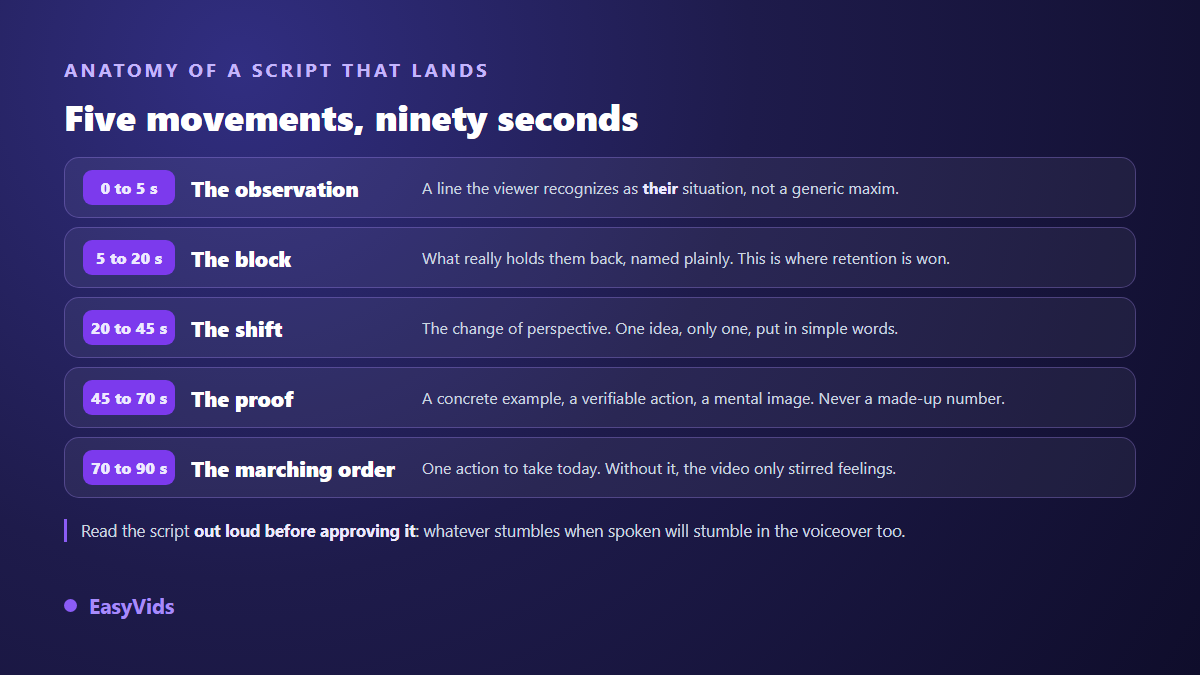
Three traps come back constantly. A quotation credited to someone who never said it: one comment pointing that out damages the whole channel. An impressive number invented to sound serious, which anyone can check in seconds. And an order dressed up as advice, the tone that commands instead of walking beside the viewer.
- One idea per video, held to the end. The second idea becomes the next video.
- Short sentences, read aloud before approval: what stumbles out loud will stumble in the voice over.
- Conversational vocabulary, not award ceremony vocabulary.
- A concrete example instead of a superlative: a gesture, a duration, a situation viewers recognise.
- No promised outcome, no guarantee, no shortcut sold as certain.
- One action they can take today, otherwise the video only stirred feelings.
- Your own experience somewhere in the text: it is the one thing no other channel can copy.
When the blank page wins, the studio drafts that first version for you. You give the idea, pick an inspiring tone, set a rough voice over length, and the text comes back already split into scenes, editable line by line. Treat it as an author's draft rather than a finished script: keep what sounds like you, rewrite the rest. The whole path lives in the EasyVids studio, from idea to final file.
Voice: intensity is set, not shouted
The voice over is where most motivation channels give themselves away. The beginner reflex is to pick the deepest, most powerful voice, then leave it at that level for the entire video. It exhausts the ear within twenty seconds. A voice that shouts throughout can never build, and the build is exactly what viewers came for.
Two settings matter. First the voice itself: some are deep and steady, others firm, energetic or warm. Preview them on your own text rather than on a demo line. Then the reading style: on one of the available engines you write the instruction in plain language, for example to read in a low, restrained voice, pausing after every question. That second setting separates a correct read from one that carries. Think of the instruction by genre: a crime story is read cold and restrained, as our guide to a faceless true crime channel sets out, while a motivational script has to hold something back so it can rise in the final third.
- Write the silences into the script: a line break before the key sentence beats any effect added in the edit.
- Start low. A calm opening leaves room to rise in the final third.
- One voice per channel, kept across every video: it is what viewers recognise before your logo.
- Test the same sentence on two voices before committing to a whole series.
- Cloning a voice requires the consent of the person it belongs to, relatives included.
- Listen back to sentence endings: that is where synthesis shows most.
Breathing, punctuation and the mistakes that make narration sound artificial are covered in our guide to natural AI voice over. They matter twice as much here, because a motivational script lives entirely in its rhythm.
Music carries the emotion, not the script
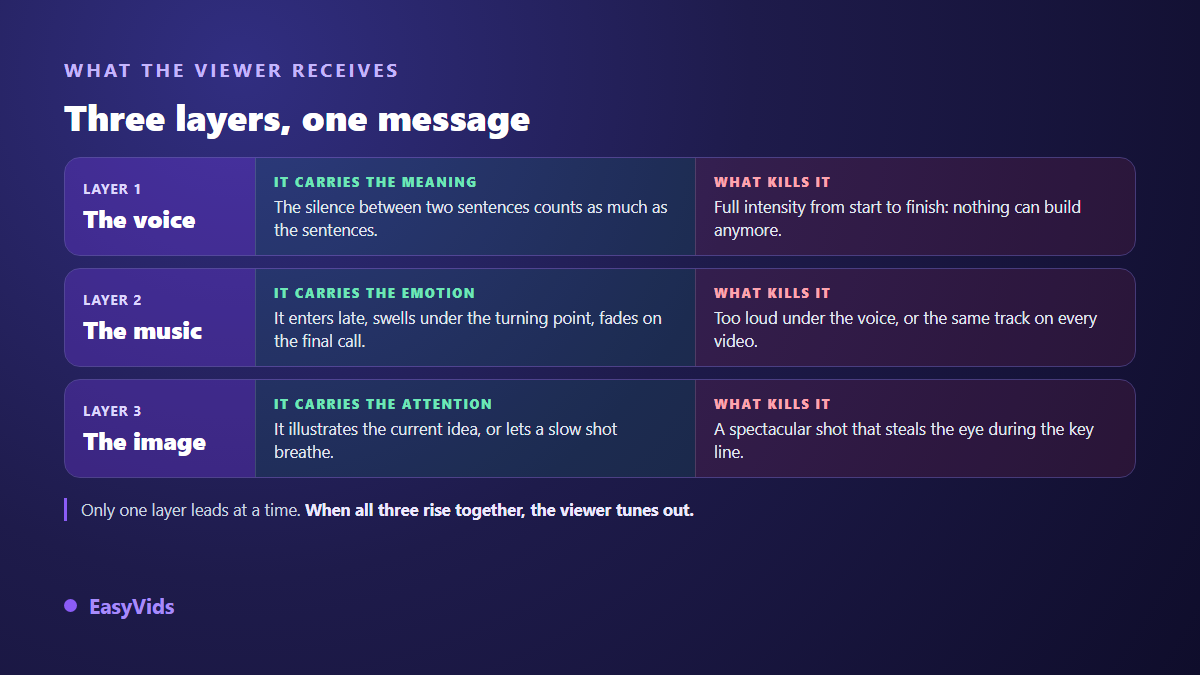
Take any motivational video that works, mute the music, and see what remains. Usually very little. The track sets the tension, lifts it under the turning line, and releases it at the end. The script carries meaning, the music carries emotion. Many creators reverse that split and write a script trying to do both jobs.
Sound design obeys one rule: only one layer leads at a time. When the voice says something essential, the music steps back. When the music rises, the voice stops. When a striking shot passes, neither should compete. Three layers rising together do not triple the emotion, they produce noise.
Then there is rights clearance, which has sunk plenty of channels. A track lifted from a streaming service is not usable, even credited in the description, and an automated claim can redirect a video's revenue to a rights holder. Producing the music yourself removes the problem at the source. Our music studio includes a motivation brief for exactly this: describe the mood, pick a genre, an atmosphere and a tempo, request an instrumental version, and the job keeps running server side even if you close the page. Two or three tracks reserved for your channel are enough to build a recognisable sound.
Visuals that support the words instead of stealing them
A motivation channel does not need complicated shots. It needs slow, wide, slightly abstract images that leave room for the sentence. Sunrise on an empty road, one athlete alone in a closed gym, an office window at night. These images say nothing on their own, which is precisely what makes them useful. When a series keeps returning to the same figure from one episode to the next, a runner, a craftsman, a student, that description has to be locked from the first shot, otherwise the face changes with every scene: our method for describing a character who stays the same lists what to pin down.
- One shot per idea rather than one shot per sentence: too many cuts break the gravity you are after.
- Slow moves and long takes, held longer than on a news style video.
- Consistent light between shots: two opposite moods cut together are noticed immediately.
- No text baked into a generated image: letters distort quickly, so add captions in the edit.
- One dominant colour across the channel, which becomes your identity without a logo.
- Captions on everything: a large share of your audience watches muted.
In the workspace each scene keeps its own text, shot and narration, and regenerates on its own when it misses. You can also upload your own footage, mix it with generated shots, then run the automatic assembly that aligns every visual to the length of its narration and outputs a file ready to publish. Captions are produced from the video's own audio, in a file you proofread before importing.
Short form or long form
The temptation is to do everything in month one, which is the surest way to do none of it well. The two formats serve different goals and are not written the same way. Vertical shorts get you discovered by strangers. Long horizontal videos turn strangers into regulars. A shorts only channel grows fast and retains badly. A long form only channel grows slowly and keeps its audience. Some faceless formats live almost entirely in short form, such as channels built on stories pulled from Reddit, where one story fits inside a minute. Motivation needs both.
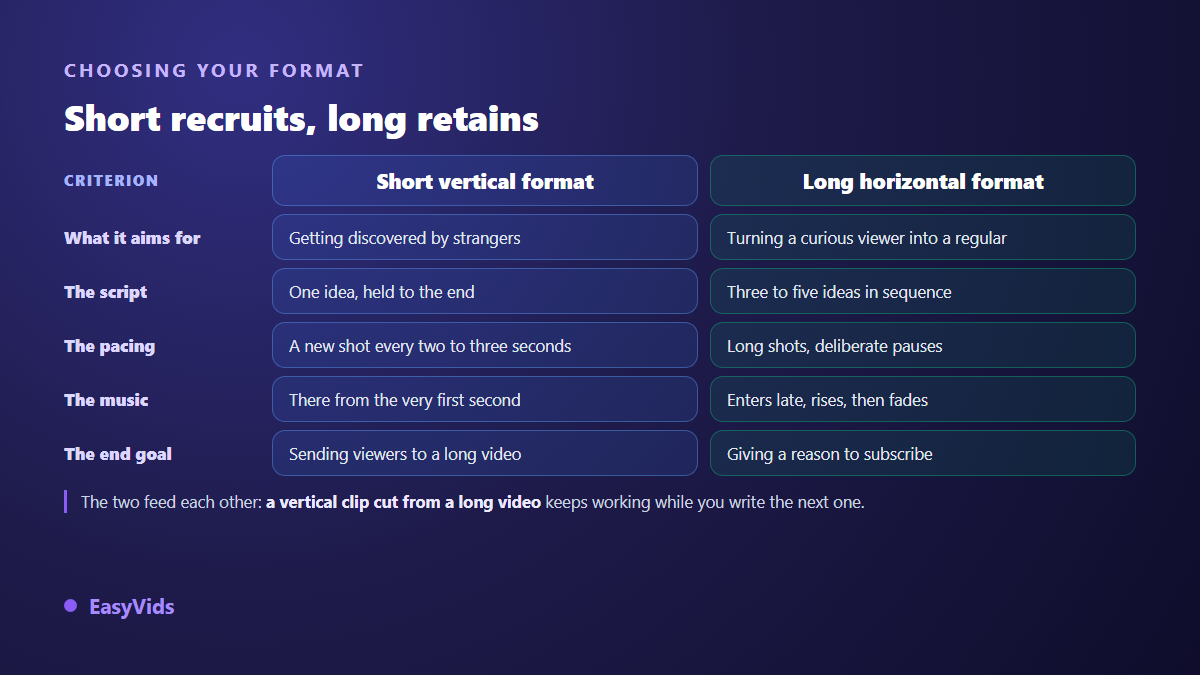
The cheapest method is to write the long version first, then cut vertical clips out of it. You reuse the script, the voice and the music already produced, reframe, add larger captions and publish while writing the next episode. Aspect ratio is chosen at generation time, and our step by step guide to a published YouTube video walks the same sequence end to end, thumbnail included.
Standing out in a saturated niche
Here is the part most guides avoid. Generic motivational content is mass produced, often by the same channels recycling one edit with barely altered words. Entering that ground without an angle is opening another shop on a street that already has two hundred. That mass production reaches far beyond motivation: it follows a whole model, which our overview of faceless YouTube channels breaks down along with its low barrier to entry. The good news is that saturation hits the middle of the market, not its edges.
- Narrow the audience until it feels too narrow, then narrow it once more.
- Speak to a precise situation: the first year of a small business, coming back from an injury, life as a family carer.
- Tell verifiable stories rather than principles: a story is far harder to copy than a maxim.
- Pick a language or a variant that is underserved instead of adding yourself to the English speaking pile.
- Hold a constant visual and sonic identity: recognition beats novelty.
- Answer comments and turn recurring questions into videos, something no automated feed replicates.
- Publish at a pace you can sustain for six months, not three weeks.
A useful test before launching a series: write your promise in one sentence, then ask whether ten other channels could sign it unchanged. If they could, the promise is too wide. Rewrite until you have a sentence only you could have written, with your history, your audience and your way of speaking.
Monetisation: what actually blocks these channels
The recurring question is whether an AI assisted channel can be monetised. It can. What gets penalised is not the tool but the absence of original contribution. A channel that repeats one template endlessly, or narrates text taken from elsewhere over stock footage, runs into the rules on repetitive and reused content. The official criteria are published in YouTube's own monetisation policies, and they talk about contribution, never about technology. We went through those criteria one by one, along with what an AI assisted channel has to add of its own, in our guide to YouTube monetisation and AI content.
There is a second duty: realistic content generated or altered by AI must be disclosed at upload, and a label can be shown to viewers. Stylised illustrative shots raise few issues; a realistic person on screen does. Ticking the box costs nothing, forgetting it can cost the video. And remember that advertising revenue alone stays a side income for most channels: the channels that hold sell something of their own, a programme, a book, a service. Our breakdown of what an AI video really costs sets the orders of magnitude, and the pricing page carries the current details.
Frequently asked questions
Do I need to show my face to grow a motivation channel?
No, and this is one of the few themes where staying faceless costs nothing. Viewers listen to a voice and watch wide shots; your physical presence is not part of the contract. What must be identifiable is the voice, the edit and the point of view. Three constants are enough to build recognition.
How long should a motivational video be?
Around ninety seconds for a dense vertical clip, and five to ten minutes for a long form video developing several beats. Voice over runs near one hundred and fifty words per minute, which gives you the practical marker: roughly two hundred and twenty words for ninety seconds. Write to that length rather than cutting in the edit.
Can I use a synthetic voice without saying so?
You are not required to list every tool you use, but two rules apply. A voice imitating an identifiable person needs that person's consent. And realistic AI generated content must be disclosed at upload where the platform requires it. Outside those cases, synthetic narration over stylised imagery raises no particular issue.
Where do I get motivational music I can safely use?
Have it produced for your channel rather than hunting for it. Describe the mood, the genre and the tempo, ask for an instrumental version, and you get a track whose use depends on no third party rights holder. Two or three pieces reused across videos end up becoming your sound signature.
How many videos before I see results?
Nobody can give you an honest number, and be wary of anyone who does. The same caution applies to the income these channels promise, which is why our review of seven realistic AI income systems also names the ones that simply do not exist. What is observable is that channels are judged on a series published over time, not on three isolated attempts. Set a horizon of several months, track retention across the first twenty seconds, and let that figure choose your next subjects.
A motivation channel is not won on equipment. It is won on a conviction only you can phrase, carried by a steady voice and music that knows when to stop. The technical side no longer holds you back: script, narration, track, shots and edit now live in one workflow. Write your first minute, read it out loud, and if it stands up, create your account and give it a voice, a soundtrack and images today.