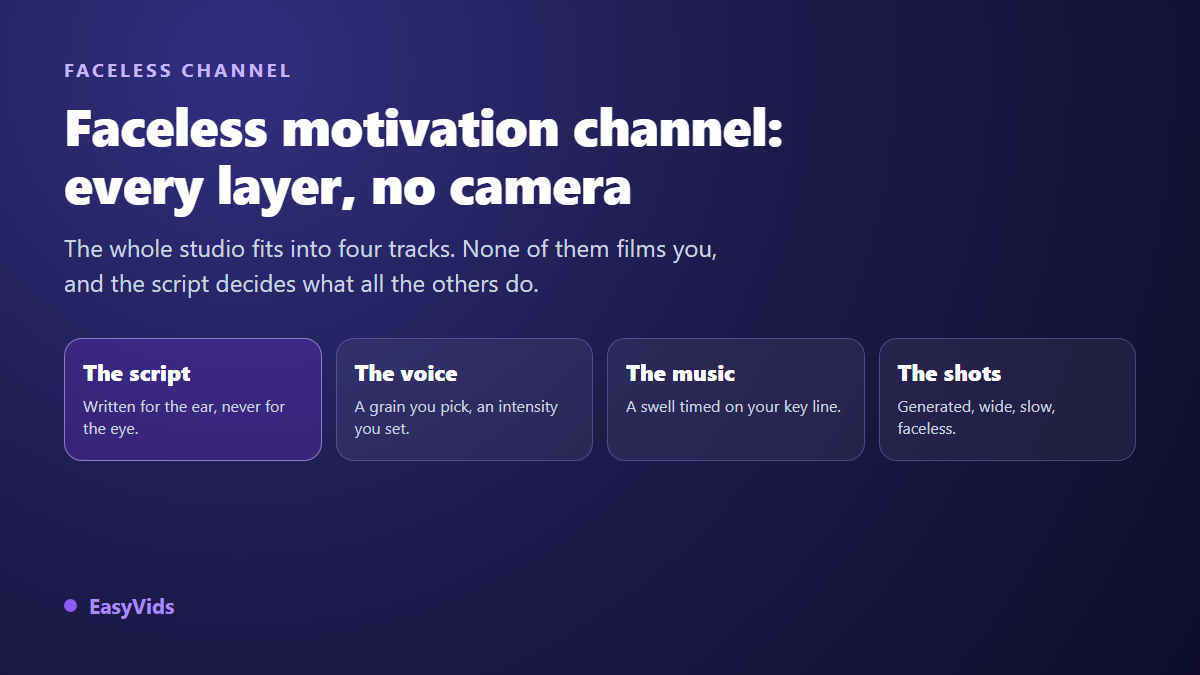
You already know the format before you have produced a single video. A low voice, a line that lands, music that swells, wide slow shots. A faceless motivation channel needs no studio, no crew and not one frame of you. It needs a speech that stands up, a voice that believes it, and a track that arrives at the right second.
The hard part sits elsewhere. This is one of the most crowded niches on the platform, and no tool rescues an empty script. This guide walks the whole build in the order it actually happens: write, speak, mix, illustrate, publish. If the faceless model is new to you, our guide to running a channel without showing your face sets the frame first.
The short answer
A motivational video rests on four tracks: a speech written for the ear, a voice over whose grain and intensity you choose, music whose swell lands on the key line, and generated shots that illustrate the idea without stealing attention from it. All four are made in a browser, with no camera and no microphone, and the assembly happens on its own. The work that matters sits in the writing and in the mix, because those are the only two places where your channel will differ from the thousands of others.
What the camera used to do
A filmed motivational video needed a presenter, a set, a sound engineer, a licensed track and an editing suite. Every one of those jobs has a direct stand-in. The presenter becomes a speech carried by a voice over. The set becomes a run of generated shots. The soundtrack becomes music written for your video. The edit becomes automatic timing of each shot on the real length of the voice.
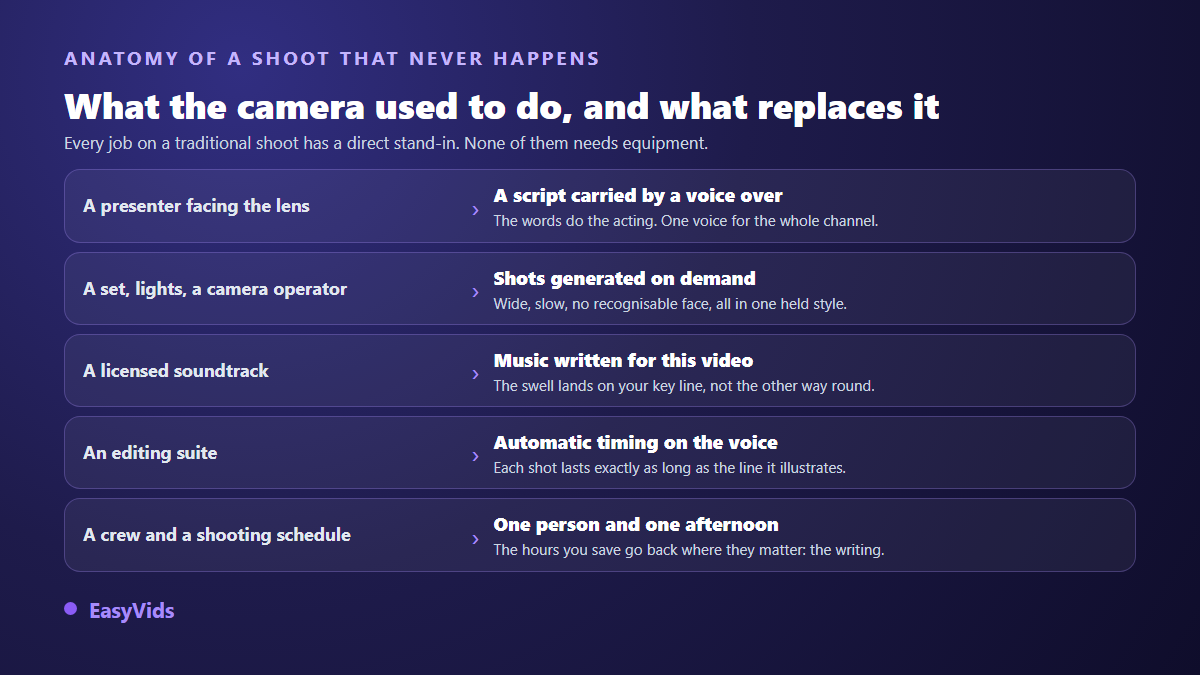
That shift moves your time towards writing, which is good news. On our own generations, a three minute video is built in under an hour once the method is settled, and the script takes roughly half of that. The writing is the part nobody can automate for you.
Writing a speech that lands without sounding fake
The mechanics are simple and unforgiving. You name a difficulty the viewer recognises, you turn that difficulty around, then you give an order. Anything outside those three beats is filler, and filler shows up in the retention curve. Write in the present tense, in the second person, with ten word sentences when the tension climbs.
The usual mistake is abstraction. Fight for your dreams moves nobody, because nobody pictures a dream. You get up at five and no one sees it moves someone, because the image is precise. Always hunt for the object, the hour, the gesture. These are the rules we apply to every script before it reaches a voice:
- One idea per video. Two lessons in one speech cancel each other out.
- One concrete image every three sentences: an object, a place, a precise hour.
- Short sentences as intensity rises, longer ones to settle the calm.
- No promise of results. You describe an effort, never a guaranteed outcome.
- A last line that gives an order, short, spoken after a silence.
Voice: intensity is set, not shouted
The voice carries half of the perceived quality. An average image survives a good voice, the reverse never happens. Pick one timbre and keep it, because on a faceless channel recognition runs entirely through the voice. A settled low register, a slow pace and clean articulation beat any voice that pushes. Our AI voice over guide covers picking a timbre and tuning the pace, and punctuation does the rest: a full stop is a breath, a line break is a longer silence.
Music carries the emotion, not your script
The same speech turns defiant or melancholic depending on the track. Music does most of the emotional work, and it is the layer most channels neglect by reusing the same free loops as everyone else. Music generated for your video solves two problems at once: nobody else owns it, and its length matches yours. Our AI music generator guide explains how to describe a mood so the swell lands where you need it.
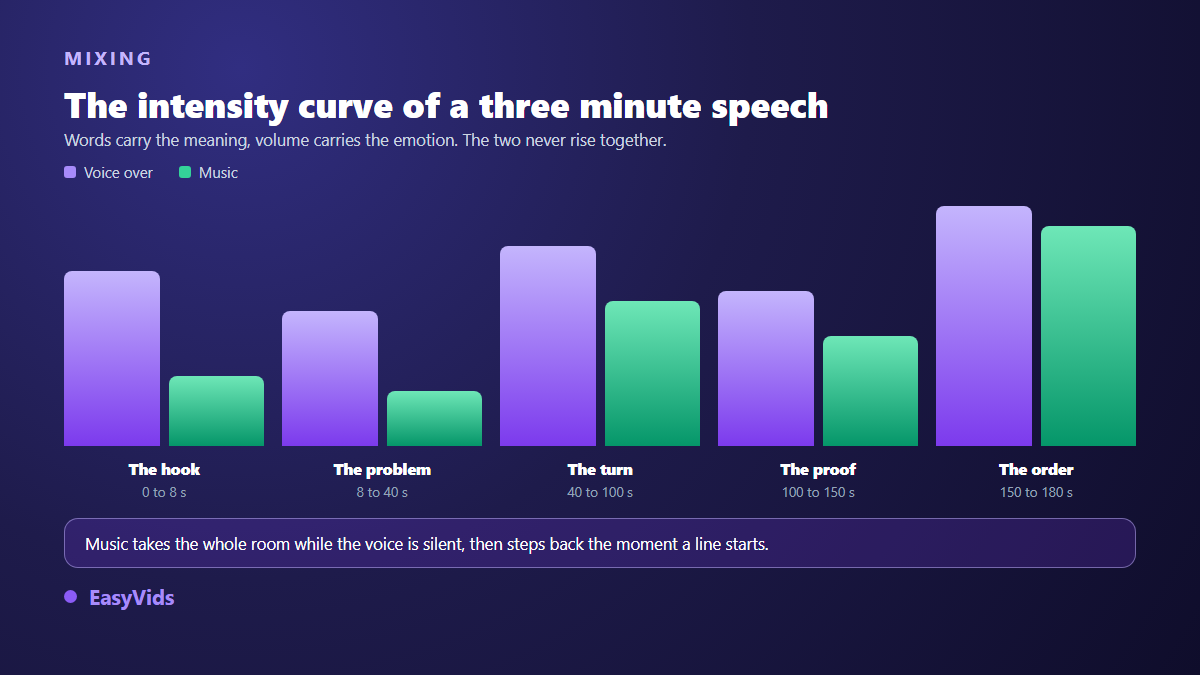
One mixing rule covers most of it: the two tracks never rise together. During a line, the music steps back. Between two lines, it takes the whole room. The peak has to fall in the silence before the closing order, otherwise the voice drowns exactly when it matters most.
Shots that support the words instead of repeating them
Images in this format tell no story, they set a climate. Wide, slow shots: a sky, an empty road, a gym at dawn, a figure seen from behind. Avoid faces looking at camera, they pull the eye away from the words. Keep one visual style for the whole video and vary only the subject. Beware literal illustration too: if the voice says the mountain, showing a mountain cancels the line, because the viewer sees what they just heard.
What YouTube expects from an AI produced channel
Two rules really matter. Since March 2024, YouTube asks creators to disclose realistic content that has been generated or altered with artificial intelligence in YouTube Studio, and a label is then shown on the video. Since July 2025, the monetisation rule formerly called repetitious content has been renamed inauthentic content, and it targets mass produced videos with no added work of your own, which is exactly the risk for an automated motivation channel.
Nothing forbids a synthetic voice or generated images. What blocks a channel is the absence of added value: the same text read again, the same recycled shots, no writing behind them. On the music side, a track composed for you avoids Content ID claims, which detect a known song even under a voice over. According to the YouTube Partner Programme entry requirements, you also need a thousand subscribers plus four thousand valid public watch hours over twelve months, or a thousand subscribers plus ten million Shorts views over ninety days. Advertising is only one door, though: seven revenue streams coexist on a channel, and several of them owe nothing to that programme.
Standing out in a crowded niche
Generic motivation has nowhere left to go. What still works is a narrow territory: motivation for an exam, for returning to sport after an injury, for a first year in business, for night shift work. The viewer has to recognise themselves in the first sentence. A channel that speaks to everyone speaks to nobody, and the algorithm has nothing to attach your videos to. Your form is a signature as well: one palette, one type of shot, one voice, one fixed structure, and after twenty videos the channel is recognisable without a logo.
A production week you can hold
The real enemy of a faceless channel is not quality, it is quitting after three weeks. The cadence holds when you batch identical tasks instead of building each video end to end. Writing four speeches in a row costs less energy than writing, producing, editing and publishing four separate times.
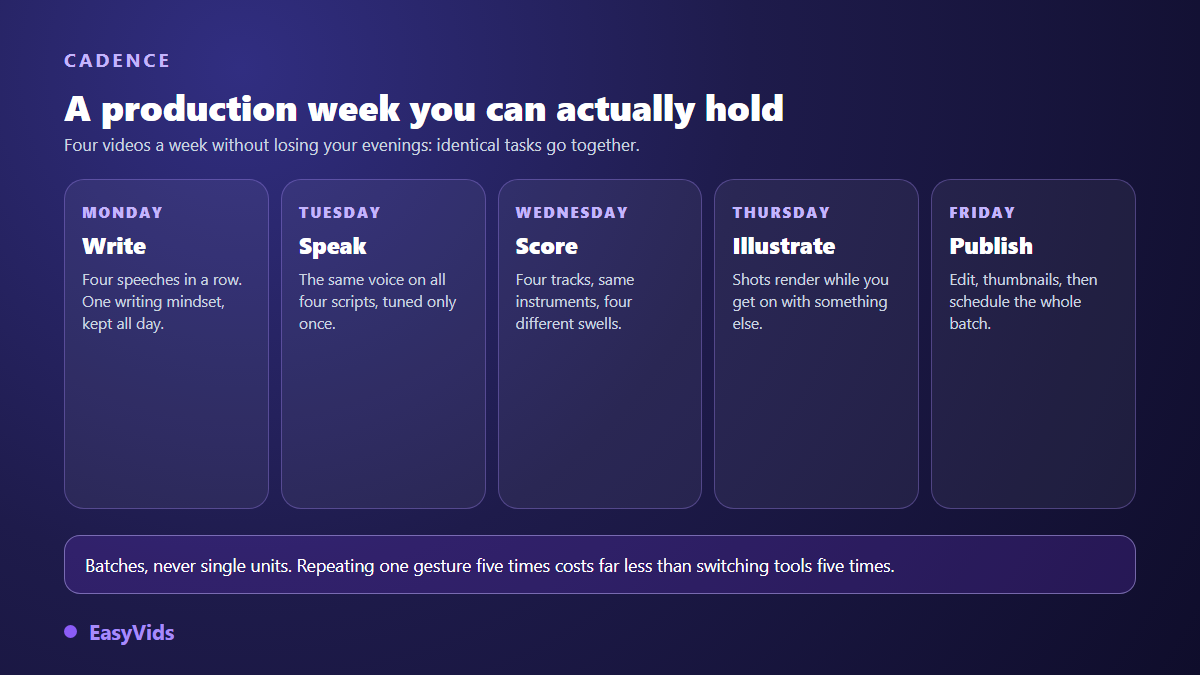
That routine also leaves room for the only thing that really improves a channel: reading your retention curves and rewriting the hooks. Watch the second where viewers leave, then rewrite that line next week, one variable at a time.
Frequently asked questions
Do I need a human voice for a motivation channel?
No. A well tuned synthetic voice works on this format, because the slow pace and clean articulation suit it. What gives a video away is not the synthesis, it is a flat script read too fast. Record your own voice if you like it, otherwise pick a timbre and keep it across the channel.
How long should a motivational video be?
Two to four minutes in landscape, thirty to sixty seconds in vertical. A longer speech needs real progression, not a queue of strong lines. Cutting a short version from the same script is the simplest way to feed two formats with one piece of writing.
Can I use a well known song in the background?
No, unless you hold an explicit licence. Content ID detects a protected track even under a voice over, and the video can be demonetised or blocked in some countries. Music composed for your video removes that risk and stays reusable from one episode to the next.
What does this kind of channel cost to run?
The real cost is writing time, not equipment: no camera, no microphone, no music licence. A free trial is enough to produce your first videos and see whether the format suits you, and the plans are listed on our pricing page.
You need no camera, no microphone and no actor's voice. You need a script that says something true to someone specific, and a production chain that does not exhaust you after a month. Write the first speech tonight, produce it tomorrow, then watch where viewers drop off. Open a free account and build your first video before you have found the perfect channel name.