A nursery rhyme plays on repeat in the living room. The child asks for the same character, the same theme tune, the same song, ten times in a row. That habit is exactly what a faceless kids YouTube channel is built on. What used to stand in the way was production: thirty animated, sung and voiced episodes meant a team, a booth and months of work, for an idea nobody had validated yet.
Two walls stop most creators who try it with generative tools. The first one is visual: the hero's face drifts from one episode to the next, and the child stops recognising it. The second one is regulatory, because this audience is the most tightly framed on the platform, and one careless checkbox switches off half of your channel's features. Both are solvable, in that order. If the format itself is new to you, our guide to channels that never show their creator covers the basics, and this article covers what changes when your viewer is four years old.
The short answer
A kids channel rests on three pillars. A recurring character whose look never drifts, because the character is what the child comes back for. A short, repetitive format, a sung rhyme or a calm bedtime tale, that survives being watched twenty times. And an honest audience declaration in YouTube Studio, because the platform treats this content differently. Generative tools write the words, compose the song, draw the character and give it a voice. Your job moves to the world, the consistency and the rules.
Why kids content follows its own rulebook
The framework comes from the United States. In September 2019 the Federal Trade Commission and YouTube announced a settlement ending a case brought under the Children's Online Privacy Protection Act, the federal children's privacy law usually shortened to COPPA. Since the start of 2020, according to the YouTube Help Centre, every creator has to state whether a video is made for kids, wherever they live. The setting is not a preference, it is a declaration.
What that declaration triggers often catches people out. According to the YouTube Help Centre, a video marked as made for kids loses its comments, its notification bell, live chat, save to playlist, memberships and paid thanks. Personalised advertising is switched off too, since the platform does not track viewer behaviour on that content. Only contextual advertising, chosen from what the video itself shows, remains available.
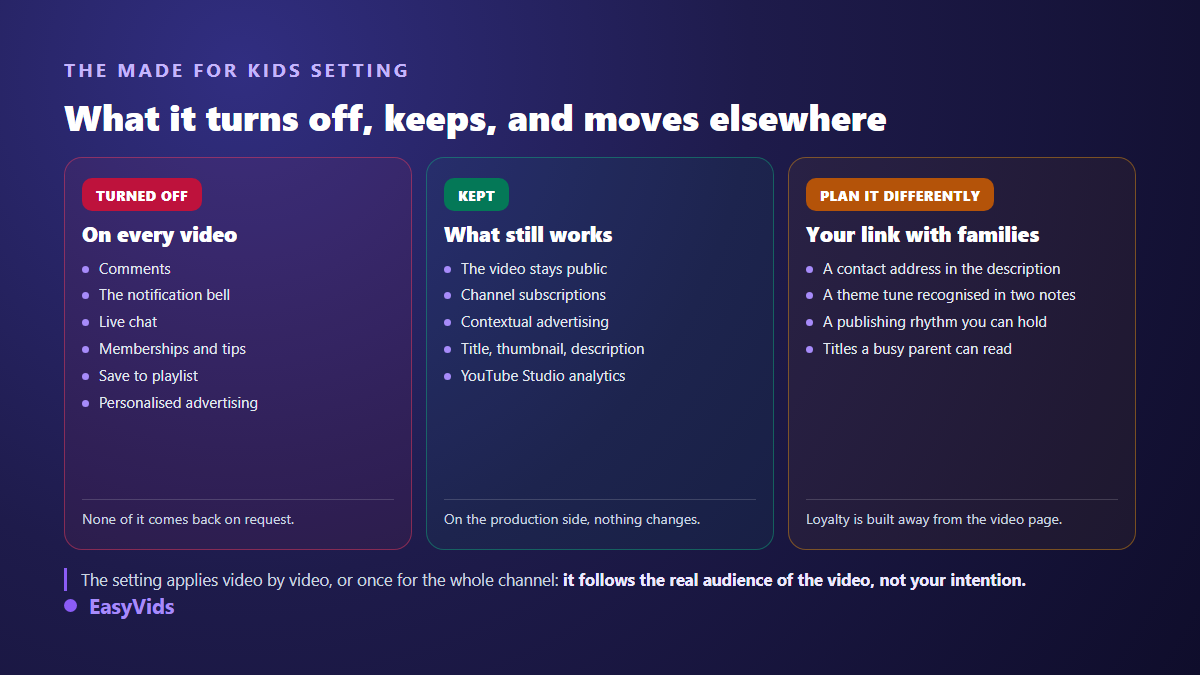
That has a practical consequence. With no comments and no notifications, your channel cannot rely on the usual signals of a community. What is left is the thumbnail, the title, the theme tune and the rhythm. Parents open a video because the character means something to them, and because the title says plainly what the child is about to watch. A clever title or a clickbait thumbnail simply misses its audience.
What the made for kids setting actually looks at
The declaration is made video by video at upload, or once for the whole channel in YouTube Studio settings. It does not follow your commercial intent, it follows the content. According to the YouTube Help Centre, several signals feed the assessment, and they only need to point at a young audience for the video to be treated as made for kids.
- The subject matter, when it is plainly aimed at young children.
- Child actors, or animated characters that appeal to children.
- Toys, nursery rhymes, games and pretend play.
- Simple language, written to be understood before a child can read.
- Songs, poems and stories written for children.
Getting it wrong is costly both ways. Marking an adult video as made for kids strips the channel of its features for nothing. The opposite is worse: according to the YouTube Help Centre, an inaccurate declaration exposes the creator to whatever the Federal Trade Commission or another authority decides to do, and the platform reserves the right to act on the channel. When in doubt, judge by the real viewer, not the one you were aiming at.
The recurring character is the asset
An episode is watched and forgotten. A character is not. Long running rhyme channels all rest on a handful of fixed figures that children name, copy and ask for. That is what turns a pile of uploads into an appointment, and it is what makes a channel hard to copy: your catalogue becomes a world rather than a list.
The technical difficulty is well known. An image model redraws a character on every call, and the resemblance is gone within three episodes. The fix is a short sheet you paste into every image description, plus a reference image the generator works from. Our method for keeping the same character from scene to scene walks through it. For a kids channel, the point to remember is that the sheet must be short, precise and never rewritten.
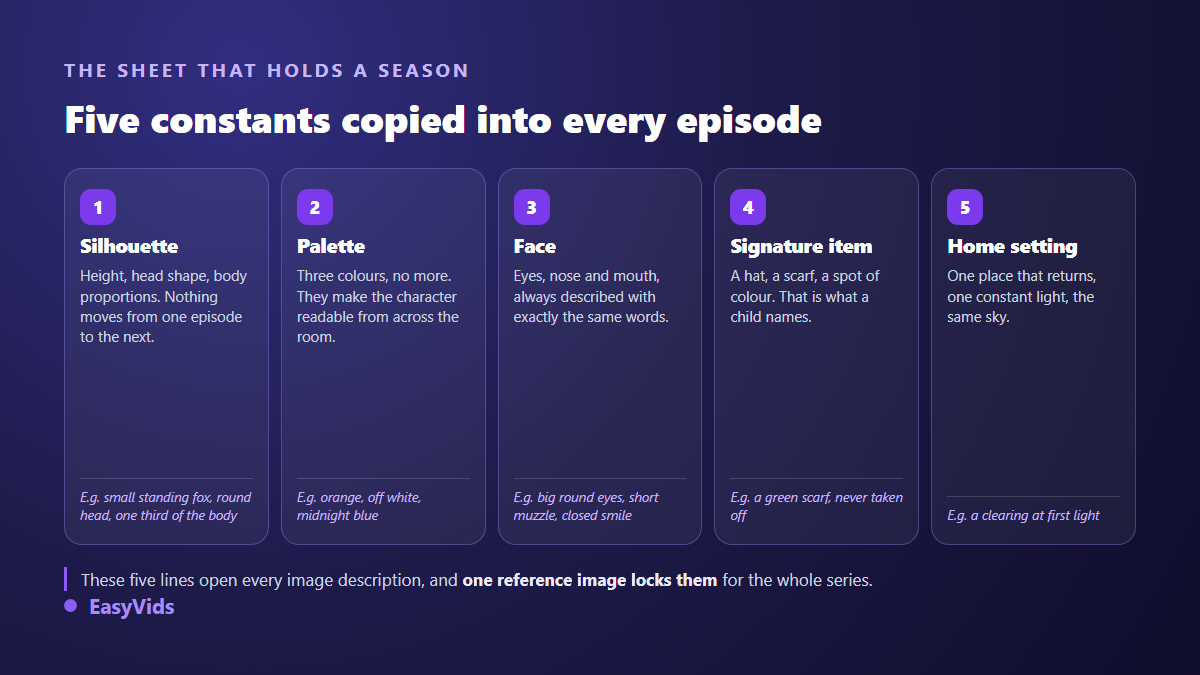
The test takes a minute. Open episode one and episode ten side by side, and ask someone who did not work on them whether it is the same character. If the answer hesitates, the sheet moved or the visual style shifted along the way. On our own generations, the drift almost always comes from three things: switching model mid series, an adjective added in passing, a background described with different words.
Writing a rhyme a child remembers
A nursery rhyme is not a short song, it is a structure. A chorus that returns identical, a verse that changes one element per pass, an action verb the child can mime, and an ending that loops back to the opening. That repetition, tiring for an adult, is exactly what a young brain wants: it learns by predicting what comes next. Write the chorus first and the rest follows.
For the music, generation gives you a gentle arrangement and an original melody in minutes, and our guide to the AI music generator shows how to describe a mood without jargon. One caution: a traditional rhyme may be in the public domain where you live, but the recording you found online still belongs to someone. Composing your own melody avoids the claim, and leaves you a theme tune of your own.
Bedtime tales, the steadiest format in the category
Alongside rhymes, calm bedtime stories hold their own space. They are watched at the end of the day, often with a parent nearby, and they tolerate long runtimes. The writing rule is the reverse of a normal video: no tension, no sound spike, no question that wakes anyone up. Our piece on building a soothing story gives the shape. Match the vocabulary to the age you target, and keep the same narrator across episodes.
One trap comes up on this format. A bedtime story written for children is still made for kids in the platform's sense, even when the parent presses play. The declaration applies with all its consequences, which changes how you read your own numbers: no comments and no notifications, so watch time and subscriptions become the only honest signals.
Voice and images for a small screen
A synthetic voice that races loses a child in ten seconds. Slow the delivery, articulate, leave room to breathe between sentences, and give the character a colour that never changes. Modern voice engines handle strong, playful timbres, and our guide to cartoon character voices shows how to get a singing tone without slipping into caricature. Punctuation matters as much as wording: a full stop instead of a comma changes the breath.
Children usually watch on a tablet propped up across the room. Shots have to survive that distance: simple shapes, clean outlines, strong contrast, one subject per image, and a background that does not compete with the character. Two flaws recur with image models. Text drawn inside the picture comes out mangled, so add it at the editing stage. Hands remain the weak spot, so favour simplified or gloved hands. A frankly drawn style forgives far more than a realistic render.
Production rhythm, six steps in order
A kids channel lives on regularity rather than on one brilliant upload. The unit of work is not the video, it is the season: settle a world, freeze a character, then produce episodes in a run. The first one takes a day, the next ones a few hours, because the world and the sheet are already written. Working by season is not specific to young viewers: running a channel of frightening stories rests on the same weekly routine, with a fixed narrator and a fixed soundscape standing in for the character.
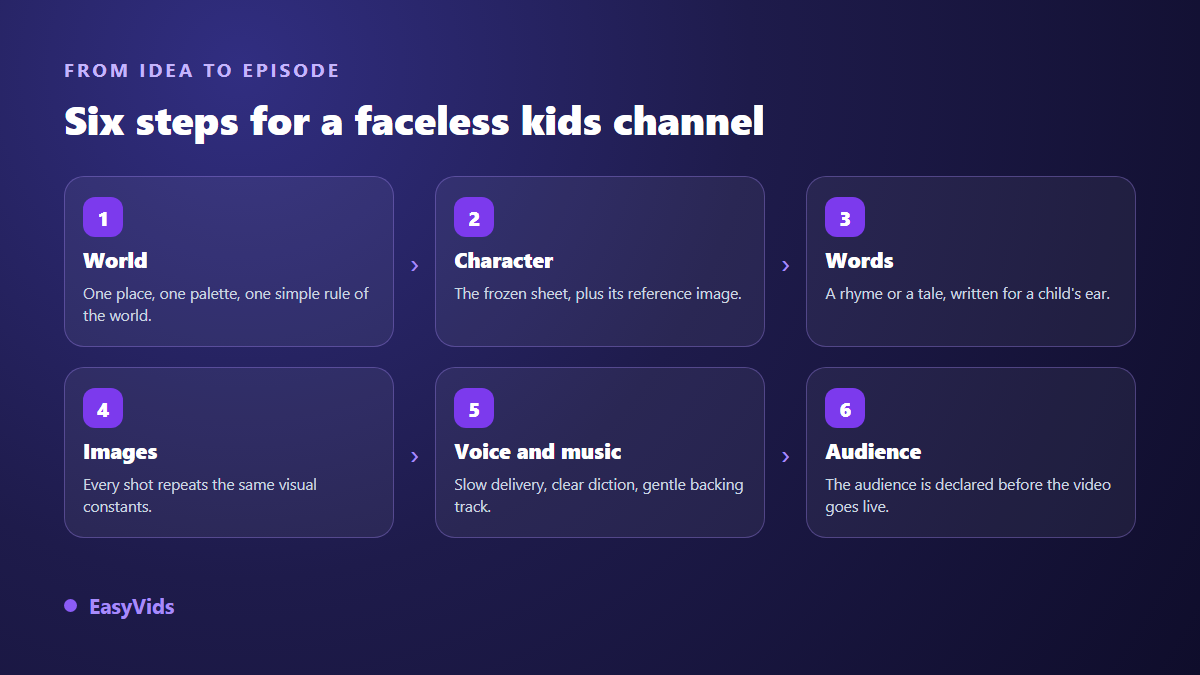
- Settle a world you can describe in one sentence, place and colours included.
- Write the character sheet in five lines, then generate its reference image.
- Draft three short scripts before you generate a single picture.
- Generate the shots of episode one, then check the character before going further.
- Add voice and music, edit, export.
- Declare the audience in YouTube Studio, then schedule the upload.
What a kids channel actually earns
This is where illusions gather, so let us be exact. A made for kids video can still be monetised once the channel meets partner programme requirements, but it only carries contextual advertising. Revenue per thousand views therefore sits structurally lower than on a comparable adult channel, and it depends on volume and watch time. Eligibility itself does not change because the content was produced with generative tools, as we set out when we went through the monetisation rules applied to AI made content.
The other usual levers partly disappear. Channel memberships, paid thanks and live chat do not work on this content. That leaves advertising, off platform licensing and merchandise, all of which assume an audience you already have. Before projecting anything, measure what one episode costs you to produce: our plans page sets the frame, and a free trial is enough to produce a full pilot.
Mistakes that sink a kids channel
The first is borrowing characters you do not own. A famous cartoon hero, even redrawn by a machine, stays protected by copyright and trademark, and that kind of video comes down fast. The second is mass production: dozens of interchangeable episodes published without intent, which the platform files under inauthentic content. The third, and the worst, is dressing unsuitable scenes in childlike figures.
YouTube publishes quality principles for kids and family content in its Help Centre. They describe what the platform promotes, content that teaches something, that encourages good behaviour and that stays sincere, and what it steers away from, notably heavily commercial, misleading or mass produced material. Read them before you launch a season: they explain better than any tutorial why two channels with similar catalogues are not treated the same way.
Frequently asked questions
Do I have to declare every video as made for kids?
Yes, the question appears at every upload, and you can also set the whole channel in YouTube Studio. According to the YouTube Help Centre, the answer has to reflect the actual content. A channel that publishes both nursery rhymes and adult tutorials sets each video separately.
Can a kids channel be monetised?
Yes, once it meets partner programme requirements. The difference is the advertising: according to the YouTube Help Centre, personalised ads are disabled on made for kids videos and only contextual ads are served. Memberships and paid thanks are not available on that content either.
Can I use a well known traditional rhyme?
It depends on the words, the melody and the country, since the public domain differs from one place to another, and a recent recording of an old tune stays protected. The safe path is to write your own lyrics and have an original melody composed. You also end up with a theme tune nobody else has.
Will my videos appear in the YouTube Kids app?
Not automatically. According to the YouTube Help Centre, marking content as made for kids does not guarantee it will show up in YouTube Kids, which applies its own selection. Publish for the main platform first, and treat the app as a bonus.
Do I have to disclose that the images are AI generated?
Since March 2024, according to the YouTube Help Centre, YouTube Studio asks creators to disclose realistic content generated or altered by a machine, the kind a viewer could mistake for a real scene. A frankly drawn animation, such as an illustrated rhyme, falls outside that duty. When unsure, disclose: the label is discreet and does not remove access to ad revenue.
A kids channel rewards patience more than inspiration. A simple world, a character recognisable with your eyes closed, short scripts that survive repetition, an honest audience declaration, and an episode landing at the same hour every week. The rest, the writing, the music, the images and the voice, now takes a few hours. Pick your character, produce a pilot and watch how it behaves: create your account and build the first episode today.