The party is in three days. The cake is ordered, the gift is wrapped, and something is still missing, the thing money does not buy. A personalized birthday song, with their name in the chorus and a nod to a story only your circle knows, does exactly that job. It proves you spent time, not just money.
The good news is that you no longer need to play an instrument or know a singer. An online studio writes the lyrics from a handful of inputs, composes the music in the style the person actually listens to, and hands you an audio file to download. The full mechanism is covered in our guide to AI music generators. Here we stay on one use case, the most requested one, and on what separates a song people replay from a greeting card set to music.
The short answer
To create a personalized birthday song, gather four things: the name people actually use, the milestone this year represents, one true detail about the person, and the kind of music they love. Have the lyrics written, read them out loud, rewrite the two lines that ring false, then start the composition. Allow one to four minutes of processing and you walk away with an audio file, ready to send as a message, play when the cake comes out, or lay under a photo video.
What personalized really means
Plenty of so called custom songs are a template with a name dropped into it. You hear it instantly: the melody does not follow the name, the words could apply to anyone, and the effect collapses on the second listen. Real personalization lives somewhere else. It lives in the two or three concrete details only your family or your close friends can supply.
One example beats any principle. Happy birthday, all the best for the year ahead belongs to nobody. Thirty, and still the last one off the dancefloor belongs to one person in the room, and everybody will know who from the first line. That is the line that makes people laugh, then cry. The machine handles the rest.
The four inputs that decide everything
The studio guesses nothing. It sets to music what you give it, and nothing more. Spend two minutes gathering these inputs before you even open the page: the writing then goes fast, and you avoid the lukewarm text an empty brief always produces.
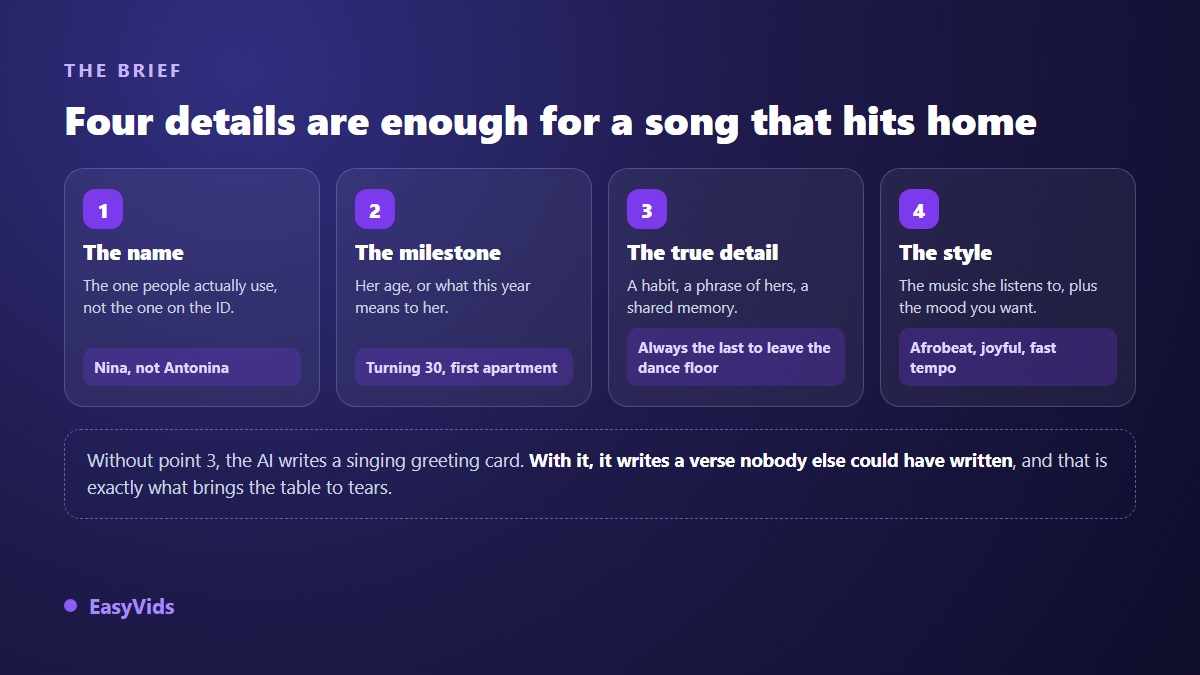
- The name people actually use. The everyday one, not the passport one. A short form usually sings better than a long first name.
- The milestone. The age, of course, but above all what it stands for: a move, a graduation, a first wedding anniversary, a homecoming.
- One true detail. A habit, a phrase of theirs, a dish, a shared memory. It is the only input no tool can invent.
- Style and mood. The genre they listen to, the tempo, and the emotion you are aiming for: joyful, moving, danceable, solemn.
- What you want to tell them, in one sentence. Not a speech: an intention, which the bridge of the song will carry.
In the Music Studio, each of these has its own field. You pick the occasion in one click from a dozen situations, birthday included, then fill in the name to weave into the song and a free field for your message or your anecdote. Everything else in the form only describes the music. The other occasions follow exactly the same mechanics, and our method for a personalised Christmas song shows what a December brief has to change.
Where the name has to land
A name mentioned once, buried in a verse, goes unnoticed. The music covers it. For it to become the heart of the track, it has to fall in the chorus, in a fixed spot, and come back every time. That is the instruction our lyricist works with: when a name is supplied, it appears in the chorus and in at least one verse.
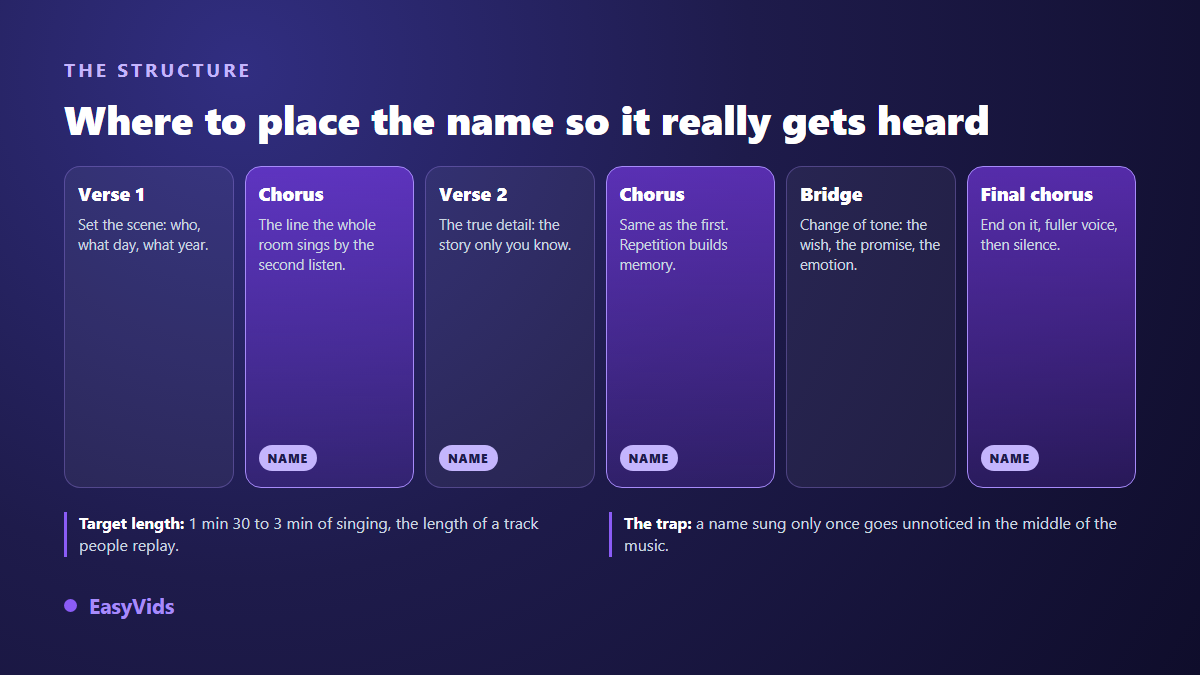
Two cases deserve care. Very long names sit badly in a bar, and the short form serves you better. Names whose spelling and pronunciation drift apart can surprise you when sung: if the playback mangles it, respell the name phonetically in the lyrics and compose again. It takes ten seconds and rescues the result. A song for two people, a couple or twins, works just as well: give both names together and the chorus will keep them in the same breath.
Pick their music, not yours
The most common mistake is asking for the music you like yourself. The song is not for you. Watch what the person plays in the car, what goes on when they clean the house, what they dance to at every party, and ask for that. A father who only listens to rumba will not care about a perfectly produced rap track. In the studio a dozen genres are one click away, from afrobeat to gospel, zouk to acoustic, along with reggae, pop, rap and jazz, and the field stays open for makossa, bossa nova or melodic drill. Add the mood and the tempo and the brief is complete. All of it sits in one place, inside the EasyVids creation studio.
Lyrics: have them written, then take them back
One button asks the AI to write the lyrics from your brief. The text comes back structured, with its section labels, a suggested title if you left the field empty, and a length calibrated for roughly one and a half to three minutes of singing. It is a starting point, never a finished product.
Read it out loud, every time. Lyrics are judged by ear, not by eye. You will spot the line that runs too long, the one that falls off the rhythm, and above all the one that does not sound like the person. Fix it straight in the lyrics box: everything stays editable until you launch the composition, and the drafts you already paid for stay filed at the bottom of the page, reloadable in one click with no new writing. If you would rather write everything yourself, go ahead. The studio takes fully hand written lyrics and sings them as they are, so structure them with bracketed labels for verse, chorus and bridge.
Composing, and what happens meanwhile
Once the lyrics are approved, composing usually takes one to four minutes. You can close the tab: production continues on the server and you find it again when you come back. That detail matters on the day itself, when the song is being prepared from a phone between two errands. The result plays straight in the browser and downloads as an audio file. An instrumental option exists when you want music without vocals, handy behind speeches or under a photo montage. The cost is counted in credits and depends on the engine you pick, the detail sits on the pricing page, and a failed generation is not charged. As long as the song stays inside a private circle, sharing it raises no further question; if it later goes up on a public channel, our guide to monetising AI music on YouTube explains what the claim systems check.
Mistakes that flatten the emotion
The same slips come back on the briefs we see. None of them is serious, and all of them can be fixed before you start the composition.
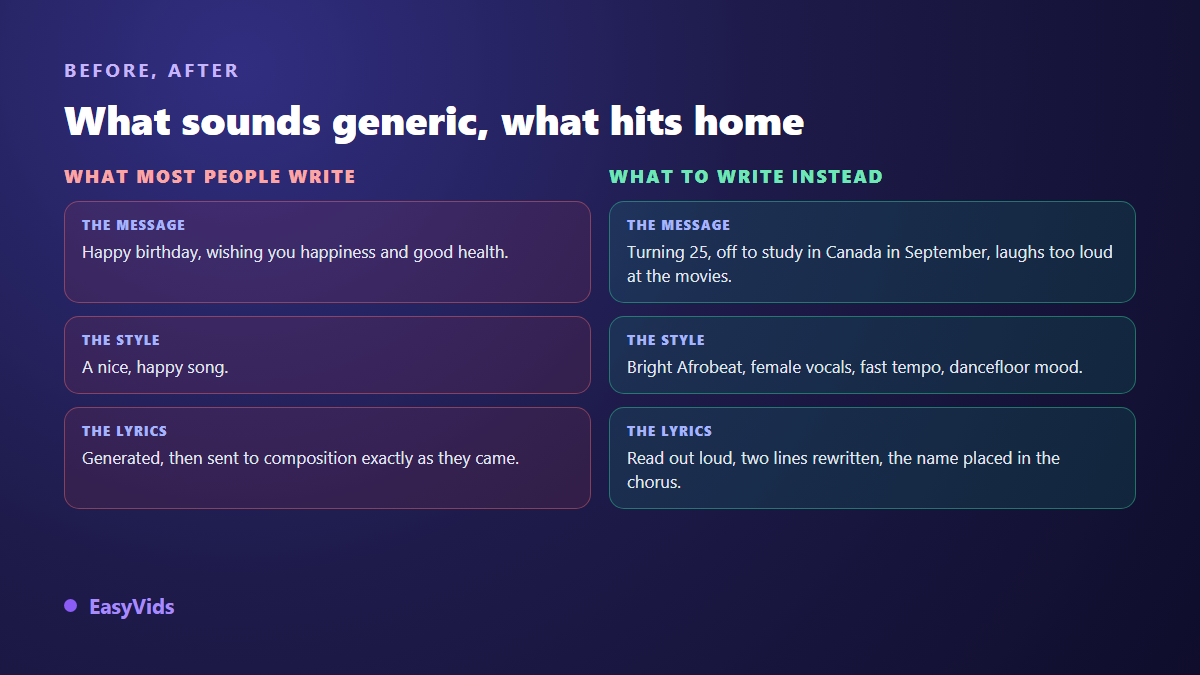
- A message stacking generic wishes. Replace it with two concrete facts.
- A style summed up in one word, joyful. Name a genre, a voice, a tempo.
- Lyrics launched without a read through, with one line that means nothing.
- A name drowned in a verse and missing from the chorus.
- A song that runs long: past three minutes, the room drifts away.
- A file heard for the first time in front of everyone. Play it beforehand, on the speaker you will use.
Giving the song, four ways that work
The audio file alone already lands, sent by message in the morning. A song gains from being staged, though, and the simplest staging is to lay it under a run of photos: a few images from the year, a rhythm cut to the music, and the gift becomes a film. The full method is in our guide to photo slideshows with music. Three other uses work well: playing it as the cake arrives, sending it as a voice message the night before, and dropping it in the family group chat where it circulates for days. Either way, say you made it. The surprise comes from the gesture, not from an illusion.
Can you still use Happy Birthday to You?
The question comes up constantly, and the answer changed more recently than most people think. According to the ruling handed down in September 2015 by Judge George H. King of the federal court in Los Angeles, in Rupa Marya against Warner/Chappell Music, the publisher held no valid copyright over the lyrics of Happy Birthday to You, and the settlement approved in June 2016 closed the case by recognising the song as public domain in the United States. Versions in other languages and the position in other countries follow their own rules, which no blog post can settle for you.
An original song removes the question altogether: you are not covering anything, you are creating. What remains are the duties attached to generated content. The European Union regulation on artificial intelligence, in its article 50, has required since 2 August 2026 that providers of systems producing synthetic audio mark those outputs in a machine readable format. For a family evening that changes nothing about your plans. If you publish the song, our article on AI music and copyright sets out what to declare, and to whom.
Frequently asked questions
Can any name go into the song?
Yes. The name is a free field, passed as it is to the lyricist, who places it in the chorus and in at least one verse. For a rare name or a tricky pronunciation, listen to the first version and respell it inside the lyrics if the singing drifts from the right sound.
How long does a personalized birthday song take?
Count five to ten minutes overall: two minutes of brief, two or three to read and adjust the lyrics, one to four minutes of composition. The reading is the longest part, and the best spent.
Can I choose a male or a female voice?
You steer it through the description rather than a dedicated setting: write a warm female voice or a deep male voice in the style or mood field. The engine follows most of the time, without an absolute guarantee. If the voice misses, run it again, since two versions of the same brief never sound quite alike.
Do I need to write or sing to get a good result?
No. The writing is handled and the voice is synthesised. Your job is to supply accurate details, then to cut the lines that ring false. That is proofreading, not composing.
What if I do not like the song at all?
Go back to the brief before you go back to the song. Nine times out of ten, a flat result comes from a vague message or a style described too broadly. Add a concrete detail, name a precise genre, then run it again. The lyrics you already have stay in the page and reload without being rewritten.
A personalized birthday song needs no gear and no musical talent. It needs attention: two true details, the right name in the right place, and their taste in music rather than yours. The rest takes minutes. To have yours ready before the next party, create your account and open the Music Studio, where the birthday occasion is already waiting with its field for the name.