The list has been ready for months. Venue, caterer, rings, seating plan. One box stays stubbornly unticked: the music that belongs to you. A song written around your two names, your first meeting and the line you never said out loud fills that box far better than a hit thousands of couples have already danced to.
Commissioning an original track used to mean a writer, an arranger, a singer and a studio, with the invoice that came with them. An AI wedding song generator now writes the lyrics from your story, composes the music in the genre of your evening and hands you an audio file to download. The full mechanism is covered in our guide to AI music generators. Here we stay on weddings, and on what makes them different from every other occasion: you do not need one song, you need several, and they do not serve the same moment.
The short answer
Open the Music Studio and pick the Wedding occasion. Put both first names in the same field, describe how you met and one true detail in a few lines, then name the genre your guests actually listen to. Have the lyrics written, read them out loud, rewrite the two or three lines that ring false, and start the composition. Allow one to four minutes of processing and you walk away with an audio file ready for the first dance. Set it up two or three weeks before the date, never the night before.
One day, several songs
The instinct is to look for the song. A wedding day calls for several, and they have almost nothing in common. The track you walk in on has to be walked on: slow, open, barely any words in the first twenty seconds. The first dance has to be danced by two people, so it needs a predictable structure. The late evening track has to fill the floor. Asking for a single title to cover all of that is like ordering one dish for lunch and dinner.
So decide, before writing a single line, which moment the song is for. That choice drives the tempo, the length and the tone of the lyrics. It costs thirty seconds of thought and it changes everything downstream.
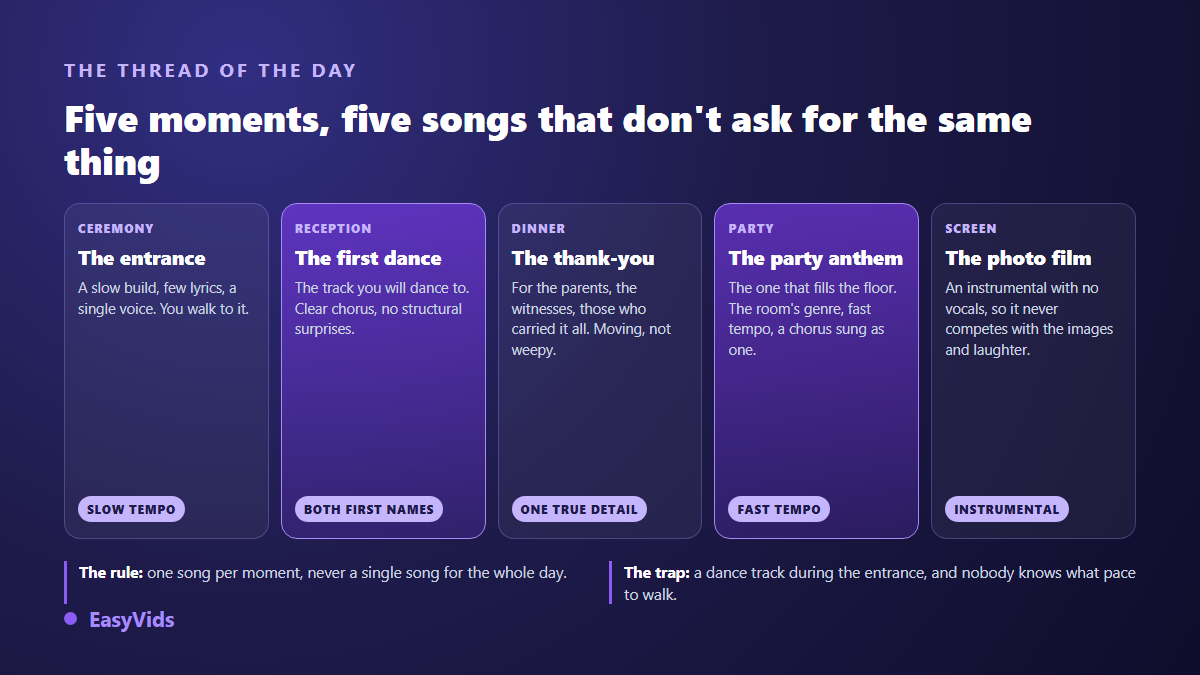
- The entrance and the ceremony. Slow tempo, an almost bare voice, few words at the start: a whole room sets its pace by the music.
- The first dance. The track the two of you will dance to. No structural surprises, a clean chorus, a length that holds: past three minutes the floor is waiting.
- The thank you song. For parents, witnesses, the people who carried the planning. Moving rather than tearful, with one true detail per person named.
- The dancefloor anthem. The one that fills the room after dessert. Your guests' genre, a fast tempo, a chorus people join without knowing it.
- The bed for the photo film. An instrumental with no vocals: lyrics under images that make people laugh will bury the laughter.
What personalised means when it is about the two of you
Plenty of so called custom wedding songs are a template with two names dropped into it. You hear it on the first play: the melody does not follow the names, the words could apply to any couple, and the emotion collapses before the second chorus. Real personalisation lives in the two or three concrete facts only you know.
One example settles it better than any principle. Today our most beautiful story begins belongs to nobody. Two years pretending not to look at each other across the office belongs to you, and half the room will laugh before the line ends. That is the line that makes the track. The machine handles the rest.
The brief: six inputs, three of which nobody else has
The studio guesses nothing. It sets to music what you give it. Spend five minutes together, before you even open the page, gathering these inputs. The writing then goes fast, and you avoid the lukewarm text an empty brief always produces.
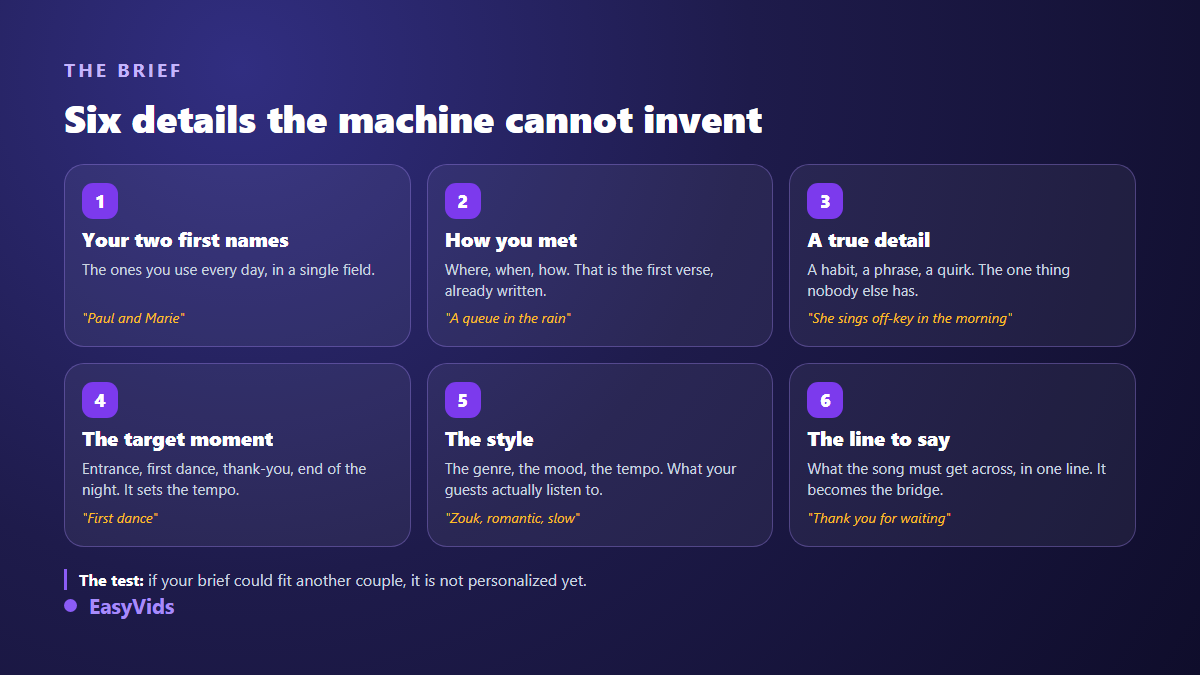
- Both first names, the everyday ones. They go together in a single field, so the lyricist treats them as one motif and keeps them in the same breath.
- How you met. Where, when, in what circumstances. Those three things hand you the first verse almost fully written.
- One true detail. A habit, a phrase that keeps coming back, a dish, a journey made a thousand times. It is the only input no tool can invent.
- The moment it is for. Entrance, first dance, thank you, late evening. It sets the tempo and the length.
- Style and mood. The genre your guests really listen to, the tempo, and the emotion you want: romantic, solemn, danceable, moving.
- The line you want to say, in one sentence. Not a speech. It becomes the bridge, the passage where the music pulls back and the words carry alone.
Both names, and where they have to land
A name mentioned once, buried in a verse, goes unnoticed: the music covers it. To become the heart of the track it has to fall in the chorus, in the same spot, and come back every time. That is exactly the instruction our lyricist works with: when names are supplied, they appear in the chorus and in at least one verse. The chorus returns three times in the standard structure, which is enough to plant both names. Nothing about that trick is specific to weddings: it is what makes a brand name stick, and our guide to writing an advertising jingle takes the mechanism apart.
Two cases deserve care. Very long names sit badly in a bar, and the short form serves you better. Names whose spelling and pronunciation drift apart can surprise you when sung: if playback mangles one, respell it phonetically inside the lyrics and compose again. It takes ten seconds and rescues the result. The same mechanics apply to every celebration, and our method for a birthday song with the name in the chorus walks through it step by step.
Style: the room as much as the two of you
The most common mistake is asking for the music you play in the car. For the entrance and the first dance that is fair enough, the moment is yours. For the evening the question changes. Look at who is at your tables. A room where three generations meet does not get up on the same tempo, and a flawless track in a genre nobody knows leaves the floor empty. In the studio a dozen genres are one click away, from afrobeat to gospel, zouk to acoustic, along with reggae, pop, RnB, rap and jazz, and the field stays open for rumba, makossa, bossa nova or a waltz. Add a mood and a tempo and the brief is done. It all lives in one place, inside the EasyVids creation studio.
Lyrics: have them written, then take them back
One button asks the AI to write the lyrics from your brief. The text comes back structured, with bracketed section labels, a suggested title if you left that field empty, and a length calibrated for roughly one and a half to three minutes of singing. It is a starting point, never a finished product.
Read it out loud, every time, and read it together. Lyrics are judged by ear, not by eye. You will spot the line that runs long, the one that falls off the beat, and above all the one that does not sound like you. Fix it straight in the lyrics box: everything stays editable until you launch the composition. Drafts already written stay filed at the bottom of the page and reload in one click with no new writing, which lets you test several musical versions on the same words. If you would rather write everything yourself, go ahead: the studio takes hand written lyrics and sings them as they are, so structure them with bracketed labels for verse, chorus and bridge.
Composing, the file, and the real speakers
Once the lyrics are approved, composing usually takes one to four minutes. You can close the tab: production continues on the server and you find it again when you come back. The result plays straight in the browser, then downloads as an MP3 at CD quality, 44.1 kHz. An instrumental option gives you music with no vocals, exactly what you want under a photo montage or behind speeches. The cost is counted in credits and depends on the engine, the detail sits on the pricing page, and a failed generation is not charged. Generate two or three versions rather than one, then choose the next morning: two compositions from the same brief never sound quite alike.
The countdown: nothing gets prepared the night before
A wedding song is planned like the rest of the day, with margin. The compute is not what takes time. Agreeing on a text that talks about you is. Allow one evening to gather the material, a second to write and review, a third to listen to the versions. Spread over three weeks those three evenings weigh nothing. Crammed into the eve of the wedding they become one more source of tension.
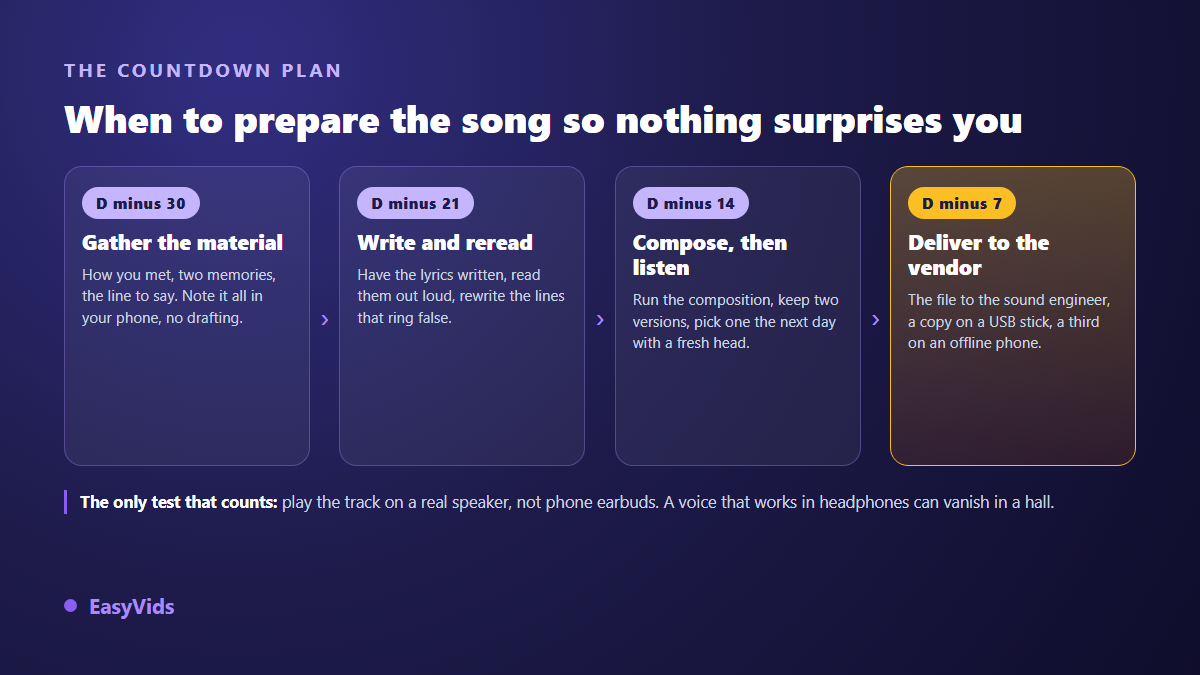
One precaution beats all the others: listen on a speaker, never only on headphones. A mix that sounds perfect in earbuds can lose its vocal in a room with height. If the venue allows it, play it through the system during setup. And hand the file to the sound engineer or the DJ several days ahead, with a copy on a USB stick and a third on a phone that needs no network. On the day, nobody will go hunting for a link in a full inbox.
From song to film: first dance and photo montage
The audio file alone already lands. A song gains from being staged, though, and the simplest staging is to lay it under a run of photos: how you met, the trips, the people no longer here, the children if there are any. A few images cut to the rhythm and the track becomes a film the room watches in silence. The full method is in our guide to photo slideshows with music. Two other uses work well: sending the song to guests the night before as a voice message, and dropping the file into the family group chat afterwards, where it keeps the day alive for weeks. That voice message can even open with a few words in your own timbre, since cloning a voice from a short recorded sample lets a dedication be read aloud weeks before the date. Either way, say you had it made. The surprise comes from the gesture and the words, not from an illusion about where it came from.
Rights, playback and transparency
An original song removes the thorniest question, the cover. Adapting, re recording or altering an existing track requires permission from the rights holders, and that permission is not obtained in three days for a private party. By creating something that did not exist, you are covering nothing. What remains is the playing of recordings in a reception venue, which depends on the country and on the collecting society the venue answers to: your sound provider or the venue itself knows its obligations, and that is who to ask.
On generated content, one duty is now written down. The European Union regulation on artificial intelligence, in its article 50, has required since 2 August 2026 that providers of systems producing synthetic audio mark those outputs in a machine readable format. For a family celebration that changes nothing about your plans. If the song later goes up on a public channel, our article on AI music and copyright sets out what to declare, and our guide to monetising AI music on YouTube explains what the claim systems check.
Frequently asked questions
Can both partners' names go into the same song?
Yes, and that is the expected use. Both names go together in a single field, for example Paul and Marie. The lyricist then treats them as one motif, places them in the chorus and keeps them in the same breath instead of splitting them across two lines.
How long does a custom wedding song take?
Around fifteen minutes of actual work: five minutes of brief, five to ten to review and adjust the lyrics, one to four minutes of composition. The lead time is another matter: start two or three weeks before the date so you have room to listen, change your mind and pass the file on.
Can I ask for a male or a female voice?
You steer it through the description rather than a dedicated setting: write a warm female voice or a deep male voice in the style or mood field. The engine follows most of the time, without an absolute guarantee. If the voice misses, run the composition again on the same lyrics, which stay in the page.
Do I need to sing or play an instrument?
No. The writing is handled, the voice is synthesised and so is the arrangement. Your job is to supply accurate memories, then cut the lines that ring false. That is proofreading, not composing.
Can I get an instrumental version for the ceremony?
Yes. A dedicated box produces a track with no vocals, composed from your brief. It is the right option behind speeches, during a cocktail hour or under a photo montage, where lyrics would compete with what is being said and shown.
A custom wedding song needs no gear and no musical talent. It needs attention: two true memories, your names in the right place, a tempo matched to the moment of the day, and three evenings taken in advance rather than one sleepless night. To prepare yours, create your account and open the Music Studio, where the Wedding occasion is already waiting with its field for both names.