You want to clone your own voice so you stop re recording every video, or reuse a performer's voice to run one campaign in ten languages. Then the question stops you: is AI voice cloning legal? The answer fits in one sentence, provided you read it to the end. Cloning a voice is lawful when the person behind it agreed, and turns into a wrong the moment that agreement is missing or the result misleads the listener.
The topic deserves better than a blunt verdict. The rules move fast, they differ by country, and platforms stack their own duties on top of the law. This guide separates the principle, the checkable rules and the practical safeguards that reputable services apply. One caveat before the detail: this is general information, not legal advice, and a specific situation belongs with a qualified lawyer in your jurisdiction.
The short answer
Voice cloning is not banned as such. What is regulated is using a voice that is not yours. Three conditions show up in almost every legal system: explicit and provable consent from the person, no deception about where the audio came from, and disclosure whenever the result could pass for authentic. Outside those conditions you land in personality rights, data protection, advertising law, and sometimes criminal law. Cloning your own voice to save time raises nothing. Cloning somebody else's without consent raises everything at once.
A voice is protected, even without an AI specific statute
Many people assume synthetic speech sits in a legal vacuum. The opposite is true. Long before AI statutes existed, a voice was already tied to the person, like a face or a name. It identifies, it distinguishes, and it has commercial value for those who make a living from it. Courts have sanctioned recognisable voice imitation used to sell a product, because the audience believes in an endorsement that never happened.
In the European Union a second layer applies. A voice identifies a person, so it is personal data. Once it is processed through technical means aimed at identifying someone uniquely, it becomes biometric data, the most sensitive category in the data protection regulation. That demands a solid legal basis, in practice explicit, free and informed consent. A generic clause buried in terms of service does not meet that standard.
A third layer concerns voice professionals. A performer who records a session sells a performance, not the right to build a synthetic double of themselves. That distinction now sits at the centre of industry negotiations, and several recent statutes have written it down. Recording is not synthesising, and the second use has to be named, scoped and paid for if it is granted at all.
Consent is the only foundation that holds
A verbal agreement cannot be proved. A written agreement with no scope protects nobody. The workable middle ground is a short but precise document, signed before the first sample is uploaded, and archived alongside the project. The logic mirrors image rights for a filmed person, which we covered in our guide to AI generated talking characters.
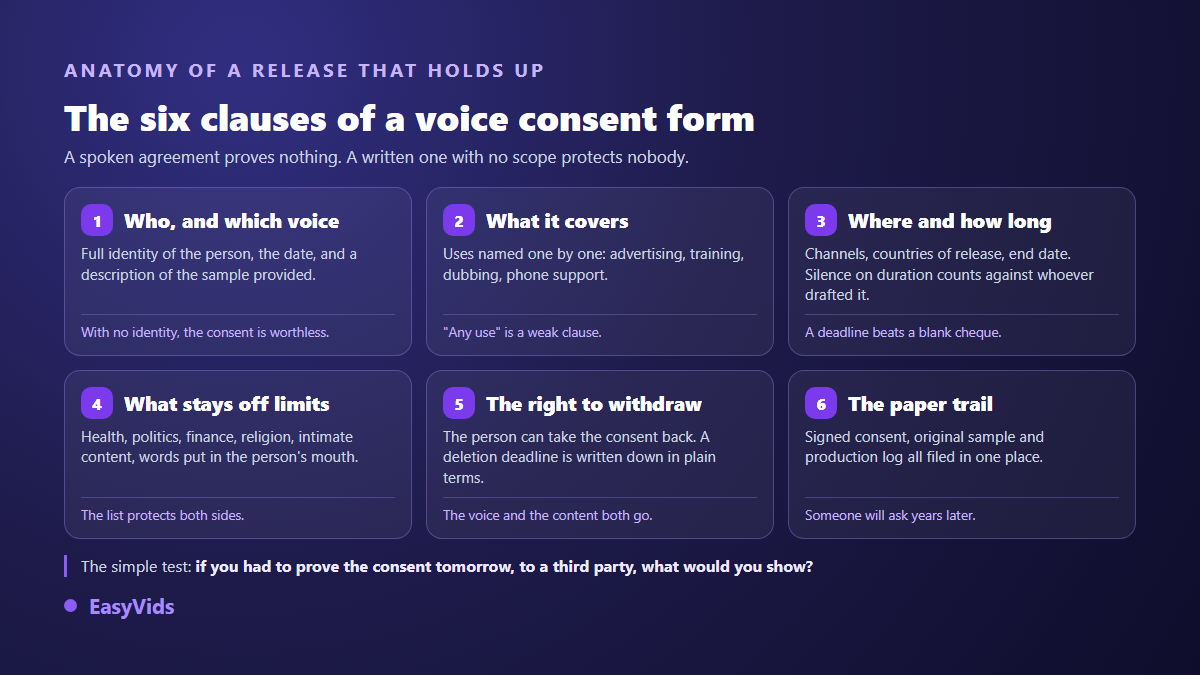
The test is simple: if you had to prove that consent tomorrow, to a stranger with no reason to trust you, what would you produce? If the answer is a casual message or a memory of a conversation, the consent does not exist. The recurring mistakes are always the same, and each one takes minutes to fix.
- Confusing permission to publish a recording with permission to synthesise a voice from it.
- Writing « all uses » instead of naming each use one by one.
- Skipping duration: an open ended agreement is read against whoever drafted it.
- Providing no withdrawal right, and no takedown deadline to go with it.
- Leaving sensitive subjects open: health, politics, finance, religion, intimate content.
- Not keeping the original sample, which proves what was supplied and by whom.
- Signing after the first generation, which weakens everything else.
What changes from one country to the next
The consent principle travels well, the legal machinery does not. In the European Union, the AI regulation places a transparency duty on whoever deploys generated or manipulated audio, video or images imitating a real person: the audience must be told the content is artificial. Those transparency obligations apply from 2 August 2026, with an adjustment for evidently artistic or satirical works, which still have to signal that generated content exists.
In the United States the protection is state by state. Tennessee moved first with a statute effective 1 July 2024, the first to explicitly cover a person's voice and its reproduction by generative tools. California followed on 1 January 2025 with two acts: one strips effect from contract clauses allowing a digital replica without a reasonably specific description of the uses and without proper representation of the performer, the other requires authorisation for a digital replica of a deceased personality. A federal bill on digital replicas has been debated across several sessions and has not become law to date.
One case matters to anyone touching telephony. On 8 February 2024 the American communications regulator ruled that an AI generated voice counts as an artificial voice under the robocall statute, which makes cloned voices in mass calling illegal without the recipient's prior express consent. The decision explicitly targeted calling campaigns imitating a well known figure.
Elsewhere, two approaches stand out. China has required labelling of generated and synthetic content since 1 September 2025, with a visible mark on synthetic speech and a duty on the publishing user to declare the content through the tools the platform provides. Denmark took a route with no European precedent by bringing a person's voice and appearance into its copyright act as a neighbouring right, in force since spring 2026. The practical consequence for anyone publishing internationally: align on the strictest rule, not on your own country's.
Uses that are always off limits
Some practices are not up for discussion, whatever the country and however good your intentions. They share one trait: they make the listener believe something false about who is speaking. That deception is what the rules punish, far more than the tool behind it. Famous voices raise a further set of questions, which we handle separately in our article on celebrity AI voices.
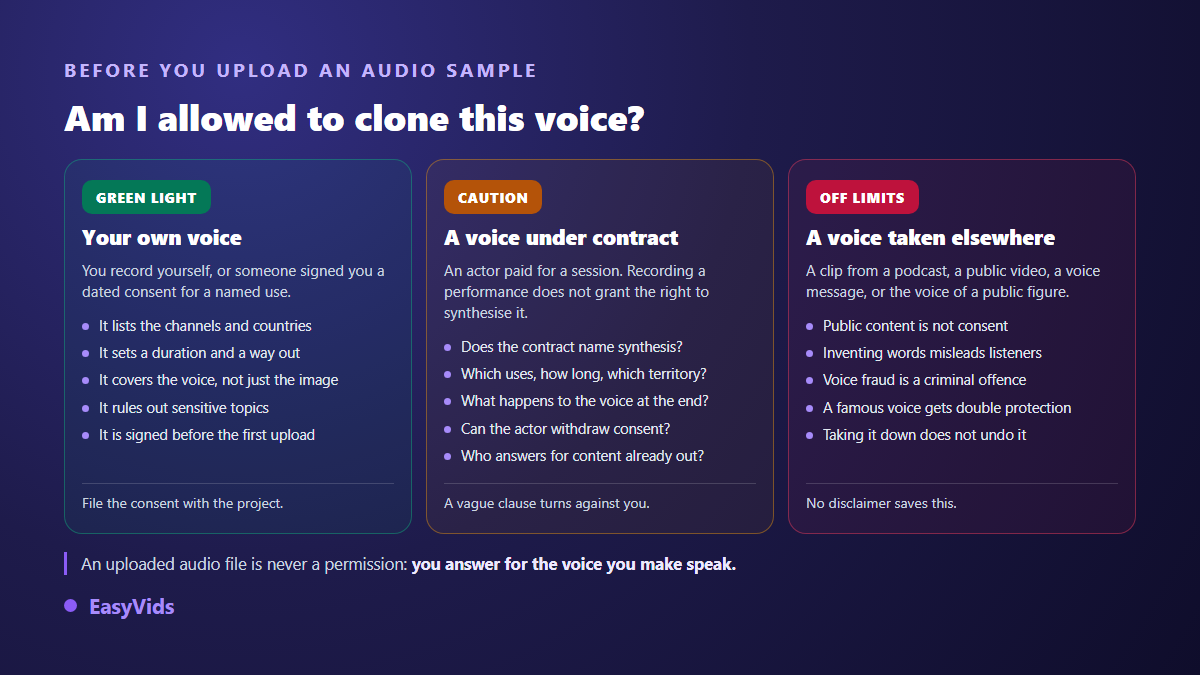
- Making a public figure speak, however humorous the tone or rough the result.
- Putting words in someone's mouth in a video, an audio clip or a voice message.
- Using a cloned voice to obtain money, a password or a transfer, which is plain fraud.
- Posing as a relative, a manager or an official from a public body.
- Fabricating a customer testimonial and presenting it as authentic in an advertisement.
- Cloning a minor's voice, or that of someone unable to understand what they are agreeing to.
- Reusing a performer's voice for anything their contract did not cover.
What platforms expect you to disclose
Above the law, the major platforms set their own requirements, and they converge. YouTube asks creators to flag realistic altered or synthetic content at upload through its altered content setting, and its documentation states that cloning your own voice for voice overs or dubs needs no disclosure, while cloning somebody else's does. TikTok requires a label on realistic AI generated content including voices, and applies that label automatically when provenance markers are detected in the file. Facebook and Instagram add a comparable notice and expect a manual declaration for photorealistic video or realistic sounding audio that was digitally created or altered.
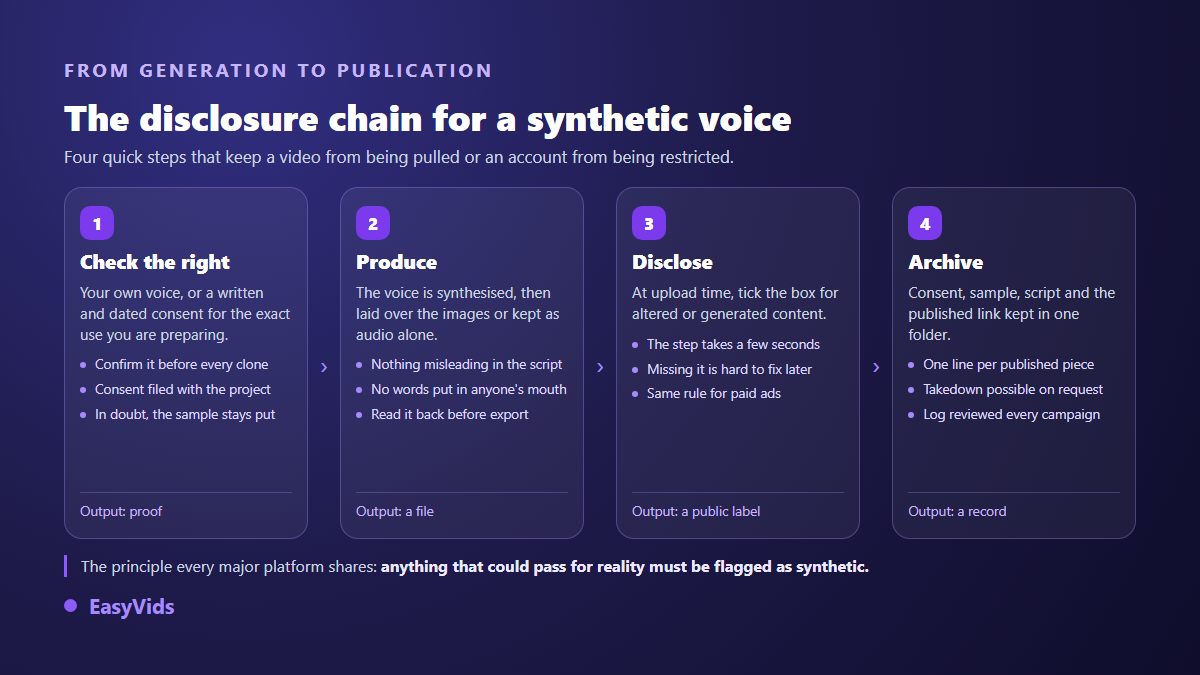
Get into the habit of ticking the box, even when you hesitate. Disclosure costs nothing, omission can cost the video or the account. We walked through a full publishing run, upload settings included, in our step by step guide to a published YouTube video.
Three common uses and the rule that applies
Advertising. A synthetic voice in an ad is allowed on three cumulative conditions: you hold the rights to the voice, you do not present fabricated speech as a real testimonial, and you meet the platform's disclosure duty. Advertising rules target deceptive commercial practice regardless of the technology. A fake review read by a cloned voice is still a fake review.
Dubbing and voice over. This is the easiest use to secure, because it usually runs on your own voice or on a catalogue voice supplied with its usage rights. Still check what the licence allows in paid advertising. Picking the timbre itself is done by ear, and the criteria that genuinely separate two voice generators matter more than the number of languages advertised on a home page. For the settings that actually change the delivery, see our guide to natural sounding AI voice over. The same licence check applies to the music sitting under the voice, which we cover in our guide to AI generated music. The same caution applies to the wording of a music brief: a choir is described by its mood and its style, never by a performer's name, and our tutorial on composing gospel with AI shows what such a brief looks like.
Telephony and customer contact. This is the most closely watched ground. A synthetic voice calling people falls under robocall rules, with the prior consent they impose, and often a duty to announce that the caller is artificial. A voice imitating a real employee without their agreement adds a personal rights breach on top. Prepare this use case with a lawyer, not with a tutorial.
What a reputable service does, and what it does not
No tool checks on your behalf that you may use a voice. An uploaded audio file is treated as a technical reference, never as permission. So reputable services put a mandatory certification in front of every clone: you state that the voice is yours, or that you hold explicit permission from the person concerned, and you acknowledge sole responsibility for what you produce with it. The most rigorous ones never remember that box. They ask again for every new voice, because a certification ticked once and forgotten certifies nothing. Plenty of projects need no cloning at all: as soon as the timbre matters more than the identity, a catalogue voice does the job and the consent question never arises, as with the whispered ASMR voices used in relaxation videos.
On the technical side, cloning starts from a clear audio sample of the voice, fifteen seconds being enough in most cases, as MP3 or WAV. How clean that sample is decides how natural the double sounds: a saturated or echoing recording produces a mechanical delivery that the settings that make an AI voice less robotic can only partly repair. With a reputable service, the resulting voice is attached to your account and appears only for you, never in another user's list. Its terms explicitly forbid cloning a person's voice without their explicit consent, along with deceptive content presented as authentic, and a breach can end the account. For our catalogue voice overs and the rest of the studio, common questions sit in our frequently asked questions, and the plans are described on the pricing page.
Frequently asked questions
Is cloning my own voice legal?
Yes, for ordinary uses. Your voice is yours to use, like your image. Two caveats remain: follow platform disclosure rules when the content is realistic, and check your contracts if you have already assigned voice rights to an employer, a studio or a brand.
Can I clone the voice of a friend who agrees?
Yes, provided the agreement is written, dated and specific. A verbal yes cannot be proved and leaves you alone in a dispute. Name the intended uses, the duration, the platforms, and include a withdrawal right. Keep the document with the project: you may be asked for it years later.
Can a deceased person's voice be used?
This is the riskiest case. Several jurisdictions protect voice and likeness after death, with durations and rights holders that vary widely, and permission is still needed in most of them. Without written consent from the estate, do not proceed.
Do I need to disclose a synthetic voice that imitates nobody?
It depends on realism and on the platform. A clearly artificial narrator, claiming to be no one in particular, often falls outside the duty. Content that could be taken for a genuine recording has to be flagged. When in doubt, disclose: the label does not penalise your content, the omission can get it removed.
What actually happens if you clone a voice without consent?
The consequences stack. The person can demand takedown and compensation. The platform can remove the videos and restrict the account. The provider can close your access. And when the voice was used to deceive someone, impersonation or fraud charges are added on top.
Voice cloning is neither forbidden ground nor a rule free zone. Its legality depends entirely on whose voice you borrow and on what you make that voice say. Start with your own, get the agreement signed before you generate, disclose what needs disclosing, keep your evidence filed. If a specific case leaves you unsure, reach us from the contact page before publishing. Creating an account opens the studio so you can produce your first voice over on solid ground.