You write the script, you plug in the microphone, and the same hour disappears again. One fluffed line, a truck outside, a breath in the wrong place, and you start over. AI voice cloning removes that hour: you record your voice once, properly, and a synthesis engine reuses it afterwards to read any text you give it, at any time of day, with no retakes.
The order of operations matters, because two things happen before the technology: the permission of the person being cloned, and the quality of the recording. This walkthrough covers the five steps, from the sample file to a voice that narrates your videos, with the settings that change the result and the mistakes that ruin it. If the subject is new to you, our complete guide to AI voice over sets the scene first. One note before we start: this is general information, not legal advice, and a specific situation deserves a lawyer in your own country.
The short answer
Cloning a voice takes two minutes of recording and one minute of clicking. You secure the permission first: your own voice, or a written and dated agreement from the person concerned. You then record a continuous sample of thirty seconds to two minutes, in a quiet room, as MP3 or WAV. You upload it, name the voice and tick the certification box. The engine extracts a voice print in a few dozen seconds, the voice joins your list, and it reads every script you write from then on. The rest of the work is listening and fixing.
What AI voice cloning does, and what it does not
Common cloning retrains nothing. The engine has already learned, across thousands of speakers, what makes a human voice. Your sample only tells it which voice to imitate: it extracts a print, a compact signature of timbre and articulation, then applies that print to your text. Research calls this zero-shot cloning, and it is why a very short file is enough and why the operation takes seconds rather than hours.
That mechanism also sets the limits. The clone inherits whatever the sample contains: read it in a flat voice and it will sound flat for months. A recording flaw cannot be fixed afterwards, it has to be recorded again. With a reputable service, the resulting voice also stays attached to your account: it never appears in anyone else's list and never becomes a shared catalogue voice.
Step 1: secure the permission before touching the microphone
This order is not negotiable, because the rules have tightened. The European regulation on artificial intelligence, published in 2024, requires under its article 50 that audio content generated or manipulated to imitate a real person be disclosed as artificial, and those transparency obligations have applied since 2 August 2026. In France, article 226-8 of the Criminal Code punishes publishing an edit made with a person's words without their consent when it is not obvious that it is an edit, and the law of 21 May 2024 on securing and regulating the digital space extended that text to content produced by algorithmic processing. The General Data Protection Regulation adds another layer: the voice of an identifiable person is personal data, and processing it through technical means meant to identify someone uniquely falls under biometric data.
The picture is similar elsewhere. In the United States protection is decided state by state: Tennessee was the first to name a person's voice explicitly, with a law in force since 1 July 2024, and the Federal Communications Commission ruled on 8 February 2024 that an AI cloned voice used in a robocall counts as an artificial voice, prohibited without the recipient's prior express consent. If you publish internationally, align with the strictest rule rather than the one that applies at home. What the law actually says about voice cloning goes through those texts country by country.
In practice it comes down to one question: if you had to prove that agreement tomorrow, to a stranger with no reason to believe you, what would you show? A remembered conversation or an informal message will not do. A dated, signed document will. Cloning your own voice obviously needs no external permission, but as soon as another person is involved, the written agreement is the only thing that holds. Here is what it should say.
- The name of the person being cloned, the name of the project owner, and the signing date.
- The voice named explicitly: an agreement covering someone's image, or a recorded performance, does not cover synthesis of their voice.
- The permitted uses, listed one by one: videos, advertising, internal training, dubbing, tests.
- A duration, a territory, and what happens to the cloned voice when the agreement ends.
- The right to withdraw consent at any time, and how quickly the voice is then deleted.
- A clear exclusion of sensitive subjects: health, politics, religion, or anything the person would not say.
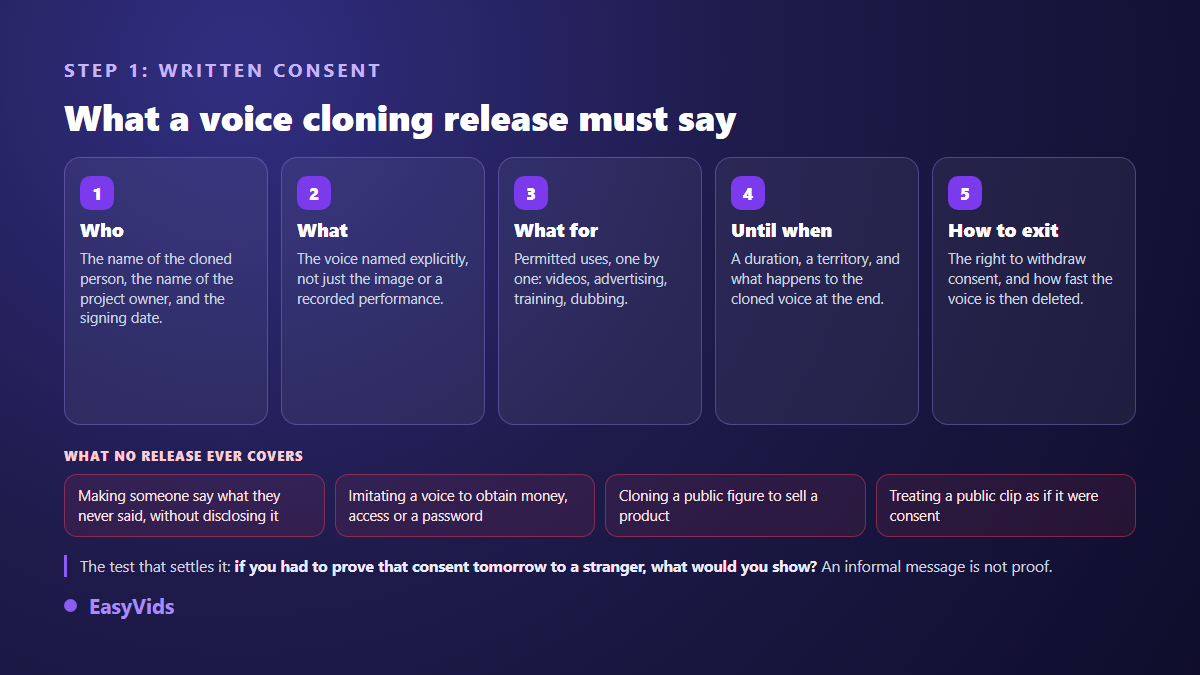
Some uses no permission can buy back. Making someone say what they never said without disclosing it, imitating a voice to obtain money, access or a password, cloning a public figure to sell a product: these are wrongs, sometimes crimes, and a discreet line at the end of a description does not erase them. The terms of reputable services expressly forbid cloning a person's voice without their explicit consent, often with a certification box to tick at every single cloning.
Step 2: record a sample worth using
Fifteen seconds of clean audio is enough for a recognisable voice, but the zone where the result really stabilises sits between thirty seconds and two minutes. Past five minutes, the gain becomes marginal. We broke down each tier in our article on how much audio it takes to clone a voice: beyond thirty seconds, what you hand the engine is no longer your timbre, it is your rhythm, your breathing and the way you attack a sentence.
A clean take matters more than a long one. Record in a furnished room, with curtains or a sofa to kill the echo, window closed and any fan switched off. A recent phone microphone twenty centimetres away is plenty, as long as you do not press your mouth against it. Record one continuous take, no cuts, no stitching: a long inconsistent sample often produces a less faithful clone than a short consistent one, because the average of an energetic voice and a tired voice sounds like neither.
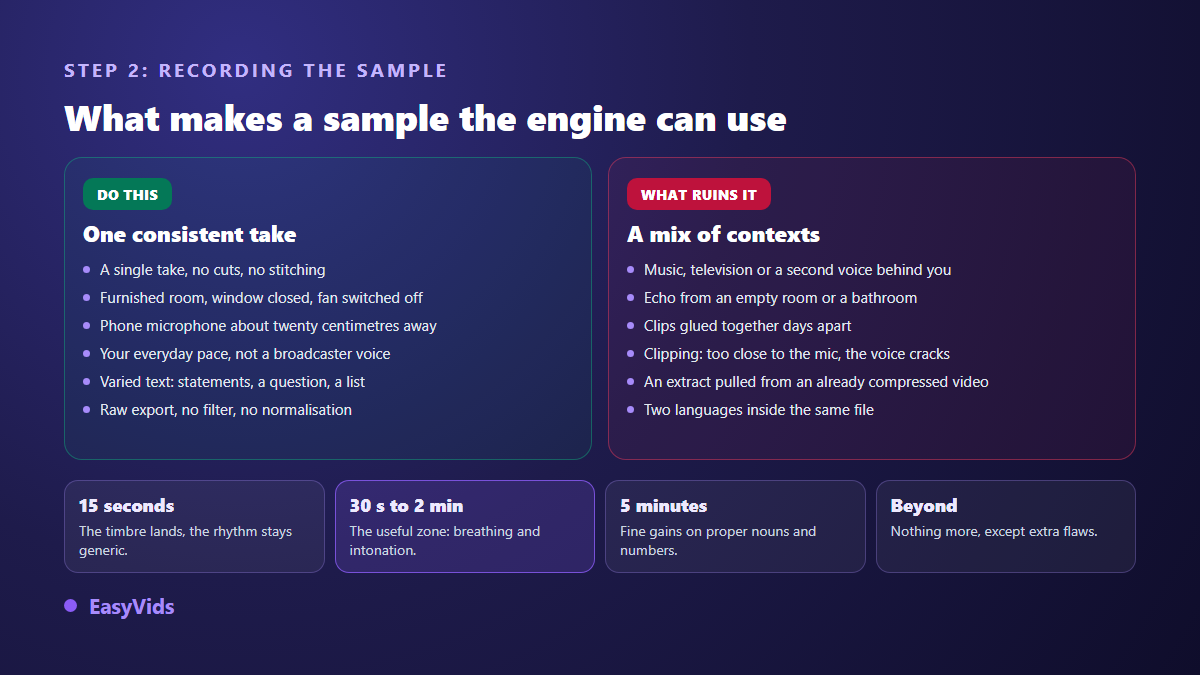
Read a varied text rather than a monotone paragraph: two or three statements, a question, a list, and one sentence containing a number and a proper noun. That is where the engine finds the intonations it will have to reproduce. Read at your everyday pace, not in a broadcaster voice you will never sustain in your videos. Export the raw file, with no filter and no normalisation. One last trap, and it gives no warning: the language declared at cloning time must be the language of the sample. An English recording uploaded from a French interface produces a degraded clone with no error message at all.
Step 3: upload the sample to the cloning tool
In most cloning tools, everything starts from the voice over screen or the voice library. A button along the lines of Clone a voice opens a small panel: you name the voice, tick the certification box, then pick the file. The help text usually repeats the minimum, around fifteen seconds of clear audio, MP3 or WAV. When a service offers several voice ranges, the requirements change from one to the next: a standard range often accepts heavier files, a premium range works on shorter, cleaner samples. Cloning is usually metered, in credits or within a subscription, in very different amounts depending on the range, so check the service's pricing grid before uploading, because it moves.
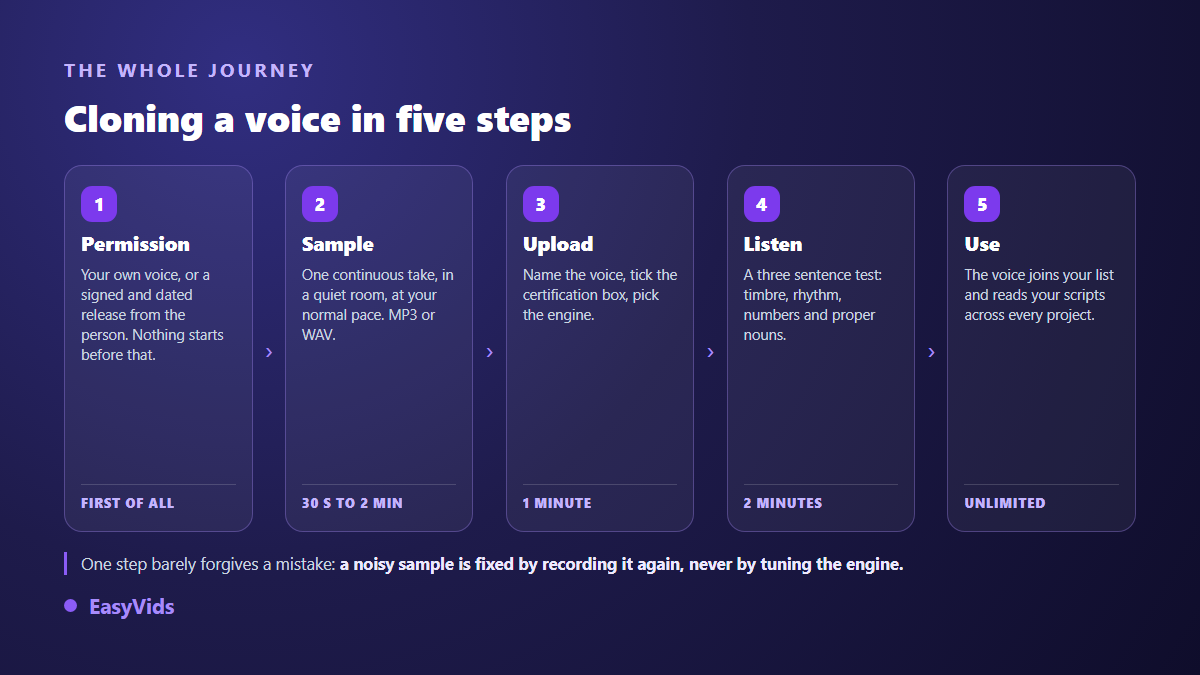
The analysis takes a few dozen seconds. The voice then appears in your list, usually marked as cloned, and stays available across every project: a single video, an episode series, a multi character dialogue, an audiobook chapter. You never rebuild it, and you can keep several, for instance a calm narration voice and a livelier one for short formats.
Step 4: listen to the clone and fix what is off
Never judge a clone on a single word. Have it read a three sentence test: a plain statement, a question, then a sentence with a number and a proper noun. Listen on headphones, then through a phone speaker, because that is where your audience will hear the video. Most flaws have a precise cause and a one move fix.
- Recognisable but flat: the sample was too short or read without intent. Record thirty more seconds with some relief in it.
- Hissing or a metallic edge: the sample came from an already compressed video. Start again from a raw recording.
- Delivery too fast, sentences running together: that is your script punctuation, not the clone. Cut the long sentences.
- A drifting accent or swallowed syllables: the declared language does not match the language of the sample.
- Mangled proper nouns and acronyms: spell them phonetically in the script, the engine reads what it sees.
- Energy that shifts from scene to scene: even out sentence length, the voice follows the shape of the text.
The habit that saves the most time fits in one line: fix the text first, the sample second. Synthesis engines read punctuation the way an actor reads a score. A full stop replaces a breath, a comma sets a beat, a question mark lifts the end of a line. After three videos you will be writing for your own clone without thinking about it.
Step 5: put the cloned voice to work
Once created, the voice behaves like any catalogue voice: you select it, you paste your script, and the narration drives the timing of the shots. That is where cloning pays off for a series or a channel. Your timbre stays identical from one episode to the next, including on days when your throat is rough, and you publish without ever opening a recording session. A sonic identity does not stop at timbre: the theme and the musical bed of a series call for the same consistency, and the nine criteria that separate music generators keep you from changing sound every episode.
A cloned voice is also a way out of your own language. Publishing the same video in another language with your own timbre changes how a channel is perceived, which is exactly the approach in our guide to translating a video while keeping your voice. One honest caveat: pronunciation in a language you do not speak deserves a check by a native speaker before publication, because a misplaced stress is heard instantly.
Disclosing synthetic content when you publish
Platforms moved before lawmakers. The YouTube help centre has asked since March 2024 that realistic altered or synthetic content be disclosed at upload, and its documentation states that cloning your own voice for narration needs no disclosure, while reproducing someone else's does. YouTube also extended its privacy request process in July 2024, so that a person can ask for the removal of content reproducing their face or voice. TikTok community guidelines require realistic AI generated content, voices included, to be labelled.
Get into the habit of ticking the box even when you hesitate. It does not hurt a video's reach. Skipping it does: reduced visibility, content removal, sometimes account restrictions. The dividing line is about realism, and it is clear enough: anything that could be mistaken for reality has to be flagged.
Deleting a cloned voice
A cloned voice is not a permanent commitment. A reputable service groups your voices in a dedicated section of your account, with deletion one voice at a time: the voice then leaves your lists and stops being offered in your projects. If the person you cloned withdraws consent, that is the move to make immediately, and to confirm in writing. Remember the content already published as well: deleting the voice does not take down the videos, they have to be unpublished separately.
Frequently asked questions
How long does cloning a voice take?
The operation itself takes a few dozen seconds with an instant engine: the file is analysed, the print computed, the voice appears in your list. Most of the time goes before, into recording the sample, and after, into the listening check. Allow a quarter of an hour to get it right the first time.
Can I clone my voice from a phone?
Yes, and that is the most common case. The voice memo app on a recent phone produces a perfectly usable file, provided you record in a quiet room and keep a little distance from the microphone. Most cloning tools run in the browser, so uploading and generating work as well on mobile as on a computer.
Can a cloned voice speak a language other than the sample?
Often yes, with an accent inherited from your original language, which can be an asset or a flaw depending on the project. The real thing to watch is elsewhere: declare the language actually spoken in the sample, otherwise the clone degrades with no error shown. For a truly native result, have a speaker of the target language listen before you publish.
Can I clone the voice of a friend who agrees?
A verbal agreement is not enough, even between friends, and not because anyone would lie: because you will have nothing to show if a piece of content travels badly. Write a short dated document, signed, naming the voice, the permitted uses and the right to withdraw. That is also what you certify at cloning time in a reputable tool, and that certification binds you.
What happens to my audio sample after cloning?
The sample is used to compute a voice print, and it is that print, not your file, that is reused at every generation. With a reputable service, the voice created is attached to your account and appears to nobody else, and you can delete it from your list at any time. If you clone someone else's voice, write that deletion into the signed agreement, with a deadline.
Voice cloning is not a technical feat: it is a recording discipline paired with a permission discipline. Secure the agreement, record one quiet minute, listen, fix the text before you touch the voice, and you get a double you can use for months across all your videos. And if you want narration ready straight away, without recording your own voice, creating an account opens the full studio: ready to use AI voice-overs, then the script, the visuals and the edit chained into a publishable video.