You have a topic, an outline, maybe even a first chapter. Then the same question stops everyone at the same point: how long should an ebook be to feel like a real book? Too short and it reads as a sales flyer. Too long and nobody finishes it, starting with you.
The answer is not personal preference. It follows from the job the book has to do: collect an email address, sell a method, establish authority, or fill a self publishing catalogue. Each job has its own range, and each range has a reason. If you are starting from scratch, our complete guide to building an ebook with AI covers the rest of the journey, from topic to delivered file.
The short answer
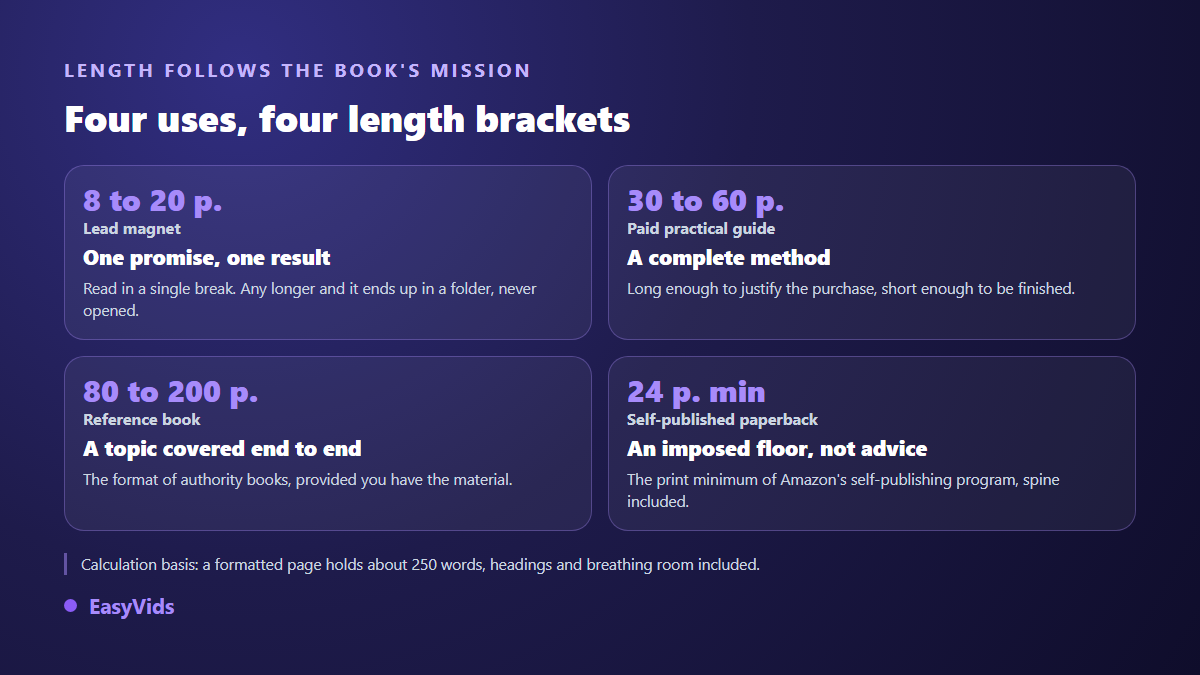
Plan on 8 to 20 pages for an ebook given away in exchange for a signup, 30 to 60 pages for a paid practical guide, and 80 to 200 pages for a reference book meant to establish authority. A printed paperback adds a separate technical floor. Above all, think in words before you think in pages: a formatted page holds roughly 250 words, so a 40 page ebook maps to a manuscript of about 10,000 words. That word count is what you will type into a writing tool, never a page count.
Why the page is a poor unit of measurement
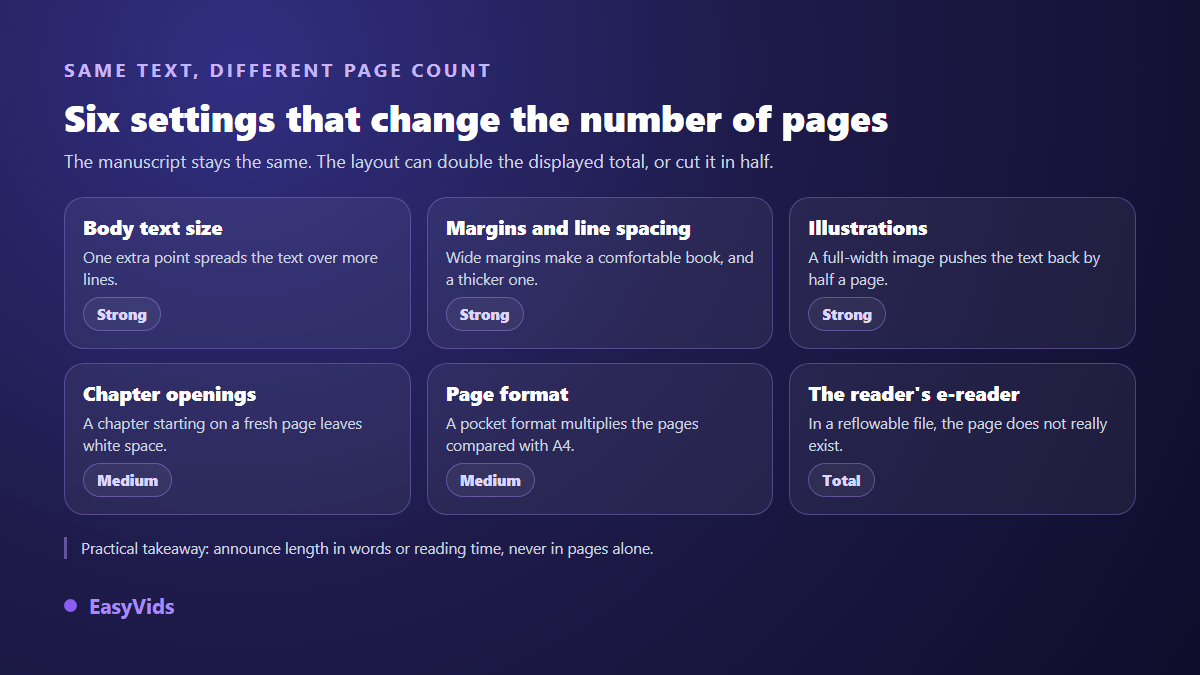
A page is not a quantity of text, it is a display outcome. The same manuscript set in a smaller body size with tight margins, then in a larger one with generous margins, does not produce the same total. The gap often exceeds 40 percent. Two authors can both claim 60 pages and deliver books where one holds twice the substance of the other.
On a reflowable file the effect goes further. Readers pick their own font size, typeface and line spacing, so pagination is recalculated on their device and the page essentially stops existing. That is why Amazon built its own unit. The Kindle Direct Publishing help centre explains that pages read in the Kindle Unlimited programme are paid on a normalised count, the KENPC, computed by the platform and independent of the layout the author chose. Padding your margins earns nothing.
Converting words into pages
The reliable conversion is 250 words per page, once headings, paragraph spacing and chapter openers are counted. Across our own ebook renders on A4 pages, with a comfortable body size and generous margins, a 10,000 word manuscript produces roughly 40 pages. That base holds for a standard practical guide. Heavily dialogued fiction climbs faster, because dialogue leaves white space at the end of every line.
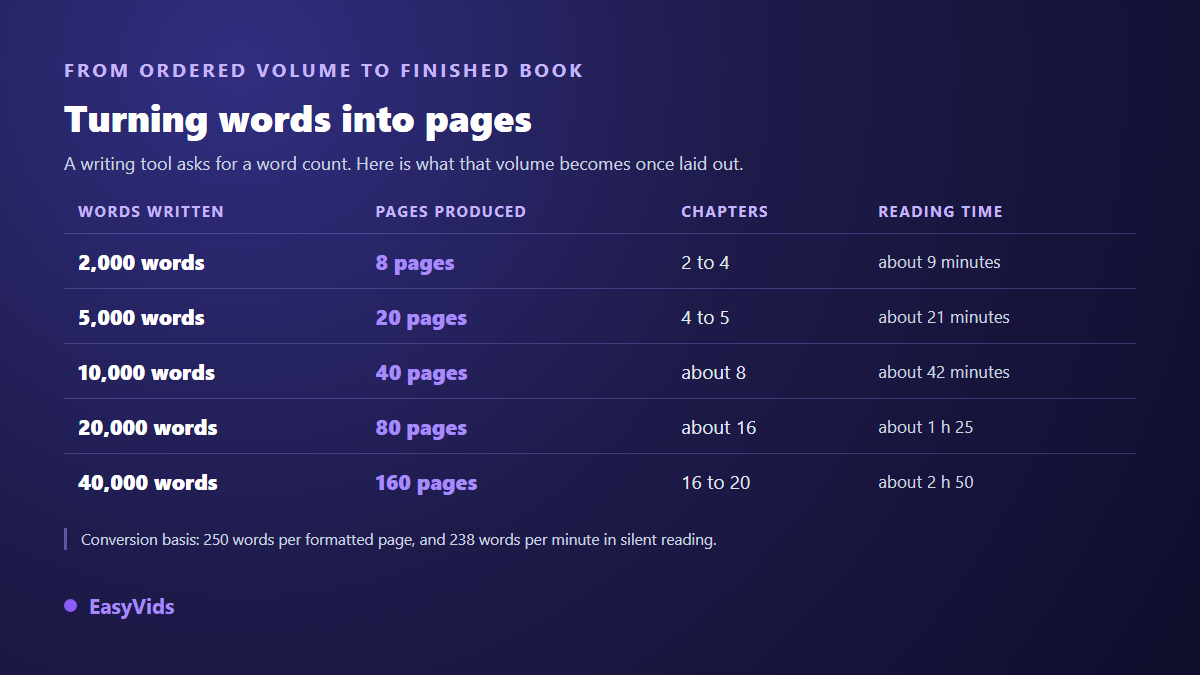
The reading time column matters as much as the others. Buyers respond to a duration far better than to an abstract page count, and the figure rests on documented data: the meta analysis by Marc Brysbaert published in 2019 in the Journal of Memory and Language puts silent reading of non-fiction around 238 words per minute. A 10,000 word book is therefore roughly forty minutes of reading. Announcing a complete method in 45 minutes of reading is both more honest and more persuasive than announcing 40 pages.
Lead magnets: short, finished, useful
An ebook given away for an email address has one job: getting read to the end the same day. Its success is measured by how many people open it and act on it, not by its thickness. Past twenty pages or so it lands in the downloads folder and never opens again, which defeats the purpose entirely.
Aim for 8 to 20 pages, meaning 2,000 to 5,000 words. One promise, one method, one reusable template, one clear invitation to the next step. The most effective format is often an annotated checklist: one point per page, fast progress, and a reader who finishes feeling they saved time.
Paid ebooks: long enough to justify the purchase
The moment money is involved, readers compare what they receive against what they already know. A ten page paid guide creates a sense of shortfall even when the content is excellent, and this is also where the free ebook tools start to show their ceiling. The range that works sits between 30 and 60 pages, or 7,500 to 15,000 words. Enough to cover a full method, its steps, its edge cases and its traps. Short enough to be finished, which remains the strongest trigger for a second purchase.
Self publishing: the thresholds the platform imposes
If your ebook also has to exist in print, the constraint stops being editorial and becomes technical. According to the Kindle Direct Publishing help centre, a paperback must run at least 24 pages, and hardcover imposes a much higher floor, in the region of 75 pages. Below that the spine is too thin to print and the file is rejected at review. Page count is only one step of the upload, and our full walkthrough for selling an ebook on Amazon picks up the rest, from the author account to tax details and royalty options. These thresholds change from time to time, so check the official page when you publish rather than trusting any article, this one included.
Two further points deserve attention before you lock a length for print. The page count must match the file exactly, with no blank pages inserted by hand to clear the floor. And declaring AI generated content is a separate procedure, covered in our breakdown of the Amazon KDP rules for AI written books, unrelated to manuscript length.
How many chapters for that length
Chapter count follows word count. A readable chapter runs 800 to 2,000 words, or 3 to 8 pages. Below that, reading feels choppy. Above 2,500 words, readers lose the thread and internal structure loosens. That single rule gives you immediate targets.
- 2,000 to 5,000 words: 3 to 5 short chapters, one per core idea.
- 8,000 to 12,000 words: 6 to 10 chapters, the most comfortable structure to read and to write.
- 20,000 words and up: 14 to 18 chapters, grouped into parts so the table of contents stays readable.
- In every case, an introduction and a conclusion worth about 6 percent of the total each.
- A chapter far longer than the others is almost always two chapters ignoring each other.
What pads a book without improving it
Chasing a page count creates a constant temptation to stretch, and readers always make you pay for it in reviews. These are the devices that raise the total without adding value, and that anyone spots without effort.
- Transition paragraphs announcing what the next chapter is about to say.
- Dictionary definitions of terms the reader already knows.
- Long autobiographical openings placed before the first useful piece of information.
- Lists restated twice, once as bullets and once as prose.
- Decorative images with no caption, filling a page without explaining anything.
Illustrations change the arithmetic
A full width image takes a third to half a page and pushes the following text down. A 10,000 word book carrying twenty visuals no longer runs 40 pages but 50 to 55. That is not a flaw: on a visual subject a well chosen illustration replaces a whole paragraph. It simply has to be planned in the original calculation. One image every 300 to 500 words suits a practical guide, more for children's books or recipes, none for an essay. Our piece on fully illustrated, automatically laid out ebooks covers holding a stable visual direction from chapter to chapter.
Setting the length before writing a line
One practical detail catches people out: book generators ask for a volume in words, not in pages, precisely because pages depend on formatting. In the EasyVids ebook studio the volume field accepts 2,000 to 40,000 words, which covers every use case described above. You then let the chapter count compute itself, or set it yourself up to twenty, and pick zero to eight illustrations per chapter. The finished book is delivered as an A4 PDF, ready to distribute. Volumes available on each plan are listed on the pricing page.
Frequently asked questions
How many words is a 50 page ebook?
Around 12,500 words, based on 250 words per formatted page. Budget slightly less if the book carries many illustrations or lists, slightly more for dense text with no images. Always enter that figure in words in your writing tool.
Is a 20 page ebook too short to sell?
Usually yes, unless it is a ready to use template, a working file or a highly specialised technical sheet. For a guide sold to a broad audience, perceived value takes off closer to 30 pages. Twenty pages does an excellent job as a signup gift.
Does page count affect how a book ranks in a store?
Not directly. Title, description, keywords and reviews carry visibility. Length acts indirectly: a book that feels thin collects disappointed reviews, and one that drags collects abandoned reads. Both hurt performance.
Should the page count appear on the sales page?
Announce reading time and chapter count instead. On a reflowable file the page count varies from device to device, and a promise the reader's own device contradicts creates avoidable disappointment. Reading time stays true everywhere.
How long does it take to write a 40 page ebook?
By hand, several weeks between research, writing and revision. With an assisted pipeline that produces the angle, the outline, the chapters and the layout, a complete first draft of a 10,000 word book takes one working session. The time then moves to revision and personalisation, which remain essential.
Hold on to the principle rather than the numbers: decide the job of the book, translate it into a word count, and let pagination follow. A short lead magnet people finish beats a doorstop abandoned at chapter three. To try the method on your own topic, creating an account opens the writing studio, and the full EasyVids creation suite brings writing, illustration and layout together in one place.