You have been uploading for weeks, the counter climbs, and the same question comes back with every video: how many views do you need to get paid on YouTube? The number circulates everywhere, different from one source to the next, and it is almost always wrong. For a simple reason: the platform does not look at your views to decide whether your channel can earn.
What it measures is subscribers, watch hours, and for Shorts a view count over a rolling window. Three counters, three logics, and an entry door that has just moved: the official YouTube blog announced on 10 August 2026 that the watch hour requirement will double for new applicants. Below are the exact figures, the calculation that turns those hours into a number of views, and what happens once the door opens. If your channel runs on generated content, the eligibility rules specific to AI content sit on top of these numeric thresholds.
The short answer
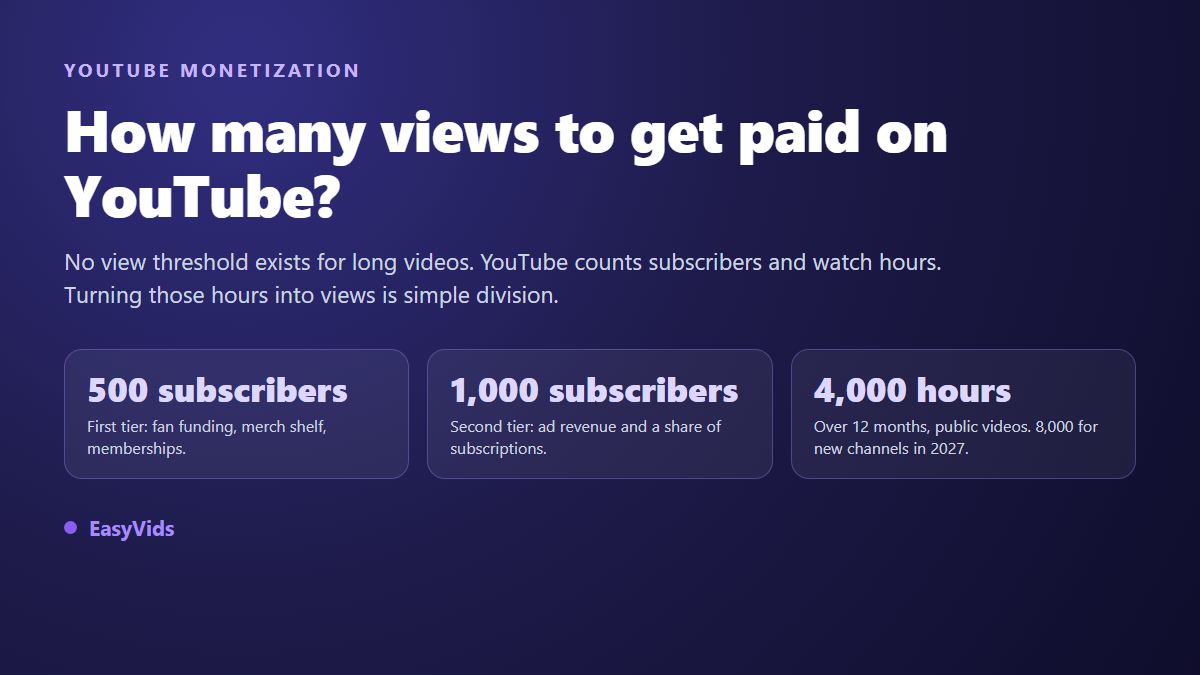
There is no view threshold for long-form videos. According to the YouTube Help Center, ad revenue requires 1,000 subscribers and 4,000 valid public watch hours over the past twelve months, or 1,000 subscribers and 10 million valid public Shorts views over the past ninety days. A lower tier opens fan funding first: 500 subscribers, three valid public uploads in the last ninety days, and 3,000 watch hours over twelve months or 3 million Shorts views over ninety days. Translated into views, those hours depend entirely on your average view duration, and the gap runs from one to ten.
Why the view question is the wrong question
A view, to YouTube, is an event without duration. It tells you someone pressed play, not that they stayed. A channel of very short videos can pile up hundreds of thousands of views and stay far from the bar, while a documentary channel crosses it with ten times fewer viewers. The platform therefore counts hours, because a watch hour measures the attention actually delivered to advertisers.
The shortcut "you need X views" comes from somewhere else. It comes from the moment you start earning, not from the moment you become eligible. Two separate questions, and mixing them up costs months: you chase clicks while the counter holding you back is the one measuring duration.
The two tiers, number by number
The YouTube Partner Program runs on two floors since it was extended. The first opens the tools your audience pays for directly, the second adds advertising and a share of Premium subscription revenue. Both are requested from the monetisation tab in YouTube Studio, where your counters stay on display.
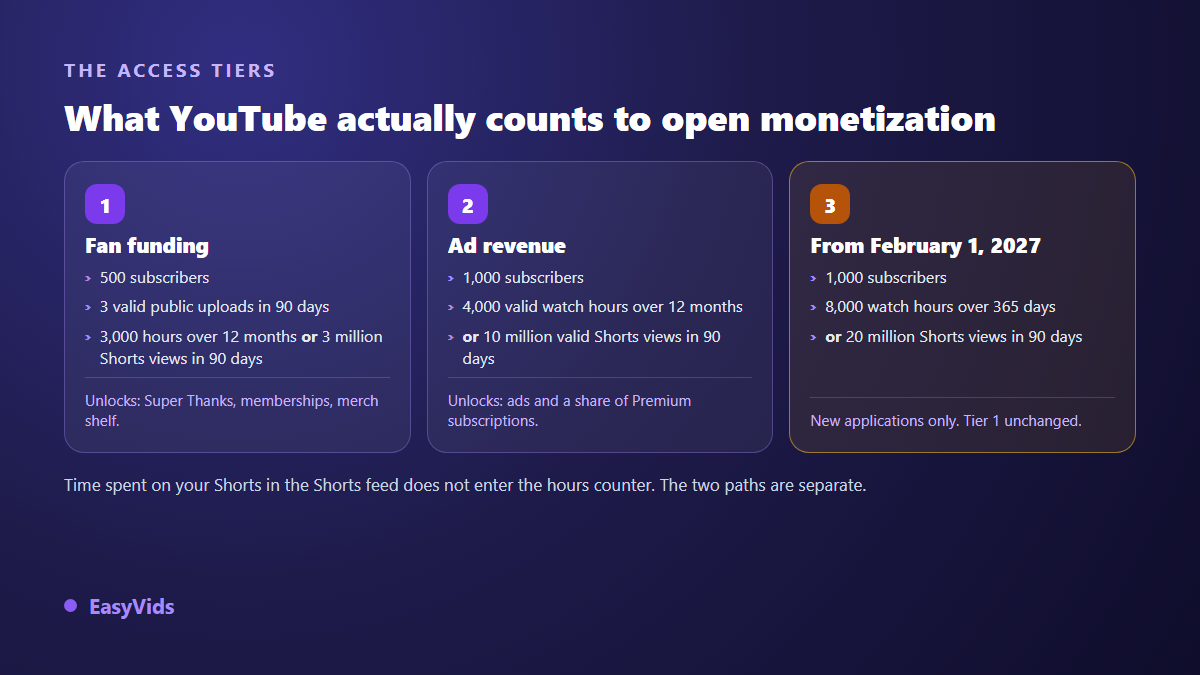
- Tier one, fan funding: 500 subscribers, three valid public uploads in the last ninety days, and 3,000 valid public watch hours over twelve months or 3 million valid Shorts views over ninety days.
- Tier two, ad revenue: 1,000 subscribers and 4,000 valid public watch hours over twelve months, or 1,000 subscribers and 10 million valid Shorts views over ninety days.
- Shared conditions: living in a country or region where the programme operates, two-step verification on the Google account, an active AdSense for YouTube account linked to the channel.
- Conduct conditions: no active Community Guidelines strike, and compliance with the channel monetisation policies.
- An inactivity clock, often overlooked: the Help Center states that a channel left six months or more without an upload or a post can lose its monetisation access.
What changes on 1 February 2027
On 10 August 2026, the official YouTube blog published the first overhaul of entry thresholds since 2018. From 1 February 2027, a new application for the ad revenue tier will need 8,000 qualified watch hours over the last 365 days, or 20 million qualified Shorts views over ninety days. The watch hour bar doubles, and so does the Shorts bar.
Three details matter as much as the number. The fan funding and shopping thresholds do not move. Creators already in the programme are not affected by the increase. And YouTube says it is adding new incentive programmes in exchange, including shopping bonuses, incentives on brand deals, and a boost for channels that start trends.
A fourth change targets short-form directly. According to the same announcement, ad and subscription revenue sharing on Shorts will be reserved for channels holding 10 million qualified Shorts views over the last ninety days. The bar becomes rolling: dropping below it pauses that share, without removing you from the programme or touching long-form earnings, and it resumes on its own once you cross back over.
The practical consequence has a date on it. A channel starting today has until 31 January 2027 to clear the 4,000 hour bar. After that, it takes twice as much. Worth writing down, because it shifts the trade-off between publishing fast and publishing perfectly.
Turning 4,000 hours into a number of views
Here is the calculation everyone is after. 4,000 hours is 240,000 minutes of viewing. Divide that by your average view duration, the figure YouTube Studio shows under Engagement, and you get the number of views you need. The formula fits on one line: views needed = 240,000 divided by average view duration in minutes.
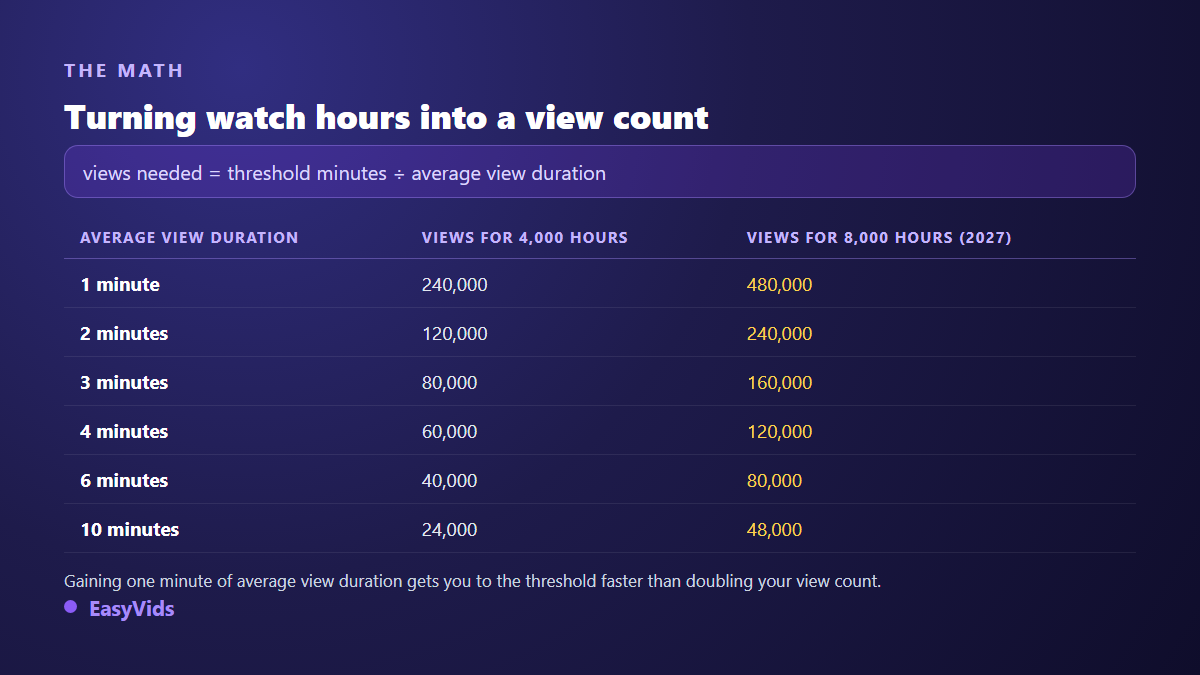
- Average view duration of one minute: roughly 240,000 views to reach 4,000 hours.
- Two minutes: roughly 120,000 views.
- Three minutes: roughly 80,000 views.
- Four minutes: roughly 60,000 views.
- Six minutes: roughly 40,000 views.
- Ten minutes: roughly 24,000 views.
The same arithmetic applies to the coming 8,000 hours by doubling each line, and to the 3,000 hours of the lower tier by taking off a quarter. The lesson beats the table: gaining one minute of average view duration moves you toward the threshold faster than doubling your view count. Format and pacing decide this, not audience size.
The hours that do not count
The decisive word in YouTube's conditions is valid. Only hours accumulated on public videos enter the counter. A video switched to private or unlisted, or deleted, takes its hours with it. Live streams count, provided they were public and stayed archived on the channel.
One exclusion surprises many creators, and the Help Center states it plainly: time spent on your Shorts inside the Shorts feed does not count toward the 4,000 hours. A channel publishing mostly vertical content watches its total watch time climb while the eligibility counter stalls. The two routes are separate, and one of them has to be your main axis.
Shorts play on a separate board
The Shorts route asks for a volume that discourages most new channels: 10 million qualified views over ninety days today, 20 million for a new application from February 2027. In practice it rewards channels that are already viral, not those getting started. It still works as a second engine, because Shorts bring subscribers toward the long-form videos that actually fill the hour counter.
The payout mechanics differ too. For long-form videos, the Help Center states that YouTube pays the creator 55% of net revenue from ads served on the watch page. For Shorts, ad revenue is first pooled together, a portion covers music licensing, and the creator then keeps 45% of the amount allocated to them. Two mechanisms, two orders of magnitude, for the same number of views on screen.
Once you are in: how the revenue is actually calculated
The second question follows immediately: how many views before the money means anything? Again, the raw view is not the unit of account. Three filters sit between the public counter and the payment, and each one can divide the result.
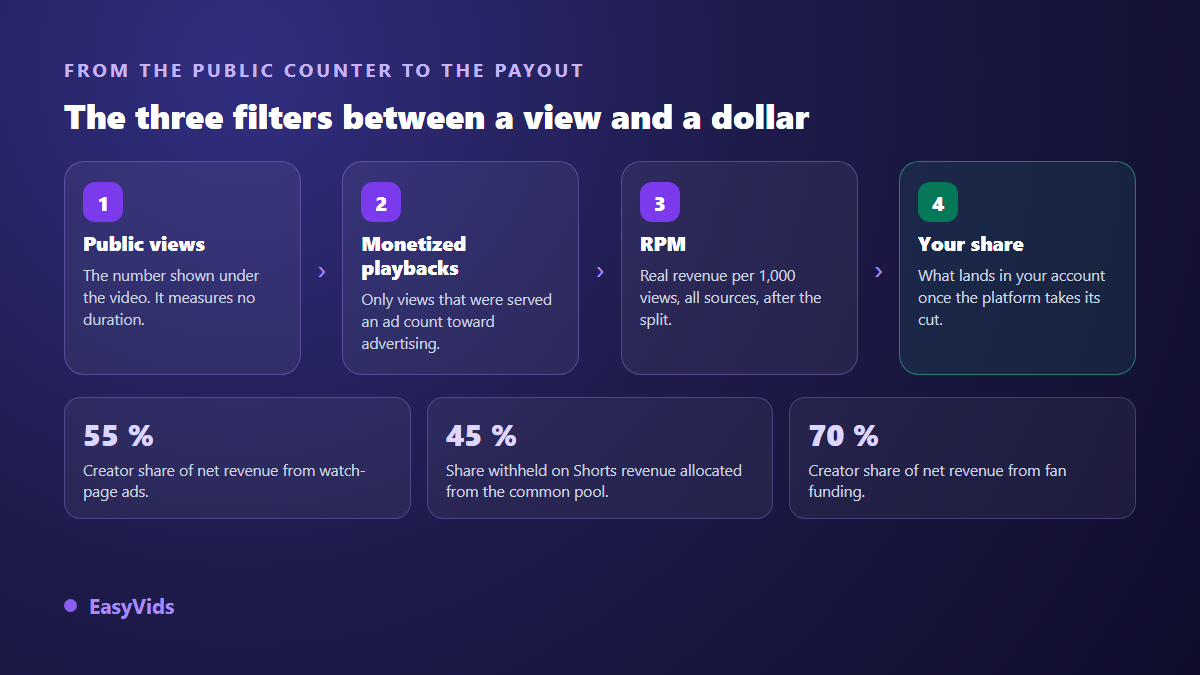
The first filter is the monetised playback rate. Not every view carries an ad: some viewers run a blocker, some watch on a Premium subscription and fall under a different payout mechanism, and some videos are judged less suitable for advertisers. The second filter is RPM. According to the YouTube Help Center, RPM is the revenue actually earned per thousand views, after the revenue split, across all sources, and it counts every view including those that carried no ad at all. CPM is what an advertiser pays per thousand impressions before that split, which is why it always looks more flattering and why it should never be used to plan.
The third filter is the make-up of your audience and your catalogue. The same video with the same view count is not worth the same depending on where viewers come from, the season, the subject, and the length of the format, which allows more ad breaks or fewer. Keep the formula rather than the earnings-by-niche tables floating around online: estimated revenue equals monetised views divided by a thousand, multiplied by your RPM. An RPM you will only discover once your channel is accepted.
The publishing rhythm that gets you there
Run the calculation backwards and it becomes a production plan. A video pulling 1,000 views with a three minute average view duration delivers 50 hours. You therefore need around 80 videos of that calibre to reach 4,000 hours, and 160 after February 2027. At two uploads a week, the first bar falls in a little under a year, assuming the views show up.
That volume is what discourages people, far more than any technical difficulty. Producing eighty narrative videos by hand takes a studio, gear and a lot of time. An AI assisted production chain changes the ratio: our step by step guide to a full YouTube video walks through one episode, and the method repeats after that. On EasyVids, the Director turns a script and a world into a structured production plan, with characters and sets that stay identical from one episode to the next, then the workshop generates the scenes in parallel, the voice over, the music and the final edit.
Two settings act directly on the hour counter. The first is length: ask for scripts in minutes of video rather than in words, and you calibrate duration instead of enduring it. The second is the thumbnail, which decides the click, and therefore the views that later feed the hours. The faceless format suits this cadence particularly well, and our guide to the invisible creator covers the niches that hold up over time. Some of them add their own constraints long before the thresholds come up: building a channel aimed at young children means knowing what the made for kids setting switches off on your channel.
Getting paid before you reach the threshold
Nothing forces you to wait for advertising. The lower tier, at 500 subscribers, already opens paid thanks, channel memberships and shopping. The YouTube Help Center states that the creator share on net fan funding revenue reaches 70%, the most favourable split in the whole programme. Plenty of niche channels earn more this way than from ads.
Outside YouTube, brand deals, affiliate links and selling your own products depend on no threshold at all. A tightly focused channel of a thousand subscribers already interests a specialist advertiser. The rule that protects your channel either way stays the same: an original, identifiable contribution, which our breakdown of the inauthentic content policy explains in detail.
Frequently asked questions
How many views do you actually need to get paid on YouTube?
No view count unlocks monetisation for long-form videos. The official criteria are 1,000 subscribers and 4,000 valid public watch hours over twelve months, which works out to roughly 80,000 views if your videos hold three minutes on average, and 240,000 views if they hold one. The Shorts route does use views: 10 million over ninety days.
Do Shorts views count toward the 4,000 hours?
No. The YouTube Help Center explicitly excludes watch time from Shorts in the Shorts feed from the watch hour calculation. Shorts feed their own counter, expressed in views over a rolling ninety day window.
Is it 1,000 subscribers or 4,000 watch hours?
Both. They are cumulative criteria, not alternatives, for the ad revenue tier. The only choice is on the second condition: 4,000 watch hours over twelve months, or 10 million Shorts views over ninety days.
What happens if I drop back below the threshold?
Once accepted, you are not removed because your hour counter falls. The real risk is inactivity, since the Help Center allows removal after six months without an upload or a post. From 1 February 2027 one exception applies to Shorts: that revenue share pauses below 10 million views over ninety days, then resumes automatically.
Can a channel produced with AI reach these thresholds?
Yes, the thresholds are identical whatever tool you produce with. What differs is the content policy applied when your application is reviewed: YouTube penalises repetitive, low-contribution output, not the use of AI itself. A story written for your channel, illustrated consistently and narrated with a considered voice, sits within the rules.
The threshold is not a view count, it is a volume of attention, and it is won through duration as much as through numbers. Measure your average view duration this week, note the date of 31 January 2027, and work out how many videos actually stand between you and the bar. To produce that volume without giving up your evenings, create your account and start a first series, or see what each plan covers on the pricing page.