Your channel publishes without you. A model drafts the script, the visuals are generated, the voice is synthetic, the upload is scheduled. Then comes the question that decides everything else: how much do faceless YouTube channels make? The answers online run from a five figure income to nothing at all, sometimes on the same page, and almost none of them say where the numbers came from.
We are not going to add an invented average to that pile. What we can give you is the mechanism that genuinely sets your income, the official thresholds to clear before a first payment, the ranking of niches by advertiser demand, and a way to estimate your own figures. If the channel does not exist yet, our guide to running a channel without showing your face covers the setup; this one is only about money.
The short answer
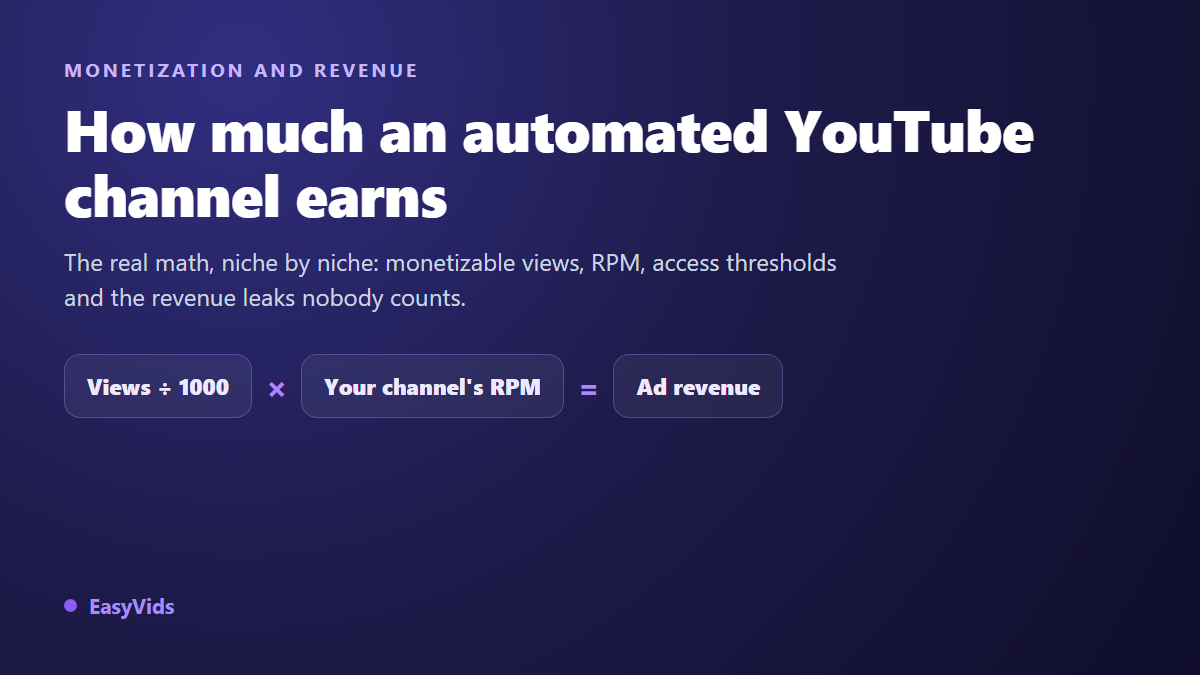
No universal figure exists, and any page that quotes one without a source is telling you a story. Ad income is always calculated the same way: your view count, divided by a thousand, multiplied by your RPM. RPM is the real revenue per thousand views, shown directly in YouTube Studio. It swings by a factor of ten, sometimes more, between a compilation channel aimed at very young viewers and a finance channel watched from a large advertising market. Niche, audience country and format each weigh more than the number of videos you publish.
The only formula that matters: views times RPM
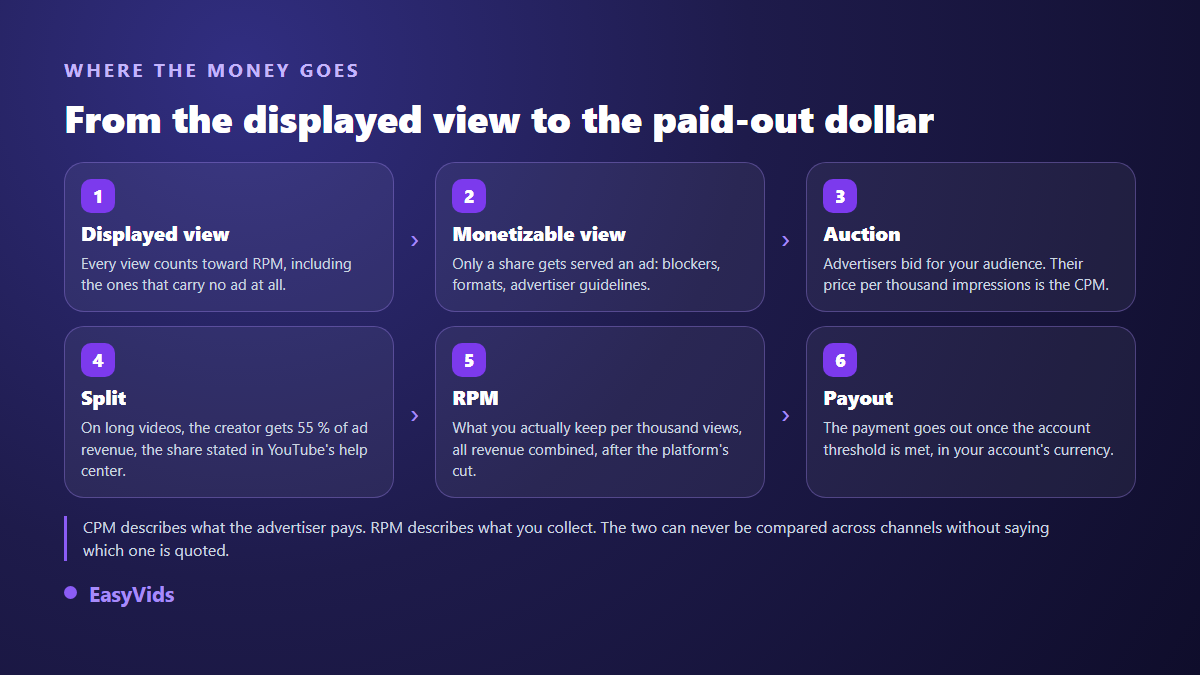
Start with the right unit. RPM, revenue per mille, adds up every YouTube income stream: ads, channel memberships, revenue from Premium subscribers, thanks and other fan funding features. According to YouTube Analytics help, it is calculated after the platform takes its share, and it covers all of your views, including the ones that carried no advertising at all. It is the only figure that describes what you actually receive.
CPM describes something else: what advertisers pay for a thousand ad impressions, before any split. Mixing the two ruins every projection, and it is the most common mistake in videos that promise earnings. On long form watch page videos, the YouTube Help Center states that the creator receives 55 % of ad revenue. Add the fact that only part of your views carried an ad, and it becomes obvious why an RPM always sits far below a quoted CPM.
Before any income: the Partner Program thresholds
A faceless channel earns nothing until it is accepted into the Partner Program, and there is no separate door for channels produced by computer. According to the YouTube Help Center, the entry conditions are identical to those of a filmed channel. The rules specific to generated content are covered in our breakdown of YouTube monetisation and AI content.
- Ad revenue: 1,000 subscribers, plus 4,000 valid public watch hours over the past twelve months, or 10 million valid Shorts views over the past ninety days.
- Fan funding features: a lower tier at 500 subscribers, with three public uploads in the past ninety days.
- Account in good standing: two step verification enabled, no active Community Guidelines strike, a linked and active payments account.
- Geography: the programme is not open everywhere, and the covered country list published by YouTube changes over time.
- Payment threshold: earnings accumulate until they reach a minimum set by Google AdSense before the first transfer goes out.
One consequence deserves to be said plainly, because it contradicts the usual promise of automation: volume does not replace an audience. Forty uploads a month bring nobody closer to 4,000 hours if nobody watches them through. Removing the camera never removes the retention problem.
Why one niche pays several times more than another
YouTube ads are sold at auction. What you receive therefore has nothing to do with how good your edit looks, and everything to do with what an advertiser will pay to reach the person watching. A wealth management firm or a business software vendor can bid very high, because a single signed client pays for thousands of impressions. A free mobile game cannot match that. Your revenue per view reflects the commercial value of your viewer, not the amount of work you put in.
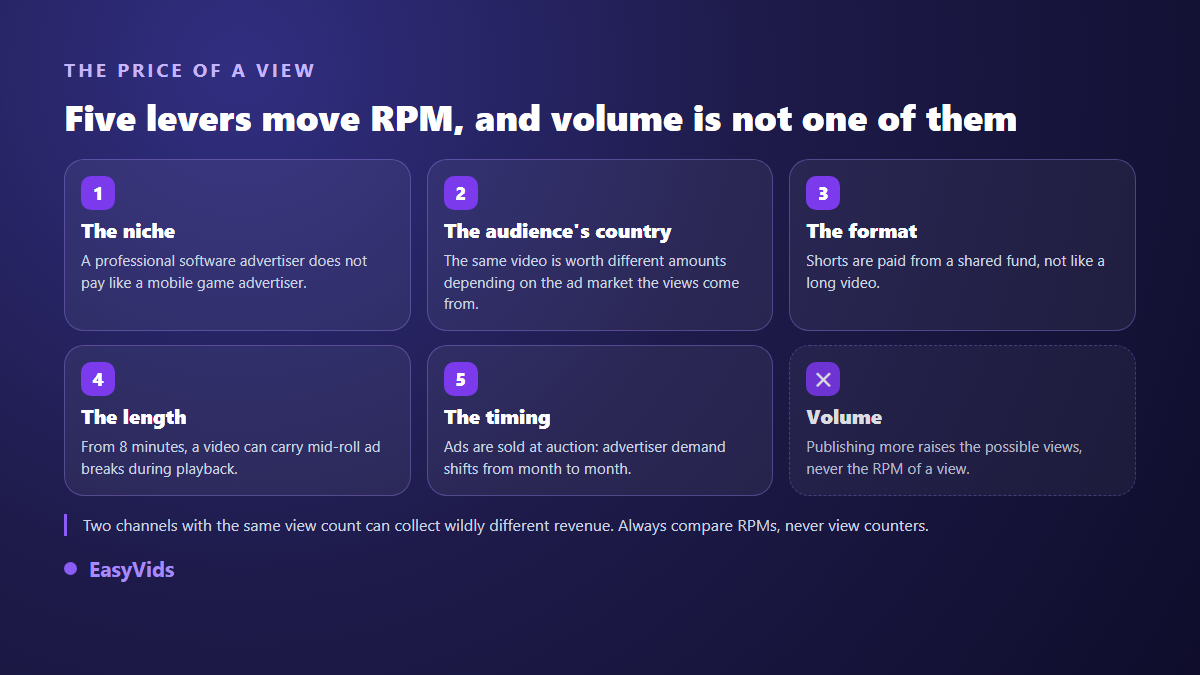
- The niche sets the ceiling your advertisers are willing to pay. Nothing downstream lifts that ceiling.
- The audience country changes everything: the same video is not worth the same depending on which markets the views come from.
- The format counts twice over: long form and Shorts are paid through different mechanisms, and averaging them together stops meaning anything.
- Length opens or closes ad slots. According to the YouTube Help Center, mid-roll ads are available on videos of at least eight minutes.
- Timing matters too, since advertiser demand moves across the year. Compare equivalent periods, never two consecutive months.
- What the channel adds decides the rest: a channel found to breach the monetisation policies earns nothing, whatever its view counter says.
The niche ladder, from lowest to highest advertiser demand
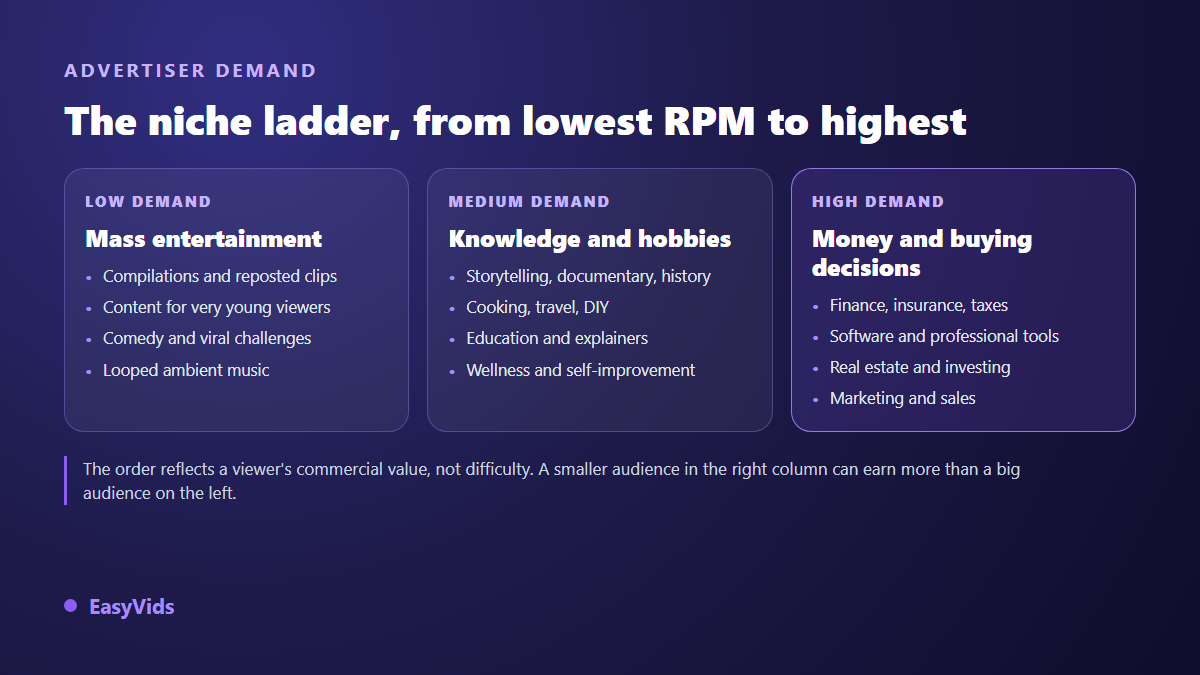
At the top sit the topics that come just before an expensive purchase: personal finance, insurance, tax, real estate, investing, business software, marketing and sales. Those audiences matter to advertisers whose customers are worth a lot, and that feeds straight into the auction price. A faceless finance explainer channel pulling a few tens of thousands of monthly views can out-earn an entertainment channel doing ten times the traffic.
The middle of the ladder holds knowledge and leisure: education, documentary, cooking, travel, DIY, wellbeing, consumer tech. At the bottom come the most watched and least sellable formats: comedy, compilations, ambient music, content aimed at children. That last case deserves a specific warning. According to the YouTube Help Center, a video flagged as made for kids does not serve personalised advertising, which cuts revenue per view sharply. Plenty of automated nursery rhyme channels discover that rule after a hundred episodes.
Shorts follow a different calculation
Never reason in a single blended RPM if you publish both formats. According to the YouTube Help Center, Shorts ad revenue is first pooled, the platform draws from that pool to cover music licensing, and creators are then allocated 45 % of what remains, shared in proportion to views. Revenue per view on a Short therefore sits structurally well below long form. That does not make it a bad format: it is a formidable acquisition channel, as long as you count it as one. To publish regularly without losing your days to it, our method for producing Shorts with AI sets out a sustainable pace.
Ads are rarely the biggest share
Faceless channels that genuinely make money almost never live on advertising alone. Ads are the base layer: steady, predictable, modest. The rest comes from what you build around the audience, and none of it depends on your niche RPM or on this month's auctions. Our overview of serious ways to monetise artificial intelligence goes through each of those routes.
- Affiliate links often out-earn advertising from the first few thousand views, and they impose no entry threshold at all.
- Brand deals are negotiated directly, priced on your audience rather than on auctions. A faceless channel can absolutely sign them.
- Your own product, a course, a template, an app or an ebook, is the most stable source, because it depends on no platform.
- Fan funding, memberships, thanks and merchandise, opens at a lower subscriber tier than advertising.
- Reusing the catalogue multiplies views without multiplying production: the same episodes recut for other platforms.
The revenue leaks nobody counts
Before chasing more views, check that the ones you already have are paying. Three leaks come up constantly on mass produced channels. The soundtrack is the first: a protected track triggers a Content ID claim and, according to the YouTube Help Center, that claim can redirect the video's revenue to the rights holder. You keep the views, you lose the money. Limited monetisation is the second, decided video by video against the advertiser friendly guidelines, where an over the top title or thumbnail is enough to downgrade an otherwise clean upload. The third is the heaviest, because it covers the whole channel: the inauthentic content rule, which we took apart in our piece on mass produced channels.
The other half: what production costs you
Income means nothing without the cost facing it. A faceless channel has two: your time, and the media production itself. Time is the line everyone underestimates, because it dissolves into invisible tasks, finding a topic, rereading a script, redoing a failed image, writing a title. Production cost, on the other hand, is steerable: a fast model for drafts, a careful one for the final version. Our plan details live on the pricing page, and a free trial lets you measure the real cost of one episode before committing to a publishing calendar.
Estimate your own numbers in ten minutes
- Open YouTube Studio, Analytics, then Revenue: your channel RPM appears for the period you select.
- Note the long form RPM and the Shorts RPM separately, never the blended average.
- Estimate the monthly views your publishing pace can realistically reach, and stay pessimistic.
- Divide those views by a thousand, multiply by the RPM: that is your expected ad income.
- Add income from outside advertising, which is forecast per sale rather than per view.
- Subtract production cost and the hours spent, then decide whether the result justifies the calendar.
Frequently asked questions
Do faceless channels earn as much as regular ones?
At equal audience and equal niche, yes: YouTube pays on views, not on how the footage was made. The difference sits elsewhere. A faceless channel produces faster, so it tests more topics, but it usually builds less personal attachment, which weighs on brand deals and on fan funding.
How many views do you need to live off YouTube?
The question has no answer in views, only in RPM multiplied by those views. A million monthly views in a low demand niche earns less than a tenth of that traffic in a high demand one, which also brings far better affiliate income. Always reason in that order: niche first, volume second.
How long before a faceless channel becomes profitable?
There is no standard timeline, and be wary of anyone promising one. What can be measured is the break even point between what an episode costs and what it returns over its first six months. While a new video costs more than it brings in, raising the pace makes things worse rather than better.
Do AI generated videos earn less per view?
No, the production tool plays no part in RPM. What lowers an RPM is an audience in low bidding markets, a topic advertisers do not want, or videos too short to carry mid-roll ads. A generated channel in a well chosen niche shows the same RPM as its filmed neighbour.
Keep the order of operations, it will serve you better than any figure read elsewhere: pick a niche advertisers want to reach, measure your real RPM, plug the leaks, and only raise the pace once an episode pays for itself. A channel run in that order earns more slowly at first, and for far longer. To produce your first episodes from script to export without stacking up subscriptions, create your account and start a first video in the EasyVids studio.