You have been publishing for months, views are climbing slowly, and the monetization tab stays stubbornly grey. The YouTube monetization requirements fit on two lines, but they hide a mechanism that discourages plenty of channels: a rolling counter, two separate entry routes, and a list of admin checks that can block a channel already sitting on the right numbers.
None of it is arbitrary. Every threshold can be calculated, tracked in YouTube Studio and turned into a weekly target. This page gives the exact figures, how YouTube measures them, then the method that shortens the trip. If you are after the payout maths instead, how many views it really takes to get paid covers the other end of the chain.
The short answer: the thresholds that matter
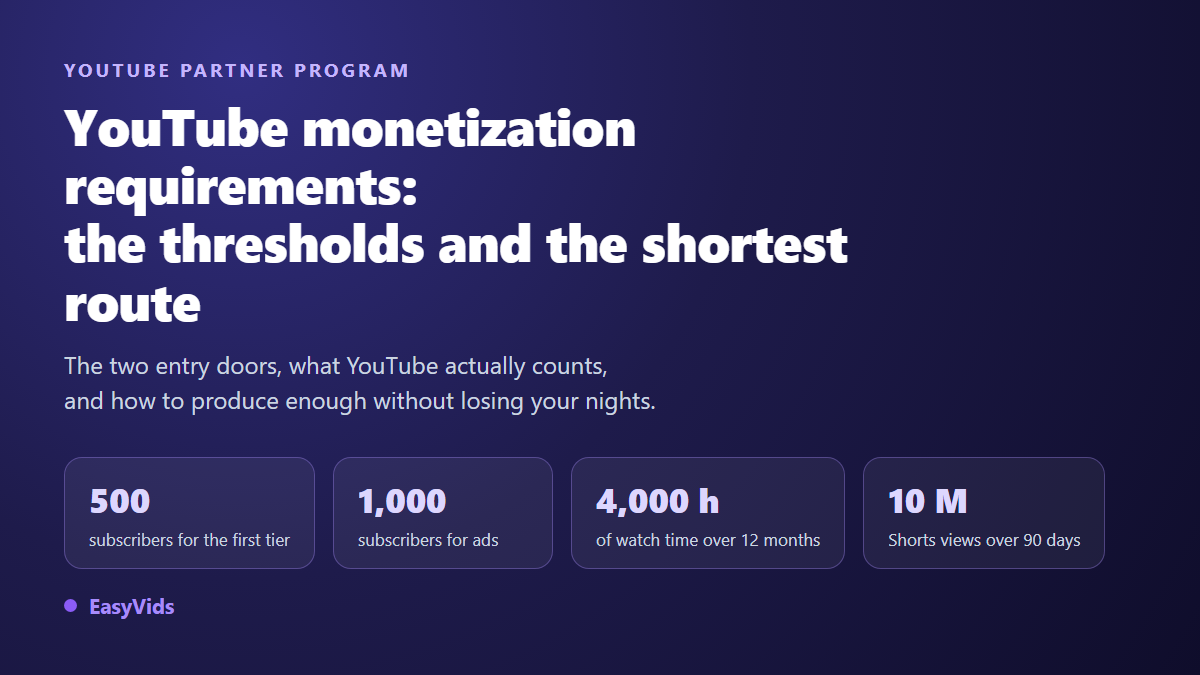
According to the YouTube Help Center, the Partner Program opens in two stages. The first tier asks for 500 subscribers, three valid public uploads in the last 90 days, and 3,000 valid public watch hours over twelve months, or 3 million valid Shorts views over 90 days. It unlocks direct fan support, not advertising. The second tier asks for 1,000 subscribers, plus 4,000 valid public watch hours over twelve months, or 10 million valid Shorts views over 90 days. That one opens ad revenue sharing. YouTube keeps updating these rules, so check the official programme page before you apply.
Two doors into the Partner Program
Many creators still believe there is a single gate, the 1,000 subscriber one. The lower tier changes the early dynamic entirely: a small channel can collect direct support long before it reaches the advertising threshold. Memberships, Super Thanks and the shopping features arrive sooner, and they carry a quiet advantage. They do not depend on how many advertisers target your topic, whereas ad revenue pays very unevenly from one subject to the next.
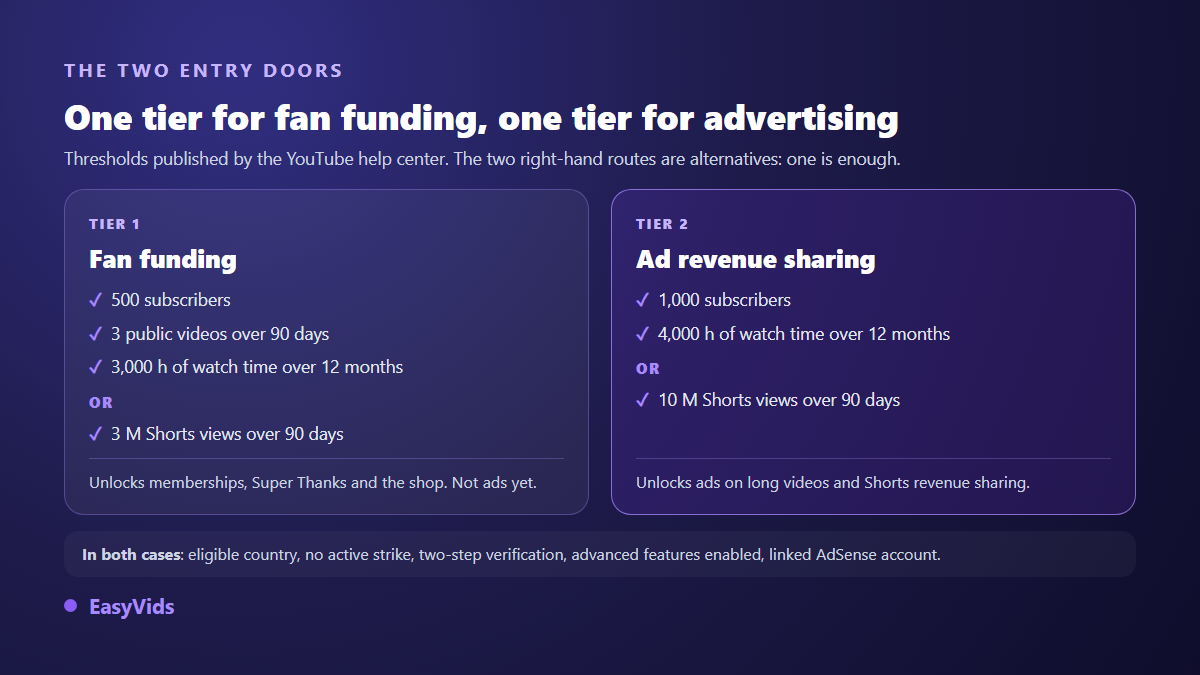
Both tiers share the same admin foundation, detailed below. The key point is that watch hours and Shorts views never add up together: they are parallel roads. So you do not pick a format on principle, you pick the one you can actually sustain week after week.
The admin checks that sink an eligible application
Subscriber and watch hour counters are only half the story. According to the YouTube Help Center, several conditions come with the thresholds, and a channel that clears the numbers still gets rejected when one of them is missing.
- Live in a country or region where the Partner Program is offered.
- Carry no active Community Guidelines strike.
- Follow the channel monetization policies, which reach further than the Community Guidelines.
- Turn on two step verification for the Google account behind the channel.
- Unlock advanced features, which requires identity verification.
- Link a valid AdSense account, in the name of whoever will receive the payments.
All of this takes one evening. Do it now, not on the day the threshold lands. Identity verification and opening a payment account sometimes take several days, and waiting on a form while the channel is ready is the most avoidable frustration in this job.
What YouTube actually counts in those 4,000 hours
The decisive word in the rule is valid. Eligible hours come from public videos. A video switched to private or unlisted, or deleted, takes its hours with it, and that is the most common explanation for counters that slide backwards for no visible reason. Views bought through an ad campaign do not count either, and neither does artificial traffic once the platform detects it.
Here is the part that surprises people: time spent on your Shorts does not feed the 4,000 hour counter. Shorts have their own route with their own view based threshold. A channel that splits evenly between both formats moves two counters halfway, and takes far longer than a channel that picked its ground.
The counter also rolls. It covers the last twelve months, never a lifetime total. A six month pause pushes the number back down, even if your older videos keep getting watched. That is why channels publishing in bursts never quite arrive: they lose on one side what they gain on the other.
Turning 4,000 hours into a weekly target
A threshold expressed in hours stays abstract, and abstract is demotivating. Convert it and it becomes a work plan. Four thousand hours means 240,000 watched minutes spread over twelve months, roughly 660 minutes a day. That is your real daily target.
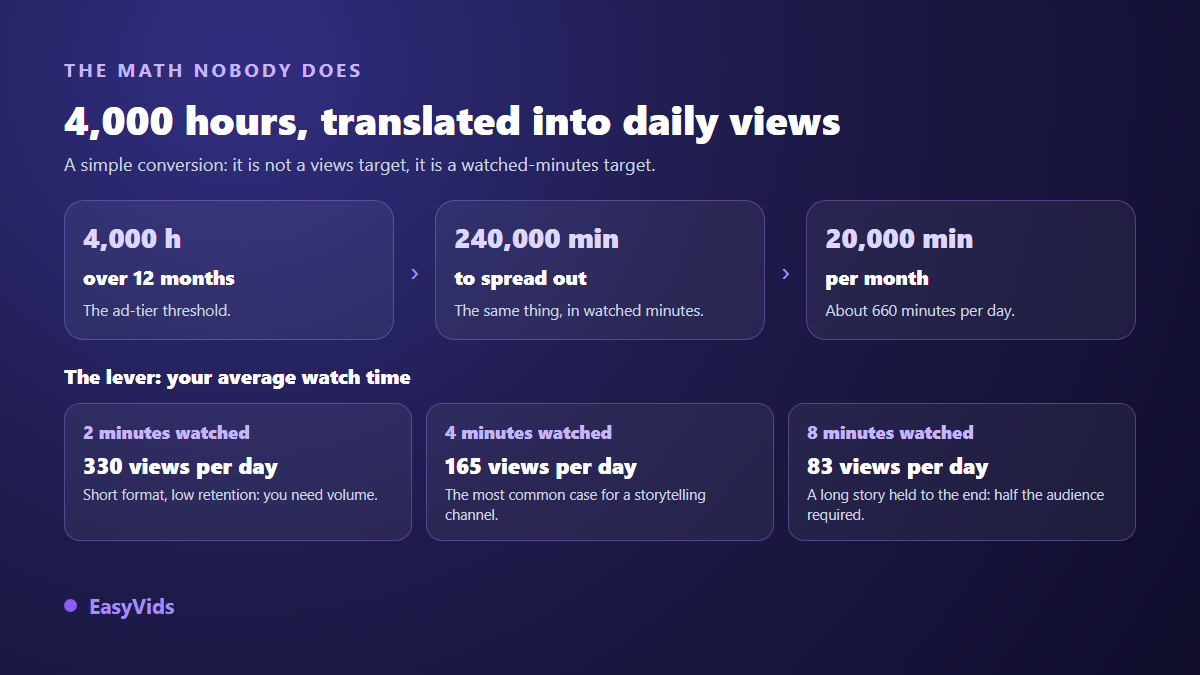
One line sums it up: your average view duration divides the workload. At two watched minutes per view, you need around 330 views a day. At eight minutes, 83 will do. Improving retention on one video pays more than doubling your upload rate. It is also why a narrative format, held from start to finish, reaches the threshold faster than a run of short videos nobody finishes.
The Shorts route is a sprint, not a marathon
Ten million views in 90 days works out at roughly 111,000 views a day. The number looks brutal, but it follows a different logic: on Shorts, a single video that takes off can deliver in one week what six months of long form would not. In exchange, everything rests on recommendation, and a 90 day window forgives no quiet weeks.
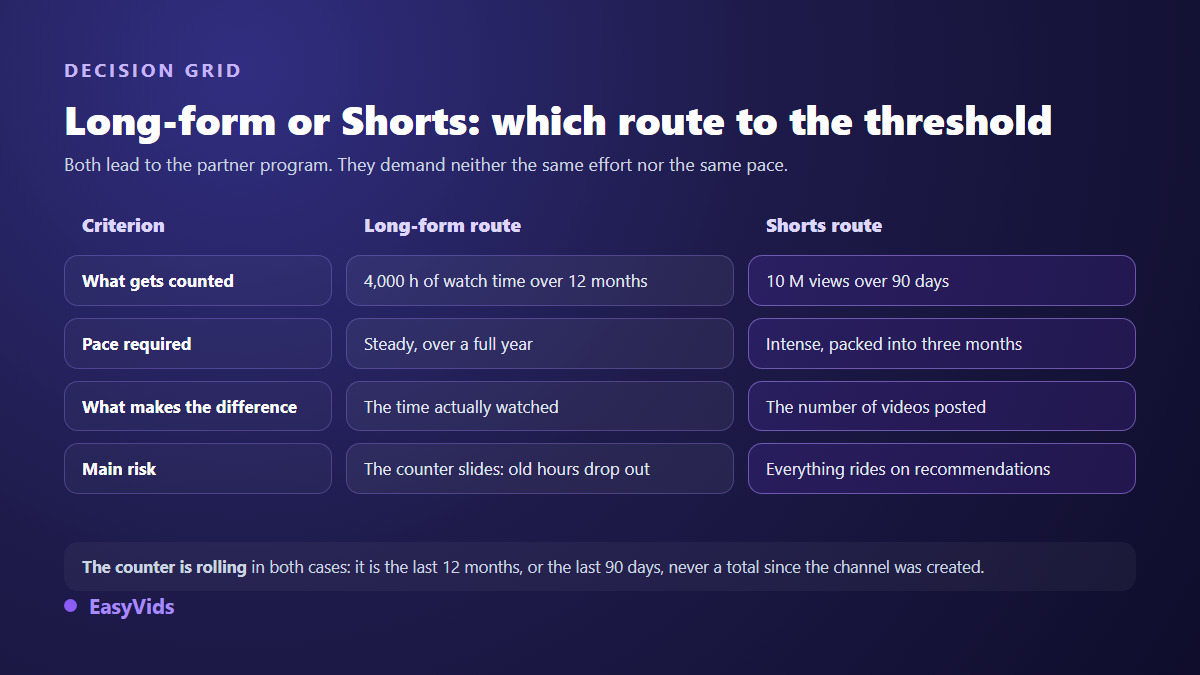
Pick the one you can hold. The long form route asks for consistency across a full year. The Shorts route asks for intensity across three months. If your topic is something you tell, the first is safer. If it is something you show in seconds, the second is faster. A niche chosen for real demand makes either route far less painful, because you never run out of subjects.
The real accelerator is consistency, not talent
Channels that clear the threshold are rarely the most gifted ones. They are the ones that kept the rhythm. The lower tier even asks explicitly for three public uploads in the last 90 days, which is a polite way of filtering out dormant channels. The recommendation system rewards what it can learn: a channel that publishes on a stable slot gives it repeated chances to test your content on nearby audiences.
Producing enough without giving up your evenings
This is where the wall shows up. A weekly upload means writing, sourcing visuals, recording a voice and editing, every week, for twelve months. AI assisted production exists precisely for that volume problem. Inside the EasyVids studio, the Director takes an idea, writes the script, cuts it into scenes, keeps the same characters from one scene to the next, generates the voice over and assembles the edit. The batch runs on our servers, so you can close the page and the production carries on without you.
Two other pieces help when you are chasing a threshold. Single shot mode produces one clip or one thumbnail without opening a full project, which is how you test a format before committing to it. The workshop view lets you regenerate one specific scene instead of the whole thing, the single biggest time saver on a series. The whole faceless channel model rests on that ability to publish steadily with no set and no camera.
The trap that rejects a channel sitting on the numbers
Hitting the figures guarantees nothing. Review also covers the content, and that is where most rejections happen. According to the YouTube Help Center, the policy that used to target repetitious content became the inauthentic content policy in July 2025. It does not target AI as such. It targets mass produced material with no contribution of your own, and material simply lifted from elsewhere and reposted. Our guide to the exact rules for monetising AI made content unpacks where the line sits.
Frequently asked questions
Do I need 1,000 subscribers AND 4,000 watch hours?
Yes for the advertising tier: those two conditions stack. The 4,000 watch hours over twelve months and the 10 million Shorts views over 90 days, however, are alternatives according to the YouTube Help Center. You clear one or the other, never both at once.
Do Shorts views count towards the 4,000 hours?
No. Time spent on Shorts feeds their own view based threshold, not the watch hour counter for long form. A channel publishing both formats moves two separate counters, and the programme opens as soon as either one is cleared.
Can a channel built on AI videos be monetised?
Yes. What the platform penalises is mass produced content with no contribution of your own, not the tool used to make it. An original story, a considered narration and a deliberate edit sit inside the rules. A pile of generic clips does not, whatever software produced it.
How long does reaching the threshold take?
No honest average exists: it depends on the niche, the format and the rhythm. The only useful calculation is your own. Take your average view duration from YouTube Studio, divide 660 minutes by it, and you get the daily view count that puts you on a twelve month trajectory.
Can monetisation be lost once granted?
Yes. According to the YouTube Help Center, a channel left inactive for six months can have its monetisation removed, as can a channel that stops following the programme policies. Entry thresholds are not recalculated forever: inactivity and policy breaches are what push a channel out.
YouTube monetization requirements reward a rhythm held for twelve months, not luck. Run your own numbers this week, pick the route that matches what you can actually produce, and clear the admin steps before you need them. On the production side, creating an account opens the full studio and lets you test in one evening the format you will keep all year.