Your channel cleared the thresholds, you applied to the YouTube Partner Program, and the answer came back in two words: reused content. YouTube does not tell you which video caused it. It does not tell you what to fix either. When the channel is automated, produced without a camera and without a face, that rejection reads like a verdict on the whole method.
It is not. The policy that blocked you existed long before generative models, and it says nothing about artificial intelligence. It talks about contribution: what your channel adds to material that was already circulating. A faceless channel passes this review perfectly well when it has been built for it, as our guide to running a YouTube channel without showing your face explains. What fails is the automatic assembly of borrowed parts.
The short answer
A reused content rejection does not punish the use of AI. It punishes the absence of your own contribution: text taken elsewhere, visuals other channels already use, a voice that only reads, an edit identical from one episode to the next. The fix comes down to three moves. Write a script nobody else publishes. Build your own visuals with an art direction you hold from the first shot to the last. Give every episode a narration of its own. All three are decided before the first second of video, not in the edit.
What YouTube actually means by reused content
According to the YouTube Help Centre, the reused content rule belongs to the monetisation policies of the Partner Program, not to the Community Guidelines. That distinction matters: it decides your ad revenue, it does not remove your videos from the platform. In July 2025 YouTube updated the page and renamed it inauthentic content, stating publicly that this was a clarification rather than a new restriction. The wording moved, the logic did not: the platform wants content that is original and authentic.
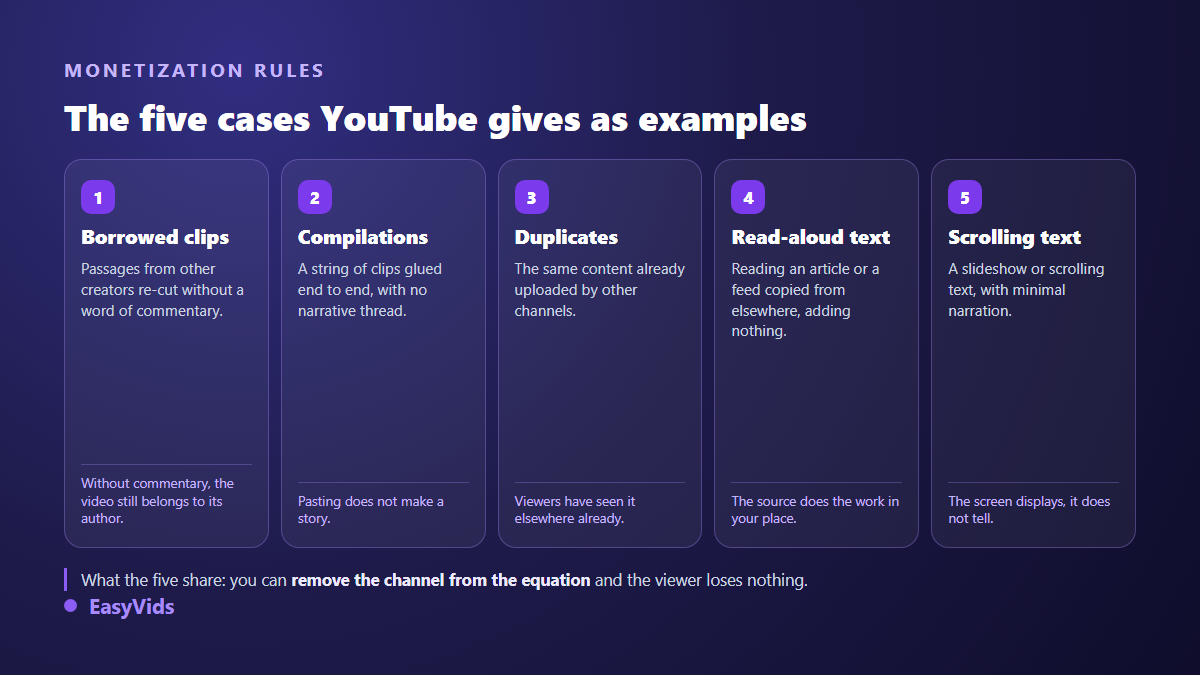
The examples in the Help Centre are very concrete. Clips from other creators re-uploaded without a word of commentary. Compilations with no narrative thread. Content already published by other channels. Reading a text copied from a website or a news feed without adding anything. Scrolling text on screen with minimal narration. Line them up and the shared flaw is obvious: you can take the channel out of the equation and the viewer loses nothing.
A second point often gets missed: the review looks at the channel as a whole, not at a single video. One strong upload does not redeem thirty episodes made on a conveyor belt. A coherent channel that states its subject, its angle and its voice is not rejected because one establishing shot came from a stock library.
Why automated channels keep tripping the policy
The trap is mechanical. You start from a text found on a forum or a news site. You run it through a speech engine. You illustrate with stock shots plenty of other channels use for the same subject. You edit on the same template every week. Taken one by one, none of these steps is forbidden. Put end to end, they produce exactly what the policy describes.
Automation adds volume, and volume makes the pattern louder. Twenty videos a month on the same template, with the same intro, the same voice and the same thumbnail structure, draw a shape that is easy to spot. Producing in series is a legitimate way of working, including on successful channels. The problem is producing in series without variation. These are the signals that weigh most heavily.
- A script lifted word for word from a website, a forum or a news feed.
- Stock visuals other channels already use to cover the same topic.
- An intro, a voice and a thumbnail structure that never change across the channel.
- Titles poured into a single template, where one word differs between episodes.
- An empty channel description that says neither who is speaking nor to whom.
- The same episode published across several channels you run in parallel.
First contribution: writing nobody else publishes
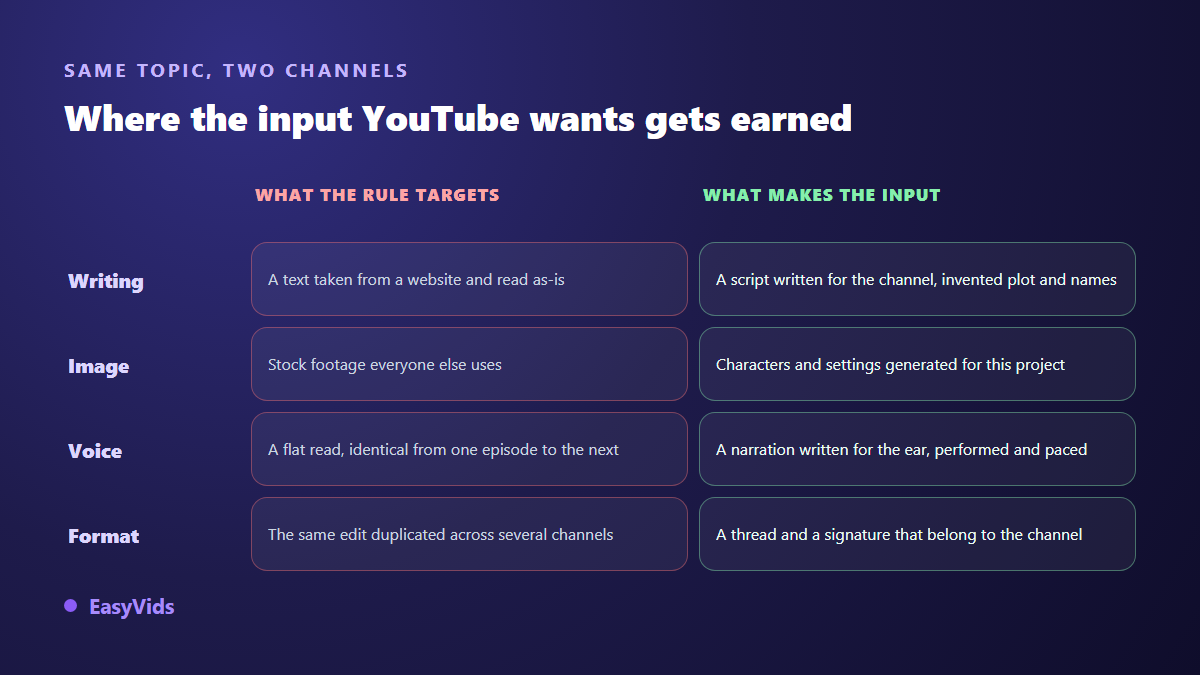
Writing is where originality costs the least effort and pays the most. A script built from an idea, rather than copied from a page, changes the nature of the work: the angle is yours, the structure follows your logic, the examples come from you. We wired that criterion into our writing engine. The instruction driving it asks the model to invent its own character and place names, to make them differ from one text to the next, and never to recycle a predictable plot. That contribution is judged first on the opening line, the one that decides whether the episode gets watched, and our collection of hooks sorted by niche offers openings to adapt rather than copy.
If your niche runs on stories found elsewhere, the job is to transform the material rather than read it. A story posted on a forum becomes your episode once you restructure it, add the context it lacked and replace reading aloud with a point of view. We covered that step in our method for turning forum stories into videos, because it is the niche where this rejection lands most often.
Second contribution: visuals that exist nowhere else
A stock library hands you the same shots as everyone else. On a popular subject, two competing channels end up showing the same footage in the same minute. Generation solves that by construction, since the images do not exist until you ask for them. They still have to form a whole rather than a pile of unrelated shots.
That is what the Director does in our studio. Before the first image, it writes a production bible: the visual world, the characters, the recurring sets, each with a stable reference identifier. Scenes then cite those identifiers, and the reference portraits are attached to the generation. The result shows on screen, because the same character keeps their face, their hair and their outfit from one shot to the next. It is the exact opposite of an edit made of borrowed footage, and we explained the principle in our article on keeping a character consistent across scenes.
Third contribution: narration, not reading
A synthetic voice is not the problem. Flat reading is. Everything depends on the text you hand it: a hook that opens on tension, short sentences built for the ear, a real turn in the middle, an ending that summarises nothing. A text written to be read with the eyes always produces a limp voice over, whatever engine speaks it. That same text has a second life on screen, since a large share of the audience watches muted, and the reasons for captioning every video have as much to do with accessibility as with how long people actually watch.
Vary the shape between episodes as well. A template repeated fifty times becomes a signal, while a channel that alternates long narrative, analysis and short form stays readable without turning mechanical. On an ongoing project that rhythm is planned from the start, as our method for building a series with linked episodes shows. The EasyVids studio keeps these steps in one place.
Disclosing synthetic content does not cost you monetisation
Since March 2024, according to the YouTube Help Centre, creators must state in YouTube Studio when a video contains realistic elements that were generated or altered by artificial intelligence. A label then appears in the description, and on the video itself for sensitive subjects. That disclosure is not a penalty and triggers no demonetisation: it informs the viewer, nothing more.
Do not confuse the two rules. Disclosure covers transparency about the process, while the reused content rule covers the originality of what you publish. A channel can disclose every upload and stay fully monetised, just as it can generate nothing and still be rejected for stacking clips. The European regulation on artificial intelligence points the same way: its transparency obligations, in force since August 2026, require content generated or manipulated by AI to be identifiable as such.
What the review looks at when you apply
According to the YouTube Help Centre, joining the Partner Program requires 1,000 subscribers plus 4,000 valid public watch hours over the past twelve months, or 1,000 subscribers plus 10 million valid public Shorts views over the past ninety days. Those thresholds open the review, they do not win it. What follows is a check against the monetisation policies, applied to the channel as a whole.
So prepare the shop window as carefully as the videos. The channel description should say who is speaking, about what, and for whom. Titles should vary. Your most watched videos should be your best, because they are the ones opened first. A rejection is not final: the Help Centre states that you can apply again twenty one days later. That delay is worth nothing if you reapply with the same channel. While the channel gets back in shape, the income does not have to stop: the nine ways to make money on TikTok show which ones run through a platform programme and which ones do not.
Fixing a channel that was already rejected
The repair calls for sorting, not for a full rebuild. Put every video through the same test: what did this channel add to the source material? If the answer is a speech engine, pull the episode or remake it. If the answer holds in one solid sentence, keep it and move on.
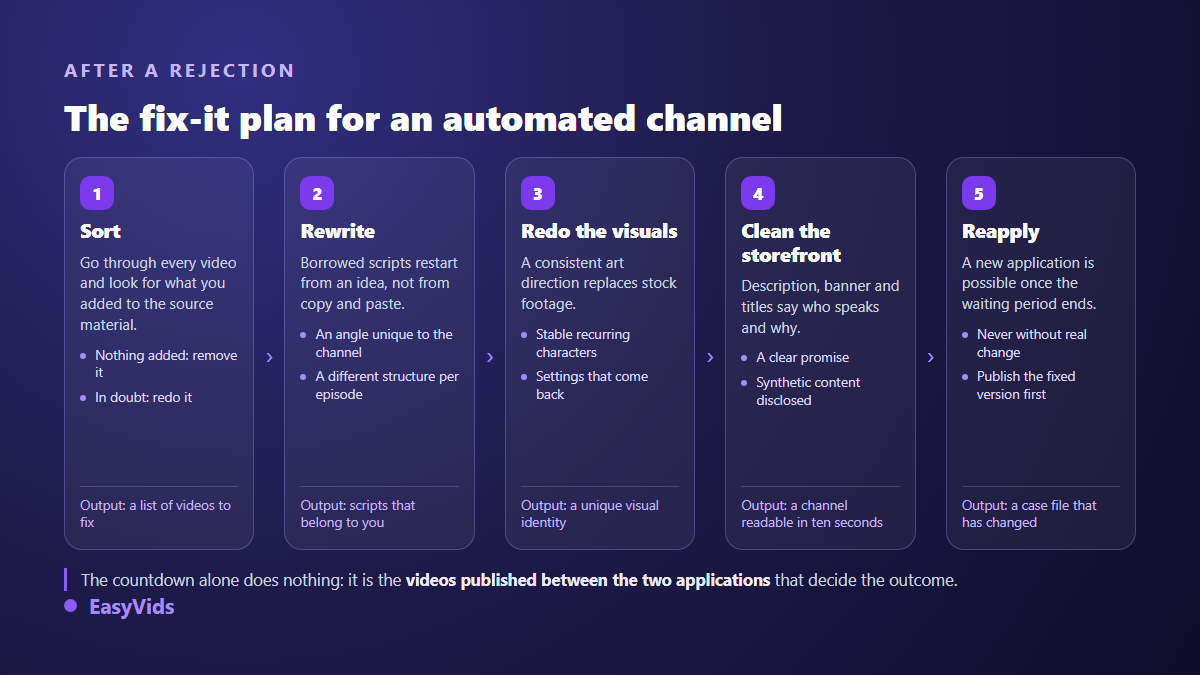
- Remove or hide episodes that add nothing to their source.
- Rewrite borrowed scripts from an idea, with an angle that belongs to the channel.
- Replace stock shots with visuals generated for your episodes, in a consistent art direction.
- Record the narration again from a text written for the ear, not for the eye.
- Rewrite the channel description and disclose realistic synthetic content.
- Publish several episodes in the new form before submitting another application.
Give it several weeks. The goal is not to slip past a check, but to make the channel defensible: if a reviewer opens three videos at random, they should see work three times. If you are starting over, our complete guide to AI video generators walks the whole production chain, from idea to exported file.
Frequently asked questions
Does YouTube ban videos made with AI?
No. The YouTube Help Centre does not forbid the use of artificial intelligence in production. It requires content to be original and authentic, and asks you to disclose realistic generated or altered elements. A video written, illustrated and narrated with AI tools stays monetisable as long as it offers something viewers cannot find elsewhere.
How long must you wait after a reused content rejection?
The YouTube Help Centre states that you can apply again twenty one days after a rejection. That is a minimum, not a target: reapplying without changing the channel produces the same answer. Use those three weeks to publish episodes that show the new standard.
Can you narrate stories found on a forum safely?
Yes, provided you do not simply read them out. The policy targets reading copied text with nothing added. Rewrite, restructure, supply context, illustrate with your own visuals and commit to a point of view. Check the source platform's terms as well, and never reuse protected content without permission.
Can a faceless channel be monetised?
Yes. Nothing in the monetisation policies requires you to appear on camera. Documentary, storytelling and explainer channels have worked without showing anyone for years. What counts is the contribution, not the presence of the author.
Should every AI generated video be disclosed?
Disclosure applies to realistic content that could pass for a real scene, not to every use of an AI tool. Clearly stylised animation does not call for the same caution as a realistic reconstruction. When in doubt, disclose: the label stays discreet and does not affect your revenue.
A reused content rejection looks like a closed door when it really points at a working method to change. Write what nobody else publishes, build your visuals instead of borrowing them, tell a story instead of reading one, and monetisation stops being the question. To build that production chain end to end, create your account and start your first plan with the Director.