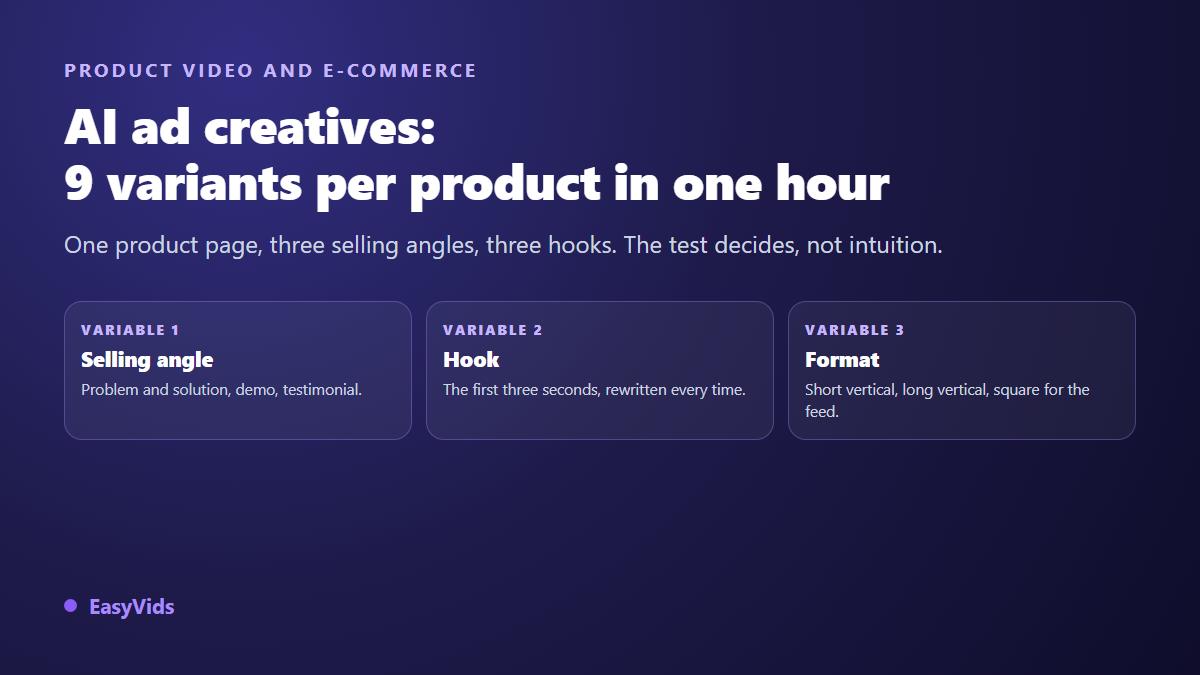
You have a product, a media budget and exactly one video. You launch it, you wait three days, the verdict lands: it does not take off. The product goes back on the shelf even though nothing proves it was the problem. AI ad creatives change that arithmetic, because they make the second, the fifth and the ninth video as reachable as the first.
You still need to know what to vary. Nine videos saying the same thing with different words teach you nothing. Nine videos built on three selling angles and three hooks name a winner within days, and explain why it won. Here is the matrix, the production method and the reading grid. If the format itself is new to you, our guide to product video covers the groundwork first.
The short answer
Nine ad creatives in an hour comes down to one discipline: one product page, three angles, three hooks, and nothing else moving. Write three scripts, one per selling angle. Split each into three openings, touching only the first three seconds. Generate all nine in the same vertical format, with the same captions, and run them in the same ad group. The value of the test comes from everything you did not change.
Why a single creative proves nothing
A video ad stacks four promises. Stop the scroll, name a problem the buyer recognises, prove the product solves it, make acting feel urgent. Each one can fail on its own. When a lone creative disappoints, you have no idea which of the four gave way, and you draw the most expensive conclusion available: the product does not sell. That shortcut buries perfectly viable items, as our method for validating a product before scaling explains.
The platforms push the same way. The Meta Business Help Centre describes dynamic ad formats as a mechanism that combines several videos, headlines and texts to find the strongest pairing: it expects variations, not a single piece. The TikTok for Business Help Centre likewise recommends rotating several different videos inside one ad group rather than running a single asset. Producing one at a time starves the very system that distributes your work.
The three variables behind nine creatives
A testing matrix is not a list of ideas. It is a table where every cell differs from its neighbour by exactly one thing. Three selling angles as rows, three hooks as columns, nine cells. By the end you will know whether the angle or the opening made the difference, because a whole row or a whole column will pull ahead.
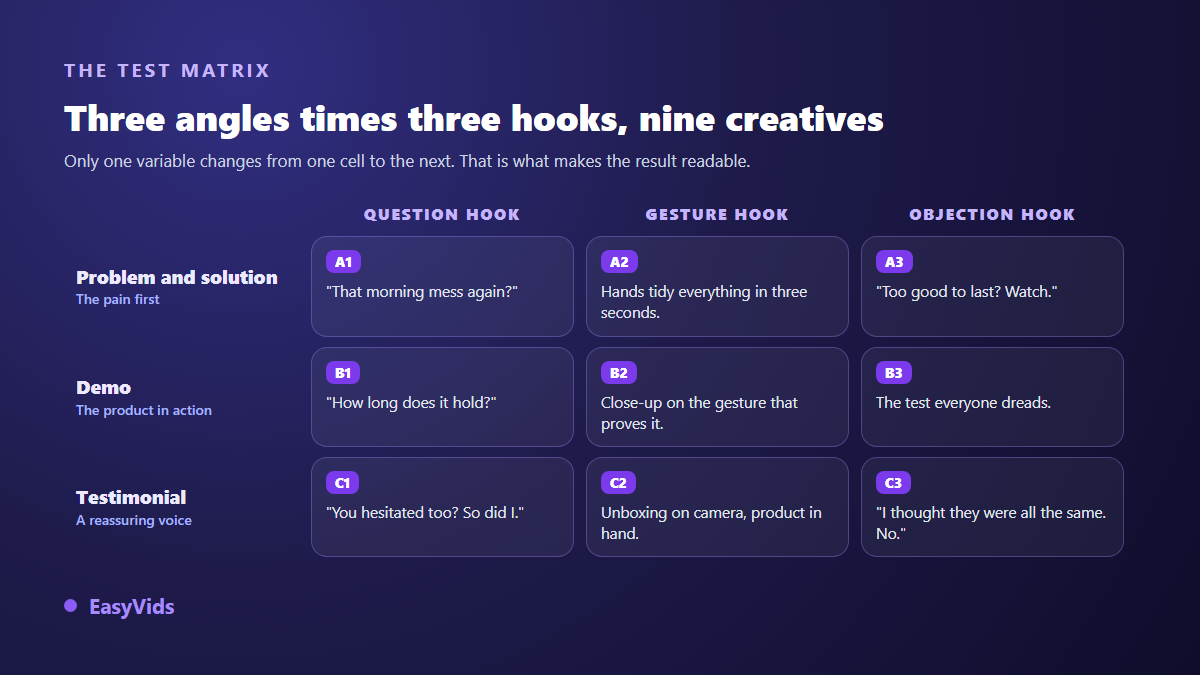
Format, the third axis, stays out of the opening matrix. Keep it identical across all nine during the first round, then test it in round two on the two or three creatives that survived. Varying three things at once gives you nine results and zero learning.
Variable 1: the selling angle
The angle decides what the video says, not how it says it. Five angles cover most of ecommerce, and they are exactly the ones the EasyVids marketing script writer offers as a forced choice once you give it your product name, description and photo. For a first round, pick three that genuinely disagree with each other.
- Problem then solution: open on the friction, let the product arrive as relief. The safest angle for anything that fixes a daily annoyance.
- Demonstration: the product in action, precise gestures, visible result. Unbeatable when the object is striking or counterintuitive.
- Before and after: the contrast between life without and life with. Powerful, but hungry for proof, or it reads as exaggeration.
- Storytelling: a grounded story that leads to the product without waving it around. It holds cold audiences better than the rest.
- Testimonial: the voice of a convinced customer, concrete and never oversold. The best pick for lifting a trust objection.
Variable 2: the first three seconds
The hook is the only block you rewrite between variations inside a row. Three families are enough. The direct question, which drops the viewer into a situation. The shown gesture, where action starts before the first sentence. The flipped objection, which names the doubt before the viewer can. All three open the same script and lead into the same body.
One practical safeguard: the visual hook and the spoken hook must say the same thing. A sharp opening line laid over a slow shot loses its effect. In a studio that splits a script into segments, treat the first segment as a video in its own right, with its own visual prompt, and regenerate it alone until it holds.
Variable 3: format, saved for round two
Full frame vertical stays the default on social feeds because it owns the whole phone screen. Square and four by five keep their place in desktop feeds and certain placements. Do not mix formats inside one round: a vertical and a square creative are not fighting on equal terms depending on where they land.
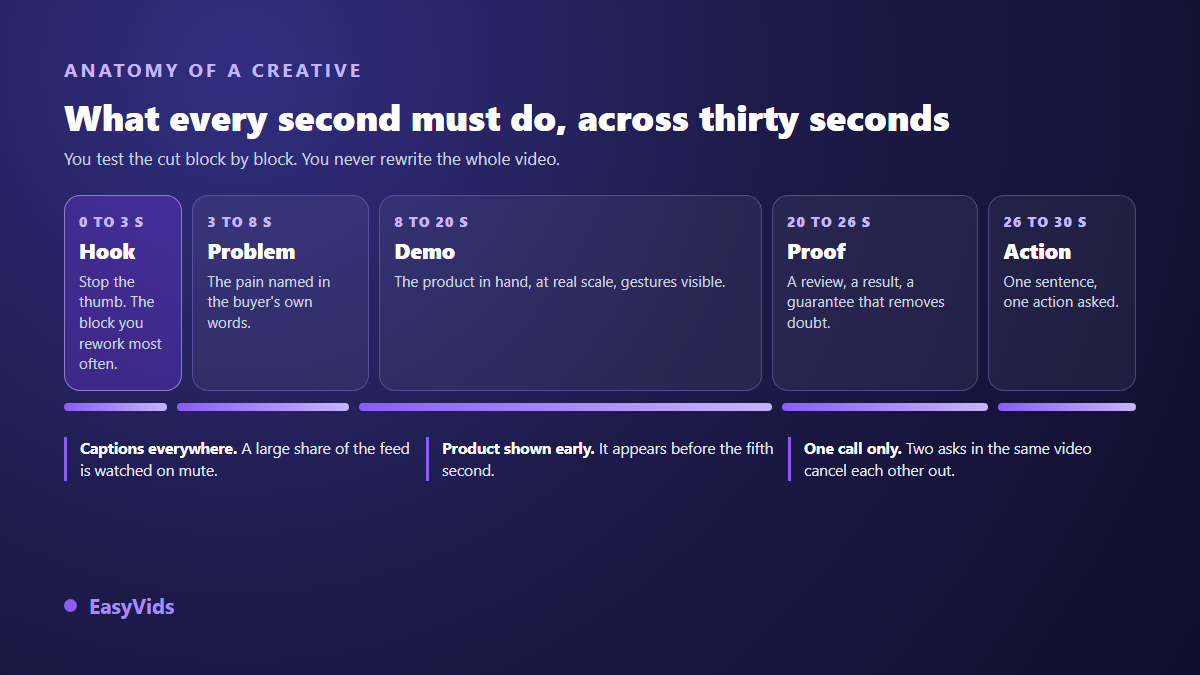
Duration follows the same logic. A first round runs on short formats, around twenty to thirty seconds, because they return a usable signal quickly, and the anatomy of a spot built from a plain description shows how to fit the hook, the demonstration and the call to action into that window. Longer cuts earn their place later, on the angles that proved they can hold attention.
Producing the nine videos, step by step
Here is the real sequence, the one that fits in an hour once the product page is ready. It starts with a photo rather than a script: the supplier shot, your own stock image, or a visual reworked from an existing picture, as our method for turning a product photo into an ad shows.
- Upload the product photo, its name and its description. Add up to four extra views of the same object, the back, a detail, a lifestyle shot: the on screen presenter will then hold it at true scale.
- Generate three scripts, one per forced angle. Think in seconds of speech, never in pages.
- Duplicate each script and rewrite only its opening, three times. You now hold nine texts.
- Launch the generations. Every video is a separate order and is billed as such, so run them in parallel rather than in a queue.
- Review, regenerate the one scene that fails, add captions, export all nine in the same format.
- Name the files with the matrix code, A1 through C3. Without that convention, reading the results becomes impossible after three days.
The visual prompt of each scene matters as much as the words. A working demonstration shot shows the product at true scale, held and handled, never parked as set dressing.
What a nine variation test actually costs
One honest note beats a comfortable promise: nine AI videos are still nine productions. Every delivered element, script, image, video shot, voice, is billed as such. What changes is not the price tag but the ratio between production cost and media budget. A creative that fails cost you a few minutes of compute, not a shoot day. Our plans live on the pricing page, and the useful principle fits in one line: fast models for round one, premium models for the survivors.
Reading the results honestly
Read a test in the order of the video, not in the order of the dashboard columns. The first useful signal is three second retention: it judges the hook, and nothing else. The second is click rate against completed views: it judges the promise and the call to action. The third, conversion, judges your landing page far more than your video.
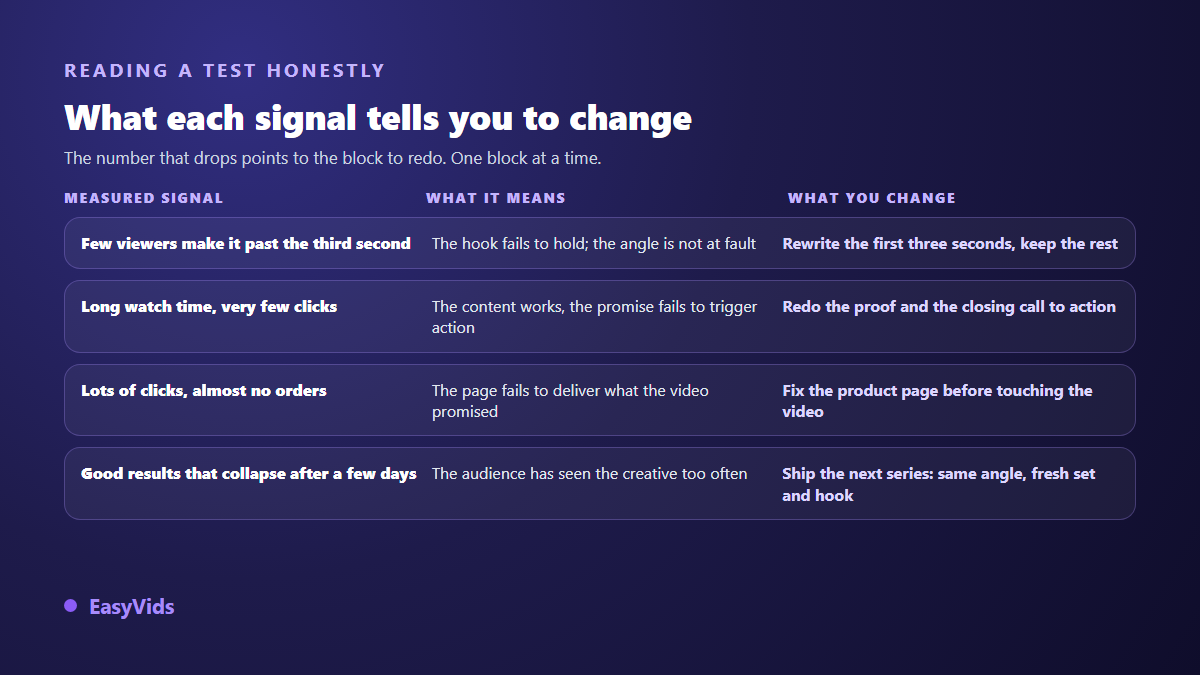
Let it run long enough to mean something. According to the Meta Business Help Centre, an ad set stays in its learning phase until it has gathered roughly fifty optimisation events in a week, and performance there is unstable by design. Killing a creative after a few hours is drawing a conclusion from background noise.
Mistakes that ruin a creative test
- Changing angle, hook and music at once: nine results, no learning.
- Skipping captions, when a large share of the feed is watched with the sound off.
- Showing the product after the fifth second: the viewer has no idea what this is about.
- Stacking two asks in one video, buy and follow: they cancel each other out.
- Running the winning creative into the ground instead of preparing the next batch while it works.
- Judging a variation on a single day, before delivery has settled.
Frequently asked questions
How many creatives should I test per product?
Nine makes a solid first round: three angles covered without spreading the media budget too thin. Below three variations you are testing a hunch. Beyond a dozen in the same ad group, each video gets too few views to separate itself. Two rounds of nine beat one round of twenty.
Can I build a video ad without ever receiving the product?
Yes, from supplier photos, and that is the common case during testing. The limit is straightforward: what you show has to match what actually ships. An invented demonstration is paid back in returns and complaints, far more expensively than the shoot you skipped.
Do platforms penalise AI generated ads?
Not as such. TikTok community guidelines ask creators to label realistic AI generated or edited content that could mislead viewers, and the platform provides a dedicated setting for it. Meta requires an explicit disclosure for political and social issue ads containing digitally created images or audio. For an ordinary product ad, what counts is whether your claims are true, not which tool built the file.
Does a creative need a human face?
Not always, but a face helps a great deal with cold audiences: it creates a direct relationship and makes a testimonial believable. A generated presenter holding the product and speaking to camera fills that role, provided the same person stays on screen from scene to scene. A face that shifts mid video destroys trust faster than any visual flaw.
How long before killing a creative that is not working?
Long enough for delivery to settle, then long enough to gather the views that make three second retention meaningful. That is counted in days, not hours. Cut the variations that lose their audience at the opening first: they are the only ones whose verdict arrives fast and without ambiguity.
The right way to approach AI ad creatives is not to hunt for the perfect video, but to stage a disagreement between nine hypotheses and let the market settle it. Take one product page, three angles, three hooks, and run your first round this week. Creating an account opens the full studio, marketing script, presenter holding your product, voice and editing in one place, and the EasyVids studio keeps those steps together instead of spreading them across five services.