You publish, people read you, and you still have no idea who they are. One algorithm change, one ranking drop, and the connection to your audience goes with it. A lead magnet fixes that specific problem: something useful, given away in exchange for an email address, which turns an anonymous visitor into a contact you can reach whenever you decide to.
The ebook is still the strongest format for the job. It needs no account to open, it gets saved, it gets forwarded, and it now takes hours to produce instead of weeks. The traps are elsewhere: a document too long to finish, a promise so broad it attracts nobody in particular, a file delivered so badly the reader never opens it. If you have never produced a book before, our complete guide to creating an ebook with AI covers the groundwork this page builds on.
The short answer
Pick one precise result your reader can reach in a single sitting. Write a short ebook that delivers it, illustrated and properly laid out. Publish a page that says one thing, with a form of two fields at most. Deliver the file by email within the minute, and show the download link on screen as well. Line up three follow-up messages that extend the topic. Until those five points hold, colours, page counts and chapter numbers change almost nothing.
What a lead magnet really trades
An email address is not free for the person handing it over. It costs future attention, a busier inbox, and the risk of months of noise. Your document has to be worth more than that invisible price. That single question decides the topic, and it explains why so many generic white papers capture nothing at all. Nobody trades an address for something three searches would have produced.
A lead magnet does not follow the rules of a paid book. A paid book must justify a purchase, so it goes deep. A magnet must prove, in one reading, that you know your subject. It works best narrow, immediately usable and finished. A reader who closes your file having got exactly what you promised will open the next message. A reader who gives up on page eight never will.
The promise: narrow, verifiable, delivered in one sitting
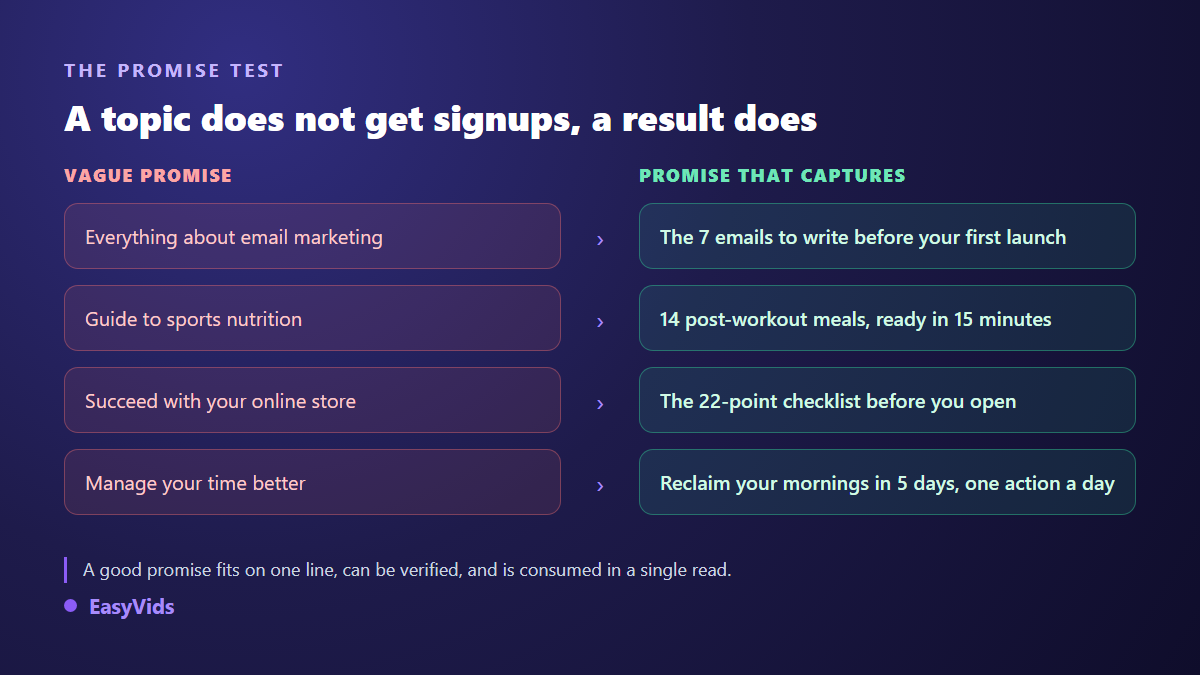
The gap between a magnet that converts and one that sits idle rarely comes down to design. It comes down to the promise written on the button. A broad promise describes a theme, a good one describes a result, with a number, a deadline or a situation. Here is the test: if fifty other companies in your field could use the same title, it is too broad. Add the audience, the moment or the specific obstacle you remove.
13 lead magnet ideas that work
The formats that convert best share one trait: they save time rather than deliver background knowledge. Here are thirteen proven templates to adapt to your business, each of which becomes a short illustrated book.
- The checklist: everything to verify before a risky move, a store launch, a shipment, a quote.
- The five day plan: one action per day, with the expected result at the end of each day.
- The swipe file: ready to use texts, emails, follow-ups, answers to common objections.
- The starter kit: what to install, open and register to get going in your field.
- The workbook: pages to fill in, which turn reading into actual work.
- The comparison brief: the available options, their use cases, and the rule for deciding.
- The mistakes file: the ones you see in your clients every week, each with its fix.
- The industry glossary: invaluable in technical fields where beginners dare not ask.
- The detailed case study: a real project, its numbers, its calls, and what you would change.
- The ready made content calendar: thirty dated topics covering a full quarter.
- The questions to ask a supplier: readers walk away equipped, and remember who equipped them.
- The recipe, routine or workout collection: strong in food, sport and wellbeing.
- The audience specific mini book: one method, restated for freelancers, retailers or nonprofits.
Length is decided before writing, not after. A magnet is read in one sitting, so twenty solid pages beat a doorstop abandoned a third of the way in. Our note on how many pages an ebook should have for each use gives workable ranges and, more usefully, the word to page conversion.
Writing the book in an afternoon
Writing is no longer the bottleneck. In the EasyVids studio a book starts from one sentence: your topic and the promise you intend to keep. The tool proposes an angle and a full outline, which you read, correct, reorder or extend before a single line is written. That is the decisive moment, and the only place where fixing things costs almost nothing: your edits to chapter titles and key ideas are followed word for word during the writing.
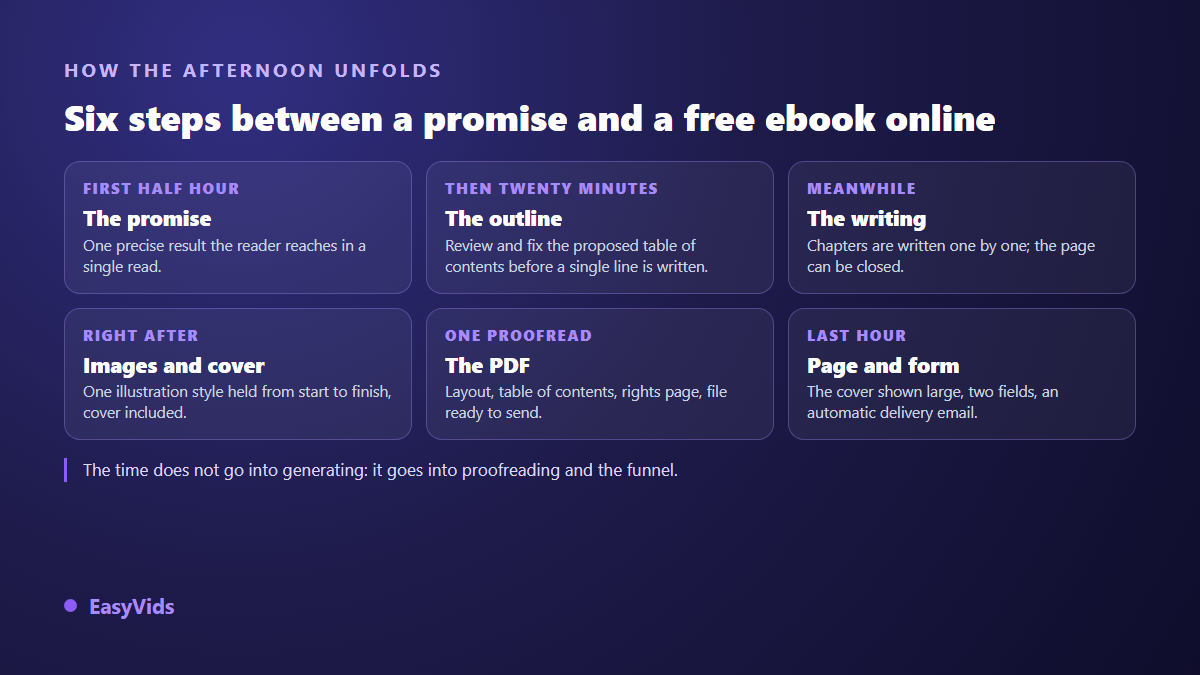
You then set the length in words, the number of chapters or let it be worked out for you, the illustrations per chapter, the language, the writing style, the tone, the page background and the author signature that appears on the copyright page. Chapters are written one by one, and production carries on if you close the tab. At the end, a report shows the words actually written, the gap with your target, the chapters and the images produced.
The cover decides part of your sign-ups
On a capture page, the cover does the job packaging does on a shelf. It has to stay readable at thumbnail size, carry the title large, and hold one visual idea. The other illustrations give the document the feel of a real book, which an exported text file never achieves. The rules are detailed in our method for a fully illustrated, laid out ebook.
Once the book is assembled, three promotional visuals are composed straight onto its cover: a square thumbnail, a wide banner and a vertical story. Those are exactly the three formats you need to announce the magnet on social platforms, at the top of an article or in an email signature.
The funnel: page, form, delivery email
A great book behind a bad funnel captures nothing. The capture page says one thing: the promise, the cover in large, three lines on what the reader will be able to do, and a form. Remove the navigation, the other offers, the sharing links. Every extra element is an exit, and visitors always take one.
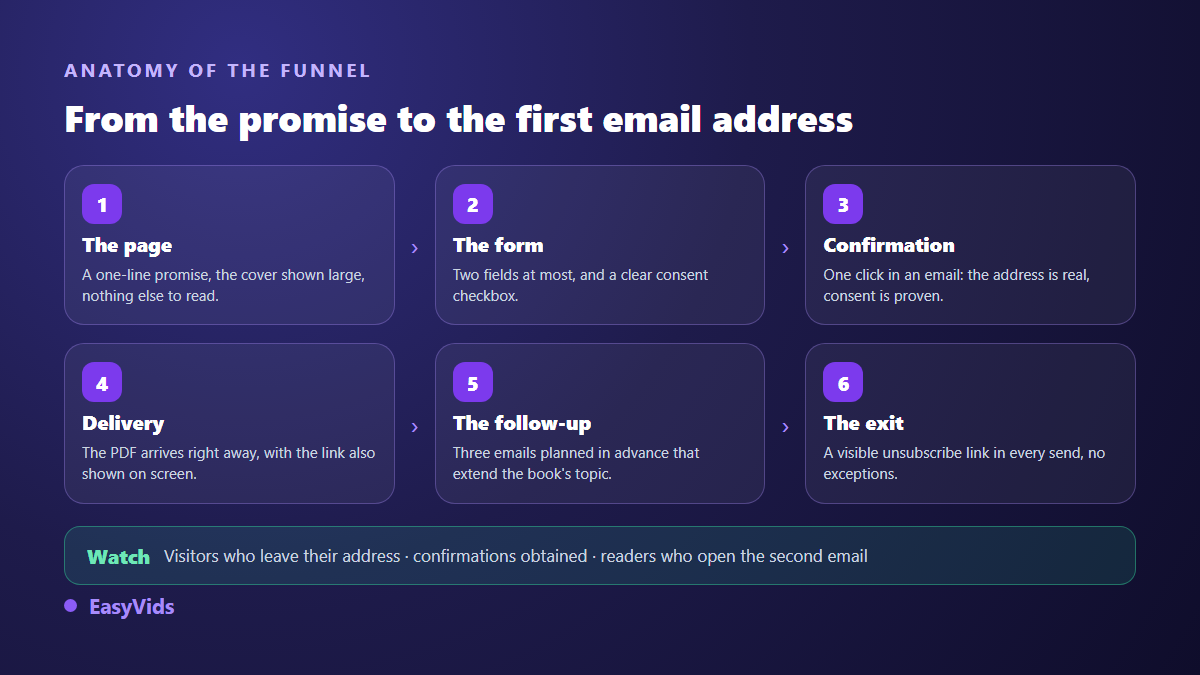
Ask for an address, and a first name only if you genuinely use it. Every added field lowers sign-ups, and a company or phone field only earns its place when your sales process depends on it. After submission, send the file immediately and also show the download link on the thank you page: that is your safety net when the email lands in spam.
Consent and unsubscribes: the part you cannot improvise
Collecting addresses puts you inside a legal framework. The General Data Protection Regulation, applicable across the European Union since May 2018, defines consent in article 4 as freely given, specific, informed and unambiguous. Article 7 requires the controller to be able to prove that consent was given, and states that withdrawing it must be as easy as giving it. In practice: an unticked box, a sentence saying what the reader is signing up for, and a dated record.
If you write to contacts in the United States, the CAN-SPAM Act of 2003, enforced by the Federal Trade Commission, requires a working opt-out mechanism in every commercial email, honoured within ten business days, plus a valid postal address for the sender and a subject line that does not mislead. Neither text requires double opt-in, but it remains the simplest way to keep a dated proof and to filter out mistyped addresses.
Delivering the file without friction
The PDF exported from the studio comes with its full page cover, its table of contents and its copyright page, ready to send as it stands. Host that file at a stable address rather than attaching it: heavy attachments get filtered, and a link lets you fix a typo without resending anything. If the magnet leads to a paid book, the checkout and automatic delivery routes are covered in our five ways to sell an ebook without a website.
Sending traffic to the capture page
A magnet without traffic is a file on a server. The three sources that work are short videos covering one slice of the book, articles answering the exact question the book answers, and messages to an audience you already have, however small. One studio option ships a short sales page, a thirty second video script and post hooks alongside the book, and that script can go straight into video production, as our AI video generator guide explains.
Then put the link everywhere it makes sense: at the end of articles, in your profile bios, in your email signature, pinned on your feeds. A magnet pays back over months, not over one post. The whole production runs on credits from a single account, and the plans are listed on the pricing page.
The three numbers worth watching
Three measurements are enough to run a lead magnet. The share of visitors who leave an address tells you whether the promise and the page hold up. The share of sign-ups who confirm or actually download tells you whether delivery works. The share of readers who open your second message tells you whether the book kept its promise. A problem with the first is fixed by rewriting the title, never by changing the button colour.
Mistakes that stop a magnet from capturing
- A promise describing a theme instead of a result: nobody signs up for a topic.
- A document too long to finish: it proves nothing and builds no trust.
- A five field form for a free file: every field costs you sign-ups.
- A capture page that keeps the site menu: visitors wander off and do not come back.
- Delivery promised within 24 hours: the wait kills the momentum.
- No message planned after the first one: the list goes cold within two weeks.
- A hidden unsubscribe link: complaints rise and deliverability drops for everyone.
- A book that ends on a sales pitch and nothing else: readers feel trapped.
Frequently asked questions
How long should a free ebook be?
Short enough to be read in one sitting, full enough to keep its promise. Fifteen to thirty pages covers almost every case, checklists included. Set the length in words before writing rather than cutting afterwards, so the text is calibrated from the first draft.
Should I ask for anything beyond the email address?
Only if you really use it. A first name earns its place when your messages address the reader by name. An industry field earns its place when it triggers a different sequence. Everything else lowers sign-ups and adds personal data you now have to protect.
Is a lead magnet written with AI worth less?
Its worth depends on what the reader gains, not on the tool that shaped it. What gives away a worthless document is generic content: advice the reader already knows. Bring your method, your numbers and your real cases, and let the machine handle the drafting, the illustrations and the layout.
Can I later sell the book I gave away?
Yes, provided you stay straight with the people who received it free. The cleanest approach keeps the magnet free and builds a paid, expanded version, longer, with templates or a workbook. You take nothing back from anyone, and you give a reason to buy.
How long before the first sign-ups?
The same day, if you already have an audience or an article receiving traffic. If everything is still to build, count in weeks: the book is ready in an afternoon, but the traffic source feeding it is built one publication at a time.
A lead magnet is not a gift, it is the first service you provide to someone who does not know you yet. Write the promise first, build the funnel second, and let the book be produced while you prepare the messages that follow. To launch yours today, create your account and start from the question your clients keep repeating. The EasyVids studio brings the writing, the illustrations, the layout and the promotional visuals together in one place.