Brands no longer buy only polished commercials. They buy footage that looks like something a customer filmed at home, on a phone, in a kitchen. That demand created a job, and it is why you are reading about how to become a UGC creator. The good news fits in one line: this work needs no audience, no studio kit and no film school.
The bad news follows immediately. Nobody hands a paid brief to someone who has never shown a single video, and no brand replies to a message that opens with « I am just starting out ». You have a proof problem long before you have a pricing problem. This guide follows the real order of the job: what a brand buys, what to build before you pitch, where brands look, what to agree in writing before you film, and where AI belongs. If you want to place this job among the others first, our overview of serious ways to make money with AI puts it in context.
The short answer
Becoming a UGC creator means selling videos to brands, not selling reach. You film content the brand publishes on its own accounts and runs as paid ads. The starting path has six steps: pick a product lane, build three spec videos with no client at all, become findable with a clear profile, pitch through creator marketplaces and directly, deliver usable files with written usage rights, then turn a first batch into repeat work. The tipping point is never the gear. It is the day you have three videos to show.
What the job actually is
UGC stands for user generated content. The name misleads, because this content is nothing like spontaneous: it is briefed, paid for and delivered. The brand takes the files, posts them under its own name, runs them as ads and often recuts them for a dozen placements. You are not selling visibility. You are selling footage, plus the right to use it.
That difference drives everything about how you start. An influencer is paid for an audience and has to build one first. A UGC creator is paid for footage and can start with an empty account. The expected format looks like a happy customer: vertical, filmed at arm's length, with a voice talking straight to camera. Our guide to AI avatars and UGC video breaks down the codes of that format, down to eye line and sentence length.
The path, in the order you actually walk it
The job has a strict chronology, and the most common mistake is taking it backwards: pitching before you have anything to show. Every step produces the proof the next one needs.
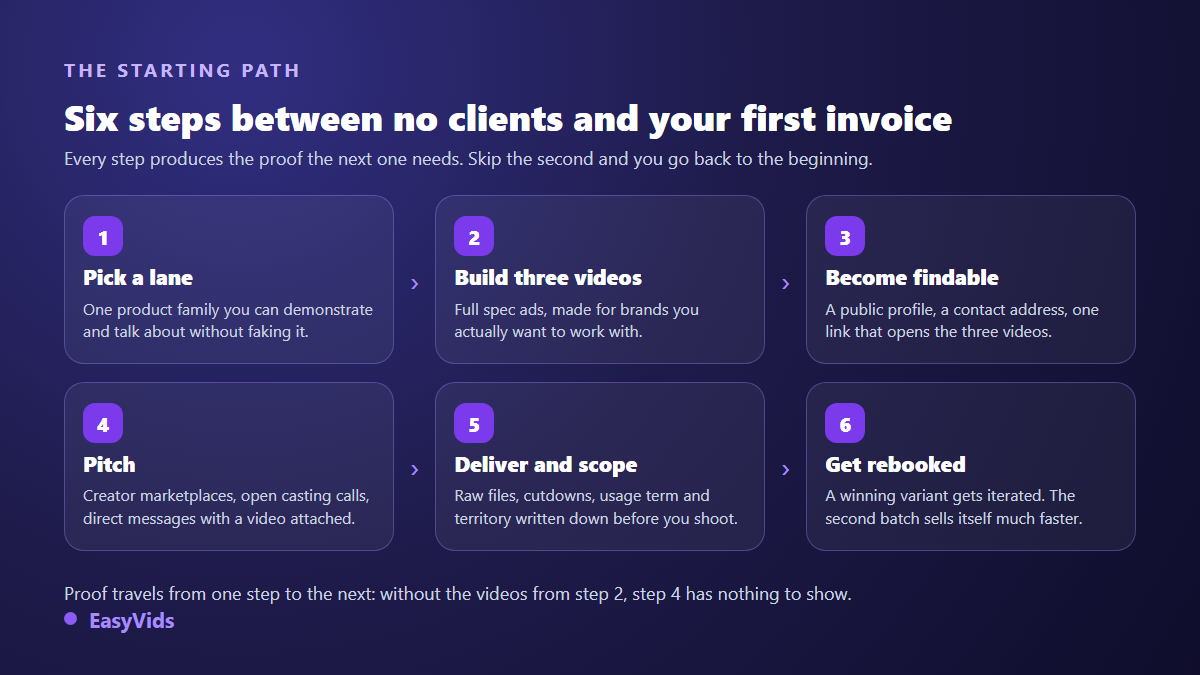
Those first two steps carry most of the starting workload and pay nothing while you do them. The four that follow take only a few hours per client once the material exists. That imbalance is what makes most beginners quit at the worst possible moment, roughly three weeks before replies start coming in.
What a brand is really buying
A UGC booking is not « a video ». It is a bundle of files plus a usage licence, and the licence often weighs more than the footage. A brand planning to run your face in paid media for a year is not buying what a brand posting once in a story is buying.
- Raw footage, unedited, at the best resolution your phone records.
- One vertical edit ready to post, captioned, with a hook in the opening seconds.
- Two or three alternate hooks cut onto the same base, so the brand can test.
- A short cutdown, for placements that clip longer videos.
- The usage licence: which placements, for how long, in which territories, exclusive or not.
- The number of revisions included, agreed before you shoot and never after.
Those lines are what separates a professional delivery from a favour. They also justify a difference in invoicing without arguing over a figure in the abstract: the same video is not worth the same thing under a short licence and a perpetual one. To see the demand from the buyer's side, our piece on concrete outlets for generated video lists what companies order most.
The portfolio: three videos beat a page of promises
You do not need a client to have a portfolio. You need three videos made for brands you want to work with, using products you already own. That is spec work: nobody ordered it, it simply proves what you can do. It is the only application document this industry actually reads.
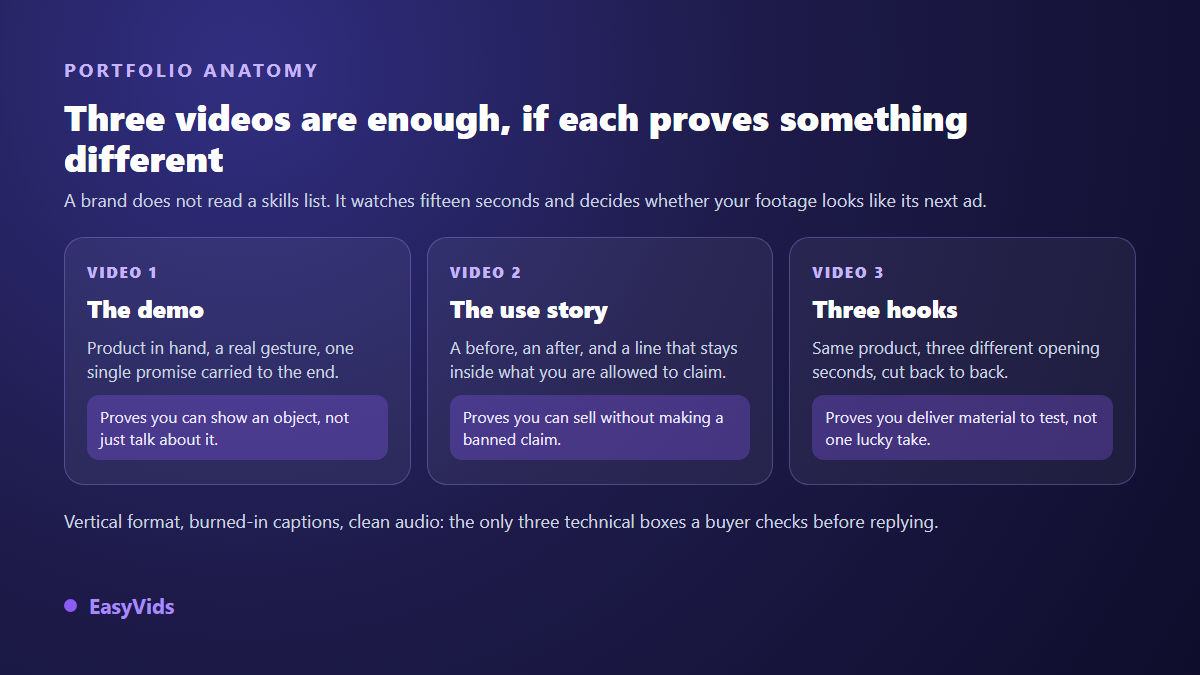
One mistake shows up constantly: filming three versions of the same exercise. Vary what each video proves, keep the finish level identical, and host them where a buyer can watch without creating an account. A link behind a signup loses half your prospects before the first second.
Where brands look for creators
Four channels genuinely work, and they ask for very different amounts of effort.
- The platforms' own marketplaces: TikTok and Instagram run creator directories reachable from a professional account, where brands post open campaigns.
- UGC-specific platforms, which hand out pre-briefed jobs with tight deadlines. Useful to start, weaker to build on.
- General freelance marketplaces, slower to take off, but they produce the first public ratings nobody else will give you.
- Direct outreach by email or DM, easily the most profitable channel once your three videos exist.
- Open creator calls posted by brands themselves, often in stories and rarely repeated elsewhere: watch the accounts you target.
Do not start with the most comfortable channel. Marketplaces put you in competition on price and turnaround, inside briefs that leave little room. Direct outreach lets you choose the brands, set your terms and own the relationship. Run both, but only the second one builds a career.
The pitch that gets an answer
A good message is four lines: what you noticed about their product, what you already made for them, the link that opens it in one click, one single question. The attached video does the work. It turns an application into a demonstration and spares everyone your life story.
Two details move the reply rate more than the wording. Write to the person who owns content, not to the general inbox. And attach a video shot with their product, not your best video for someone else. The first costs an hour of work. The second costs nothing and returns nothing.
Usage rights, the clause that hurts when it is missing
The topic bores everyone, which is exactly why it costs money. Footage delivered with no term stated shows up in paid ads two years later, with no further conversation and no further invoice. Put three things in writing before you shoot: the licence duration, the placements covered, the territories.
Then settle exclusivity, which bars you from a competitor for a period and should be priced accordingly. Finally, handle the likeness of anyone else on camera. If a friend appears in your shot, get a signed release: a serious brand will ask for it, and its absence stalls a campaign at the worst moment.
Where AI fits, and where it does not
The question beginners worry about is the wrong one. AI does not replace what the brand pays most for: a real hand on a real product, filmed with the small imperfections that make the clip believable. It replaces everything around that shot, which is already a lot when you work alone.
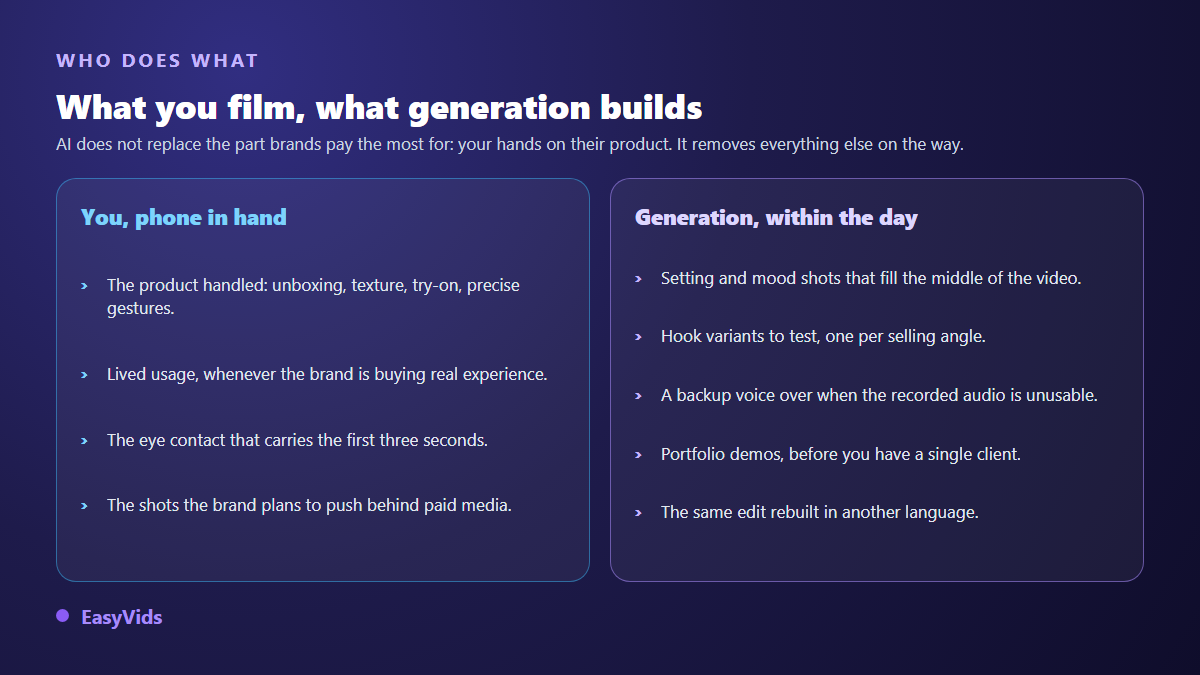
In practice, a generator that builds a full video from a single idea earns its place at three moments. Before your first client, to build portfolio demos while the product is not yet in your hands. During production, for setting shots and for the hook variants a brand wants to test against each other. After delivery, to rebuild a winning edit in another language. Our plans live on the pricing page, which moves too often to be copied into an article.
One limit deserves plain words. A generated shot that appears to show a real person really using a product is not a testimonial: it is a staged scene, and it has to be declared. On how the two approaches compare in performance, our analysis of an AI avatar versus a human creator sets out where each one wins.
What you must disclose, and what is simply banned
Platform rules converge. TikTok's Community Guidelines require you to label realistic AI generated or AI edited content using the in-app disclosure tool, and TikTok announced in May 2024 that it reads C2PA Content Credentials to apply that label automatically. On YouTube, disclosure of realistic altered or synthetic content goes through a checkbox in YouTube Studio, in place since March 2024. Meta announced in 2024 that it displays an AI information label on content detected as AI generated across Facebook and Instagram, and asks people posting realistic AI content to disclose it themselves.
The advertising side is stricter still. The Endorsement Guides of the United States Federal Trade Commission, updated in 2023, require any material connection between a brand and the person endorsing it to be disclosed clearly and conspicuously, which is precisely what a paid UGC video is. The same agency adopted a rule on fake reviews and testimonials in August 2024, banning testimonials attributed to someone who does not exist or who never used the product. In Europe, the AI Act sets transparency obligations in Article 50 for content that realistically imitates people or events, applicable since 2 August 2026. The working rule is short: you may generate a setting, you may not manufacture a customer.
The mistakes that cost you the first clients
- Waiting for a booking before making a first video, and therefore never making one.
- Sending a link to an empty social account instead of a video that plays on its own.
- Delivering a single edit, with no raw files and no alternate hook, so nothing can be tested.
- Agreeing to unlimited advertising usage without scoping it, then finding your face in a campaign a year later.
- Promising a sales result. A video sells on what it shows, never on a performance guaranteed in advance.
- Switching style with every video, so a brand cannot tell what it is buying.
- Skipping captions, when a large share of the audience watches with the sound off.
Frequently asked questions
Do you need followers to become a UGC creator?
No. You are selling video files and a licence, not reach. Some matchmaking platforms set a minimum follower count to open a profile, but a brand you approached directly watches your three videos, not your counter. An empty account has never blocked a first booking.
What gear do you really need to start?
A recent phone, a window for daylight and a small tripod cover your first deliveries. If you buy one thing, buy a microphone: bad audio gets a video rejected far more often than average footage. Shoot vertical, keep the frame steady, and light your face from the front rather than the back.
How many videos does a starting portfolio need?
Three, provided each proves something different: a product demo, a use story, a set of hooks on one product. Beyond that you repeat yourself. Below it, a brand cannot tell whether you can vary. Add one more each time you target a new category.
Can you do UGC work with AI generated video?
Yes for part of the work, under three conditions. The brand knows and agrees. The AI content label is switched on wherever the platform requires it, as TikTok's Community Guidelines and the YouTube Studio disclosure checkbox both do. And nothing fabricated is presented as lived experience. A generated setting is fine. A fabricated customer is not.
How do you set your terms as a beginner?
Charge for the deliverable and the licence, never for the hour. A simple grid does the job: the base bundle, an add-on per extra hook, an add-on for licence duration and territory, exclusivity as an option. You raise it as the portfolio grows and enquiries start arriving without outreach. A creator who bills by the hour punishes themselves for getting faster.
The job starts the day three videos exist, not the day you feel ready. Pick a product already sitting on your shelf, film the demo this week, build the other two, then send the link to five brands whose products you genuinely like. If you want those demos ready before you own a single product worth filming, create an account and build your first video so the portfolio is waiting before your first message goes out.