You run a generator, you get forty pages in twenty minutes, and you read it back. The prose is clean. The sentences connect. And something is still missing: this book could be signed by anyone, on any neighbouring subject. An AI generated ebook rarely fails on grammar. It fails on personality, and that is the first thing a buyer notices.
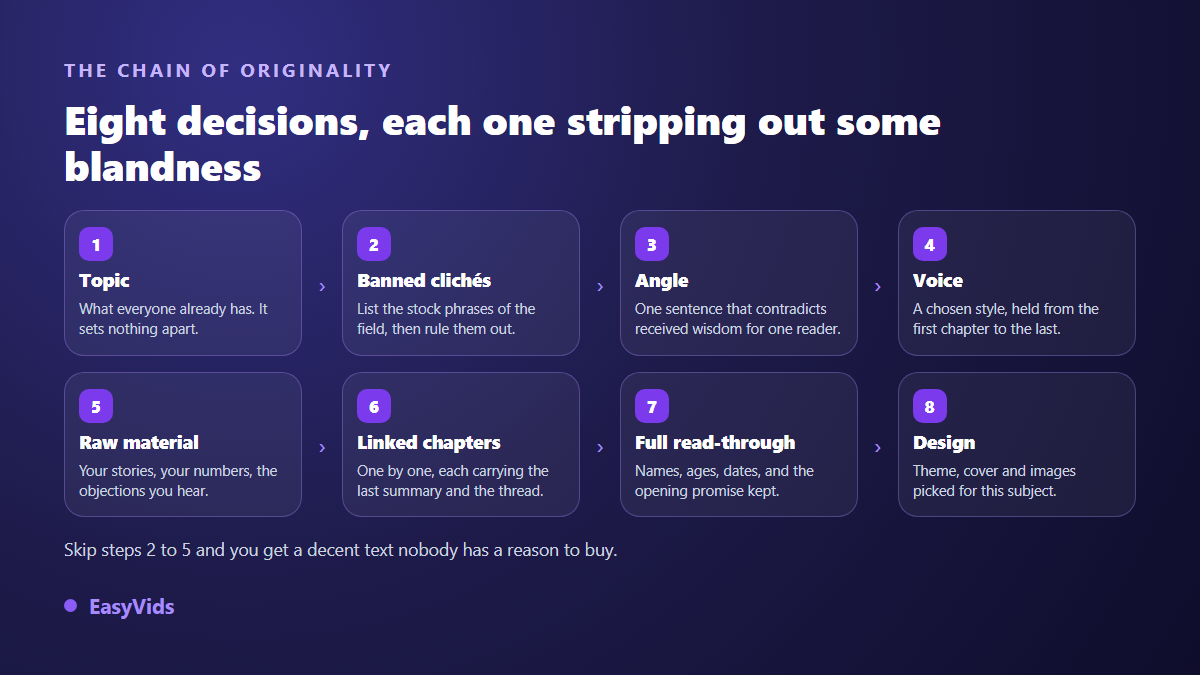
The usual reflex is to switch tools, or to ask the model to be « more original ». Both fail, because the problem sits well upstream of the writing: a vague subject gives a vague outline, and a vague outline gives interchangeable chapters. Each of the nine techniques below acts at one precise point in that chain. If you have never taken a book from subject to finished file, our complete guide to creating an ebook with AI lays out the six steps first.
The short answer
An AI generated ebook becomes unique when three decisions are made before the first sentence: an angle that contradicts what the field repeats, an author voice held from start to finish, and raw material the machine could not have known, which is yours. Proofreading never rescues a book that lacks those three. It only polishes something interchangeable. Everything else, illustrations, layout, output format, exists to serve that base.
Why two AI books on the same subject read the same
A language model produces what is most probable. That is its definition, not its flaw. Ask ten people with ten different tools for « a book about time management » and you will get the same table of contents ten times. Urgent versus important, the two minute rule, the chapter on notifications, the morning routine. With no constraint, the tool returns the average of what already exists.
The commercial consequence is immediate. A reader who has already opened two books in the field recognises that table of contents at a glance and closes the file. Uniqueness is not an author's vanity. It is what justifies paying for your book instead of asking a free assistant the same question.
1. Ban the clichés before the first line
The most effective technique takes one paragraph of instruction, and almost everybody skips it. Before asking for an outline, ask the model to list the clichés most books in the field repeat, then to forbid itself from using them. It knows those clichés perfectly, since they are exactly what it would produce on its own. Naming them first forces it to look elsewhere.
This is the first thing our writing workshop does, before it even proposes a title: it builds the list of the field's stock ideas, keeps it, then repeats it at every writing call. A cliché named once and forgotten comes back by chapter three. A cliché repeated at every chapter actually disappears.
2. Chase an angle, not a subject
The subject belongs to everyone. The angle belongs to you. « Managing your time » is a subject. « Why organisation systems collapse in jobs interrupted every ten minutes » is an angle. The second one excludes part of the audience, and that is precisely what makes it sellable: it speaks very loudly to the people it targets.
A useful angle fits in one sentence, contradicts a received idea in the field, and names a precise reader with a precise situation. If your sentence could open any book on that shelf, it is not an angle yet. Write three, keep the most uncomfortable one.
3. Pick an author voice and hold it
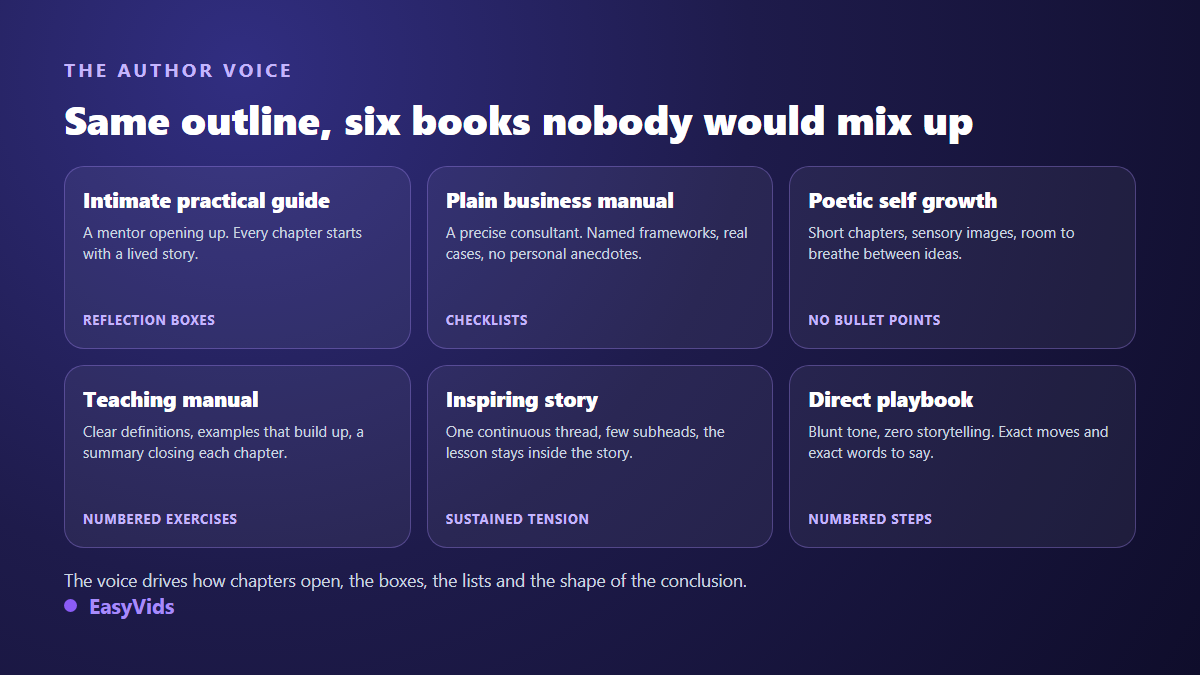
Two books can share an angle and still read nothing alike. Voice is what separates them. The mentor who confides does not write like the consultant who sets a framework, and neither writes like the narrator who leaves the lesson implicit. Text generated with no voice instruction has exactly that problem: no voice at all, or a different one by chapter three.
- Intimate practical guide: a mentor confiding, a lived story opening every chapter, a reflection box to close.
- Sober business manual: named frameworks, case studies, checklists, no personal anecdote.
- Poetic personal development: short chapters, sensory images, no bullet lists at all.
- Teaching manual: definitions first, progressive examples, numbered exercises, end of chapter recap.
- Inspiring narrative: one continuous thread, few subheadings, the lesson stays inside the story.
- Direct playbook: no storytelling, numbered steps, exact sentences to say, traps flagged.
Pick one, write it into your instruction, and check at every chapter that it holds. In our workshop that voice is a setting in its own right: it drives how chapters open, whether boxes appear, how often lists show up, and even the shape of the conclusion. The same outline run through two voices produces two books nobody would confuse.
4. Write chapter by chapter, with memory of the last one
Asking for a whole book in one shot is the most expensive shortcut there is. The model works inside a limited window: the further it writes, the less it remembers what it promised at the start. The result is easy to spot. Chapters shrink as pages go by, the same examples return in other words, and the conclusion picks up nothing from the introduction.
The method that holds is one chapter at a time, passing back at each call the book title, the promise, a summary of the previous chapter and the continuity items: first names, places, ages, chronology. That is what our engine does, saving each chapter the moment it is written and restating continuity at the next call. You gain coherence, and the ability to resume exactly where writing stopped.
5. Bring the material the machine does not have
This is the technique that permanently separates your book from the rest, and nobody can do it for you. An AI knows what has been published. It knows nothing about your client last Tuesday, the exact sentence they used, the number you measured on your own projects, the mistake that cost you six months.
Gather that material before writing. Five lived stories, three objections you hear constantly, two methods you genuinely apply, a handful of words you use that the field does not. Feed them in as instructions, chapter by chapter, where they belong. A book holding ten things nobody could invent becomes impossible to confuse with another.
6. Ban the writing tics that give the machine away
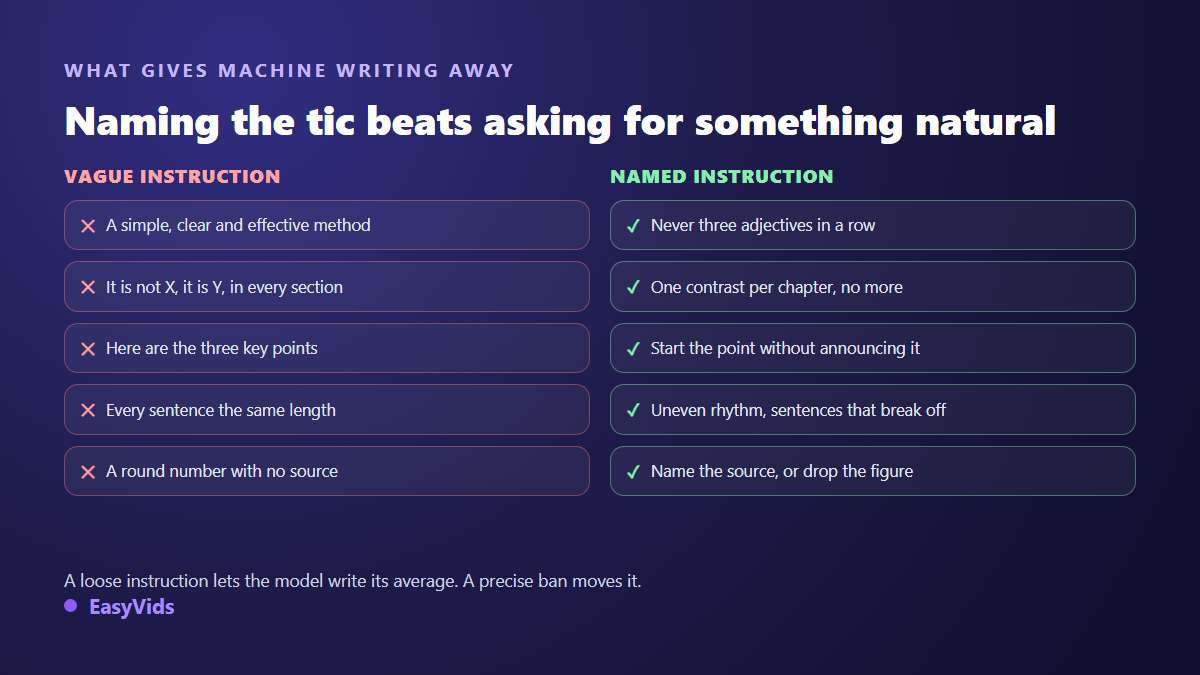
A regular reader spots generated text within three paragraphs, almost always on the same signals. These are not errors, they are statistical habits. Naming them in the instruction is enough to remove them, provided you name them precisely. « Write naturally » changes nothing. « Never use three adjectives in a row » changes something immediately.
- Adjective cascades: « a simple, clear and effective method ».
- The looping antithesis, « it is not X, it is Y », repeated in every section.
- The mechanical « here are » opening, and lists announced before they exist.
- Rhythm that never varies: every sentence the same length, no break.
- Essay transitions that open each chapter with the same formula.
- Round numbers with no origin, which discredit the rest of the chapter.
7. Proof for coherence, not for spelling
Spelling is the smallest problem a generated text has. The real defects escape every checker. A first name spelled differently between chapter two and chapter seven. A character who is thirty at the start and forty at the end. A promise made in the introduction the book never keeps. Two chapters telling the same anecdote from two angles.
Those defects survive a chapter by chapter review by construction: they only exist between chapters. So you need a second pass that takes in the whole book and hunts those four things specifically. In our workshop that pass is a separate option, recommended for longer books, because it sees what a local review cannot.
8. Dress the book like a book, not like a document
Excellent text delivered in a default font, with no cover, no margins and no breathing room, will be judged sloppy before it is read. Styling is not decoration. It is the first signal of value, and it should follow the subject. A finance manual in pastel and a sleep book in black and gold both start with a handicap the text will not repair.
Two rules are enough. The visual theme, colours and typefaces included, is chosen for the subject and the target reader, never at random. The illustration style is locked once for the whole book, otherwise every chapter looks borrowed from another title. We covered that side in our method for a fully illustrated and laid out AI ebook.
9. Measure the uniqueness before publishing
Uniqueness can be tested, and the test takes minutes. Take your table of contents, hide the title, and ask yourself whether a reader of the field could guess which book it belongs to. Then run the checklist below, honestly, before opening any storefront.
- The promise fits in one sentence no competitor could sign.
- At least one chapter openly contradicts a received idea in the field.
- The book holds ten concrete things an AI could not have invented.
- The voice is the same from the first chapter to the last.
- No first name, age, place or date shifts along the way.
- The conclusion delivers exactly what the introduction promised.
- Cover and illustrations tell the same book as the text does.
Unique is not enough: what selling still requires
A unique book nobody can find sells no better than a bland one. Two jobs remain: disclosure and go to market. On marketplaces, the Amazon KDP help centre asks you to flag AI generated content at upload, separating generated content from merely assisted content. We break down what that box covers in our review of the KDP rules, and our pricing page shows what a full production covers today.
Frequently asked questions
Can an AI generated ebook be detected?
Automatic detectors return unreliable verdicts in both directions, and no major platform bases a sanction on them alone. The real risk is human: a reader recognises text with no point of view, no verifiable examples and no voice. The nine techniques above address that risk, which is the only one that costs sales.
Is it legal to sell an ebook written with AI?
Yes on the main platforms, provided you meet their disclosure duties: the Amazon KDP help centre asks you to flag generated content at publication. Copyright is a separate question. According to the guidance published by the United States Copyright Office, a text produced without creative human input is not protectable, which is one more argument for a substantial personal contribution.
How many words does a sellable ebook need?
It depends on the use more than the genre. A document given away for an email address can keep its promise in a few thousand words. A paid book usually needs somewhere between twenty thousand and forty thousand words to avoid feeling like a stretched blog post. Density matters more than length.
Do I have to rewrite everything by hand?
No, and it is counterproductive: manual rewriting flattens the text without giving it a point of view. The useful work happens before generation, in the angle and the material, then after, in the coherence check. Plan an active read where you add your examples, your numbers and your phrasing where they belong.
Can AI write a book in my own style?
Yes, if you describe that style instead of naming it. « Write like me » does nothing. Describe your sentence length, your relationship with the reader, your recurring formulas, what you refuse to say, and attach two or three samples of your writing. Our workshop accepts a free description of the voice and uses it as the writing instruction for the whole book.
An AI generated ebook is not doomed to look like all the others. It becomes that way when the decisions that set it apart are skipped. Pick the angle that makes people uncomfortable, hold a voice, pour in your own material, check the coherence, dress the book for its subject. Production itself then takes hours instead of months. To write yours with all those settings in reach, create an account and start a first outline in the EasyVids studio.