A synthetic voice stopped you mid scroll, you looked up where it came from, and the name ElevenLabs came back. That is how most people arrive at an ElevenLabs review, with one precise question behind it: does that quality hold on my own script, in my own language, and not only in a polished English demo?
This article maps what the tool really covers, based on its public pages and documentation, then hands you a test you can run yourself in ten minutes. No invented benchmark, no fabricated ranking: when a fact comes from the vendor, the sentence says so. If you are weighing several tools at once, our comparison of AI tools for content creators sorts the market by need rather than by brand.
The short answer
ElevenLabs does one thing remarkably well: producing a believable synthetic voice, and reproducing an existing one from a sample. It is a serious audio studio, not a video studio. Its limit is not a technical weakness, it is a scope: the tool ships a sound file. If your deliverable is a podcast, an audiobook or a narration track, you are well served. If your deliverable is a published video, voice covers one step out of six, and the rest of the chain has to be assembled somewhere else.
What the tool covers, according to its public pages
ElevenLabs presents itself as an AI voice platform. According to the documentation published by the vendor, the catalogue is built around a handful of blocks reachable from the same account.
- Text to speech: a script becomes an audio file, with a choice of voices and models.
- Voice cloning: a voice rebuilt from a recording, in an instant or a professional version.
- The voice library, filled by users who share their own voice, with a payout programme.
- Dubbing: a track translated into another language while keeping the original timbre.
- Transcription, which turns audio back into text and feeds your captions.
- Sound effects and conversational agents, further from a content creator's daily needs.
Language coverage depends on the model you pick. According to the model documentation published by ElevenLabs, the reference multilingual model announces 29 languages, while the faster Turbo and Flash models announce 32. The spec sheet still says nothing about the part that matters: two models claiming the same language do not read it the same way at all.
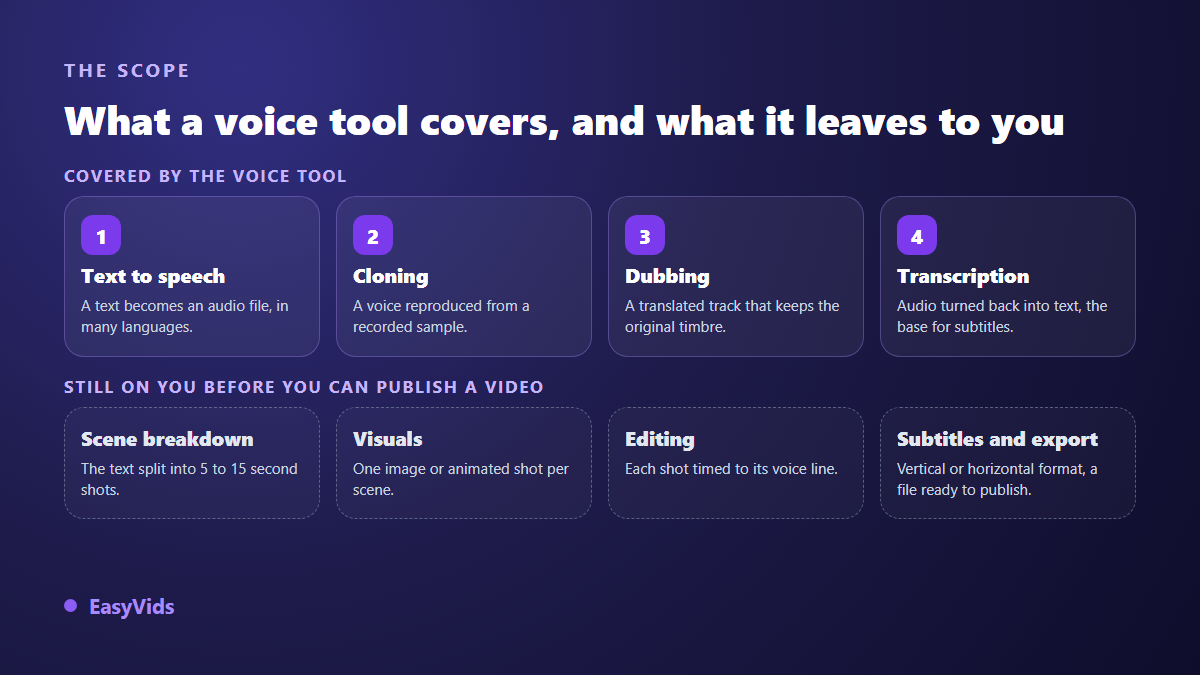
The diagram makes the point: these blocks cover sound, and only sound. Scene splitting, visuals, syncing every shot to its narration and burning captions all remain your job, in another tool or by hand.
The voices, and what really shows up when you listen
This is where a demo stops being an argument. Every language piles up traps that a marketing sample avoids: numbers written as digits, acronyms, proper nouns, liaisons. A voice can sound flawless on a welcome sentence and stumble on a date, swallow an acronym, or drop a foreign accent on a city name. Those faults never appear in a ten second clip picked by the vendor. They appear on your script.
The result also depends on two settings every engine offers under one name or another. Stability holds the voice steady, at the cost of a flatter read when pushed to the maximum. Similarity sticks to the timbre of your sample, and copies its flaws too when set too high. The rest is writing: short sentences, one idea per sentence, punctuation that breathes. Those habits apply to any engine, and our complete guide to AI voice over gathers them.
One calibration figure, measured across our own generations: a minute of narration is roughly 150 words, about 1,000 characters. Since voice quotas are counted in characters, that figure instantly translates any plan into minutes of speech.
Instant cloning against professional cloning
Two cloning routes coexist, and they do not play in the same league. According to the ElevenLabs documentation, instant cloning needs roughly one minute of clean audio and returns a usable voice in seconds. Professional cloning requires thirty minutes of recording as a minimum, with two to three hours recommended by the vendor, followed by several hours of training before first use.
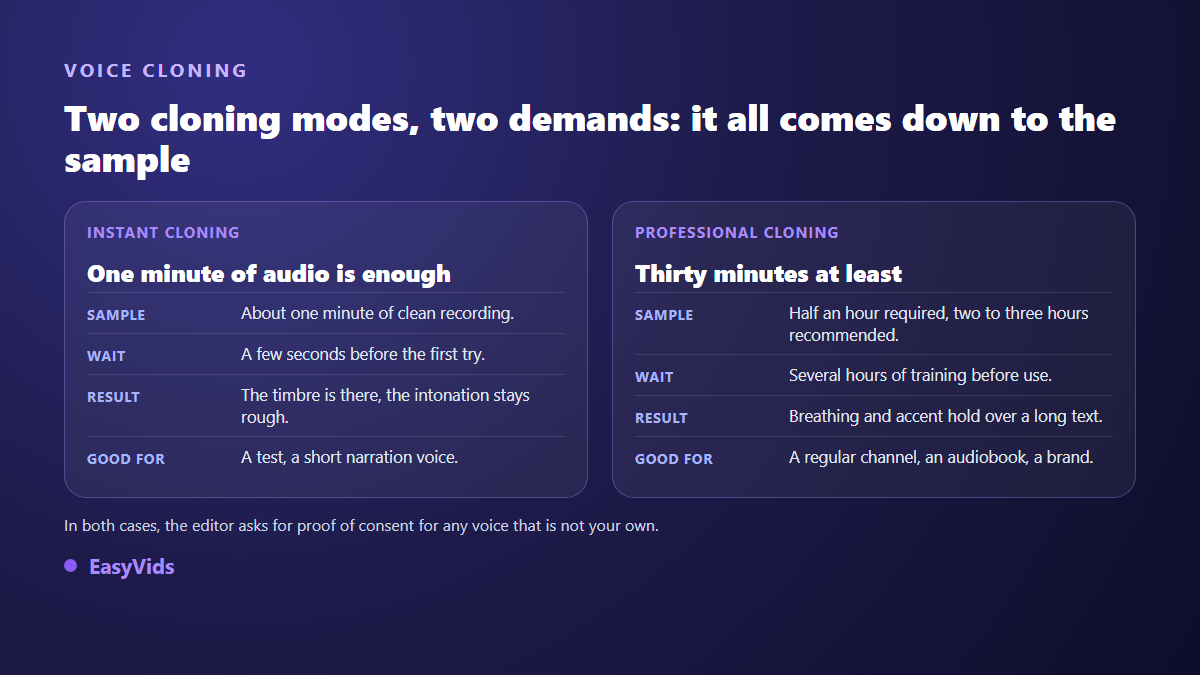
The gap shows up over length. Across three sentences, instant cloning passes. Across a full chapter, breathing, accent and sentence endings drift, while the professional version holds. Our article on how much audio it takes to clone a voice breaks down what each sample length is worth, and why recording quality beats recording length.
On consent the vendor leaves no ambiguity: professional cloning goes through a verification recording, where the person being cloned reads a confirmation sentence. That step is not paperwork, it is your evidence the day the use of that voice is challenged. For a first no commitment attempt, what free voice cloning really allows sets out the limits honestly.
What the law now requires
This part goes well beyond one brand. The European Union AI Act sets transparency duties in its article 50, applicable since 2 August 2026: audio or video content that imitates a real person has to be disclosed as generated or manipulated by artificial intelligence. Several countries add a national text on top, and in France article 226-8 of the Criminal Code punishes publishing an edit of someone's words made without their consent, unless the edit is obvious or explicitly stated. Two habits keep you safe: written consent before recording, visible disclosure after publishing. Our article on the legality of voice cloning goes case by case.
What the free plan allows
A free account exists, and it is genuinely useful: hearing the voices on your own sentences before committing. Two caveats, both stated by the vendor on its public pages. The quota is counted in characters, so in minutes of speech, and it melts as soon as you retake the same paragraph. More importantly, the free plan carries an attribution requirement, with commercial use reserved for paid plans, which is worth checking before you publish a monetised video. On our side, plan details live on the pricing page, the only source that stays current.
Testing a voice in ten minutes
No review replaces your own ears on your own script. The protocol below fits inside a free account, works with any vendor, and settles the question faster than any ranking. Write one paragraph that carries every trap, have each candidate voice read it, and always compare the same text.
- A date and a percentage written as digits, the most common failure of speech synthesis.
- Two everyday acronyms, to hear whether they are spelled out cleanly or swallowed.
- Three proper nouns from your world: cities, brands, customer names.
- A real question, to check that the intonation rises at the end.
- A three line sentence with a clause in the middle, the breathing test.
- A replay on headphones, then on a phone speaker, where your audience actually listens.
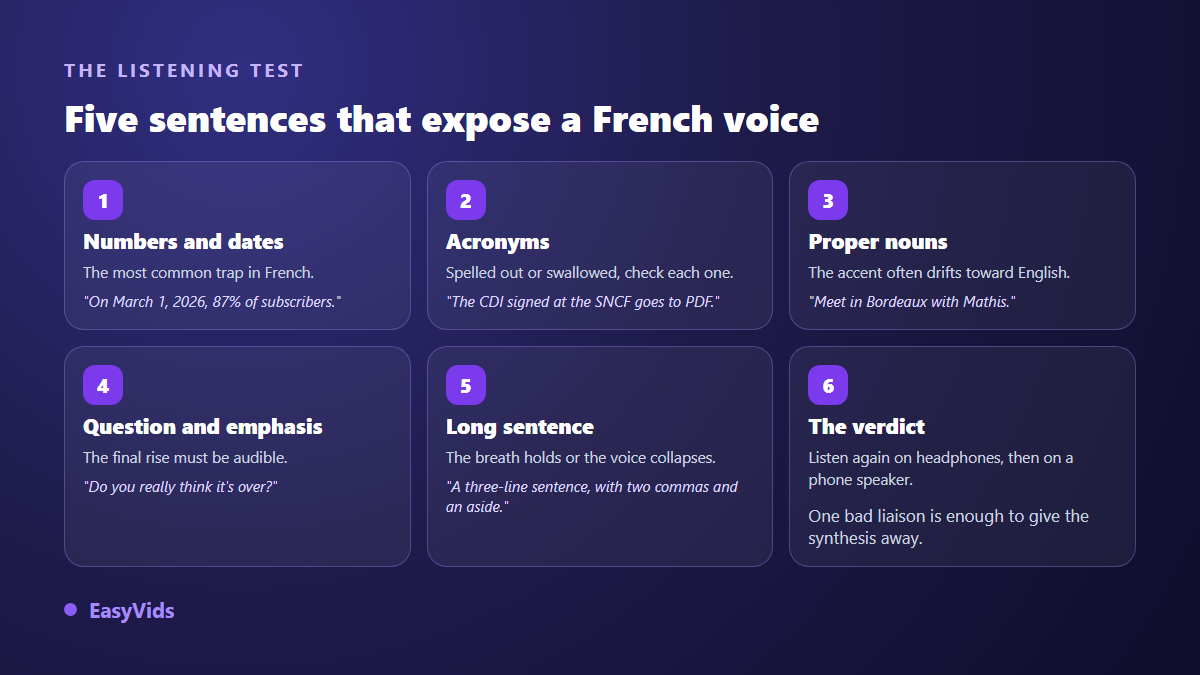
What should worry you is not an imperfect timbre, it is a reading error: it will repeat on every sentence of the same shape, across every video you publish. When a voice trips on one word, the fix is a phonetic spelling dropped into the text, a comma placed at the right spot, or a pronunciation dictionary when the engine offers one.
The limits you meet in daily use
- The quota is counted per character: every retake consumes, including the ones you throw away.
- A rare word has to be fixed text by text, the correction is not learned from one project to the next.
- Instant cloning done on a noisy recording reproduces the noise faithfully.
- The tool stops at audio: no scenes, no visuals, no edit, no burned in captions.
- A cloned voice stays tied to one account: switching platforms means recording the sample again.
- Shared library voices are used by thousands of people, so your narration is not exclusively yours.
A voice is not a video
This is the real decision before you subscribe. A flawless audio track brings you one sixth of the way to a publishable video: you still have to split the script into scenes, produce a visual for each one, sync every shot to the exact length of its narration, add captions and export in the right ratio. Plenty of creators who start with a voice tool end up with three subscriptions and an editor open on the side. Text to video services attack the problem from the other end and fold the voice into a full chain, with their own trade offs on visuals: our review of Fliki shows where that model wins and where it stalls.
A complete studio such as EasyVids keeps the six steps in one place: script, visuals, voice over, music and editing. The narration can be regenerated scene by scene without relaunching the whole production, which changes how you work when a single sentence sounds wrong. Three voice ranges are available, with a reading style dictated in plain language.
Frequently asked questions
Is ElevenLabs good outside English?
Yes. The multilingual models cover a wide range of languages and the output sits at the top of the market. The reserve concerns local details: liaisons, digits and acronyms. Those points are verified in two minutes with the listening protocol above, and are usually fixed by editing the text rather than the settings.
How much audio does voice cloning need?
According to the vendor documentation, about one minute is enough for instant cloning, while professional cloning demands thirty minutes minimum, with two to three hours recommended. Recording cleanliness weighs as much as length: a quiet room with a decent microphone beats an hour captured in a noisy space.
Can I use an ElevenLabs voice on YouTube?
Yes, provided your plan allows commercial use and you follow the vendor terms. On the platform side, the YouTube help centre penalises repetitive mass produced content with no added value, not the use of a synthetic voice: a carefully written story, read by an AI voice and edited with intent, stays within the monetisation rules.
Do I need permission to clone someone's voice?
Yes. Consent from the person concerned is the baseline, and written consent is safer. Since 2 August 2026 the European Union AI Act also requires disclosing that content imitating a real person was generated or manipulated by artificial intelligence. Cloning a public figure without consent exposes you to action, even when the video is framed as parody.
Can ElevenLabs produce a finished video?
No. The tool produces audio, plus dubbing and transcription from an existing video. Turning a plain idea into a finished video takes a studio that writes the script, builds the visuals, syncs the shots to the narration and exports in the right format.
The right way to choose fits in one sentence: start from your deliverable, not from the demo that impressed you. If it is an audio file, this tool is among the best available. If it is a video ready to publish, the voice is one piece of the puzzle. To hear what a voice sounds like inside a complete chain, create a free account and have it read your own test paragraph: ten minutes are enough to decide.