You are looking for a video script example because the blank page has been winning for twenty minutes. The topic is clear in your head, so is the length, and the first line still refuses to come. You know what happens next: you improvise on camera, you cut thirty times in the edit, and you publish something twice as long as it needed to be.
Fill in the blank templates rarely help. Reading hook, problem, solution on three lines tells you nothing about tone, rhythm, or what thirty seconds of speech actually weighs. A complete script can be copied and rewritten in your own words in ten minutes. Here are seven of them, one per common situation. For the mechanics behind them, our guide to writing a video script explains what each block does.
The short answer
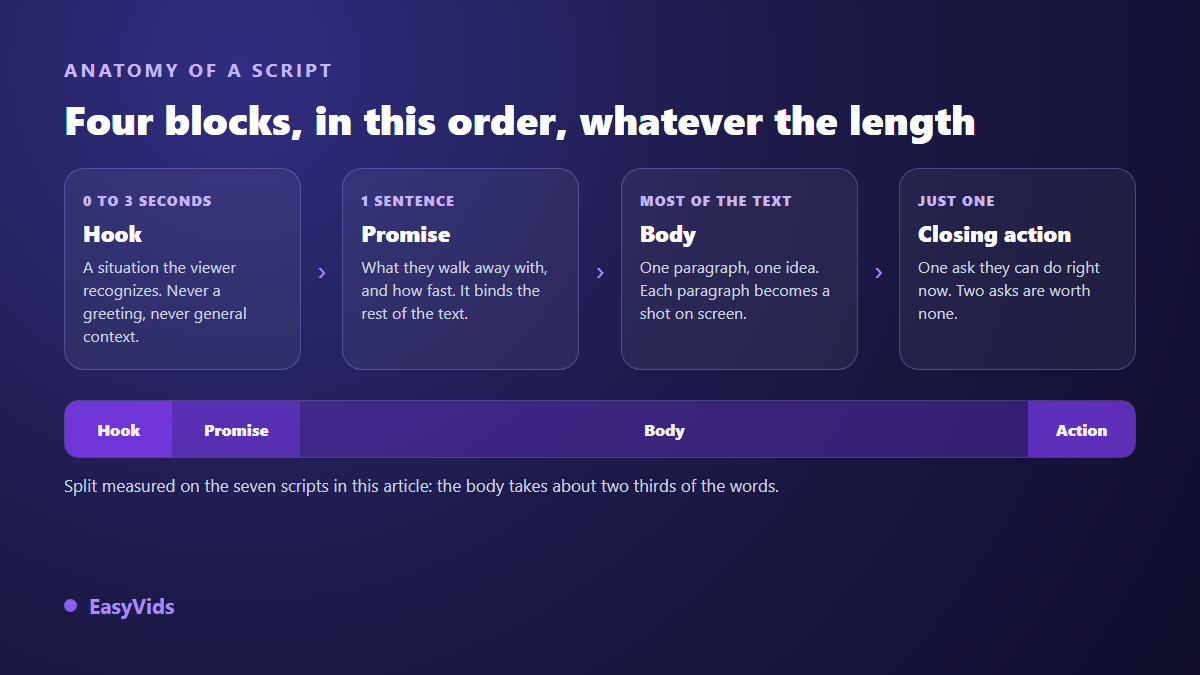
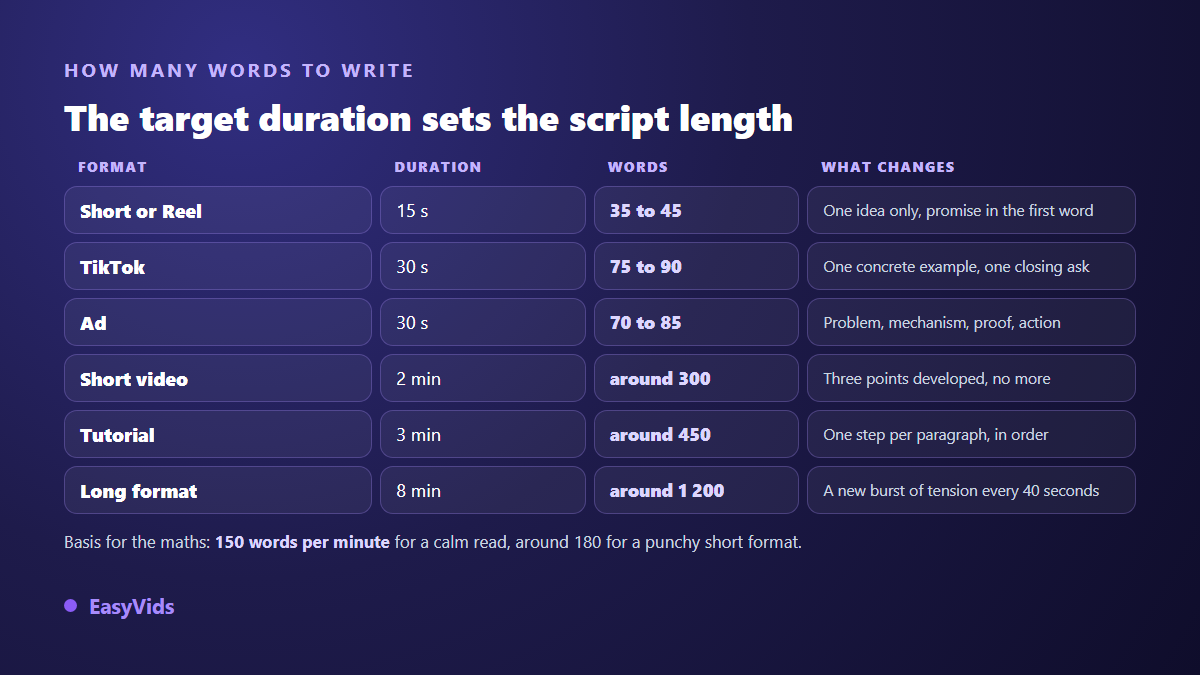
A usable script holds four blocks: a hook that gives a reason to stay, a promise that states what the viewer walks away with, a body where each paragraph carries one idea, and a single request at the end. Length comes from delivery speed. We calibrate our texts at about 150 words per minute of voice over, which means roughly 40 words for a 15 second Short, 80 words for 30 seconds and 450 words for three minutes. The seven scripts below follow that maths, so you can time them.
How to read these scripts
Each script is written the way it is filmed: spoken words only, no stage directions, no shot notes. Brackets mark the only parts you replace. The situations and characters are invented for the example, the mechanics are what matter. A short note after each text explains what holds it together, so you can reuse the method on your own topic instead of copying sentences.
One habit before you copy anything: a script is judged out loud, standing up, at the speed you actually speak. The sentences that trip you up are the ones that lose viewers, and a single read is enough to find them.
Script 1. YouTube tutorial, two to three minutes
Your product photos are sharp, and still nobody wants to buy. The problem is not your phone, it is where you put the object. Three moves, and your visuals change category.
First move: put the product next to a window, three quarters on, never in direct sun. Daylight draws the volumes a flash flattens. Second move: empty the background. A pale wall, a sheet of card, a plank of wood, anything, as long as it stays the same across your whole shop.
Third move: shoot three framings of the same object. A wide shot for scale, one at eye level, one close up on the material. Your customers are buying the detail they cannot touch.
Reshoot your favourite product tonight, put both versions side by side, and you will know which one to publish.
Why it works. The hook starts from something the viewer has already lived through, the promise announces three moves and the text delivers exactly three. The last line asks for something doable tonight, not a subscription. If your opening feels weak on your topic, test several: 51 hooks sorted by niche makes a decent testing bench.
Script 2. Story for a faceless channel
Nobody notices the old man who sits on the same bench every morning at seven. He opens a notebook, writes one line, closes it, walks away. He has done it for eleven years.
The baker across the street finally asked him why. He said he wrote down whatever had changed in the street since the day before: a repainted shutter, a felled tree, a child who no longer waits for the bus in the same spot.
The morning he did not come, four people ended up standing in front of that bench, strangers to each other, waiting for someone whose name none of them knew.
What they found on the bench changed the way that street talks to itself. And it was not the notebook.
Why it works. The story opens without introduction or presenter, straight on a concrete image, and every paragraph closes on an open question. The ending is announced without being given, which is the only real engine of a long format. Narration channels live on that structure, and it reads as well with a synthetic voice as with your own.
Script 3. Short or TikTok, one idea in thirty seconds
You answer customers in under three hours and you still lose the sale. Your response time is not the problem. Your first sentence is.
'Hello, thank you for your message' moves nobody forward. Meanwhile the seller next door wrote: 'Yes, size 39 is in stock, I am holding it for you until tonight.' A reply that contains a decision beats three polite follow ups.
Open your last ten replies. Count the ones that contain a decision. There is your plan for tomorrow.
Why it works. One idea, a counter example in two lines, an instruction you can apply tomorrow. Short formats carry neither context nor pleasantries: the whole promise has to land in the first three seconds, or the thumb keeps going.
Script 4. Product demo, before and after
This is my [product] after six months of daily use. Look at the colour, top right.
I did nothing special: warm water, two minutes, a soft brush. Nothing else, no miracle product and no machine.
And here is the same object, filmed straight after, with no cut between the two shots.
The question coming in the comments: does it last? I will film the same object again in three months, on this channel.
Why it works. The demo opens on the result instead of introducing the product. The line about no cut between the two shots defuses the doubt before it forms, and answering the objection in advance turns the comments into a conversation rather than a trial.
Script 5. Thirty second ad
You have three hundred photos from your last trip, and nobody has ever seen them.
[Service name] turns a folder of photos into a two minute film, with music and a narrated script. You drop in your images, you pick a mood, you get the video back.
The file is ready before your lunch break ends. Your parents will watch it tonight.
Try it free with ten photos at [address].
Why it works. Three seconds of problem, one line of mechanism, one proof built on time, one low commitment action. Not a single technical feature is named, and the closing promise stays verifiable. That last line carries more weight than people think: 21 call to action formulas shows how to ask without begging.
Script 6. Customer testimonial in three beats
I used to spend Sunday evenings preparing the week's posts. Four hours, every week, taken from my family.
I tried [tool] without believing in it, mostly because a colleague kept insisting. The first week I kept my old method running in parallel, just in case.
On the third Sunday, I never opened it.
Now I prepare the week in forty minutes on Monday morning, and I publish more than before. What I got back was not working time. It was my Sundays.
Why it works. The testimonial runs in three beats: the situation before, the tipping point, the result. It names a precise moment, the third Sunday, where an adverb like quickly would convince nobody. One caution: this script exists to prepare the interview of a real customer and remind them of the shape you need, never to manufacture a review that does not exist.
Script 7. Company profile, sixty seconds
[Company name] started in a thirty square metre garage, with two machines and an order book kept by hand.
We make [product] for people who use it every day and would rather not think about it. That is the entire brief: it has to hold.
The workshop now runs with [number] people. The order book stayed in the desk drawer, because it holds the first signature we ever got.
If you are looking for a supplier who picks up the phone, write to us. We answer ourselves.
Why it works. A company profile tells one decision, not a list of values. The concrete detail, here the order book in the drawer, travels further than three stacked adjectives, and the closing promise can be checked on the first phone call.
Length is the only maths to do before writing
A script that runs long is not repaired in the edit, it is cut, and your best sentences usually go first because they are the longest ones. The calculation fits on one line. A calm delivery moves at about 150 words per minute, a tight short form delivery climbs towards 180. That is the marker we use to size our own scripts, and it predicts duration within a few seconds.
Four checks beat a rescue edit:
- Read the text out loud with a timer. It is the only measurement that counts, a word counter only estimates.
- Allow one breath per full stop. A lightly punctuated text reads too fast and lands badly, whatever the voice.
- If you overshoot the target by a fifth, delete a whole paragraph instead of shaving every sentence.
- Keep the last sentence short. It is the one viewers remember, and often the only one they repeat.
Adapting one of these scripts in four moves
Copying a script is not enough, you have to move it into your subject without breaking its frame. Four moves, in this order.
- Replace the bracketed parts first, then reread. If a sentence stops meaning anything, it was resting on a detail you now have to invent from your own material.
- Rewrite the hook last, never first. It gets chosen once the body exists, because the body decides which promise you can keep.
- Cut one idea in two if you need a shorter format. These texts are sized for the duration announced, not for yours.
- Swap the examples for your own, even rough ones. A borrowed example is audible, a lived one tells itself.
From script to finished video
A validated script is not a video yet. The next step splits it into scenes: one paragraph becomes one shot, and that split decides the final rhythm. It is done on the text, where a fix costs a minute, rather than on the timeline, where the same fix costs ten. The full handover is covered in our method for turning a finished script into an edited video.
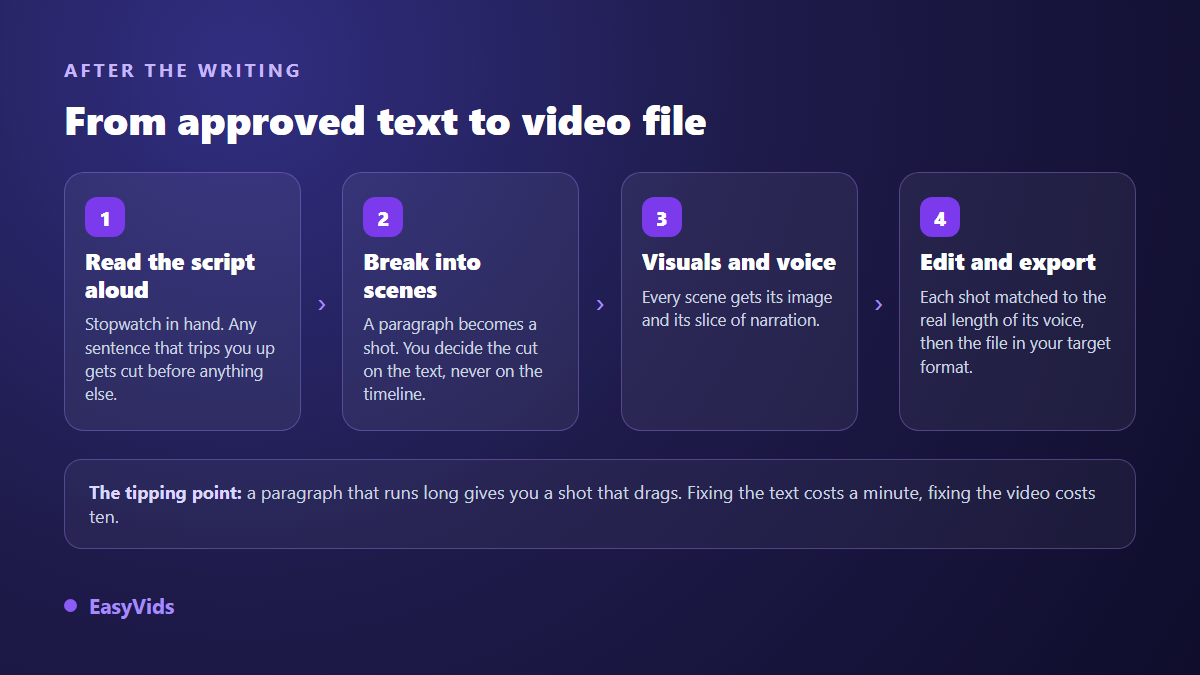
That split also explains why the paragraphs in these seven examples stay short. A six line paragraph produces a shot that drags, and the viewer stares at the same image for twenty seconds. Writing short gives you a decent rhythm before you even open an editor.
Writing your own from a one line idea
On EasyVids, writing opens the whole path. You type an idea in one sentence, you pick a tone or let the tone be chosen from the idea itself, and you set the length in words or directly in minutes of voice over. Four writing languages are available: French, English, Spanish and Portuguese. One checkbox adds the closing call to action, another grounds the text in a web search when the subject needs facts, and your personal instructions stay saved on your account between sessions.
A more demanding writing mode runs five passes over the same text: first draft, critical review, corrections, final check, last touch ups. The work continues server side, so you can close the page and find your texts again in the history. The finished script then moves into the scene split and into the workshop, where each paragraph gets its visual and its voice. For an ad, the product presentation path also writes a marketing script from the product name, its photo and the description you provide. The EasyVids studio keeps those steps in one place, and the plans are detailed on the pricing page.
Frequently asked questions
How many words for a 60 second script?
About 150 words for a calm delivery, 120 if you leave silences, up to 180 for a punchy short form read. Write the 150 word version, time yourself reading it, then adjust. Real pace varies from one voice to another, and your own read is the reference.
Can I copy these video script examples as they are?
Yes for the structure, no for the sentences. The mechanics are free to reuse, but a text copied word for word will appear on other channels and will not speak about your subject. Replace the brackets, then rewrite every line in your own vocabulary.
Should shot directions live inside the script?
Keep them apart. The script holds spoken words only, which lets you time it and hand it to a voice over without cleaning it up first. Visual notes belong beside it, in a column or in the scene split, never in the middle of the words to say.
Does an AI written script sound like one?
It does when nobody has reviewed it. The signs are familiar: sentences of identical length, interchangeable transitions, stock phrases, no concrete detail. A read out loud plus two or three cuts removes those marks, and that is exactly what the critical review pass does for you.
An example never replaces your voice, it saves you the worst half hour, the one spent in front of a blank page. Pick the script closest to your next video, replace the brackets, read the result standing up, cut whatever trips you. To write the next one from a single idea and carry it through to an edited file, creating an account opens the full studio.