A channel posts three times a week, pulls hundreds of thousands of views, and you never see a single person in it. A voice, some visuals, a tight edit, nothing else. So the question comes up fast: what is a faceless YouTube channel exactly, and why are there suddenly so many of them?
The label is new, the format is not. It simply means a channel whose creator never appears on screen. What changed recently is not the idea, it is what it costs to manufacture. This page gives the definition, shows what unlocked the model, breaks down what replaces the face in a video, and says where the format stops working. For the hands on part, niche by niche, our guide to running a YouTube channel without showing your face takes over.
The short answer
A faceless YouTube channel is one where the creator never films themselves: the voice, the visuals and the edit carry the whole thing. It is not an official YouTube category, not an account status, not an algorithm trick. It is a staging choice that brings a different production method with it: you write and assemble instead of shooting. Subscriptions, search, Shorts and monetisation all work exactly as they do on any other channel.
What the format actually covers
Take any video in the genre and mentally remove everything a camera would have produced. What remains is a spoken text, a run of visuals, a soundtrack and an edit. That is the whole definition. The creator still authors everything, they are simply not the visible subject of their own channel. Some push the logic to full anonymity, others sign with their real name in the description, with a contact page and a proper brand.
Three confusions come up constantly. Faceless does not mean anonymous: plenty of creators in the format are perfectly identifiable, they just do not film themselves. Faceless does not mean automated: the format still demands an angle, a script and a careful review. And faceless does not mean nobody on screen: an illustrated narrator, a mascot or a recurring character all sit comfortably inside the format, as long as the face is not yours.
Why the model is booming now
The format is as old as the platform: compilations, screen recorded tutorials, narrated documentaries, sleep and relaxation content. So what shifted is not audience appetite. Four production bottlenecks gave way, almost at the same time.
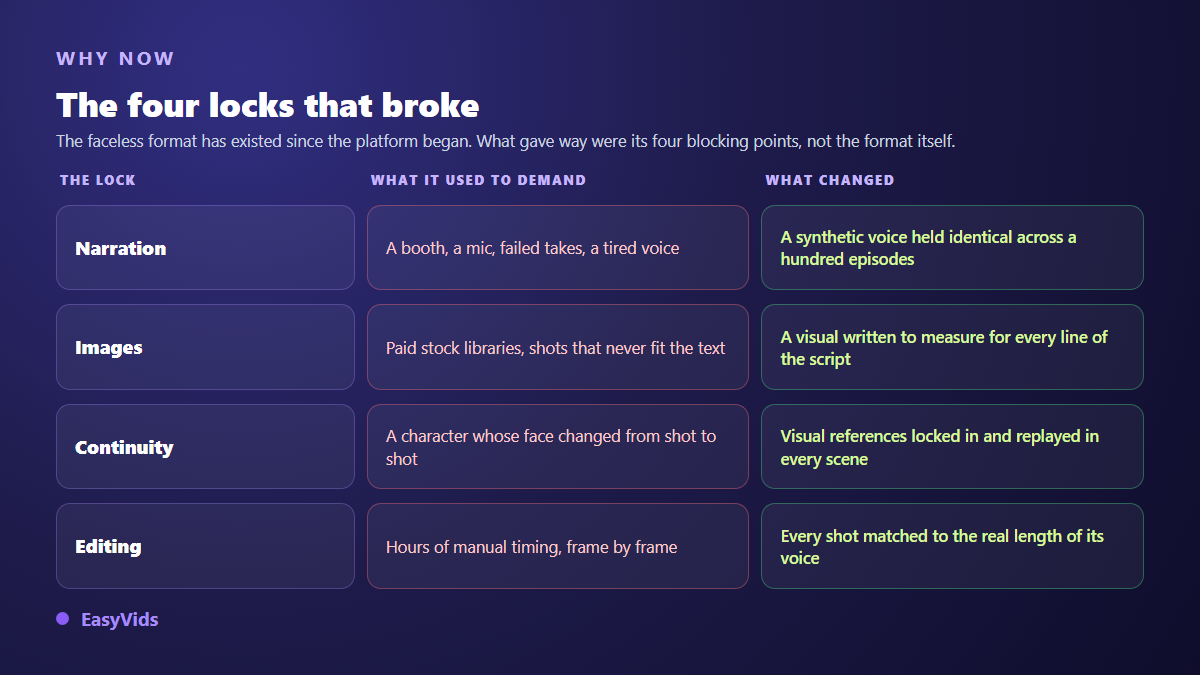
Look at the middle column: every one of those constraints came back with each upload. That repeated cost is what ended most channels around video five, not a shortage of ideas. Once the unit cost of an episode collapses, one person can hold a schedule that used to require a small team.
A second effect matters just as much and gets mentioned less: the format duplicates. The same editorial base rolls out in several languages, in landscape and vertical, across several channels, with nothing ever reshot. The full chain, from script to exported file, is laid out in our guide to AI video generators.
What replaces the face on screen
Removing the camera does not remove the work, it moves it. Four elements then carry the viewer's attention on their own, and a fifth one holds them together from episode to episode.
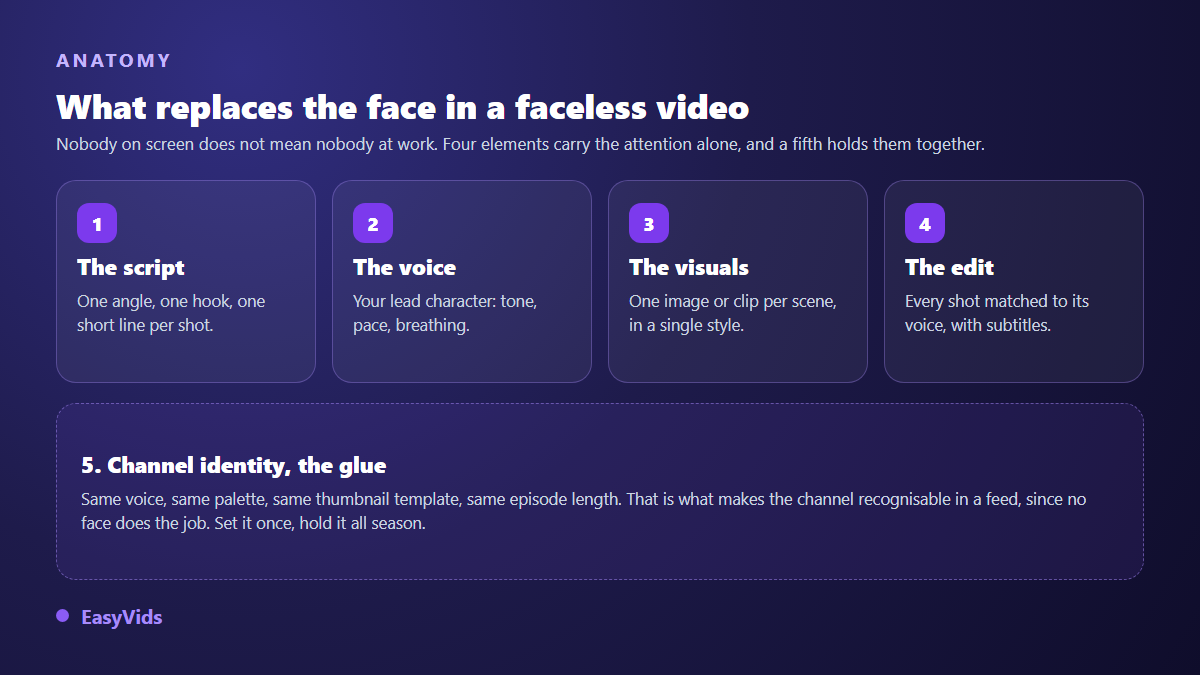
The voice deserves its own note: it becomes the lead character. Average visuals with a well handled narration work fine, and the reverse never does. Keep one timbre across the whole channel, and take care with punctuation, because synthesis engines read it the way an actor reads a score. On screen text then takes over as soon as the video is watched with the sound off, and our roundup of the reasons to caption your videos shows how large that share of the audience has become.
The families that actually last
Faceless covers very different jobs. Two channels in the same format can demand half a day of research per episode on one side, twenty minutes of writing on the other.
- Stories and narrative: the sturdiest of all, because each episode creates appetite for the next.
- Explainers and education: the one that ages best in search, still found years after upload.
- Documentary and investigation: heavy sourcing, but far longer watch time.
- Motivation and self improvement: fastest to produce, and by far the most crowded.
- Cases and true crime: particular care is required on facts and on the people named.
- Relaxation, sleep and ambience: little editing, a lot of patience before anything moves.
Each family sets its own pace, episode length and type of voice. Stories pulled from public discussion threads live on a nervous edit and a very spoken narration, as our method for launching a narrated stories channel details. Criminal cases sit at the opposite end, asking for deliberate slowness and constant factual rigour, covered in our true crime channel guide. Explainers, for their part, stand or fall on the clarity of their visuals, and our guide to animated infographics shows how to hold data on screen without losing the viewer along the way.
Continuity is what separates a channel from a pile of uploads
This is the technical point that decides everything, and the last one to give way. As soon as your stories feature an illustrated narrator or recurring characters, their appearance has to hold still. A written description, however detailed, will not do it: the face drifts between generations, and viewers spot it instantly.
The method that works is to lock visual references once, then replay them in every scene instead of redescribing the character in each prompt. The principle, its limits and the settings that matter are covered in our article on keeping a character consistent.
That is exactly what the EasyVids Director does. Before a single image is generated, it reads your script and derives a production bible: the universe is locked (era, style, palette, keywords), every character gets its own portrait prompt, every set gets its own, and a group that keeps coming back can be frozen into a single combined reference. Scenes then cite those identifiers instead of redescribing anyone. The plan stays saved on your account, and you can close the page: generation carries on on our servers.
One production benchmark, measured across our own generations: count roughly 110 characters of script for six seconds of voice over, one line per scene. Automatic splitting aims at that target and flags any segment past 220 characters, which is about fifteen seconds on a single shot. Past that, the pace drops and the viewer leaves.
The economics, with no income promises
Advertising is one revenue line among several, and rarely the first to trigger. Channels in this format also live on affiliate links, digital products, partnerships and licensing of their own footage. The trait genuinely specific to faceless sits elsewhere: the channel does not depend on a person. It can be produced by several people, partly delegated, even handed over. A channel built on a face cannot be transferred.
Spending changes shape too. The main line item is no longer equipment, it is writing time and generation compute. A credit system lets you arbitrate scene by scene: a fast model for drafts, a more careful one for the published cut. Our plans are detailed on the pricing page, because they move and an article sentence ages badly. And treat any revenue figure quoted without a channel name, a niche and a start date as decoration.
What YouTube allows, and what it penalises
According to the YouTube help centre, no rule requires you to appear on camera, and Partner Program eligibility does not depend on it in any way. The subscriber and watch time thresholds do change from time to time: check them in the official platform terms rather than in an article, ours included.
The rule that really matters has had a precise name since the monetisation policy update YouTube published in July 2025: what the help centre used to call repetitious content is now called inauthentic content. The platform's creator liaison team stated publicly at the time that this was a clarification, not a ban on AI. What is targeted is the same template rolled out at scale, text lifted from elsewhere and simply read by a synthetic voice, an edit that adds nothing to its source. A faceless channel that writes its own scripts and picks its own angles stays well inside the rules.
Two obligations do deserve attention. Since March 2024, YouTube asks creators to disclose in the video settings any realistic altered or generated content that could mislead viewers, especially when it depicts real people or events. The European regulation on artificial intelligence provides, since its transparency obligations came into application in August 2026, that such content be labelled as generated. And you must be able to justify your rights to the music and imagery you use: one badly licensed track is enough to strip the revenue from an episode that works, sometimes months later.
The limits, stated honestly
The format has trade offs, and enthusiastic write ups tend to skip them. Here they are, in the order you meet them.
- Attachment builds more slowly: without a face, you need a very strong audio and visual identity to compensate.
- Competition is immediate, since the barrier to entry dropped for everybody at the same time.
- Some niches saturate fast, motivation and true crime above all.
- The work moves to writing, the one task nothing really automates.
- Brand partnerships stay harder to land than with a recognisable presenter.
- A channel published without review eventually shows it, and the audience notices before the platform does.
Whether the model suits you
The format is not universal, and starting purely out of camera shyness is a poor reason. The real question is about your subject: can it be told, or does it have to be demonstrated with you present?
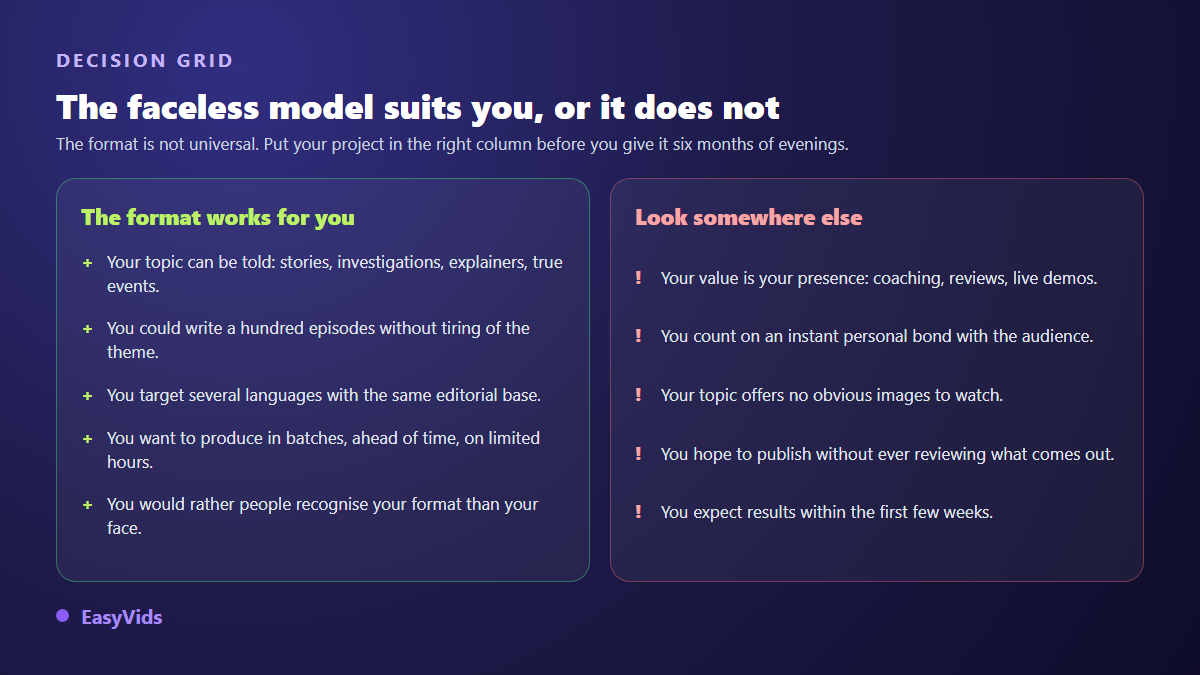
If you recognise yourself on the left, the rest is method: a niche you can sustain, a one page channel bible, a buffer of finished episodes before the first upload, and a rhythm you can hold in a busy week rather than an ideal one.
Frequently asked questions
Can a faceless channel be monetised?
Yes. Neither the missing face nor the use of AI closes monetisation. You need to reach the Partner Program thresholds, follow the content rules and bring something of your own to each episode. What gets refused is repetitive output with no contribution, however it was made.
Should a faceless creator stay anonymous?
No, and it is often a handicap. A stated identity in the description, a brand name and a contact page make partnerships easier and reassure advertisers. Not filming yourself and not naming yourself are two separate decisions.
How long does one episode take?
On a three to five minute narration, writing stays the longest task. Generating visuals and voice takes minutes when scenes run in parallel, and review takes the rest. The real gain appears once you produce in batches instead of one episode at a time.
Can I use my own voice on a faceless channel?
Of course, the format only rules out the camera. Your own voice is an asset if you like it, but it ties the channel to your availability and your health, which makes batching harder. Many creators start with their voice, then move to a synthetic one held identical as the pace increases.
Does the model work on Shorts and Reels?
Yes, and that is where it spreads fastest, because short form is often watched with the sound off. Two habits follow: frame vertically from the writing stage rather than cropping afterwards, and caption everything, since the opening seconds are won in text.
A faceless YouTube channel is not a shortcut, it is a shift of workload: less filming, far more writing and art direction. The channels that last are the ones that fixed a voice, a style and a format, then held them across a hundred episodes. To test a first series before giving it your evenings, creating an account opens the full studio, from script to final edit, and EasyVids keeps those steps in one place instead of five separate tools.