If you want to make money with AI, you have already met the same promises everyone else has: income arriving while you sleep, a fully automated channel, a system that supposedly asks almost nothing of you. Those promises all sound alike because they come from the same place. They are sold by people whose real product is the promise itself.
This article takes the opposite approach. You will find no figures here, no typical income, no dashboard screenshot. A number quoted by a stranger tells you nothing, because it depends on a market, an audience and a timeframe you do not share. What can actually be compared is mechanisms. For each route, three questions matter: what it genuinely requires, how quickly it can produce a first result, and why most people give up before it does.
Make money with AI: the short answer
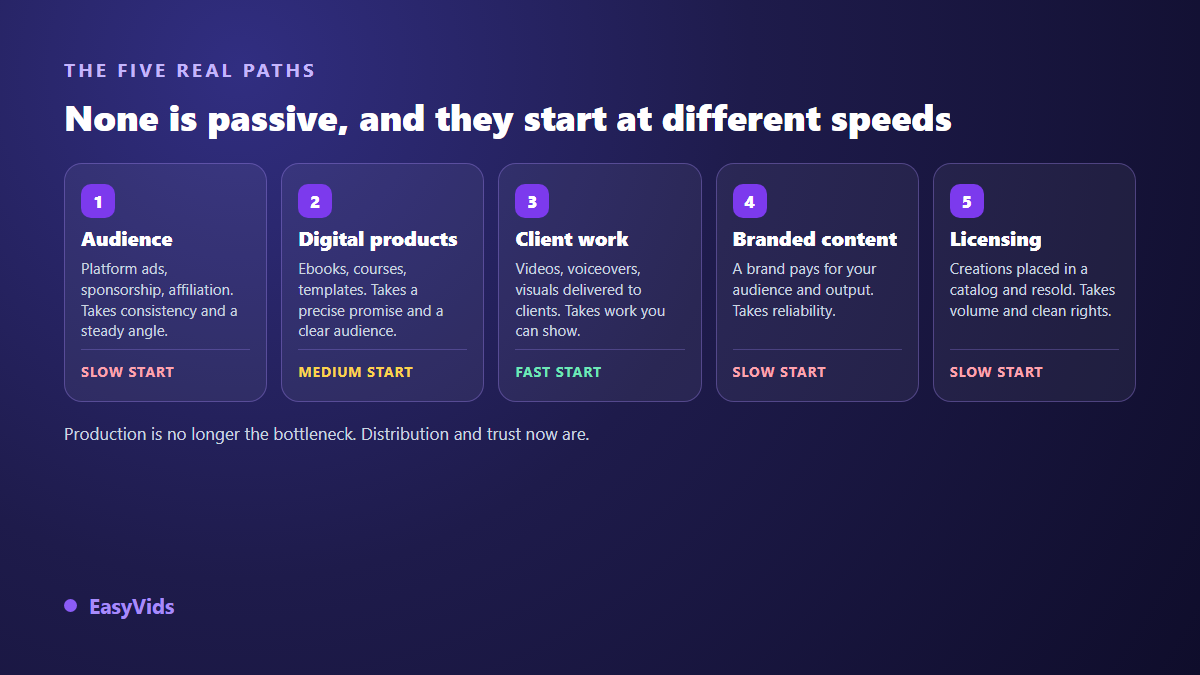
Five routes work: monetising an audience (platform advertising, referrals, affiliate links), selling digital products, selling services to clients, producing branded content, and licensing your creations. Client work starts fastest, because a client pays for a need that existed before you showed up. Audience monetisation is by far the slowest. None of them is passive. AI shortens production time. It does not replace judgement, distribution or trust.
What AI changes, and what it leaves untouched
The shift is real but narrower than the hype suggests. Producing a video, a voice over or a set of illustrations used to require gear, skills and time. That bottleneck is gone. You can now ship in an evening what once took a week, and a complete video generation studio runs inside a browser.
Everything else stayed the same. AI creates no demand. It does not make you known. It does not make you credible to a hesitant client. And because it reached everyone at once, raw production capacity lost value rather than gaining it. What gets paid for now is not knowing how to make things, but knowing what to make, for whom, and recognising when the result is not good enough.
The practical consequence is short. Routes built on volume alone degraded, because anyone can produce volume. Routes built on a relationship, a kept promise or real expertise got stronger, because their painful part finally became cheap.
Route 1: monetising an audience
The most visible route, and therefore the most crowded. It bundles three mechanisms people routinely confuse. Platform advertising pays you per view once an access threshold is cleared, with a separate mechanism for short form, where Shorts revenue comes out of a shared pool rather than an ad placed in front of each video. Referral programmes pay you when someone you brought becomes a customer. Affiliate links pay you on a sale your link triggered. All three assume the same starting point: people who watch you.
What it really demands: a publishing rhythm you can hold for months, and a format recognisable enough that people come back. Nothing forces you in front of a camera for that, and our guide to the faceless YouTube channel shows how a format can rest on voice, visuals and editing alone. A first result takes months, rarely less, because advertising thresholds assume an audience is already in place. Affiliate income can arrive earlier, on one condition: only recommend what you actually use, or you burn the trust the whole mechanism runs on.
Why most people quit: they watch the wrong number. The first weeks produce almost nothing however carefully you work, and an empty dashboard discourages more reliably than a clear failure. Early on, the only useful metric is how many episodes you published. A full walkthrough of a properly made YouTube video gives an honest picture of the work per episode.
Route 2: selling digital products
Ebooks, courses, templates, visual packs, document kits: you build once and deliver indefinitely. AI opened this route to people without a team, which is exactly what makes it treacherous. The market filled up with products made quickly, on topics picked because they looked sellable.
What it really demands: a precise promise aimed at an audience you can name. A guide for everyone sells to no one; a guide that solves an identified problem for an identified job sells. A first result can land within weeks, provided you have somewhere to offer it, however small. With no audience and no contact list, quality alone keeps the product invisible.
Why most people quit: they build before knowing who they are talking to, then conclude it does not work when nothing was ever put in front of the right eyes. The habit that changes everything is selling the promise before writing the product, then writing what people responded to.
Route 3: selling services to clients
The least discussed route, and the fastest. Businesses need short ad videos, voice overs for internal training, product page visuals, captions, one campaign declined into several formats. That need predates AI. It was simply too slow or too expensive for smaller organisations to satisfy. One request keeps coming back on those voice overs: hearing the founder or the in house trainer rather than a generic voice, which means a source recording and written consent, and our benchmark on how much audio a voice clone needs stops you promising a timeline you cannot hold.
What it really demands: a few showable examples, and the ability to turn a vague request into a precise deliverable. This is the only route where a first result can arrive within days, because you are not building an audience, you are answering a need already stated. Narration quality matters more than technique, and a voice over that sounds genuinely natural often decides whether a quote is accepted or ignored.
Why most people quit: they sell AI instead of selling an outcome. A client is not buying a technology, they are buying a video that presents their product. The second trap is pricing: without knowing what your output really costs you, you quote blind and work at a loss without noticing. Our comparison of what a video production costs gives the orders of magnitude to know before quoting.
Route 4: branded content
A brand can pay you in two ways, and mixing them up wastes months. It can rent your audience, because it wants to be seen by the people who follow you. Or it can buy your production capacity, because it wants regular content for its own channels and does not care whether you are known.
What it really demands: reliability. Brands tolerate a modest audience, never a missed deadline or a sloppy deliverable. Visual continuity counts just as much: a mascot or a spokesperson whose face stays the same from one campaign to the next reassures an advertiser, and the consistent character method is what makes that holdable without starting over on every image. A first contract rarely lands before several months in the first case, and faster in the second if you can show existing work. One practical point discovered too late by many: a growing number of advertisers now require AI use to be stated in the contract, and sometimes on screen.
Route 5: licensing your creations
Stock image and video libraries, music catalogues, template marketplaces: you submit a creation, a buyer pays for a usage right, and the same piece can sell repeatedly. On paper this is the closest thing to recurring income.
What it really demands: volume, plus a check that discourages many people. Not every marketplace accepts AI generated content. Some ban it, some accept it with a mandatory declaration, others refuse anything containing a realistic face. Read the terms of your target platform before preparing a catalogue, never after. A first result takes months, and per piece income stays modest by design: accumulation is the whole point.
What does not work, and why
Three approaches dominate the promises circulating online, and none of them holds. They fail for the same underlying reason: they bet on production, and production is precisely what became abundant.
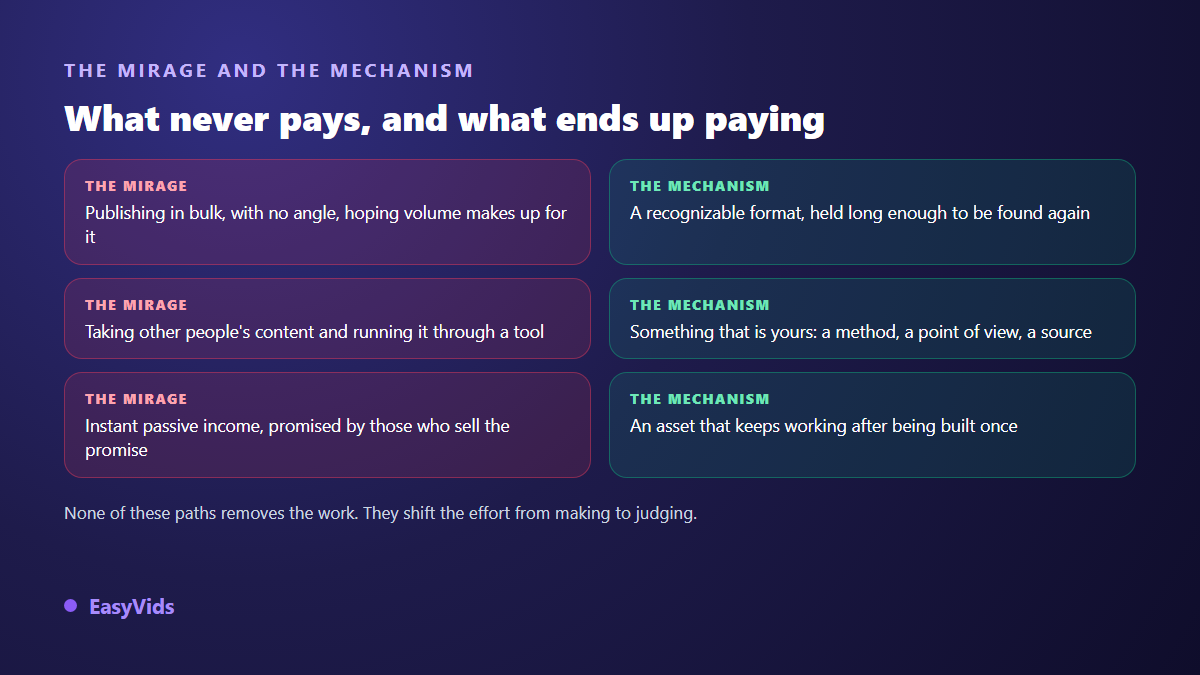
- Mass production with no added value: publishing a lot never replaces having an angle. Recommendation systems measure viewer satisfaction, not quantity.
- Recycling other people's content through a tool: detectable, punishable, and it builds no reason to follow you rather than anyone else.
- Promises of instant passive income: an asset that earns without you has always required heavy work upfront. AI shortens that work, it does not remove it.
- Copying a successful creator move for move: you inherit their flaws without their history or their community.
- Stacking tools without ever publishing: time spent comparing subscriptions produces no income at all.
Platform rules and AI disclosure
This is the most misunderstood part of the subject, and it is expensive to learn late. Major platforms do not penalise the use of AI. They penalise repetitive mass produced content with no contribution, which is a different thing. A carefully written story, consistently illustrated and properly narrated, remains fully eligible even when every element was generated. That is what separates a channel built with intent, of the kind our guide to an AI made motivation channel describes, from a pile of recycled quotes.
Disclosure is a separate matter. Several video and social platforms now ask you to flag realistic content that was generated or altered by AI, especially when it involves a face, a voice, or an event that could pass for real. The principle is the same everywhere: disclosing costs you nothing, failing to disclose exposes you. Rules change often, so reread each platform's help page before a campaign rather than trusting a dated article.
Two prohibitions are universal: imitating a real person without consent, and presenting an invented fact as information. Either one is enough to take down an entire account, however careful the rest of your work is.
Rights: what you are actually selling
Selling a creation means knowing what you are allowed to transfer. Before any sale, check three things in the terms of the tool you used: is commercial use allowed, are exports watermark free, and what rights can you pass on to a client. A free tool that reserves commercial use for its paid plans is a classic trap, usually discovered once an invoice has already gone out.
Some things cannot be transferred at all: a real person's voice, a recognisable face, a registered trademark, or music you do not hold a licence for on the target platform. On that last point, an uncleared track does not block publication. It blocks monetisation, often once the video starts working. For client work, write down exactly what is granted: internal use or paid advertising, duration, territory, exclusivity or not. Our answers on commercial use of exports are in our frequently asked questions.
Choosing a route and sticking with it
The opening mistake is choosing the route that looks most profitable instead of the one you can sustain. Start from what you already have: a skill, an audience however small, time, or a catalogue in progress. The right answer changes completely depending on which box you are in.
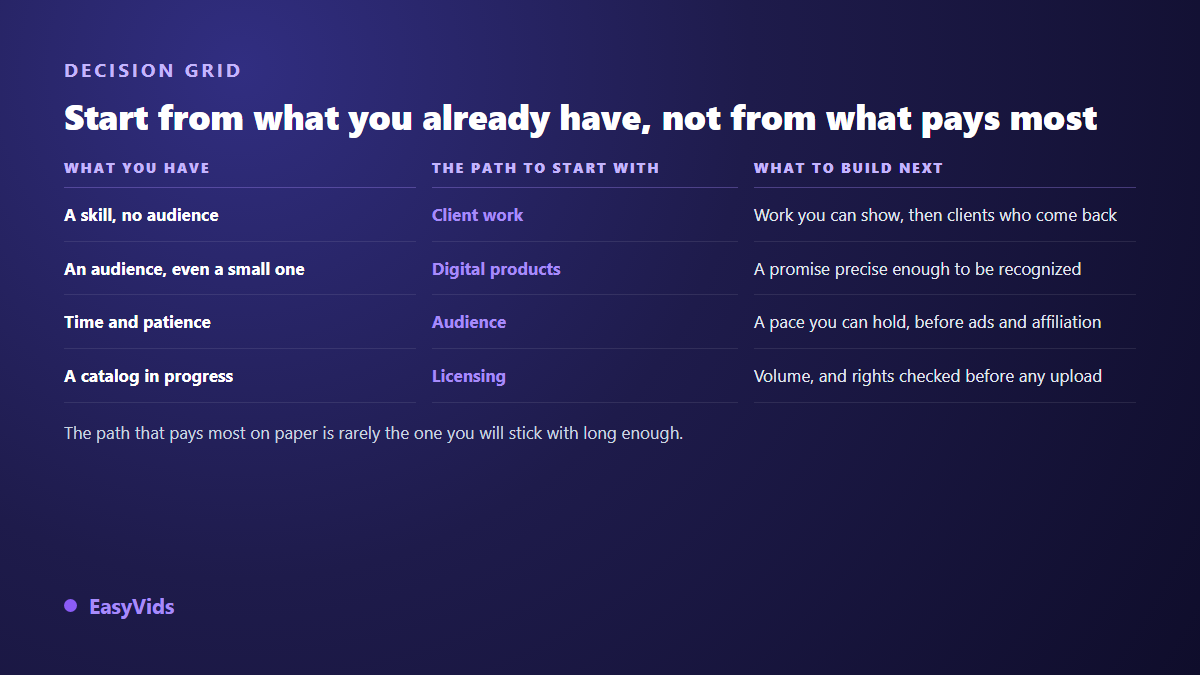
Two rules avoid most dead ends. First, one route at a time, long enough to know whether it takes. Second, combine two routes only when they feed each other, such as an audience that makes a digital product possible. Combinations that do not feed each other simply split your attention.
Frequently asked questions
Do I need an audience to make money with AI?
No, but without one only a single route starts quickly: client services. You answer a need that already exists, without depending on your visibility. Every other route assumes people can see you, and that takes time to build.
How long before a first result?
It depends entirely on the route. Client work can land within days if you know how to reach out. A digital product takes weeks, provided you have somewhere to offer it. Audience and licensing income are counted in months. Any promise faster than that deserves suspicion.
Can AI generated content be monetised on platforms?
Yes, as long as you contribute something: an original scenario, a considered voice, a deliberate edit, a point of view. What platforms target is repetitive output with no contribution, not the tool used to make the images. The same rule applies to text and to video.
Do I have to disclose that content was made with AI?
Often yes, and there is no downside. Several platforms require disclosure for realistic content, particularly anything showing a face or a voice. Disclosing carries no distribution penalty. Skipping it can cost you monetisation, or the account.
Can I sell what I generate to a client?
Yes, if the tool allows commercial use and exports without a watermark. Check that before your first quote, spell out in your proposal exactly what the client receives, and never include music or a face you do not hold the rights to.
The real question is not which route pays best, but which one you will sustain long enough for it to produce anything. Pick one, give it several months, and measure what you publish rather than what you earn at the start. The making part will no longer slow you down, and that is precisely what AI made accessible. To produce your first pieces and see what it changes in your working rhythm, creating an account opens the full studio, no bank card required.