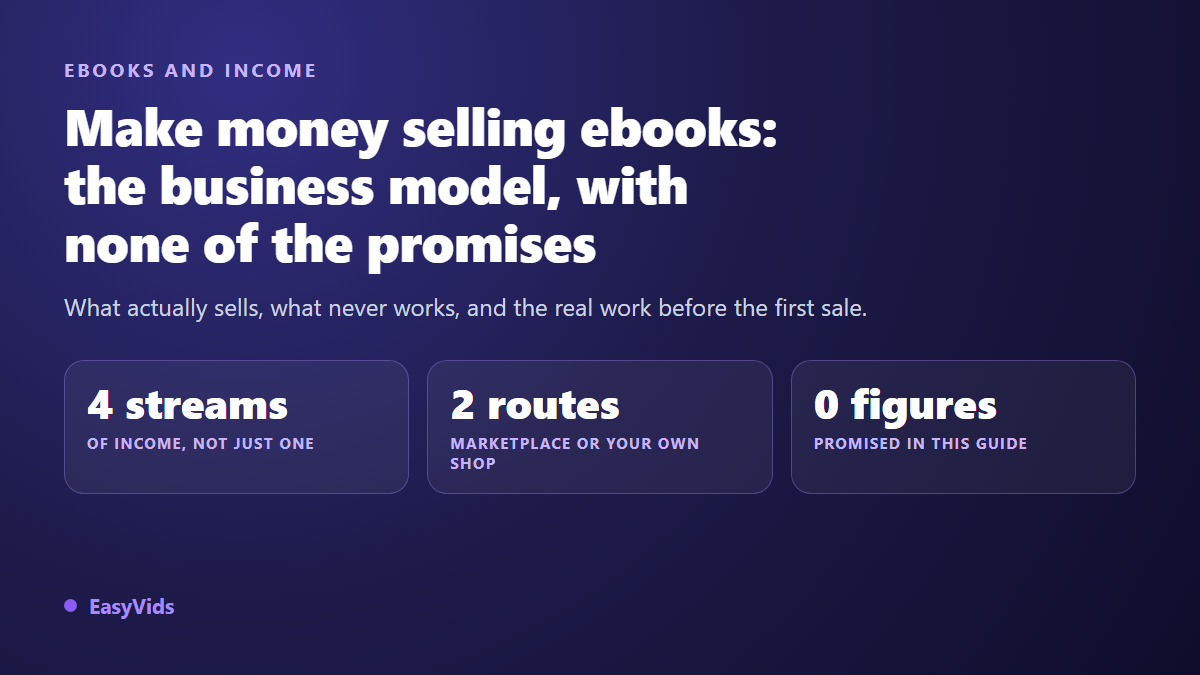
Your ebook is finished, or nearly, and one question comes before all the others: does this actually pay. Searching for how to make money selling ebooks mostly returns two extremes. On one side, dashboard screenshots whose real job is selling you a course. On the other, articles repeating that the market is saturated and there is nothing left to take. Neither one explains how money actually travels from a file to your bank account.
This article describes the model, not the outcome. You will find no income figures, no monthly targets and no niche presented as a gold mine: those numbers depend on your topic, your audience and your consistency, and anyone quoting them in advance is inventing. You will find the useful part instead: where the money comes from, what makes a book sell, what never works, and how long each stage really takes. Ebooks are one product family among several, and our guide to selling digital products puts the book back into the wider picture.
The short answer
An ebook does not earn because it exists. It earns when a clear promise meets a reader who was looking for exactly that, on a channel where the reader already spends time. The money then arrives through four possible routes: direct sales from your own page, sales on a marketplace that keeps a royalty share, per page payouts from subscription programmes, and the free book that earns nothing alone but feeds a paid offer behind it. The file is the shortest part of the work. The long part starts the day it goes live.
You are not selling a file
Nobody buys pages. Readers buy an outcome, a shortcut, one worry removed. That is why a short book on a precise problem outsells a thick volume covering a whole field: the first promises something checkable, the second asks the reader to guess what they will gain. Length reassures the author, precision reassures the buyer.
This has a practical consequence for writing. Pick the topic from a question people already ask, in their own words, rather than from what you feel like explaining. Once that question is on the table, the manuscript becomes an ordered series of answers and the writing moves far faster. That is where our method for creating an ebook with AI starts: the promise first, the outline second.
Four income streams, and what each one costs you
Authors who live off digital books almost never depend on a single channel. Each stream has a trade off, and knowing it stops you from locking yourself into a choice that is hard to undo.
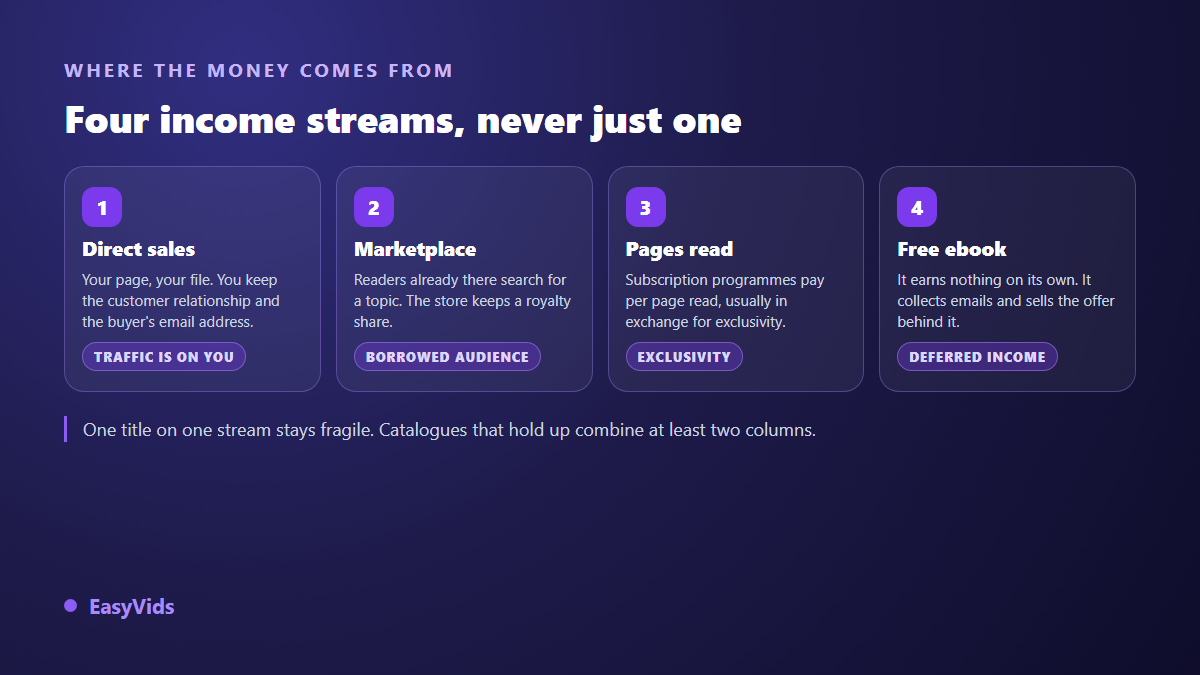
Direct sales leave you the largest share and, more importantly, the buyer's email address, but you have to bring every visitor yourself. A marketplace does the opposite: it lends you an audience and keeps the customer. Per page payouts arrive more steadily, often in exchange for exclusivity. The free book earns nothing on its own, and yet it sometimes funds everything else. A durable catalogue combines at least two of these columns.
What makes a book sell, in order
The elements that decide a purchase do not carry equal weight, and they do not arrive at random. A reader sees an image first, then a title, then a block of text, then other people's opinions. Each step exists only to earn the next one, and one weak link stops the whole chain.
- The cover: it is judged as a thumbnail, often no wider than a thumb. A title readable at that size matters more than a detailed illustration.
- The title and subtitle: they must name the reader and the problem. A poetic title sells badly because nobody searches for it.
- The description: only the first lines show before the read more link. Promise at the top, biography at the bottom.
- A visible table of contents: showing the chapters reassures buyers more than a long sales pitch, because it proves the book covers what it claims.
- The first reviews: the one element you do not control, and the most decisive. You get them by asking, not by waiting.
- Consistency with neighbouring books: priced too low, a book worries as much as it attracts; priced too high with no proof, it never gets a first try.
Amazon KDP: the rules to read before committing
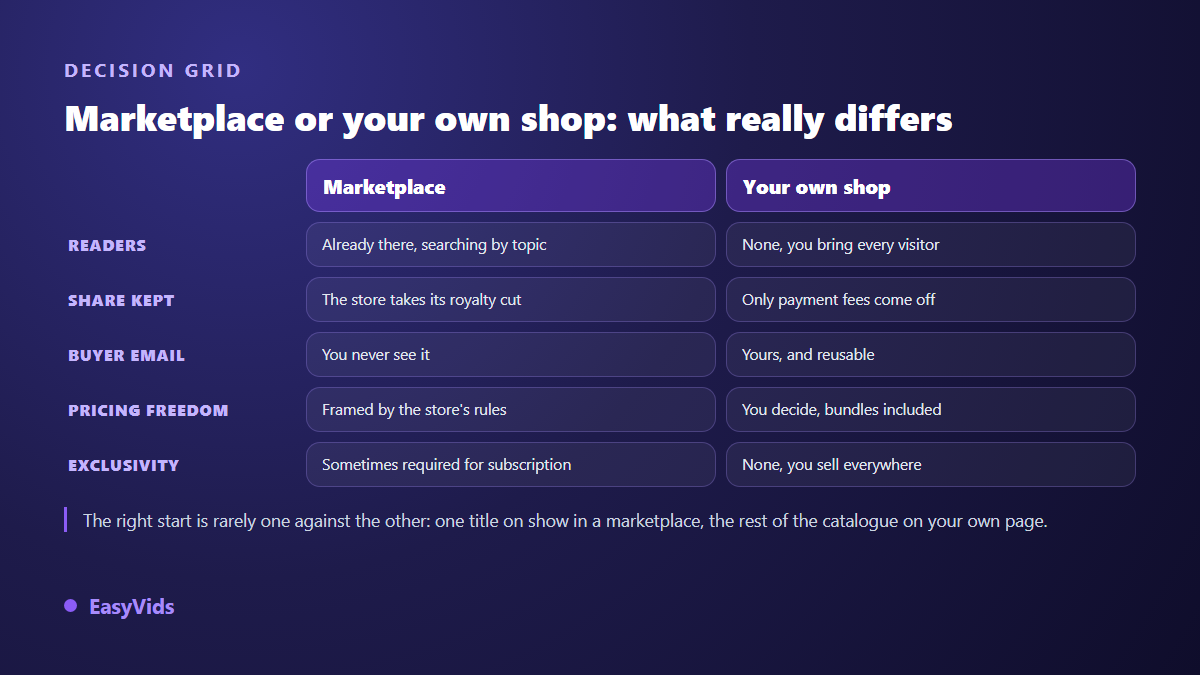
The largest digital bookstore sets its own conditions, and they are worth reading before you tick a box. According to the royalty page of Amazon's Kindle Direct Publishing programme, in its version consulted in September 2026, authors choose between two royalty rates, 35% and 70%. The higher rate applies only to books priced inside a range set by Amazon, it does not cover every territory, and it comes with a delivery cost deducted according to file size. A heavily illustrated book therefore returns less than a text only book listed at the same price.
The second point is exclusivity. The terms of Amazon's KDP Select programme, as published in September 2026, require that the digital edition is not sold or distributed anywhere else for a period of 90 days, renewed automatically unless you opt out. In exchange the title enters the Kindle Unlimited subscription catalogue and the author is paid on pages actually read. The choice is reversible, but while it lasts it closes every other channel, including your own shop.
The third rule concerns books written with machine help. Since September 2023, Amazon asks authors to declare at upload whether the content was generated by artificial intelligence, and separates generated content from merely assisted content. The declaration stays internal to the platform. Amazon also introduced, at the same time, a daily cap on how many new titles one account may upload. The detail of these disclosure rules deserves a careful read before a first upload, because a broken content rule can cost the whole account, not only the title involved.
Your own shop: bigger share, more work
Selling from your own page reverses every term of the calculation. Only the payment processor's fees come off, you set the price freely, you build bundles, and above all you keep the buyer's email address. That is the only asset that follows you from one book to the next. In return, nobody lands on your page by accident: every visitor comes from something you published, a video, a newsletter or a recommendation.
Two practical duties come with direct selling. The first is delivery, which has to be automatic and instant, otherwise refund requests arrive before reviews do. The second is tax: the European rule on value added tax for digital services, in force since 1 January 2015, places the tax in the buyer's country, something most selling platforms handle for you, provided you have checked that they really do.
How long it really takes
This is the question method sellers avoid. Writing the manuscript is the most visible stage, and often the shortest. Layout, cover and product page take fewer hours but decide a large share of the sales. Then comes the stage that never ends: bringing readers in, collecting reviews, fixing what stalls, publishing the next title.
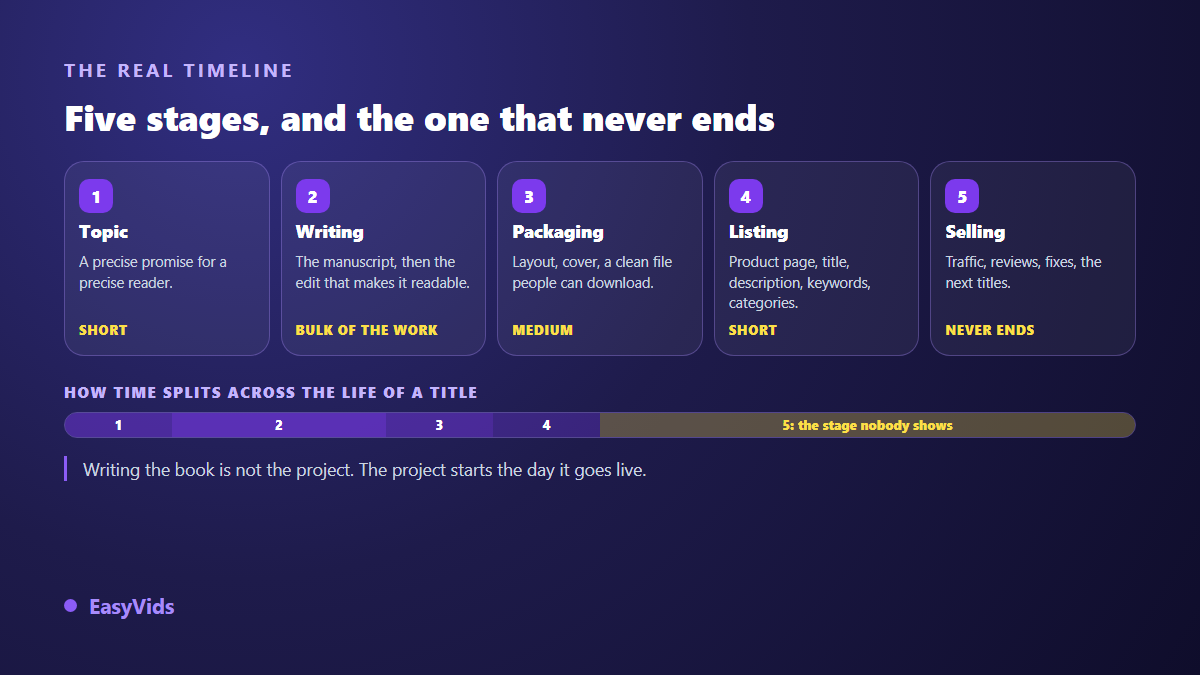
A first title published without an existing audience does not sell in a few days. It sells once something pushes it: regular content that mentions it, a position earned in the store's search results, an email list that grows. That is why the question of how much it pays has no honest answer in advance, while the question of how long before things move does have one: as long as it takes you to build the thing that pushes.
What never works
A few approaches come back with every wave of enthusiasm and fail every time, for structural reasons rather than bad luck.
- Uploading a pile of generic titles at once. Marketplaces cap daily uploads, remove duplicated content, and a catalogue with no readers never becomes a catalogue that is read.
- Selling raw generated text with no editing. Readers feel it in the first pages, ask for a refund, and leave a review that follows the title for years.
- Copying the topic of a book that works. You arrive after it, with no reviews, on a query already held by someone buyers have validated.
- Relying only on store search. It rewards titles that already sell, not titles that just arrived.
- Refusing to give anything away. With no sample, no excerpt, no free guide, a stranger has no reason to trust you the first time.
The free ebook is a business model too
A free book looks like the opposite of this topic. It is in fact one of its most reliable forms. A short guide, given in exchange for an email address, turns an anonymous visitor into a contact you can reach again, and the income arrives with the next offer: a course, a service, a fuller paid book. That is exactly what our walkthrough of the lead magnet describes, and it is often the first title to write when nobody knows you yet.
The catalogue is the only thing that compounds
A single title hits a ceiling. Two titles aimed at the same audience sell each other: the reader who finishes the first goes looking for the second, and the last page can point the way. That is what a catalogue means, and it is the only mechanism in this trade that genuinely improves with time. It stays a maintained asset rather than a pension, and our inventory of realistic passive income with AI shows exactly where that line sits. AI changes the speed of production, not the nature of the work: it shortens the first draft, the cover, the audio or video versions, while the topic and the readers stay yours to find. Tooling cost belongs in the calculation like any production expense, and sits on the plans page.
Frequently asked questions
Do you need a website to sell an ebook?
No. A marketplace, a checkout page hosted by a payment platform, or even a link sent to an email list is enough to get paid. A website becomes useful later, once you have several titles and want control over the page that presents them.
How long before the first sale?
It depends entirely on the audience you have on launch day. With an email list or an existing channel, the first sales land the same day. With no audience, count the time needed to build a channel, and that delay is measured in months rather than days. Nobody can hand you a reliable number in advance.
Can an ebook written with AI be sold legally?
Yes on the main platforms, provided you follow their disclosure rules: Amazon has asked since September 2023 that authors state at upload whether the content was AI generated. Copyright protection is a separate question. The United States Copyright Office stated in its March 2023 guidance that a work must contain sufficient human authorship to be registered. Your structuring, rewriting and editing therefore count, and they had better be real.
One long book or several short ones?
Several short books aimed at the same audience, in most cases. They multiply the entry points in store search, they sell each other, and each one teaches you something the next will use. A long book earns its place when the subject genuinely demands it, or when it serves as the reference attached to your name.
Should you discount a title at launch?
A launch discount limited in time helps collect the first reviews, which are exactly what a new title lacks. A permanently low price, on the other hand, signals low value and makes climbing back difficult. Set the normal price first, decide on the promotion after.
Making money selling ebooks is not a secret formula: a precise promise, an identified reader, careful production, a channel chosen with its rules in mind, then a second title that leans on the first. The part AI genuinely shortens is production, and that is already a lot when it hands you back the time to handle everything else. If your topic is ready, open a free account and write the first chapter instead of hunting for one more number.