You post on TikTok, the views climb, and one question always arrives: when does this account start paying for itself. Making money on TikTok does not depend on a hidden button you failed to find. It depends on which method you pick. There are nine of them, they ask for very different things, and most creators start with the hardest one.
That hardest one is the official programme that pays for views. Everyone talks about it, it sets high thresholds, and it only runs in a list of countries TikTok publishes. Meanwhile other doors open with a few hundred followers, and one of them opens with none at all. This guide lists the nine methods, says what each really costs in audience, lead time and skill, then gives the order to try them in. For the wider picture across platforms, our overview of serious ways to monetise what you create covers the rest.
The short answer
The nine methods sort into three families, by who actually pays. The platform pays you: the Creator Rewards Programme, LIVE gifts, subscriptions. A brand pays you: shop affiliate commissions, disclosed brand deals, paid video production. Your audience pays you: paid Series, your own shop, an offer hosted somewhere else. Only one of the nine needs no audience at all, producing video for brands. That is where you start from zero, while the account is still being built.
Nine methods, sorted by who pays
The sorting is not decoration, it predicts risk. Anything the platform pays depends on criteria it can change at will, and has already changed more than once. Anything a brand pays depends on an agreement between the two of you. Anything your audience pays outside the app depends on nobody but you. A durable account ends up sitting in all three families.
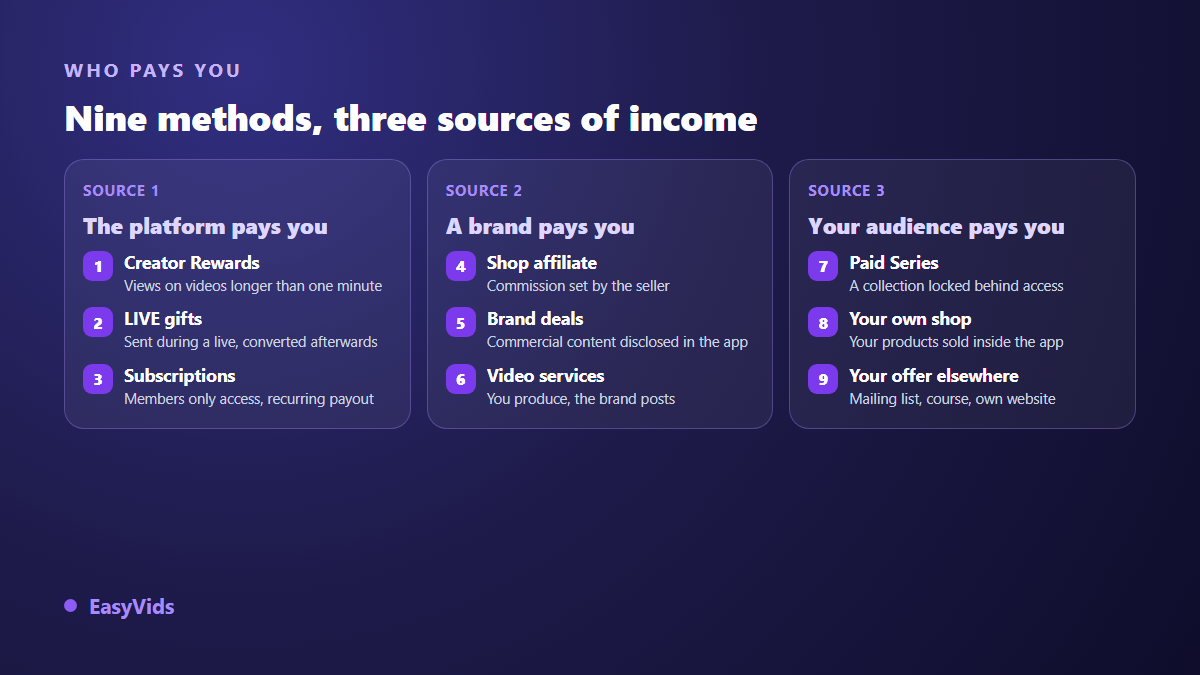
- Creator Rewards Programme: the platform pays for views on videos longer than one minute, under conditions.
- LIVE gifts: viewers send virtual gifts while you are live.
- Subscriptions: members only access for paying followers, with a recurring payout.
- TikTok Shop affiliate: you feature a seller's product and earn the commission that seller set.
- Brand deals: a brand pays for a post, which must be disclosed as commercial content.
- Video production services: you deliver files a brand posts on its own account.
- Paid Series: a collection of videos behind paid access.
- Your own shop: your products, sold inside the app.
- Your offer off platform: mailing list, course, service, website. TikTok is the door, not the till.
Method 1: the Creator Rewards Programme
This is the mechanism that pays for views directly. According to TikTok's help centre page for the Creator Rewards Programme, checked in September 2026, access requires being 18, having at least 10,000 followers, at least 100,000 video views over the last 30 days, an account in good standing, and living in a country where the programme is open. Only videos longer than one minute count. The same page lists content that does not qualify: duplicated content, videos carrying another app's watermark, static image slideshows with no editing.
Two warnings before aiming at this door. The scheme has already changed name and logic: TikTok opened its first creator fund in 2020, replaced it with a programme announced in early 2023, then reworked the whole thing under its current name in 2024. Nothing guarantees today's version is next year's. And the AI question comes up constantly: generated visuals do not disqualify a video by themselves, missing work does, which our breakdown of what the programme agrees to pay for when the visuals are generated sets out in detail.
Method 2: gifts during a LIVE
Going live is the fastest way to receive something from your viewers. According to TikTok's help pages on LIVE and on gifts, you need at least 1,000 followers to open a live, and you must be 18 to send or receive gifts. The entry bar sits ten times lower than the rewards programme.
The trade is time. A live happens in person, at a fixed hour, often for an hour or more, and the result rests on a relationship rather than an algorithm. It is the method least compatible with a fully automated account, which is exactly why it stays available: few creators keep the rhythm up.
Method 3: subscriptions to your account
Subscriptions turn part of your audience into recurring income: paying subscribers get reserved content, badges or members only lives. TikTok limits this to accounts eligible for LIVE and publishes its criteria in the help centre. It only works if subscribers get something genuinely different. Without that, perceived value collapses within two months and cancellations follow.
Method 4: the TikTok Shop affiliate
You feature a seller's product, the app shows the buy link, and you earn the commission that seller set. This is the method that pays earliest on a small audience, because it rewards the ability to trigger a purchase rather than raw view counts. A thousand well targeted viewers beat a viral video shown to an indifferent crowd.
Two real limits. TikTok Shop is not open everywhere, and the conditions for joining the affiliate programme vary by market: TikTok publishes them in its shop help centre, market by market. Check your own country's page rather than a number heard in someone's video, because those criteria differ between markets and move often.
Method 5: brand deals
A brand pays for a post on your account. Size matters less here than how readable your niche is: a baking equipment brand would rather have 8,000 baking enthusiasts than a much larger general account. TikTok also runs an official marketplace, the Creator Marketplace, matching creators with advertisers, with entry criteria published by TikTok that vary by country.
One obligation is worth knowing before your first collaboration. TikTok's branded content rules require you to switch on the commercial content disclosure when you post, as soon as a brand pays you or supplies a product. The same policy keeps certain product categories out of branded content entirely. An undisclosed paid post risks removal, and that kind of strike follows an account.
Method 6: producing videos for brands
This is the only one of the nine that needs no audience. You do not post on your own account: you deliver files a brand posts on its own, or turns into an ad. The market exists because advertisers need dozens of variations a month, vertical, in a natural tone, and have neither the time nor the appetite to shoot them.
Your portfolio replaces your follower count. Three to five demo videos, a consistent format and fast delivery are enough to start pitching. The easiest formats to produce in volume are the ones that need no camera pointed at you, and nine vertical formats that work without showing your face make a solid starting point for that portfolio.
Method 7: paid Series
TikTok lets you sell access to a collection of videos, branded Series. When the format launched, TikTok announced collections holding up to 80 videos, each up to 20 minutes long, far beyond what ordinary posting allowed at the time. Eligibility conditions live in the help centre and have already shifted since launch. The method suits accounts that teach something specific: a method, a skill, a programme. It suits entertainment badly, because nobody buys entertainment one collection at a time.
Method 8: selling your own products in the app
Nothing forces you to sell someone else's product. A creator can open their own shop and sell what they make, physical or digital. The upside is simple: you keep the whole margin instead of a commission. So is the downside: you inherit stock, customer service and shop rules that depend on your country and that TikTok updates regularly. This is a business, not passive income.
Method 9: sending your audience to your own offer
The last method is refusing to depend on TikTok for the transaction. Your video attracts, your bio points, and the purchase happens elsewhere: a mailing list, a course, a service, your own shop. The click through rate is always low, and that is normal. One viewer willing to leave the app is worth several hundred passive views. It is also the only method no rule change can shut down overnight.
What each method really asks for
Lists of methods usually stay quiet about the entry price. Here it is, across the four criteria that decide what you can attempt this week: audience needed, lead time before the first payout, skill to acquire, and dependency on platform rules.
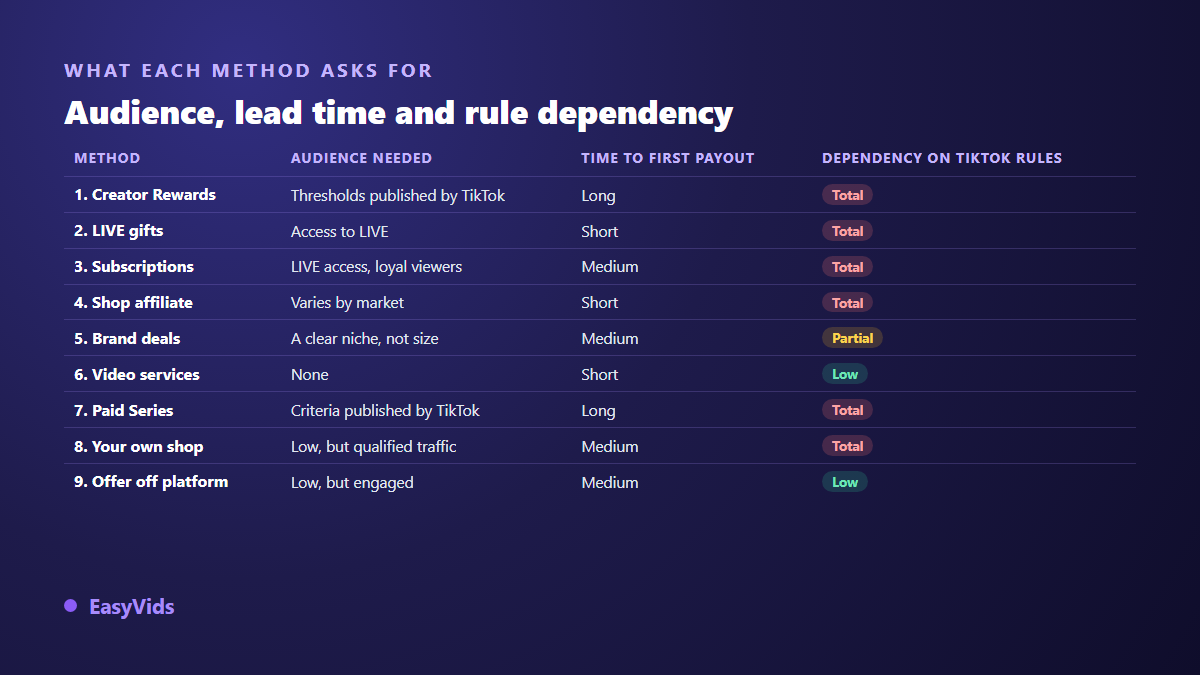
A method with total dependency can close with a terms update, without notice and without appeal. That is no reason to skip it. It is a reason never to build an entire living on it alone.
The order to try them in when you start from zero
The order below accounts for one thing only: what you can do today, with the account you have today. There is nothing to wait for before starting stage one.
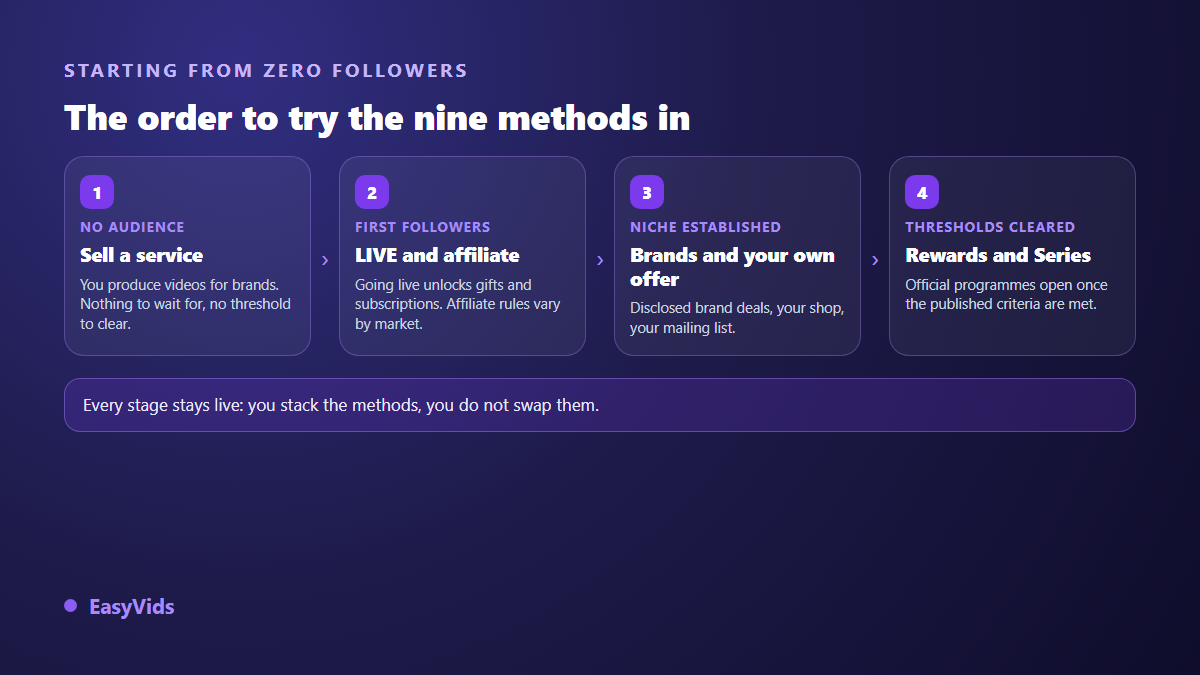
- Stage 1, no followers. Sell video production to brands. In parallel, post for yourself, on a narrow niche, in a consistent format.
- Stage 2, first thousand followers. LIVE opens, so do gifts and subscriptions. Check whether the shop and its affiliate programme run in your country.
- Stage 3, once the niche reads clearly. Pitch brands, open your shop or your own offer. Income starts to steady here.
- Stage 4, once the published thresholds are met. Apply to the rewards programme, and to Series if you teach something.
An account that genuinely supports someone almost always runs three or four of these methods at once, never one. The stacking is what absorbs bad months, not the performance of any single video.
These rules move, and here is how to check
One point of method outweighs every tip above: thresholds, open countries and accepted formats change. The programme paying for views has already changed shape twice in five years. Shop conditions differ between markets. Series criteria have shifted since launch.
The only source that counts is TikTok's own help centre, on the page for the programme concerned, plus the creator tools tab in your own app, which shows your actual eligibility. A video quoting a threshold without naming the official page and its date is worth nothing. Treat the figures quoted here the same way: they describe TikTok's official pages as of September 2026, and deserve a fresh check before any decision.
Producing enough video for any of this to work
Every method shares one constraint: volume. Services need a portfolio, affiliate work needs many products tested, the rewards programme needs long videos posted regularly. In practice production breaks first, not strategy. On EasyVids, a one sentence idea becomes a script, vertical shots, a voice over and a captioned edit, with no filming and no editing software. Exports come out natively in 9:16 and carry no watermark, which matters given that another app's watermark sits on TikTok's list of content excluded from rewards. A free trial covers your first videos before you look at the available plans.
Frequently asked questions
How many followers do you need to make money on TikTok?
It depends entirely on the method. Selling video production to a brand needs none. Opening a live needs 1,000, according to TikTok's help page on LIVE. The rewards programme needs 10,000, plus 100,000 views over thirty days. There is no single threshold, which is good news: the first door is already open.
Does TikTok pay creators in every country?
No. The rewards programme runs only in a list of countries TikTok publishes in its help centre, and TikTok Shop is not available everywhere either. Check the official programme page for your country of residence before building a plan on it. The methods that bypass the platform, services and your own offer, carry no such limit.
Can you make money on TikTok without showing your face?
Yes, and it is common. None of the nine methods requires a face on screen, apart from going live, which needs at least a voice and a real time presence. The rest work with a voice over, visuals and careful editing.
Are AI generated videos monetisable on TikTok?
Yes, on two conditions. TikTok's Community Guidelines require realistic AI generated or modified content to be labelled, and TikTok announced in May 2024 that it had joined the C2PA coalition to label certain uploaded content automatically. Second, the rewards programme excludes unoriginal content or content posted without effort, however it was made. A narrative you wrote, illustrated with generated visuals and properly edited, stays eligible.
Do you have to disclose a paid post?
Yes. TikTok's branded content rules require the commercial content disclosure to be switched on whenever a post is paid for, or a product was given to you in exchange. The disclosure protects your account, and many countries require it in their advertising law anyway.
Take the method that needs no followers, and produce three demo videos this week. It is the only starting point that depends on no threshold, no country and no terms update. Create your account to make those first vertical videos, then climb the stages in order: the later doors open on their own once the audience follows.