You have the occasion, the person, sometimes even the tune in your head. What stalls is the words. You write two lines, read them back, and they sound like a greeting card. An AI lyrics generator exists to get you past that wall: you give a short brief, it returns a structured text with verses, a chorus and a bridge, ready to be sung.
You still need to know what to feed it. Ask for a love song and you get correct, tidy, interchangeable rhymes. Give it a precise occasion, a name, a true anecdote and a musical genre, and the text becomes recognisable to the person you wrote it for. This guide covers that brief, the structure to impose from the start, the pass that saves a weak verse, and what happens once the words exist. If you are arriving from the music side, our complete guide to the AI music generator sets the scene first.
The short answer
An AI lyrics generator turns four pieces of information into singable text: the occasion, the person, a message to land, a musical genre. Always ask for an explicit structure, two verses, a repeated chorus and a bridge. Then read the result out loud, never with your eyes: only your voice reveals the lines that will never fit a bar. Expect a few minutes to get a clean text, and about as long again to make it personal.
What an AI lyrics generator really does
Behind the phrase sits a writing engine held to a craft brief. It is not asked for a poem or an article, it is asked for lyrics: short lines, concrete images, a chorus that comes back identical, words that do not trip the tongue. That instruction does half the work, which is why a tool built for songwriting returns something more singable than a general assistant given the same request.
What it cannot do matters just as much. It knows nothing about your family, your team, or the joke everyone is waiting for. Without detail it fills the gaps with plausible lines, and plausible is exactly what makes a song interchangeable. It does not write the melody either. Lyrics and music stay two separate steps, which is good news: you can fix the text as often as you like before paying for the heavier stage.
Structure first: verse, chorus, bridge
A song without a frame reads like a text chopped into pieces. The convention that works everywhere holds six blocks: a first verse that sets the scene, a chorus, a second verse that moves the story on, the same chorus, a bridge that shifts the angle, a final chorus. Ask for that frame in your brief, and ask for the section labels to be written in brackets. Those labels are not decoration: the lyrics field expects that layout, and it is what tells the composing engine where the chorus comes back.
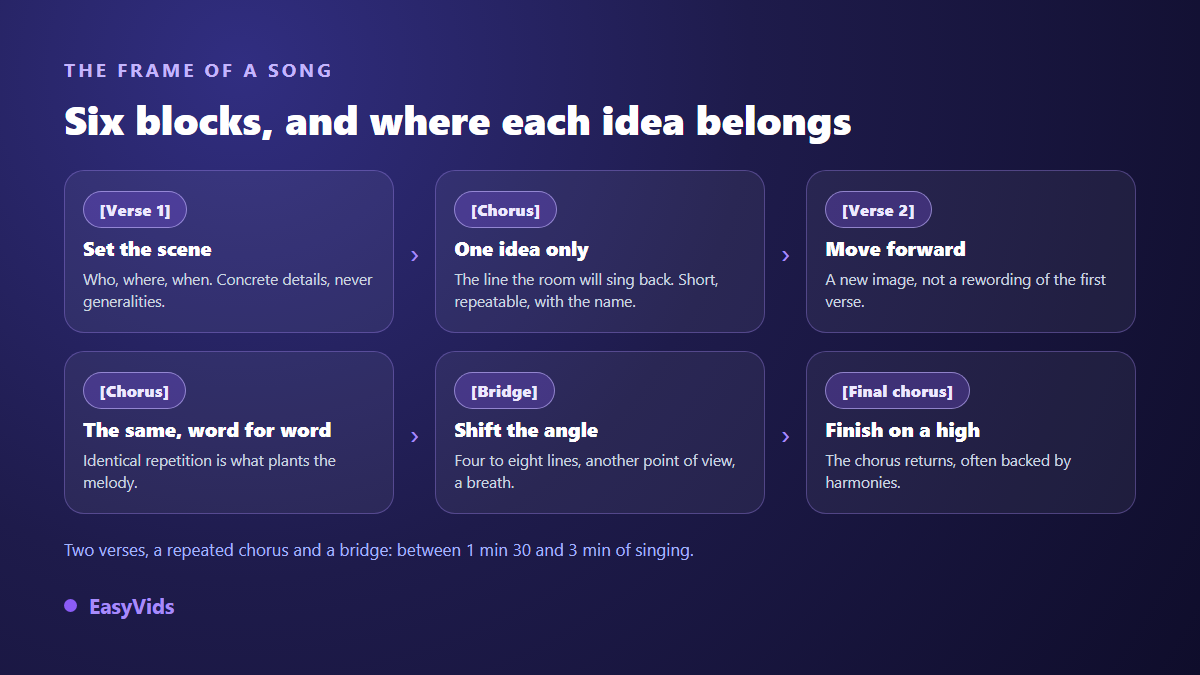
One rule outranks the rest: the chorus does not change. Plenty of generated texts rewrite it on every return, with good intentions and better rhymes. The result is a song nobody can sing along to. Repeating it word for word is not laziness, it is the mechanism that plants a melody in someone's head. If your draft offers three variants, keep the best one and copy it into the other two slots.
The six line brief that decides everything
The quality of generated lyrics is settled before generation. Six pieces of information are enough, and each one moves a different dimension of the text. Write them as plain notes, one sentence each, with no style at all. The writing is the engine's job; the raw material is yours.
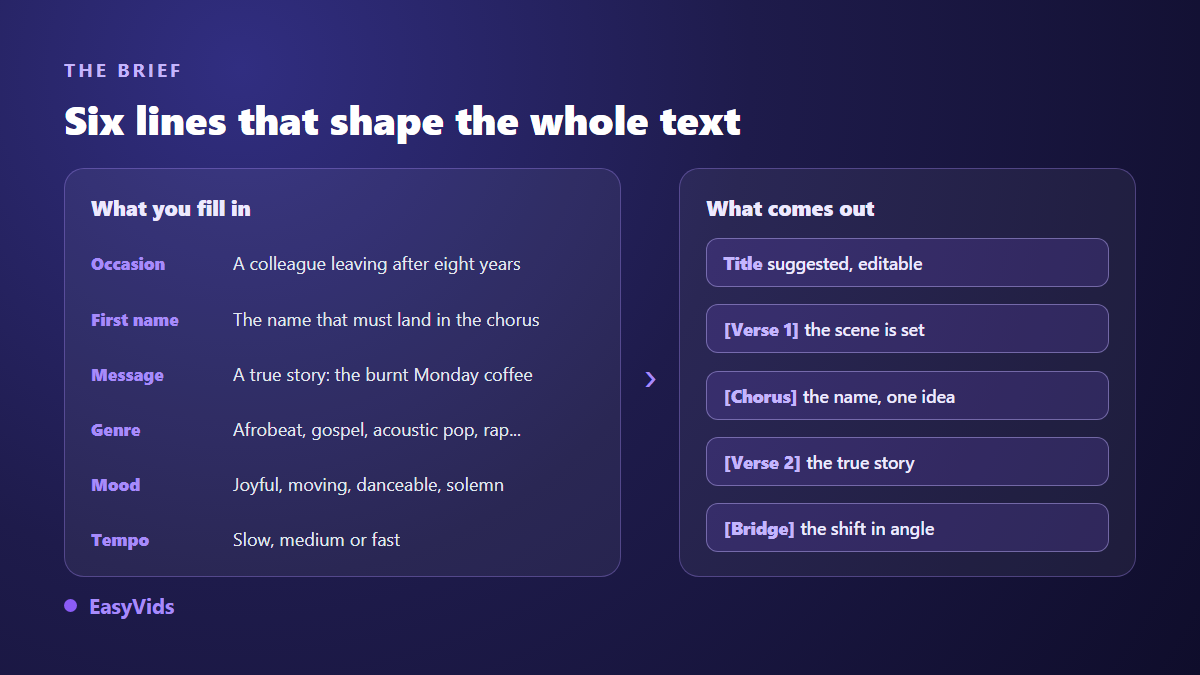
- The occasion, as precise as you can: retiring after thirty years in the same team beats a leaving party.
- The name that has to land in the chorus, spelled the way it is pronounced.
- The message or anecdote: the one line that makes the song impossible to recycle for someone else.
- The musical genre: afrobeat, gospel, rap, acoustic pop. It changes the vocabulary and the line length as much as the music.
- The mood: joyful, moving, danceable, solemn. One word is enough, two often contradict each other.
- The tempo: slow, medium or fast. A fast tempo forces short lines, a slow one carries longer phrases.
Genre deserves an extra word, because it acts where you least expect it. Gospel calls for images of light and gratitude. Afrobeat calls for brief, danceable repetition. Rap accepts long phrases and internal rhymes that pop would reject. Describing a style accurately is a skill of its own, and our twenty five music description formulas by genre give you the exact wording to reuse in your brief.
The chorus is the only line anyone remembers
Listeners forget your verses. They keep four lines, sometimes one. That is where the care belongs. A strong chorus carries one idea and one only, holds four short lines, and puts the important word at the end, where the note is held. When the name of the person you are celebrating sits inside it, the song stops being a nice text and becomes a gift.
Test the chorus without music. Say it to someone, then ask them to repeat it ten minutes later. If they find the words, it works. If they find the idea but not the words, it is still too long. That test takes two minutes and saves whole rounds of generation, because a weak chorus is never rescued at the composing stage, whatever the voice sounds like.
Verses tell the story, the bridge turns it
The first verse answers three questions: who, where, when. It sets a scene you can picture. The second verse has to bring something new rather than restate the first. That is the most common flaw in unguided generated lyrics: two verses saying the same thing in different words, and a song that never moves. The bridge exists to break the pattern, in four to eight lines, often addressing the person directly.
Singing is not reading: the read aloud pass
A text can be accurate, moving, neatly rhymed and still impossible to sing. It comes down to syllable count and where the stress falls. An eighteen syllable line reads beautifully and sings badly, because it does not fit a bar. English leans on stressed syllables, so lines run shorter than their French equivalents, which is why translating a chorus word for word almost always produces something too long.
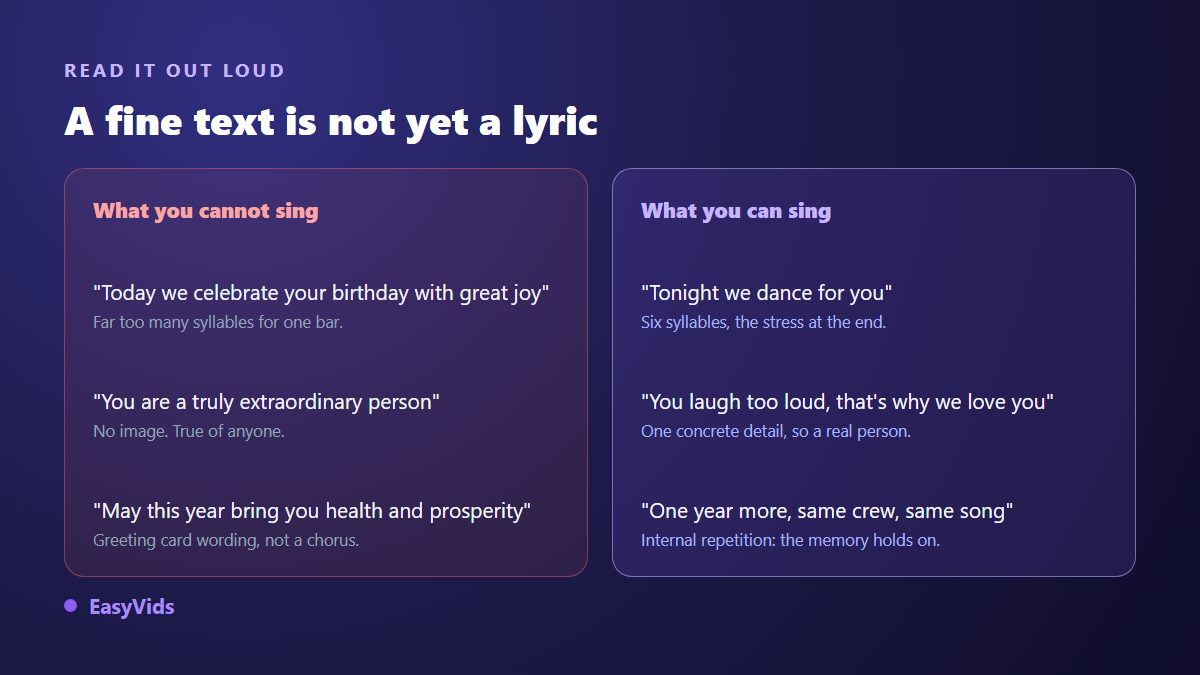
- Read every line aloud while tapping the beat. If you run out of breath, the line is too long.
- Count the syllables of two rhyming lines: a wide gap makes the melody limp.
- Put the important word at the end of the line, that is the one carrying the held note.
- Watch out for easy suffix rhymes, they arrive fast and sound like a shortcut.
- Cut connectors nobody sings: however, additionally, furthermore.
- Keep one idea per line. Two ideas in the same line make the vocal muddy.
Fixing those lines yourself takes minutes and beats another generation. You know the right detail, the nickname, the word that person always uses. Lyrics generated and then retouched by hand always ring truer than lyrics regenerated five times in the hope of landing on the good one.
From lyrics to a finished song
Once written, the lyrics land in a field you can edit freely, with a suggested title you can replace. That title names your file and your song in the history, which matters as soon as you produce several. Composing then reads your text as it stands, section labels included, and returns a sung track. It takes one to four minutes and keeps running if you close the page.
Three paths open at that point. You supply your lyrics and the song follows them. You leave the field empty and the composition works from your brief alone. You tick the instrumental option and get a track with no vocals, useful as a video bed. Writing the words costs a fraction of what composing costs, and every draft stays in your history, reloadable in one click with no new charge. Plan details sit on the pricing page.
What you can do with AI written lyrics
Rules differ from one country to the next, so caution is warranted. One point is settled in official guidance: according to the guidance published in March 2023 by the United States Copyright Office, material produced by a machine without human intervention is not protected by copyright, and only the part genuinely written, selected or arranged by a person can be. The more you rework your lyrics, the more identifiable your own contribution becomes. On the distribution side, YouTube states in its help centre that Content ID compares published tracks against reference recordings supplied by rights holders.
Frequently asked questions
Can an AI lyrics generator write in several languages?
Automatic lyric writing in the Music Studio currently works in French. Nothing stops you singing in another language: write or adapt the words yourself, paste them into the lyrics field, and the composition follows them. Avoid word for word translation, which keeps the meaning and loses the syllable count, so the line no longer fits the bar.
Do I need musical training to use generated lyrics?
No. The bracketed section labels are enough to tell the music engine where the chorus and the bridge belong. Counting syllables helps you fix an awkward line, but no formal training is required to turn a text into a complete song.
Can I edit the lyrics before generating the song?
Yes, and you should. The text arrives in a fully editable field: cut a line, swap a word, add a verse of your own. Composing starts from the final version in front of you, not from the original draft.
Are AI written lyrics unique?
Two identical briefs give two different texts, though they lean on similar images. Uniqueness comes from you: a true anecdote, a name, a place. A detailed brief produces something nobody else will get, while a vague brief produces a song you could give to anyone.
How long does it take from brief to finished song?
Writing the lyrics takes under a minute, reading and reworking them around ten, composing one to four minutes. In practice a polished custom song takes a quarter of an hour, and most of that time goes into the text rather than the waiting.
Writing lyrics was never about sudden inspiration. It is about well set constraints: a frame, a short chorus, true details, a read aloud pass. An AI lyrics generator removes the blank page and leaves you the work that counts, the part that makes the text recognisable. To write your first set and hear it sung straight after, create your account and open the Music Studio inside the EasyVids creation studio.