You have a product to sell and you need a video to run as an ad. No crew, no studio, sometimes not even a sample in your hands. An AI video ads generator exists for exactly that: you write what you sell and who buys it, and the tool hands back a finished ad, with its script, its shots, its voice over and its music, ready to upload into an ads manager.
What nobody says out loud is that the quality of the ad depends mostly on what you typed in the box at the top. Two shops selling the same insulated bottle get two unrelated videos, because one described an object and the other described a buyer. This guide walks through what the machine actually builds at each step, what to feed it so the first output is usable, and how to produce a family of variants instead of one fragile creative.
The short answer
An AI video ads generator turns a product description into a finished video ad. It picks a selling angle, writes a short script built like an advertisement, cuts that script into shots, produces a visual for each one, adds a synthetic voice over and music, then exports in the format of the platform you target. The first version lands in minutes. Inside the EasyVids creation studio the whole path fits on one screen: a description, a format, a button. The rest of this article is about making that first version already good.
What the tool really builds, and what it does not
An ads generator is not a single model spitting out a video. It is a chain: a language model writes, an image or video model produces the shots, a speech model reads the script, an editing engine assembles everything. Each link can be reworked on its own, and that is the one test that separates a toy from a working tool. If you cannot replace a single shot without regenerating the whole thing, you do not have a tool.
What it does not build: your positioning, your proof and your offer. No model guesses that your strongest argument is two day delivery or a lifetime guarantee. If you want the human side of the method, our guide to building a video ad from scratch covers the reasoning, from picking the offer to the final edit. The generator executes fast, it does not decide for you.
The six steps from a description to an exported ad
Knowing the sequence tells you where to step in when a result disappoints. A failed ad is almost never failed because of the image model. It fails at the angle, two steps earlier, and nobody walks back that far.
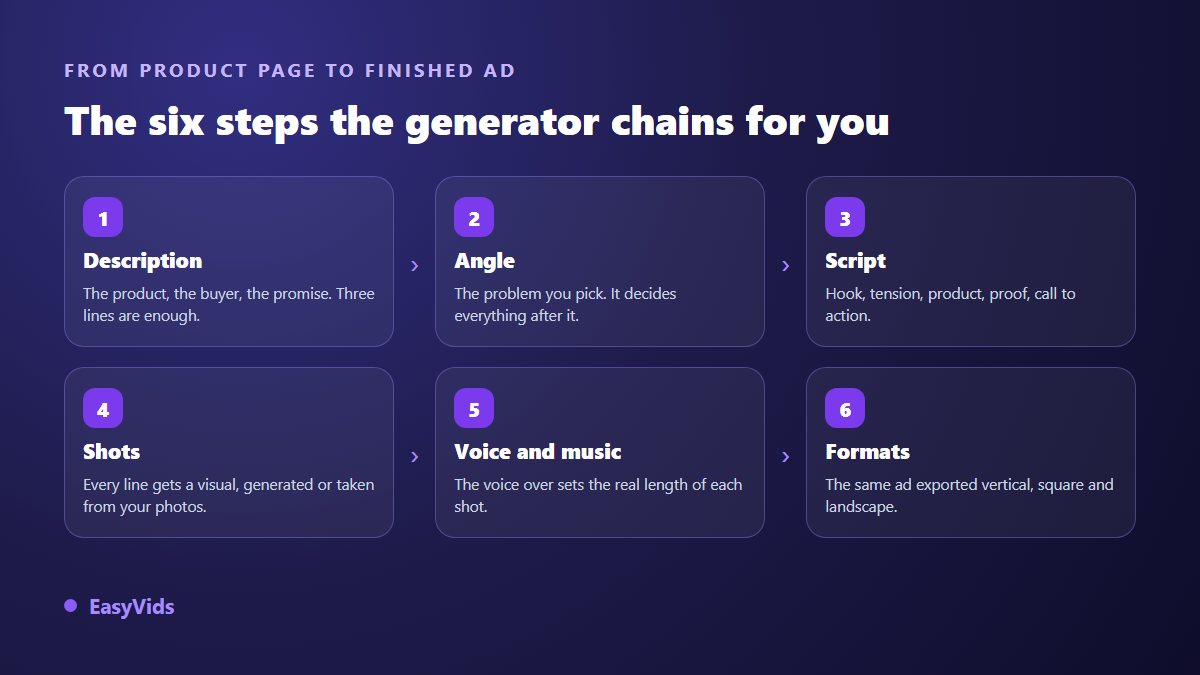
You only write the first step. The other five run on their own, and stay editable one by one. Editing a single link by hand is what moves an ad from acceptable to publishable.
What your product description must contain
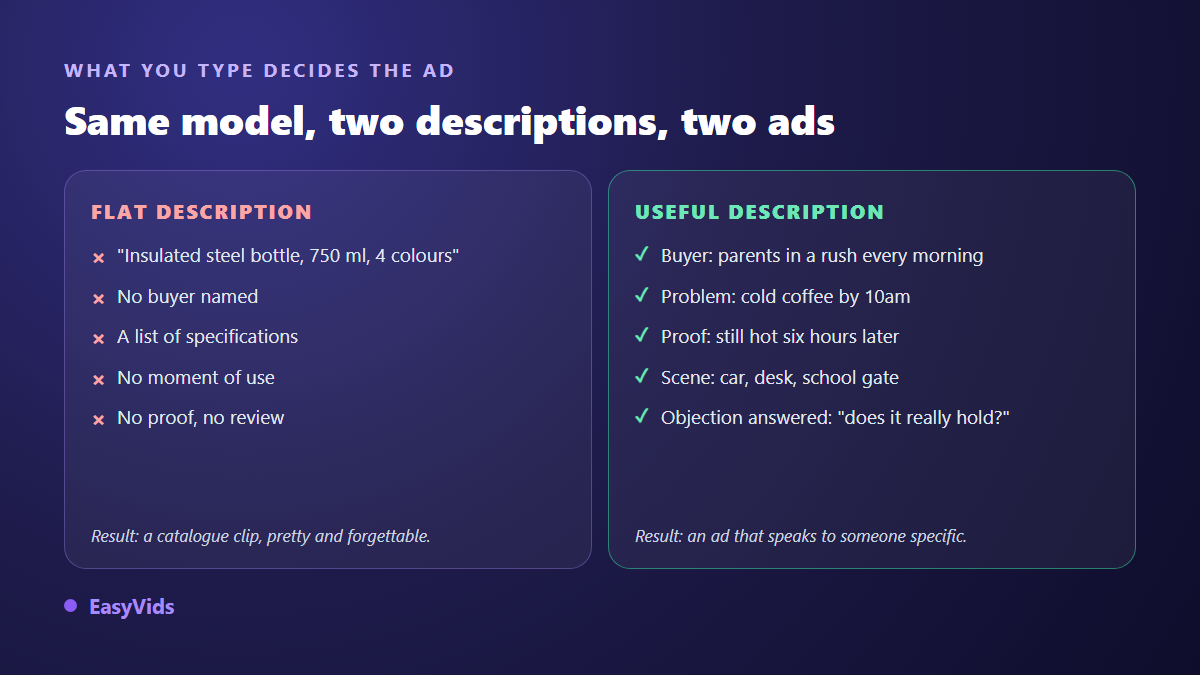
The description is the real creative brief. A pasted spec sheet gives you a catalogue clip, pretty and inert. A description that names a person and a moment gives you an advertisement. A good brief carries these six things, in any order:
- The product in one line, the way you would say it to a friend, not the way it reads on the box.
- The buyer, as narrow as you dare: parents in a rush every morning beats everyone.
- The problem it solves, phrased the way your customer lives it, not the way you sell it.
- One proof: a recurring review, a guarantee, a measured duration, a before and after.
- A scene of use: a place, a time of day, one concrete gesture to show.
- The action you want: buy, try, subscribe. One verb, not three.
Those six lines take three minutes to write and change everything downstream. The comparison below shows the same model fed two different ways, on the same product.
The angle decides everything else
A product always has several reasons to be bought. An insulated bottle sells on heat retention, on cups saved, on looks, or on toughness. Each reason produces a different ad, with a different hook and a different proof. The classic mistake is to cram them all in: the ad turns into a list, and a list convinces nobody.
Ask for one angle at a time and generate one version per angle. It is also the fastest way to learn something real about your market: three ads identical except for the angle tell you within days what your buyers actually care about. Our product video guide explains how to pick that angle from your own reviews rather than from instinct.
Anatomy of a 30 second ad
A short video ad follows a very stable structure, one the model respects if you ask for it explicitly. Thirty seconds is roughly 75 words of voice over at a natural pace of 150 words per minute. There is room for five ideas, one per block. Cutting rhythm and sound treatment weigh just as much, and what gives a thirty second spot its television polish covers that directing work no generator guesses on your behalf.
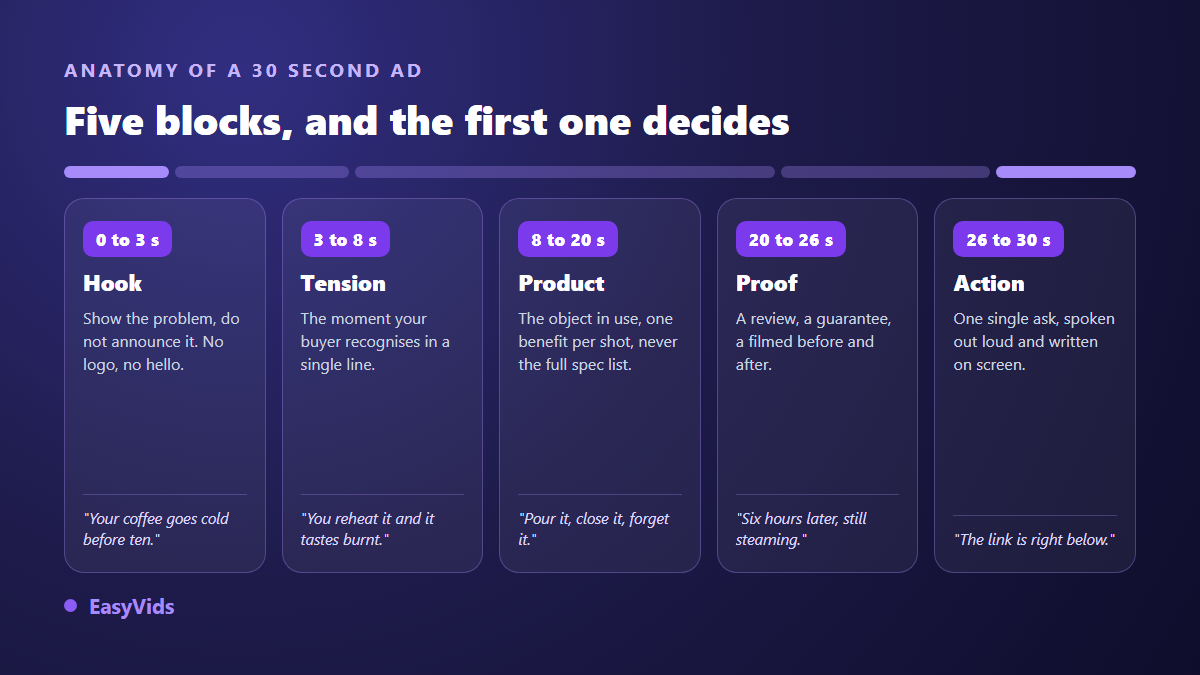
The first three seconds carry a wildly disproportionate load. The creative guidance Meta publishes for advertisers has repeated the same instruction for years: show the product or the problem immediately, with no opening logo and no warm up. An ad that opens on your brand talks about you, and nobody unlocked their phone to hear about you.
The closing block deserves the same care. A call to action is spoken out loud and written on screen at the same time, because a large share of social viewers watch with the sound off. One ask, one verb, and the same wording as the button that follows.
Voice and music carry half the result
In an ad the voice is not decoration, it is the spine. It sets the real duration of every shot: a good edit fits the picture to the voice, never the other way round. A serious generator produces the audio first, measures it, then stretches or trims each shot to match.
Pick the timbre from the angle, not from personal taste. A reassuring promise wants a calm voice and a slower pace; a limited offer wants energy and shorter sentences. Our advice on getting a natural sounding AI voice over applies directly to ads, with one nuance: advertising is read slightly faster than narration.
Your own product photos beat an invented visual
Here is the limit to know before you start: an image model does not know your product. It will build a plausible object, never yours, with the wrong label and the wrong cap. For anything that shows the item itself, start from your own photos and let the AI animate them, reframe them and build the world around them.
Keep pure generation for what does not need to be exact: the context, the mood, the slice of life, the transition. Real photos for the product, generated images for everything around it. That single rule prevents most complaints about an ad that looks nothing like what arrives in the parcel.
Formats, platforms and required disclosure
The same ad is not served the same way everywhere. Meta publishes advertising specifications recommending vertical 9:16 for Reels and stories, and a taller than wide ratio for the feed; TikTok runs full screen 9:16; YouTube takes classic 16:9 and vertical for Shorts. Those pages change often, so check the platform documentation before an important campaign rather than a table copied into a blog post.
Disclosure matters just as much. TikTok community guidelines have required labelling of realistic AI generated or edited content since 2023. YouTube has asked creators, in its Studio, to disclose realistic synthetic content since 2024. Meta adds an AI information label on content it detects as generated. A stylised set raises no question; a scene that could pass for a filmed customer testimonial does. When unsure, disclose: an omission costs far more than a label.
If your catalogue lives on an online store, think beyond paid traffic. Our piece on adding video to a Shopify store shows where the same ads belong on the product page, working around the clock with no media budget.
An ad is not judged, it is tested
The real win is not producing one video, it is producing nine. As long as a creative cost a shooting day, you were allowed one hypothesis. When it costs minutes, you launch a family of variants and let the audience decide.
One rule of method: change one thing at a time. Same product, same edit, three different hooks. Then, on the winning hook, three different proofs. Our guide to AI generated ad creatives lays out the full variant plan and a sane number of versions per product.
Then read the right metric at each floor. Three second view rate judges the hook. Average watch time judges the body. Click through rate judges the call to action and the promise. A weak click through rate is never fixed by changing the music.
The mistakes that keep coming back
They are almost always the same ones, and every one of them is fixed upstream, in the description:
- Opening on the logo instead of opening on the problem.
- Stacking five benefits where there is room for one.
- Letting the model invent the product when your photos already exist.
- Writing for the eye, full of clauses no voice over can deliver.
- Forgetting captions, when much of the audience watches muted.
- Publishing a single version, then deciding that generated video does not work.
None of these come from the technology. They all come from a brief written too fast, and they all take two minutes to repair.
Frequently asked questions
Does an AI video ads generator replace a shoot?
For testing angles, producing variants and covering a whole catalogue, yes, comfortably. For a brand campaign built around a face, a real location or a precise technical demonstration, no: filming still wins. Plenty of advertisers do both, using AI to find the right message and a shoot for the winner.
Is there a free AI video ads generator?
Most tools, EasyVids included, open with a free trial that produces real videos before you pay anything. Limits usually sit on duration, resolution or the number of generations. The current plans are listed on the pricing page, which stays up to date, unlike any figure copied into an article.
Do I have to disclose that an ad was made with AI?
Yes as soon as the result could pass for real, and it is a platform obligation rather than advice: TikTok has required it in its community guidelines since 2023, YouTube asks for disclosure of realistic synthetic content in Studio since 2024, and Meta adds an AI information label to content it detects. Also check the advertising rules of your own sector, health and finance in particular.
Can I use my own product photos?
You should. You upload your visuals, the tool animates them, reframes them to the format you need and generates the surrounding scene. The product stays exactly yours, with its real label, which no fully generated image can promise.
How long should an ad be?
Fifteen to thirty seconds covers the large majority of social placements. Fifteen seconds is enough for a simple offer and one benefit. Thirty seconds earns its keep when you need a proof or a demonstration. Beyond that you are no longer writing an ad but a sales video, which follows different writing rules.
Start small and concrete: take your best selling product, write the six lines of description, generate three versions that differ only by the hook, and run them the same week. Within days you will know what your buyers want to hear, and you will have a reusable mould for the rest of the catalogue. Open a free account and build your first ad tonight.