The hook has been going round your head for three days. Two verses sit in your phone notes, and you have nothing to record them with: no studio, no beat, no decent microphone. That is exactly the gap an AI rap generator fills. You supply a text and a musical direction, the machine returns a listenable track, vocals included, in a few minutes.
A rap track is not ordered the way a background pad is. This is the genre where the voice carries everything, where tempo changes the meaning of a line, and where one syllable too many breaks a bar. Current engines do well when you speak to them in subgenre, tempo and structure. They do badly when you type « make me a rap ». This guide walks the whole method, from the first verse to the downloaded file, alongside our complete guide to the AI music generator.
The short answer
Work in this order. Pick the subgenre and its tempo range, because everything follows from it. Write your lyrics, or have them written, structured with [Verse 1], [Chorus], [Verse 2] and [Bridge]. Read them out loud while tapping the tempo with your foot, and cut whatever does not fit. Then launch the composition with a description that names the instruments, the delivery and the type of voice. Expect one to four minutes of processing, then download the file. Keep one rule in mind: the first take is for listening, the third one is the one you publish.
What an AI rap generator actually does
Two different machines hide behind the phrase, and confusing them explains most disappointments. The first one writes: it turns a brief into structured lyrics, with rhymes, a punchline and a hook. The second one composes: it turns a text and a description into an audio file, with a beat and a voice riding it. You can use only one of the two. Plenty of people arrive with their own verses and want the music alone.
What none of these tools does today is worth saying straight away. It does not hand you separate stems, vocals on one side and instrumental on the other. It does not guarantee the same timbre twice across two different tracks. And it does not replace writing: a flat text stays flat, however good the beat under it.
Rap is not one style, it is a family of tempos
The first useful habit is to drop the bare word « rap » from your descriptions. Between a laid back boom bap and a tense drill, everything differs: drums, bass, melody, and the way the voice sits. Tempo is not a finishing detail, it is the decision that drives all the others. The same lyrics become a story at 90 BPM and a nervous statement at 140.
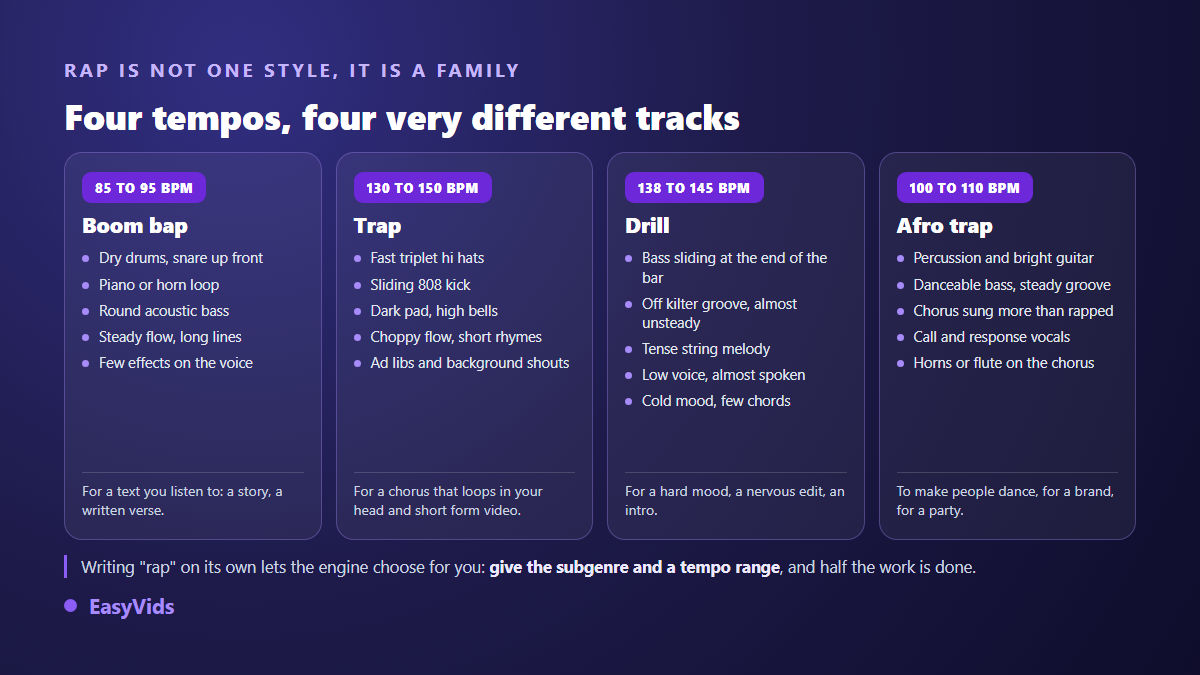
In the Music Studio, the style field offers a Rap chip, but it stays completely open: that is where you type « drill 140 BPM, tense strings, sliding bass » instead of settling for the word alone. The same logic applies to every genre, and our twenty five music prompt formulas show how to carry it elsewhere. Remember the hierarchy: subgenre, tempo, instruments. The rest is fine tuning.
The description that sets the beat
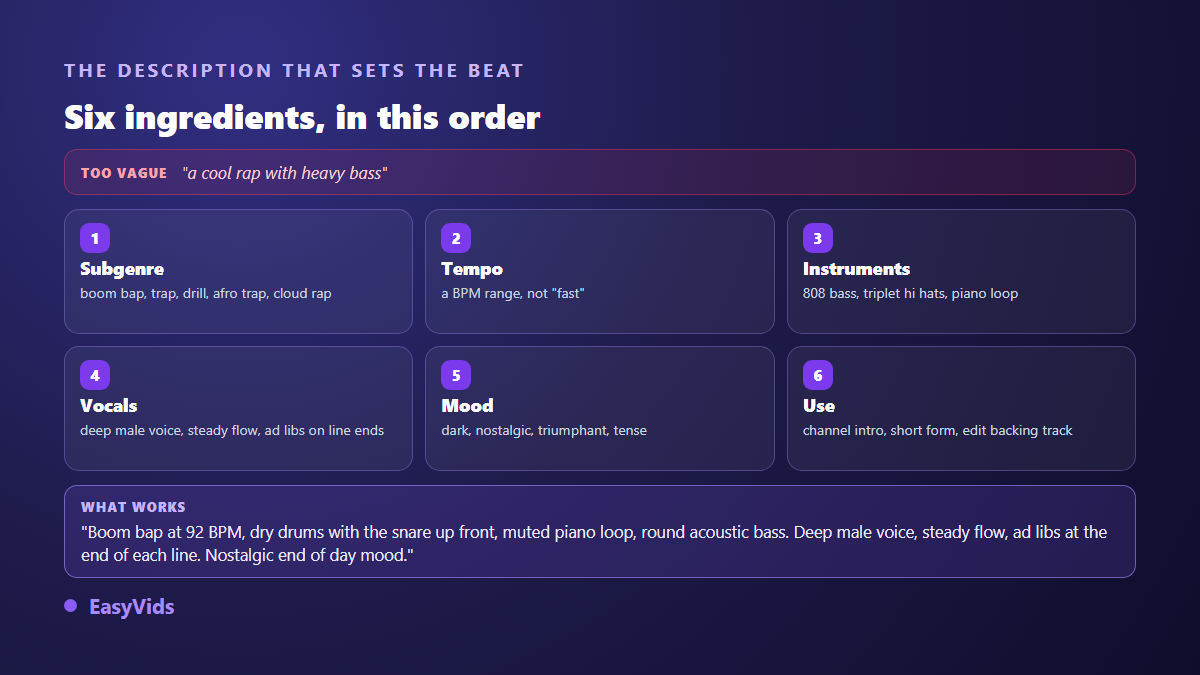
A useful description runs three or four sentences and always answers the same questions. Which subgenre. Which tempo. Which instruments carry the loop. Which voice, with which delivery. Which mood. And finally which use, because a track meant for a channel intro is not built like a track meant for listening.
One trap comes up constantly: naming a famous rapper in the hope of getting their sonic signature. Serious engines filter those requests, and when one slips through it exposes you for nothing. Describing what you hear works better than the name itself. « Deep voice, dragging delivery, very long 808 bass, few chords » tells the engine far more than a surname.
Nine descriptions to copy, sorted by use
- Laid back storytelling: boom bap 92 BPM, dry drums, snare up front, muted piano loop, round upright bass, deep male voice, unhurried delivery, late afternoon nostalgia.
- Short form punch: trap 140 BPM, fast triplet hi hats, sliding 808 bass, dark pad and high bells, saturated voice, choppy delivery, ad libs on line endings.
- Tense intro: drill 142 BPM, bass sliding at the end of each bar, off kilter rhythm, plucked string melody, low almost spoken voice, cold mood, few chords.
- Danceable brand track: afro trap 104 BPM, bright percussion, high looping guitar, round bass, sung chorus over rapped verses, answering backing vocals, sunny mood.
- Floating melancholy: cloud rap 78 BPM, stretched synth pads, distant drums, wide reverb, soft heavily doubled voice, nocturnal drift.
- Message driven: conscious rap 88 BPM, warm bass, muted drums, discreet horns at the end of the verse, clear voice, steady delivery, serious without being dark.
- Club atmosphere: jazz rap 94 BPM, upright bass, brushes on the snare, open piano chords, muted trumpet on the bridge, relaxed voice, late night feel.
- Workout energy: high energy rap 150 BPM, open drums, powerful horns, bass on every beat, shouted chorus, triumphant mood.
- Background loop: instrumental loop 95 BPM, no vocals, discreet drums, no build up, room left for a voice over on top.
Writing a verse that fits, and a hook that sticks
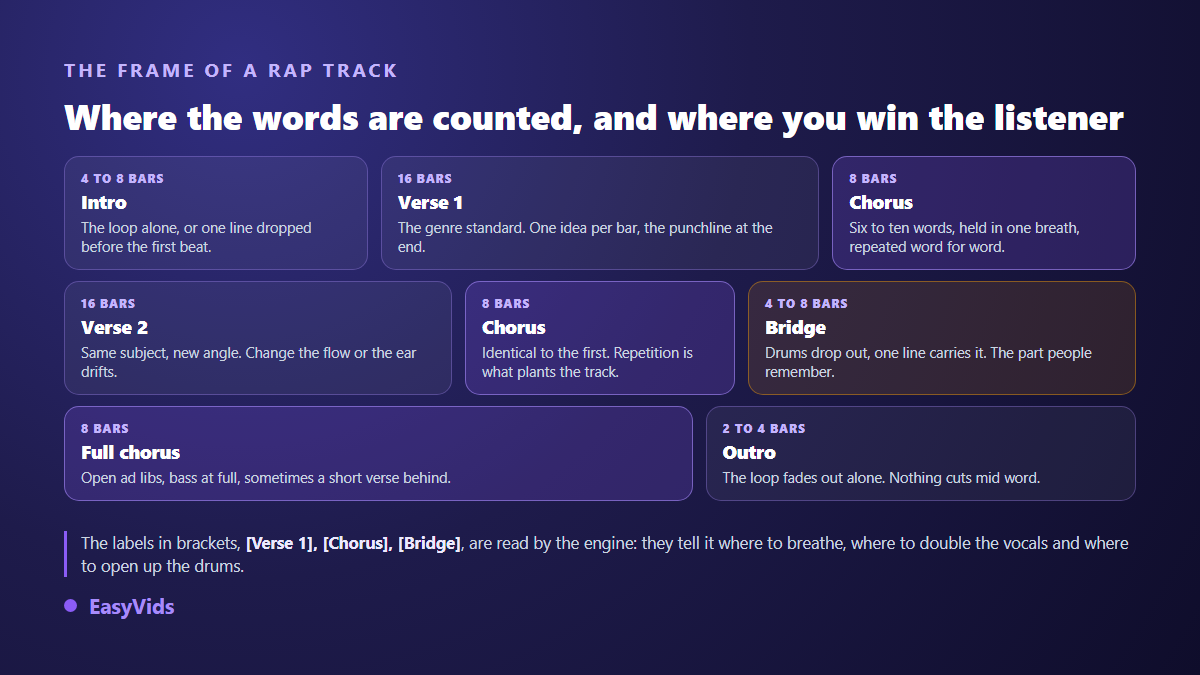
The convention has been stable for decades: a verse runs sixteen bars, a hook runs eight. It is not sacred, it is a marker that stops you delivering a text the music cannot hold. One idea per bar, a punchline at the end of every fourth, and the frame stands on its own.
One test replaces every theory of flow: read your verse out loud while tapping the tempo with your foot. Run out of breath before the end of a line and that line is too long for this tempo. Land two beats early and you need more syllables, or a slower tempo. Engines lock the voice onto the rhythmic grid, they do not rewrite a badly measured text, they flatten it.
A hook follows different rules. Six to ten words, held in a single breath, repeated identically every time. It is the one place in a track where variation hurts. If a single line of your text is genuinely good, put it there.
Step by step in the Music Studio
- Open the Music Studio, pick the Custom occasion, then describe your track in one sentence.
- Add a name if the track is addressed to someone: it then comes back in the hook and in at least one verse.
- Drop two or three concrete details into the message field. One true detail beats a paragraph of generalities.
- Click the Rap chip, then complete the field by hand with the subgenre and the tempo. It accepts anything you type.
- Pick a mood and a general tempo. The numeric value belongs in the style field.
- Have the lyrics written if you start from scratch: you get a title and a structured text, which you edit freely before composing.
- Select the engine. AI song returns voice and music together, AI instrumental returns the beat alone.
- Launch, then close the page if you want: composition continues on the server and the track waits for you on your return, one to four minutes later.
Two details change everything over time. The page keeps your previous tracks and the lyrics already written, and one button reloads them into the form with no new writing charge. Every delivered item is billed in credits, which lets you try three versions of a hook without committing to a full production. Plan details sit on the pricing page.
What the machine still gets wrong
- Slang and invented words: diction slips on anything no dictionary contains. Spell the word phonetically in the lyrics when pronunciation matters.
- Ad libs: shouts and doubles land where the engine decides. You can suggest them in brackets, not place them on an exact beat.
- Voice consistency: two runs of the same text do not return exactly the same timbre. For a series, keep the take you like rather than hoping to reproduce it.
- Separate stems: you get a mixed file, not vocals and instrumental apart. Plan for it if you meant to remix.
- Exact tempo: the BPM figure is a written hint inside the description, not a guaranteed setting. Check it by ear before editing your video.
- Very long texts: the lyrics field comfortably holds two verses, a hook and a bridge, but an endless text ends up truncated.
Publishing without getting into trouble
A generated rap track publishes like any other, provided you know where the lines are. On monetisation, the YouTube help centre replaced its repetitious content policy with an inauthentic content policy in July 2025. It does not target the use of AI as such, it targets channels stacking mass produced files with no original contribution. A track you wrote, edited and selected sits comfortably inside those rules, and our article on AI music and YouTube monetisation covers claims and payouts in detail.
Two areas call for more care. Imitating the voice of an identifiable rapper, which platforms and rights holders treat harshly, a subject we covered for celebrity voices. And reusing the lyrics or the instrumental of an existing track, which stays an infringement even when a synthetic voice performs it, as our file on AI music and copyright explains. Note as well that, since March 2024, the YouTube help centre asks creators to disclose realistic synthetic content in YouTube Studio when it could mislead the audience.
Frequently asked questions
Does the voice really rap, or does it just recite?
It raps, in the sense that it places syllables on the rhythmic grid and respects the accents of the tempo. The result convinces on a measured delivery and regular rhymes. It strains on very fast deliveries and on flow switches inside a verse, which the machine does not anticipate. The better your text fits the requested tempo, the more the delivery lands.
Do I need to know how to write lyrics?
No. A dedicated button writes a title and a complete text from your brief, structured into verses, hook and bridge. The real gain comes right after: you edit that text, cut the weak lines, swap a generic image for a precise memory. A text you have been through always sounds better than one taken as delivered.
Can I get the instrumental only?
Yes. The instrumental engine composes a loop with no vocals from your description, which suits a video bed or your own voice on top. Keep in mind that these instrumentals are short and built as loops, not as three minute tracks.
How long does a complete track take?
Expect one to four minutes for the composition itself, and around half an hour overall if you write the text, read it out loud and run two or three versions. The page can be closed while it processes: production continues on the server and the track waits for you.
The real work on a generated rap track does not happen in the compose button, it happens before: a chosen tempo, a counted text, a hook that fits in one breath. The rest settles in three attempts. To record your first verse, create a free account and open the Music Studio. Writing, composing and editing all live in the same place, inside the EasyVids studio.