You are looking for short scary stories to narrate, and you keep landing on the same recycled texts. Their quality is not the issue. The issue is that they have already been read aloud hundreds of times, so your viewer recognises the ending by the second sentence and leaves. A narration channel cannot be built on stories everyone already owns.
The thirteen stories below are original and published here for the first time. Each one runs two to three minutes of voice over, with its twist placed last. You also get the mechanism that holds them together, the same one behind our guide to writing a video script: a short story is built backwards, from its final line.
The short answer
A short scary story that works runs 300 to 500 words, or two to three minutes of narration. It sets an ordinary place, breaks one single detail, lets the narrator look for a rational explanation, then flips everything in the last sentence. One fear per story, never two. Take any story below, swap the setting for a place you actually know, and you have a video to record tonight.
Why short beats long in horror
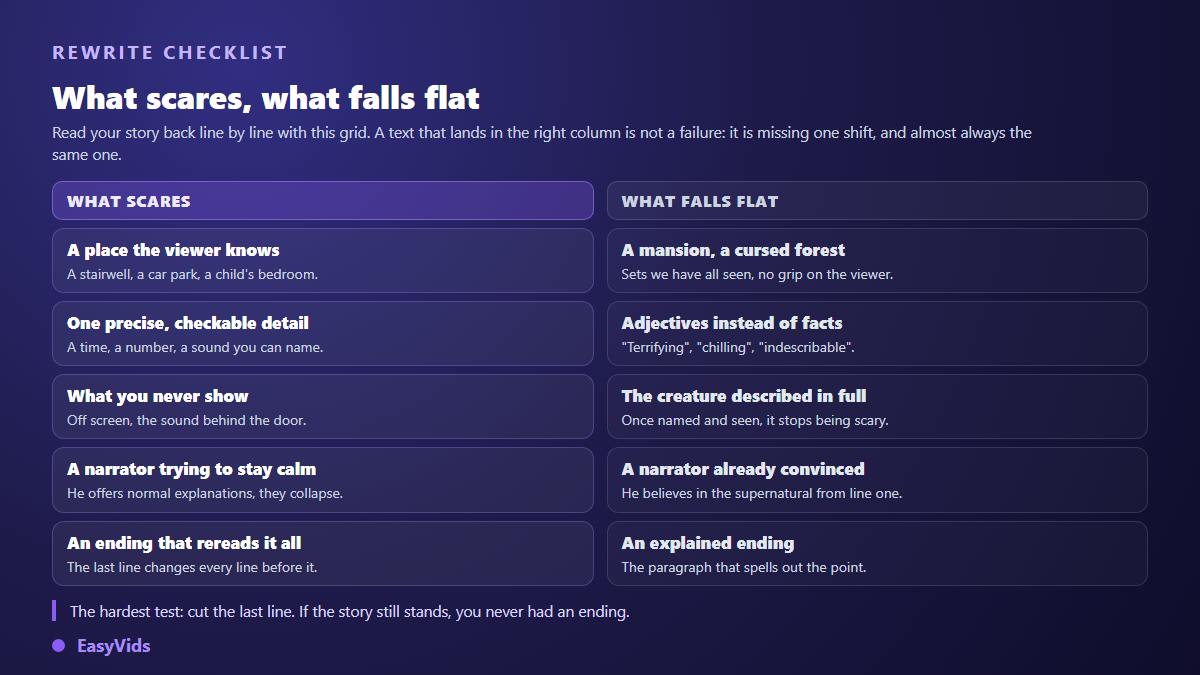
Fear is tension, and tension does not hold for long. Past four or five minutes the viewer has settled in, learned the rules of your world and guessed the ending. A short story keeps the advantage because it explains nothing: there is no room for it. That is also what makes it hard to write, since no sentence can be decorative.
The four beat structure
All thirteen stories share the same frame: an anchor, a broken detail, an escalation, a twist. The word budget matters as much as the order. One minute of narration is roughly 150 words, and that is the ratio our script generator uses to turn a duration into a text length.
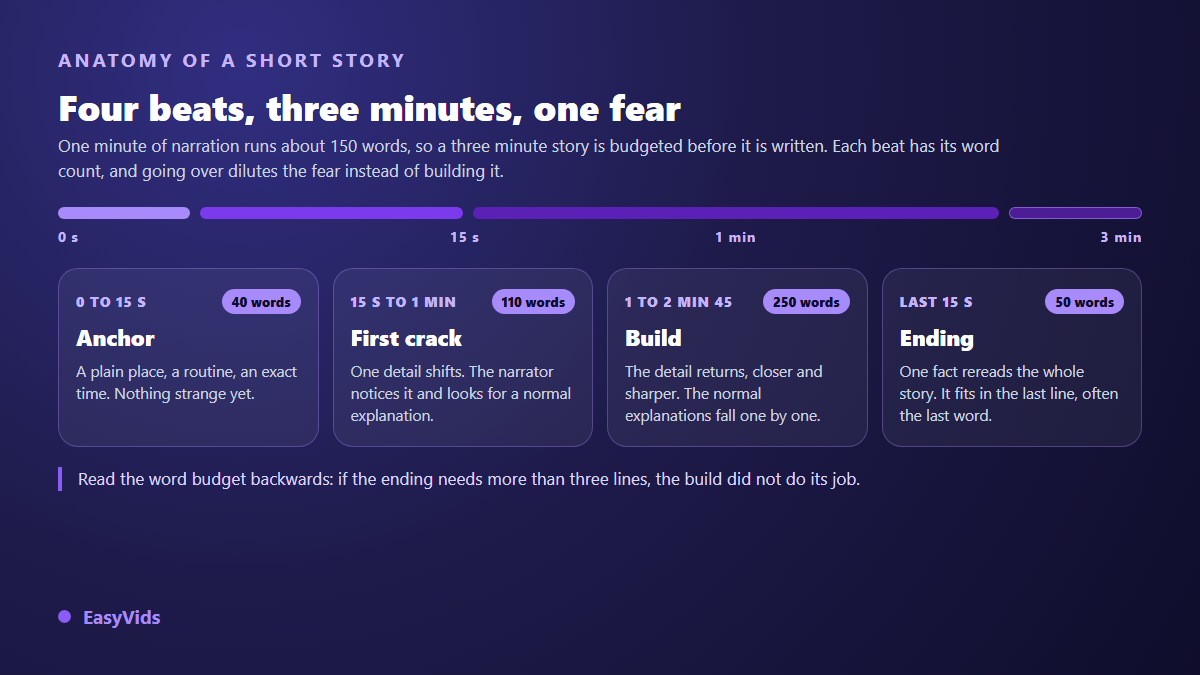
The beat writers get wrong is the first one. A good anchor is not frightening at all: it gives an hour, a place, a habit. That normality is exactly what makes the broken detail unbearable thirty seconds later. Opening with a warning that something strange happened robs the viewer of the only thing they came for.
Thirteen original short scary stories
They are grouped by family, because each family teaches something different about fear. Use them as they are, or change the setting. The one thing to keep is the final sentence.
Four stories where daily life slips
1. The stairwell timer. He gets home at 11:40 every night. The hall light runs forty seconds, just enough for four floors. One evening it dies on the third. The next, on the second. He changes the bulb, times it, counts the steps: the light always dies one floor earlier. The last night it goes out before his foot reaches the first step. The timer is not getting shorter. Whatever is coming down to meet him gains one floor a night.
2. Two dry coughs. Every night at 2:14, two coughs come through his bedroom wall. Nothing worrying: a neighbour sleeping badly. After three weeks he knocks twice on the partition, politely. The coughing stops and he falls asleep pleased with himself. The next day the caretaker tells him that wall backs onto no flat at all: behind it there is a duct, bricked up years ago. The following night, at 2:14, something knocked twice.
3. The shopping list. She finds a list in her coat pocket, in her own handwriting, that she never wrote. The first six lines match yesterday's shopping exactly, in receipt order. The next four describe purchases she has not made. She decides to buy nothing all week and leaves the list in a drawer. On Friday every line is ticked off in her handwriting, and the last line is not food.
4. The 3:12 file. An app records the night and keeps only the audible parts. First morning: snoring. Second: a door. Third: a voice saying his name, very close to the microphone. He moves the phone to the hallway and locks the bedroom door. The next recording lasts eleven seconds: a key turning, then his own sleeping breath, captured from inside the room.
What this family teaches: fear comes from a number, not an adjective. An exact hour, a count of steps, a battery percentage. The viewer checks the detail against their own life while listening, and does half your work for you.
Three stories about places that will not stay still
5. The ninth door. A roadside hotel, eight rooms, one corridor. He sleeps in room 6. On the second night he hears a key, a muffled laugh, a flush behind a door that does not exist during the day. He counts the doors as he walks: nine. At the desk the register lists eight rooms, and his name appears twice. Once in 6, for tonight. Once in 9, with an arrival date eleven years old.
6. Level minus four. The car park map shows three basement levels. For a week his car has been parked on minus four. He goes down, finds it, comes back up, and nobody around him finds this strange. The camera on the lowest level films the ramp all night: every evening his car drives down, and nothing drives back up. The night he decides to take the bus instead, the lift opens before he presses anything, already showing minus four.
7. The halfway station. Three hundred kilometres of road, one service station in the middle, a cashier who recognises him. She says he came through twenty minutes ago. He drives on for an hour and reaches the same station, the same cashier, the same crumpled receipt in his pocket. On the fourth pass she no longer looks up. She lines up four cold coffees on the counter and asks whether he plans to stop this time.
What this family teaches: an ordinary place scares people more than a mansion. Viewers already know car parks, roadside hotels and night stations, so you can spend every word on the thing that is wrong.
Three stories about objects that watch you
8. The video doorbell. The camera sends a notification at 3:04 every night. The image shows nobody, just an empty landing and a sensor that triggered on its own. He adds a second camera inside, facing the door. The next night both clips carry the same timestamp. Outside: the empty landing. Inside: himself, standing at his own front door, staring at a phone screen. He is in bed, holding that phone.
9. Shuffle mode. Between tracks, his headphones slip in a few seconds of audio that belong to no library. A sheet moving. A breath. A whispered sentence, too low to catch. He exports his listening history: the files are named with dates, all of them at night, all from this month. The most recent one is dated tomorrow night. It runs forty minutes.
10. Four percent. A cellar, a phone torch, a boiler to restart. At 12 percent he sees a shape between the boxes and tells himself it is a coat on a rack. At 8 percent the coat has turned. At 4 percent he stops pointing the light that way. He switches it off to save what is left and counts his steps back to the stairs. He takes seven. On the way in, he took eleven.
Three family stories
11. The fifth figure. The little girl draws the same family every evening: father, mother, herself, the dog. Since March a fifth figure stands at the back, taller than the rest, always turned away. Her mother finally asks who it is. "That's you," the child says. Her mother points out that she is already there, next to the dog. The child points at the figure at the back and corrects her, calmly: "That one is you now."
12. The lullaby. A woman's voice comes through the baby monitor after midnight. Soft, slightly slow, a song nobody in the house knows. The parents go up: empty room, empty cot, window locked from inside. Their son has been downstairs in his mother's arms all evening. The lullaby keeps playing in the monitor while they walk back down, and stops the second the father says there is nobody up there.
13. The silence game. The grandmother teaches the children a game: when she raises her hand, nobody speaks and nobody moves until she lowers it. She always wins. On game nights the hallway floor creaks, as if someone were pacing outside the door. That last winter she raises her hand and falls asleep in her chair. The children hold the silence for two hours, until the footsteps stop at the door and wait. Nobody ever learned what would have happened if one of them had spoken: the grandmother opened her eyes, and lowered her hand.
What this family teaches: fear travels better through a child's line than through description. Six words spoken by a little girl weigh more than a paragraph of atmosphere, because the viewer draws the conclusion alone.
Turning a story into a narrated video
Production always follows the same order. The text is split into scenes of 5 to 15 seconds, roughly 15 to 40 words, and each scene gets a still or an animated shot. The voice is generated, then every visual is locked to the real duration of its narration. In our script generator, the horror and suspense tone and the length in minutes are chosen before the first line, and the web research option stays off because this is fiction.
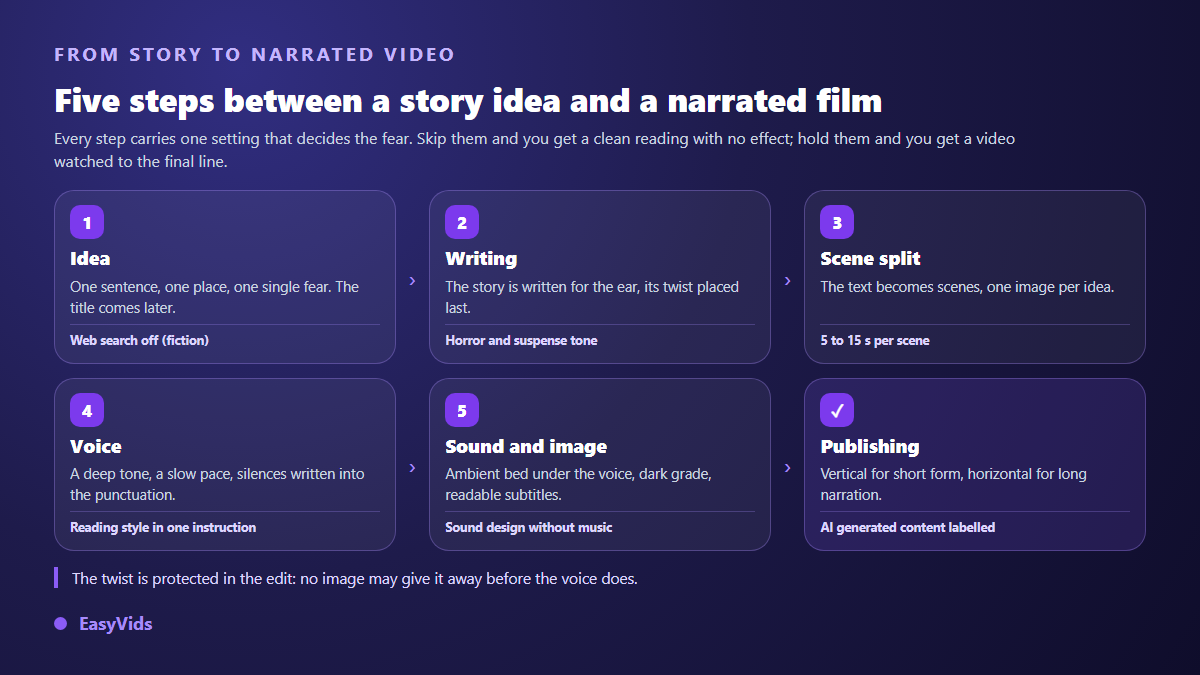
If you start from a text you already wrote, the conversion needs preparation, and our method for turning a written story into a film walks through it: strip the writerly asides, keep dialogue short, decide what stays off screen. A story that reads well is never directly speakable.
The voice carries half the fear
A chilling text read like a station announcement scares nobody. Timbre matters, pace matters more: horror narration is slow, with longer silences than anywhere else. On our V1 voice model a reading style is given as one plain sentence, such as reading low and slowly, like a memory you are not sure of. Deep, steady voices suit first person accounts; breathy ones suit confessions.
Punctuation is your score. A full stop cuts, a comma breathes, a blank line installs silence. Write the silences into the text instead of adding them in the edit, and the narration will already have its rhythm before you touch the timeline.
Sound: the layer nobody notices
Mute a horror film and it becomes a set of harmless shots. The same rule applies to narration with tiny means. In our productions the atmosphere is set scene by scene, with three options: sound design without music, background music, or voice only for a near silent scene. Alternating those three does more than one continuous pad from start to finish.
- A dark, very low bed under the whole escalation, only noticed when it stops.
- A short riser before the turn, never after: placed late, it announces what is coming.
- A heartbeat or a ticking clock to count time in the narrator's place.
- One deep impact on the twist, followed by nothing at all.
- Two or three seconds of real silence before the final sentence: the cheapest effect there is, and the strongest.
What platforms actually allow
Horror is not a banned genre, explicit imagery is. The YouTube help centre places violent or graphic content without context among what can be age restricted, or removed when the violence looks gratuitous. TikTok community guidelines likewise prohibit gory imagery and content made to shock. A story that suggests travels everywhere; a video showing a mutilated body closes both doors.
One more rule before publishing: since its March 2024 update YouTube asks creators to disclose realistic content made with synthetic tools at upload, and TikTok requires an equivalent label for realistic AI generated scenes. Clearly stylised worlds are out of scope; a reconstruction that could pass for real footage is not.
Frequently asked questions
How long should a short scary story be?
Count 300 to 500 words for a two to three minute narration, based on roughly 150 words per minute of voice. For a vertical format, drop to 110 or 150 words, about 45 to 60 seconds, and keep the twist inside the last ten seconds.
Can I publish a story written with AI?
Yes. Platforms penalise mass produced content with no contribution, not the writing tool. A story you reworked, narrated with a chosen voice and edited with care carries that contribution. Disclosure is still expected when the visuals could pass for real footage.
Should the monster ever be shown?
As late as possible, and preferably never in full. A hand, a shape at the end of a corridor, a reflection is enough. Once the creature is visible and named, the viewer stops imagining, and imagination is your best special effect.
Can a synthetic voice really be frightening?
Yes, if you slow it down and write silences into the text. The flaws of a generated voice show up in long, fast sentences. Slow, punctuated narration with a deep timbre holds the genre perfectly, and many narration channels have run that way for years.
A good short scary story needs no budget and no gear, only a solid last line and the discipline to explain nothing before it. Pick one from this page, move it to a street you know, record it, and watch where viewers drop off: they will tell you which beat runs too long. To write, narrate and edit your first story in one place, create an account and open the EasyVids studio.