The child wants a story, your supply ran out, and it is too late to improvise. Or you run a relaxation channel and need a twenty minute sleep story every week, in the same voice, with the same atmosphere. The need is the same either way: a text that settles instead of hooking, a delivery that slows instead of driving, and a length that lands where you planned.
That is where most attempts fall apart. You ask an AI for a story, you get a pretty tale, a synthetic voice reads it, and the result keeps everyone awake. Nothing strange about that: a well built narrative creates tension, and tension is exactly what has to go. Writing to send someone to sleep means inverting almost every rule from our guide to video scripts. Here is how, from the text to the finished file.
The short answer
A bedtime story is built backwards: it sets a calm place, moves without obstacles, slows down, then fades out without a conclusion. Count roughly 150 words per minute of listening at a normal pace, closer to 120 when the delivery is genuinely slow. Pick a soft, low voice, keep the music around a fifth of the voice level, and end on a fade to silence. The rest comes down to three words: slow, repetitive, unsurprising.
Why a sleep story inverts the usual rules
A video script exists to hold attention. It opens on a hook, raises a question, delays the answer, cuts away before circling back, which is exactly the machinery taken apart in our three part YouTube script model, from the hook to the call to action. A bedtime story wants the opposite: it must be possible to leave it at any moment without frustration. If the listener wonders what happens to the character, they stay awake to find out. So the first move is to remove every open question: no danger, no countdown, no mystery, no character hiding something.
The second move concerns the sentences themselves. Video writing is short and sharp. Sleep writing is long and even: sentences that unroll, clauses linked one to the next, the same words returning from one paragraph to another. That regularity works like a rocking motion. Keep the vocabulary concrete and familiar, because a rare word makes the brain work, and prefer the present tense, which sounds less like a classroom reading.
The four part arc
A calming story still has a structure, just a different one. Four beats are enough, and they descend instead of climbing.
- Setting in: a place, a light, a temperature, three sounds. The listener needs somewhere to settle before letting go.
- Wandering: slow movement with no goal and no obstacle. A walk, a night train, a careful tidying up.
- Slowing: sentences stretch, the same images return, description replaces action.
- Fading out: the story stops on a still image, with no moral and no reveal. Nobody should be waiting for the last line.
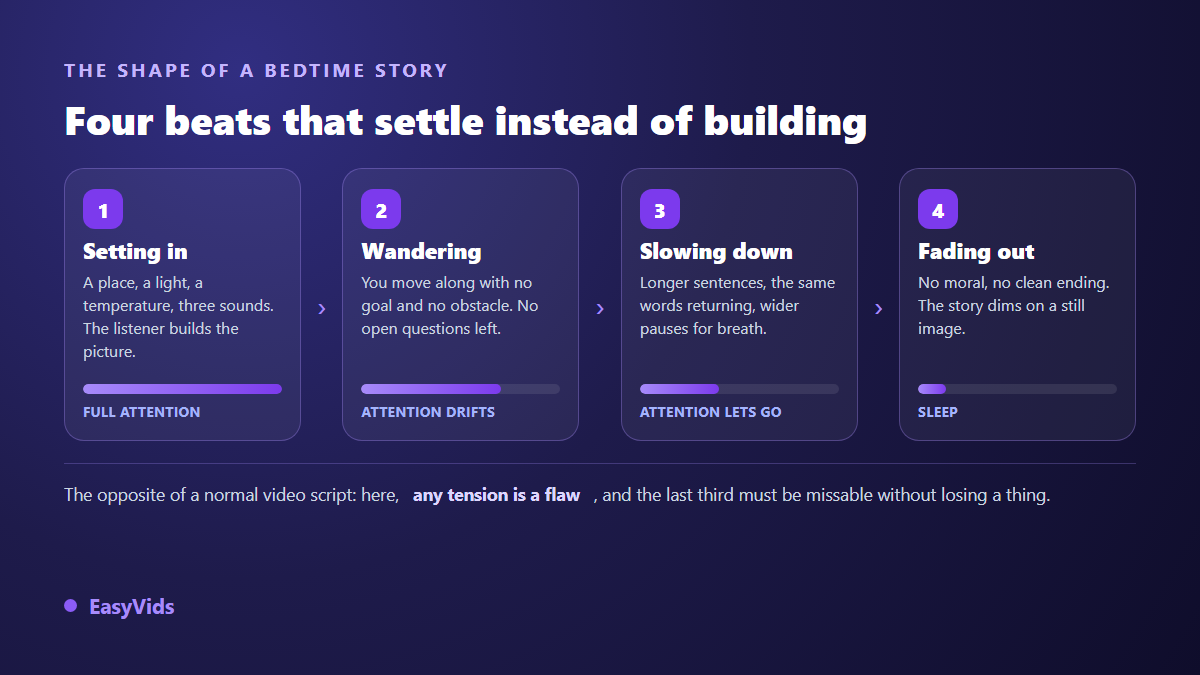
Take that last beat seriously: the final third of a sleep story is meant never to be heard. You still write it carefully, because some listeners reach the end, but nothing important belongs there. No information, no twist, no line you would regret seeing missed.
How many words for the length you want
The calculation is simple. A voice over reads around 150 words per minute at a normal pace, which is the figure we use to match a script to a target duration. A calm reading drops to roughly 120 words per minute, because it breathes more and holds the pauses. Use the lower figure for a bedtime story and you avoid a text that overruns by several minutes.
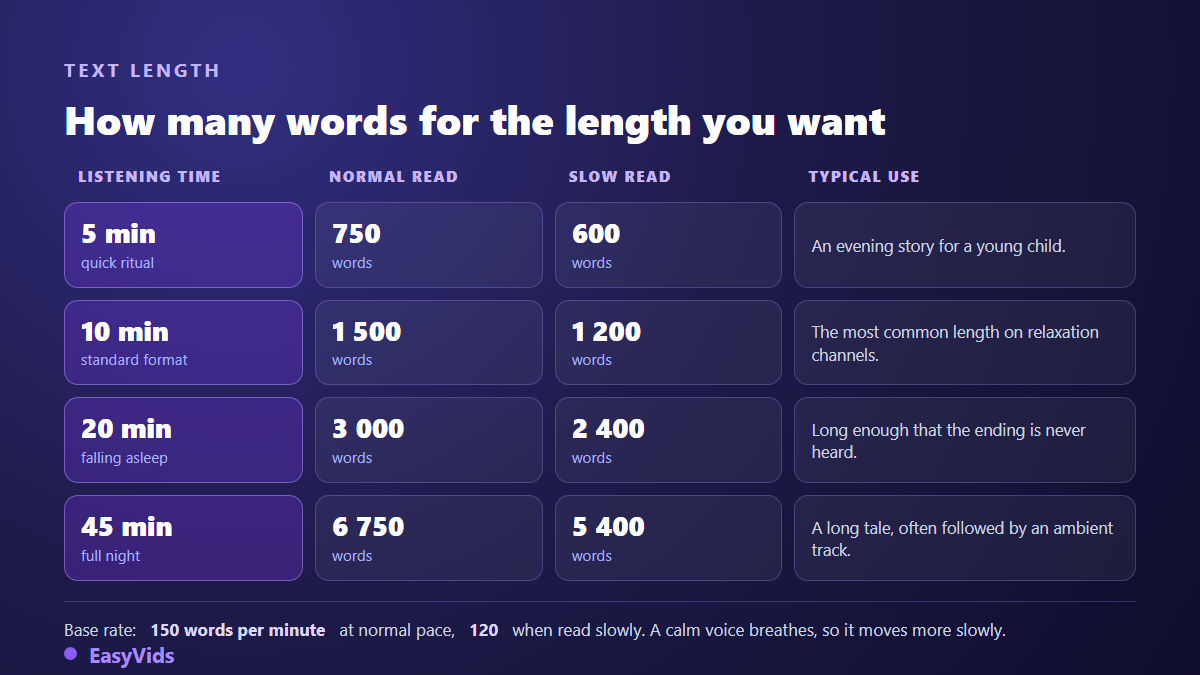
In practice, a ten minute story fits in 1,200 to 1,500 words, and a forty five minute sleep session needs more than five thousand. The script generator takes a length instruction in minutes of narration or in words, so you never have to trim an oversized draft by hand. Planning a whole series works the same way as writing a week of content in one sitting: one brief, seven variations, a single session.
The voice: what sends people to sleep, and what wakes them
The text carries half the result, the voice the other half. Three things matter: timbre, pace and consistency. A low, slightly breathy timbre works better than a bright, projected one. In the studio each voice in the catalogue carries its character next to its name, soothing, soft, breathy or relaxed, so you do not have to audition every sample. The logic sits close to our piece on whispered voices for relaxation videos, only far less pronounced.
Pace is not controlled by a speed slider. On the V1 voice model, a reading style field accepts a plain language instruction such as "Read slowly, in a low, gentle voice, like a storyteller at a child's bedside". It applies to every segment of the narration and is remembered on your account, so episode after episode keeps the same colour.
Punctuation does the rest, like a score. A full stop creates a real pause, a comma a short breath, an ellipsis a moment of drift. Break long sentences with commas even where grammar does not require them, and the voice slows exactly where you want it to. Length is not a technical problem: narration runs as a background task and accepts tens of thousands of characters at once, more than enough for an hour long story in a single pass.
Music and atmosphere: under the voice, never in front of it
An instrumental bed changes everything, as long as it stays invisible. Three rules cover it. No memorable melody, because a good melody pulls attention. No marked percussion, because rhythm wakes people up. No abrupt variation, so no build and no break. The music studio produces exactly that kind of track when you describe a custom occasion and switch on instrumental mode. Our guide to the AI music generator covers how to phrase those requests.
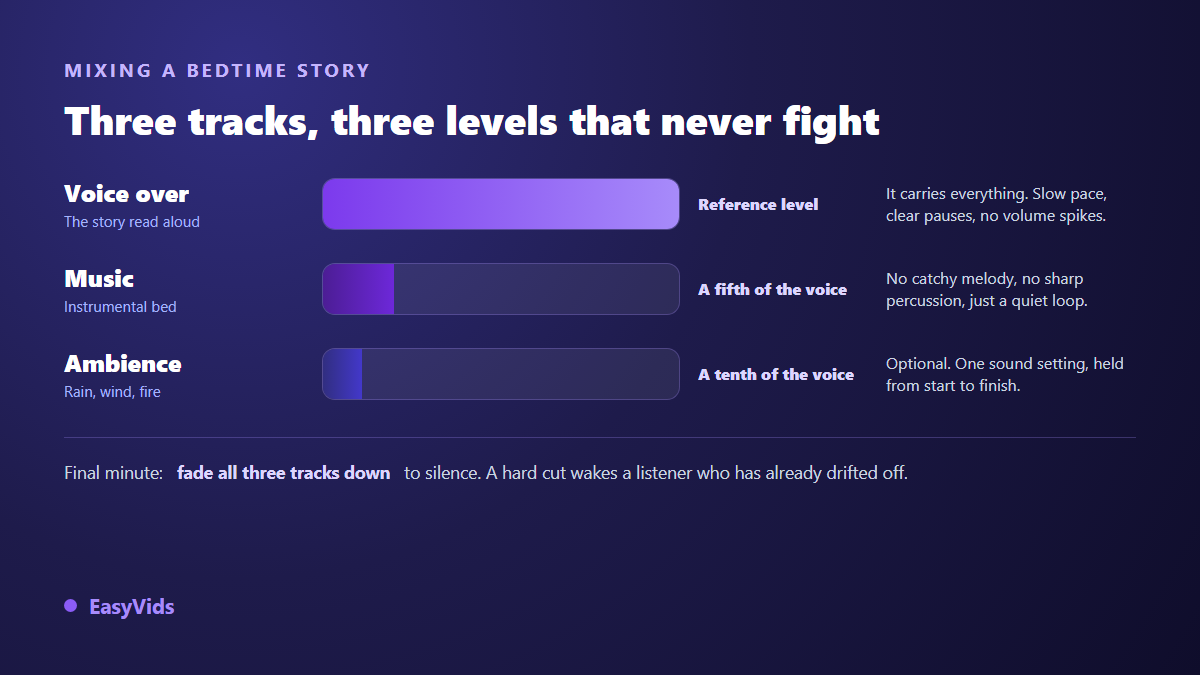
Set the mix by ear against one reliable marker: music at about a fifth of the voice level, any rain or fire ambience lower still. Keep a single ambience from start to finish, because a change of sonic scenery wakes a listener as surely as a noise does. Then fade everything down across the final minute, all the way to silence. A hard cut at the end of the file startles someone who has just fallen asleep.
Do you even need a picture?
For private use, no. The American Academy of Pediatrics recommends avoiding screens in the hour before bed, and this format works perfectly as an audio file played with the lights off. The studio can produce the narration on its own and hand you a sound file, with no video step at all. It is the shortest path, and often the most effective one at home.
For a published channel the image becomes mandatory, but it has to be forgettable. Still or very slowly moving shots, a dark palette, no flashes, no fast transitions, no blinking text. One image every two or three minutes is plenty. To describe those visuals without ending up with spectacular landscapes, lean on the five block method for writing a video prompt and insist on slow motion, low light and no foreground character.
Putting it together
- Write the text with a length instruction, a narrative tone, and an explicit rule to create no tension at all.
- Read it aloud and delete anything that raises a question. That single pass is the one that matters.
- Generate the narration with a soft voice and a slow reading style, then listen to the first two minutes before launching the rest.
- Produce an instrumental bed longer than the story, so you never have to loop it audibly.
- Assemble it in the online editor: voice on one track, music on another, levels set, final fade, export.
The editor handles audio tracks separately, with a volume control and fade in and fade out per element. That is all this format asks for, and the same edit is reused for the next episode, since only the voice file changes. The EasyVids studio keeps writing, narration, music and editing in one place, so no files travel between three services.
A series beats a single story
Rituals live on repetition. The same narrator, the same music, the same opening and closing lines: a child recognises the signal and settles before the story even starts. On a channel the same regularity builds the audience habit and simplifies production, because only the text changes from one episode to the next. A story that lands also has a second life as an illustrated book.
Frequently asked questions
How long should a bedtime story be?
Ten to twenty minutes covers most needs. Five minutes is often enough for a young child. For adult listening aimed at falling asleep, target twenty minutes at least, with an ending nobody is expected to hear. Beyond forty five minutes you are producing a continuous soundscape rather than a story.
Which AI voice works best for children?
A lower, slightly breathy voice with a slow delivery. Gender matters little, consistency matters a lot. Avoid voices labelled energetic, bright or firm, which carry too far. And keep the same voice night after night: it becomes the signal for bedtime, more than the story does.
Can I publish sleep stories on YouTube?
Yes, provided the text and the narration are yours rather than a pile of material taken from elsewhere. According to the YouTube help centre, a video must run at least eight minutes to carry mid-roll ads, which suits this format well. Monetisation rules look at how original the content is, not at the tool used to make it.
Music or silence?
Both work. Music masks household noise and links the scenes, while silence suits listeners who are bothered by any continuous sound. If you are unsure, go with a very discreet bed, which suits the largest number of people. Three nights of testing settles it for your own household.
A bedtime story succeeds not by being beautiful, but by what it fails to provoke: no question, no start, no urge to know what comes next. Write slowly, have it read slowly, mix it low, end on a fade. To write your first story, have a soft voice read it and add music in the same session, create an account and start with a ten minute story: it is the format that forgives the most.