It is almost midnight. Someone puts a phone face down on the nightstand, turns the volume low and starts a video they will never watch. They will listen for eight minutes, maybe twelve, then fall asleep on it. That is the real audience of a bedtime stories YouTube channel, and most creators treat it exactly like any other audience: a musical intro, a bright presenter voice, a subscribe request after thirty seconds. The listener leaves, because you just woke them up.
A relaxation channel works backwards compared with the rest of the platform. Everywhere else you fight for attention. Here you release it, and success is measured at the moment the viewer stops listening. The good news is that this format needs no camera, no set and no voice of your own, like the other formats covered in our guide to running a channel without showing your face. Here is how one episode is built, how it becomes a series, and which platform rules are worth reading before your first upload.
The short answer
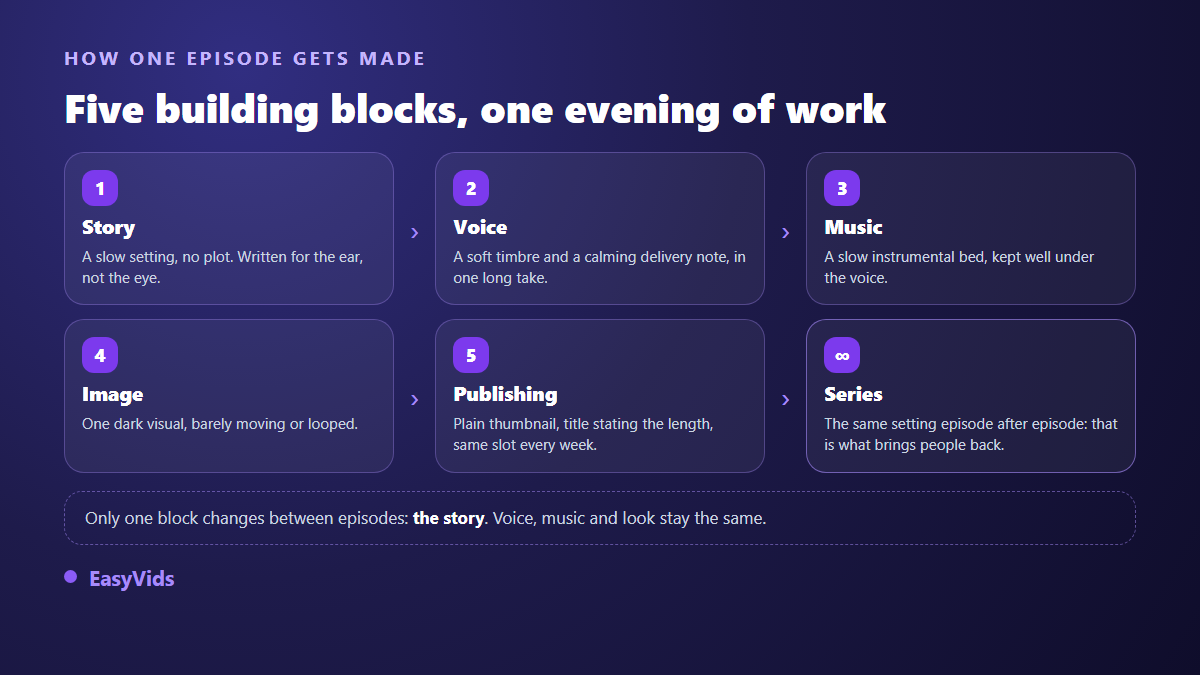
A bedtime stories channel rests on four decisions, and three of them are made once. You lock a calm, repeatable narrative frame, a slow voice with a soothing reading instruction, an instrumental bed kept well under that voice, and a single near motionless visual. Only the story changes between episodes. Aim for long episodes, twenty minutes to an hour, published on a fixed slot. Everything else is execution, and once the template exists that execution fits into one evening per episode.
A night audience does not listen like a day audience
A daytime viewer watches. A night listener listens, screen turned over, usually in the dark, often with one earbud. Three consequences follow. Your image carries almost no information, so its main job is to avoid any bright flash. Your edit does not need pace, it needs continuity. And your voice becomes the product, because it is the only thing the person really perceives during the ten minutes that decide everything.
This audience has another quality that strongly favours the creator: it is loyal and repetitive. Someone who managed to fall asleep to your voice comes back the next night, often to the very same video. A catalogue of thirty consistent episodes therefore works for you every night, while a commentary channel starts from zero every week. That makes the format a close cousin of long form ambience channels, and a daily motivation channel is its morning counterpart.
Why episodes have to be long
Long videos are usually recommended for watch time. True, but that is not the real reason here. A five minute story ends, and the end of a video triggers autoplay into the next one, with a different loudness, a different voice, sometimes an ad. You wake the person you had just put to sleep. A forty minute episode runs well past the moment of falling asleep and ends into nothing.
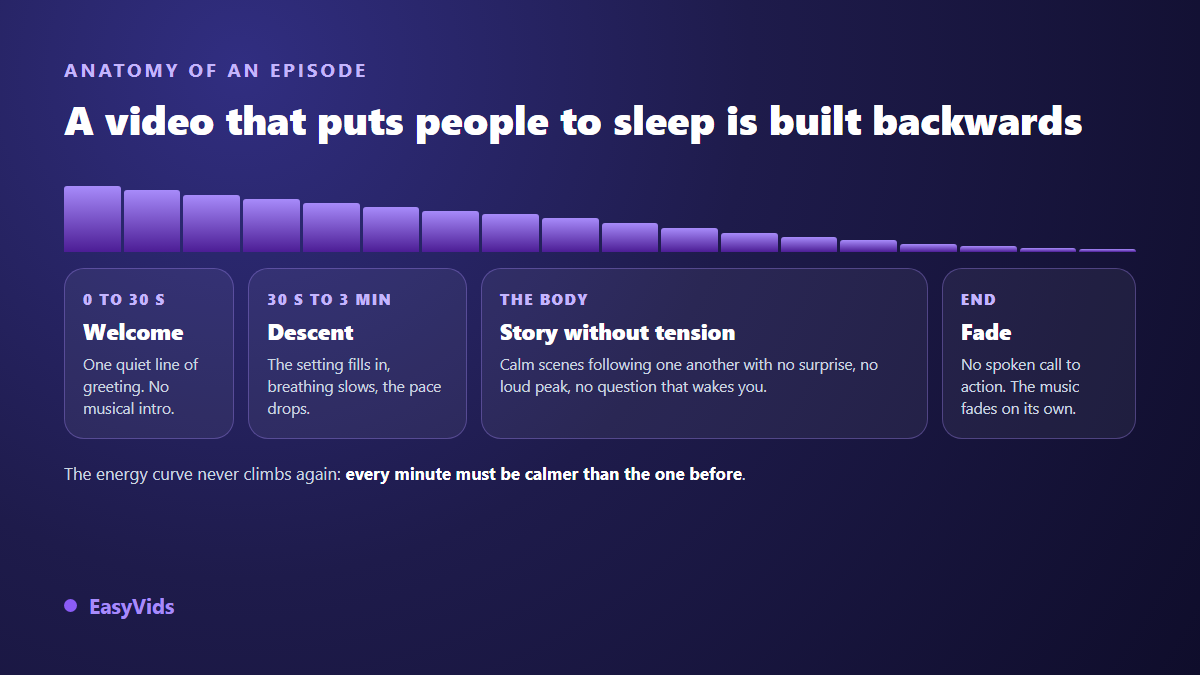
Internal structure matters as much as total length. The energy curve should fall from start to finish and never rise. No twist in the middle, no open question, no sound peak. The story stretches and repeats itself a little, and that is deliberate: repetition is a sleep tool here, not a writing flaw.
The voice is the decisive setting
On a relaxation channel the voice is not half of perceived quality, it is almost all of it. Three things make it soothing: a low or breathy timbre, a slow delivery, and silences you allow to live. The first two are chosen, the third is written, because your punctuation drives the breathing. A long sentence with no comma will be read in one push, and listeners hear it.
In the EasyVids studio the voice catalogue labels timbres by character, and several are described as soothing, soft, relaxed or breathy. More importantly, one of the voice models accepts a reading style written in plain language next to your text. An instruction such as read in a soft, soothing voice, like a meditation sits among the examples offered in the interface, and that is exactly what this format needs. If you want to push further into whispering, our article on whispered AI voices for relaxation covers the limits of the exercise.
One practical detail changes how a long form channel is organised: the voice over accepts very long texts in a single request, up to one hundred thousand characters, which is well over an hour of narration. The text is split, generated in parallel chunks, then joined back into one audio file, and the job runs on the server so you can close the page. You never have to cut your story into ten manual takes, which is what usually creates tone breaks between segments.
Music: present, never in front
A slow instrumental bed does two jobs. It masks the micro flaws of a synthetic voice, and it gives the brain a steady anchor. It should not tell a story, evolve, or carry a memorable melody. A simple looping progression beats a composed track, because a composed track pulls the ear back instead of letting it drift.
The mixing rule is one line long: keep the music far below the voice, around a fifth of its level, and always check on headphones at low volume, since that is how your audience listens. The studio music generator can produce an instrumental only track with a genre, a mood and a slow tempo, which is enough to build one dedicated bed per season of your series. The full method sits in our guide to the AI music generator.
One visual that wakes nobody
Many creators lose hours on visuals for a video nobody looks at. One shot is enough, and it should be dark, free of harsh contrast, with no face staring into the camera. A bedroom under rain, a forest at night, a cabin lit by one window: the subject matters less than the stability.
Two technical routes give a clean result. Either a still image carrying a barely perceptible zoom, or a short clip looped until it covers the whole narration. The studio assembly locks every visual to the real duration of its voice track and can loop a clip that is too short instead of cutting it, which is precisely the behaviour you want here. Skip visible transitions: a long fade, or no cut at all, beats a rhythmic edit on this format.
Turning episodes into a series
A relaxation channel lives on regularity, not on breakout hits. Listeners are buying a ritual, and a ritual means finding the same thing again. Keep the same voice, the same sound bed and the same visual style across a whole season. Vary the story, the setting, the season, never the sensation. That logic is the same for any batch produced collection, and our article on reused content and monetisation refusals shows where the line sits between a coherent series and repetitive output with no added value.
- Put the runtime in the title. Someone going to bed picks a format first, a topic second.
- File every episode in a themed playlist, so autoplay stays inside your world instead of wandering off.
- Write a description with chapters, useful for listeners resuming a story they started the night before.
- Keep thumbnails dark and quiet, readable when small, with no shouting text: they should promise calm, not clicks.
- Publish on the same slot every week, late in the day for the time zones you target.
- End with no spoken call to action. Put the subscribe prompt in the description, not in the voice.
What YouTube allows, and what it penalises
This niche attracts a lot of mass produced channels, which puts it under scrutiny. Three points are worth knowing before your first upload. First, monetisation access: according to the Partner Programme eligibility conditions published in the YouTube help centre, you need one thousand subscribers plus four thousand valid public watch hours over twelve months, or one thousand subscribers plus ten million valid public Shorts views over ninety days. A catalogue of long episodes reaches the watch hour threshold faster than short form does. Getting there is the unglamorous half of every income stream that only looks passive from the outside, and this one is no exception.
Second, authenticity. Again according to the YouTube help centre, monetisation requires original and authentic content, and mass produced or repetitive content with no added value is not eligible. The use of AI is not the target: the absence of work is. A story written for your own channel, a chosen sound direction and a considered narration are that added value.
Third, the point almost nobody anticipates in this niche: content made for kids. YouTube requires creators to declare whether a video is aimed at children, and according to its help centre such a video loses personalised advertising and has its comments disabled. A fairy tale channel for children and a channel of stories for sleepless adults are therefore run differently. Decide who you write for before you start, because the setting is declared episode by episode.
Rights: old tales, recent translations, music
Classic tales are an obvious temptation. The Grimm collections and the Andersen tales are in the public domain, their authors having died in the nineteenth century. One trap catches many creators: the Berne Convention treats translations as protected works in their own right. Copying a modern translation word for word therefore means copying a recent work, even when the underlying tale is free. Start from the story and rewrite it, or have it rewritten.
On the music side, a track generated for you avoids claims triggered by a recognised soundtrack, though the topic deserves care, as covered in our analysis of AI music, monetisation and claims. The general rule holds: a track you generated and never registered anywhere leaves you alone, while a track found on a sharing platform protects you from nothing.
The habits that wake your listener
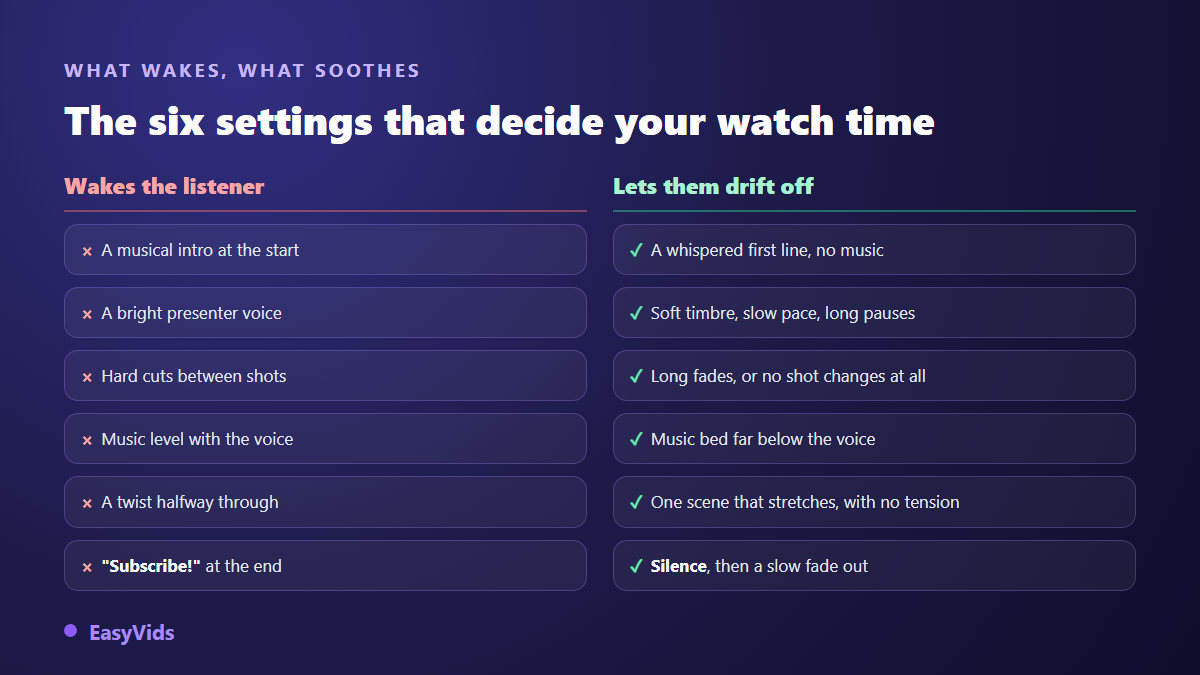
Almost every failure on this format comes from a reflex imported from another kind of video. The comparison below gathers the six most common ones with the matching fix.
One last point, more commercial than technical: do not chase the video that explodes. Growth here comes from an accumulating catalogue and returning listeners, not from a recommendation spike. Publish steadily for several months before judging results, and watch average view duration rather than view counts. Production cost belongs in that equation too, since every generated element consumes credits, and the pricing page carries the current detail.
Frequently asked questions
Do I need to be a writer to start a bedtime stories channel?
No, but you need to pick a frame. A bedtime story does not need a plot, it needs a place, a pace and an atmosphere. A clear frame handed to a writing engine produces usable text, which you then read aloud quietly and trim wherever it speeds up.
How long should a first episode be?
Aim for around thirty minutes. That is long enough to run past the moment of falling asleep, and short enough for you to review the whole thing before publishing. Move up to an hour once your template is stable, without turning length into your main selling point.
Can a synthetic voice really put someone to sleep?
Yes, provided you slow it down and give it an explicit reading instruction. What gives an artificial voice away is the intonation rising at the end of sentences and the lack of silence. A slow, punctuated, even reading works well here, often better than on an explainer video.
Should I mark my channel as made for kids?
Only if your episodes genuinely target children. The declaration is mandatory for that audience, and it costs you personalised advertising and comments, according to the YouTube help centre. Many relaxation channels therefore choose to write clearly for an adult audience.
How many episodes before results show?
Think in catalogues, not videos. Around twenty consistent episodes published over a few months give the platform enough to recommend you to someone who liked the first one. Below that you do not have a series yet, you have experiments.
The real secret of this format is neither the voice nor the visual: it is consistency. Lock your template once, hold it for thirty episodes, and let the catalogue work while you sleep. To build your first episode, creating an account opens the full studio, and the EasyVids studio brings text, voice, music and editing together in one place.