You publish a carefully filmed, carefully edited video. It gets two hundred views. The next one, thrown together in five minutes, gets fifty thousand. The gap almost never comes from the topic or the editing. It comes from the TikTok hook, those first three seconds where a viewer decides, without thinking about it, whether to stay or swipe.
That moment is designed, not improvised. A strong hook is not a clever line you stumble upon: it is a shape you choose before writing, carried at the same time by the voice, the opening shot and the on screen text. This guide gives you 51 hooks sorted by niche, the seven families they all come from, and the method to adapt them to your own subject. If your problem sits higher up, in the structure of the whole video, our guide to writing a video script covers the rest of the road.
The short answer
An effective TikTok hook fits in fewer than ten spoken words, lands in the first second, and opens a tension the video will resolve. It states a conflict or a benefit, never the outline of the video. It sits on an opening shot that needs no explanation, plus three to five words burned on screen. And it gets tested: writing two openings for the same content teaches you more than reading ten pieces of advice.
What the platform actually measures at the start
The fate of a short video does not depend on your follower count. It depends on attention signals: watch time, the share of viewers who reach the end, replays, shares. According to the creator help pages inside the TikTok app, the Analytics tab reports average watch time for each video, the share of people who watched it in full, and a second by second retention curve.
Look at that curve on your own posts: it almost always starts with a sharp drop. That drop is the only part of the graph your writing controls directly, and it is exactly where the hook lives. The creative recommendations published by TikTok for Business point the same way: put the main message in the very first seconds, ahead of brand identity. In other words, the platform itself suggests you start with the content and introduce yourself later, or never.
Three tracks working together, not one clever line
Most creators shrink the hook down to its first sentence. That is a scale error. A viewer receives three streams at once: what they hear, what they see, what they read. All three must carry the same idea without repeating it, otherwise two of them turn into noise.
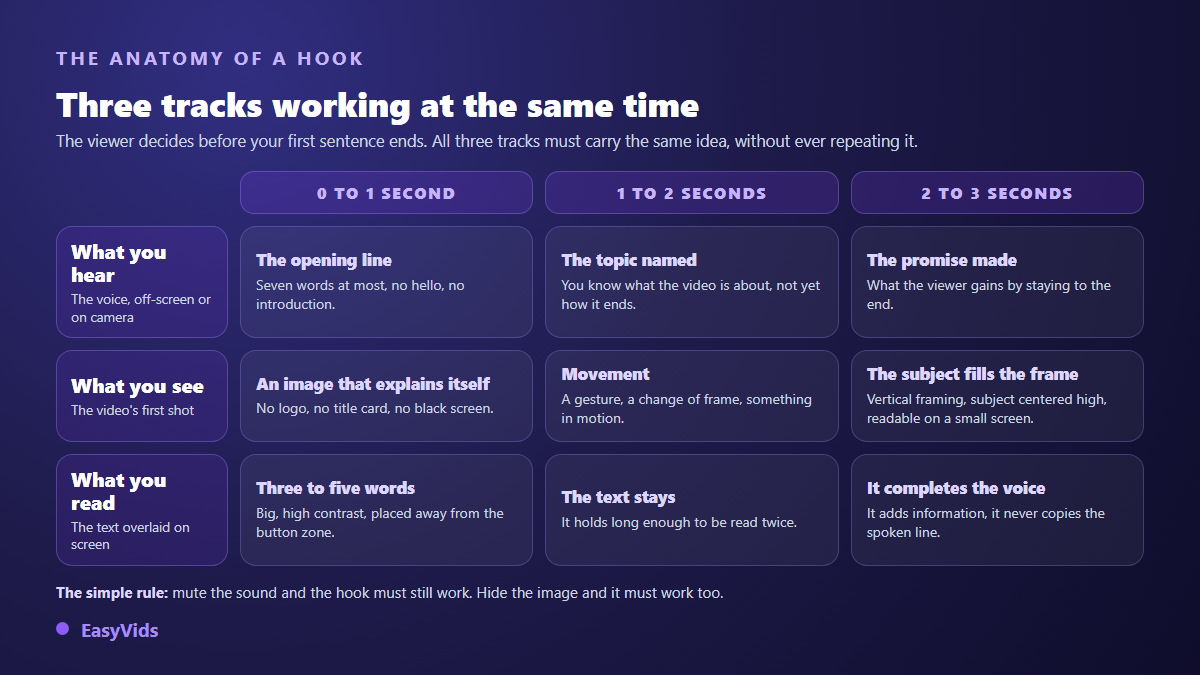
The voice sets the tension, the image gives a reason to keep watching, the text adds what the voice has no time to say. On a phone, that text belongs in the upper part of the frame: the bottom is taken by the caption, the buttons and the account name. A perfect hook hidden behind the interface is still a lost hook.
Seven hook families, chosen before you write
Formulas that work do not appear out of nowhere. They belong to seven families, and the real work is picking the family before hunting for words. One video idea produces seven very different openings depending on the door you walk through.
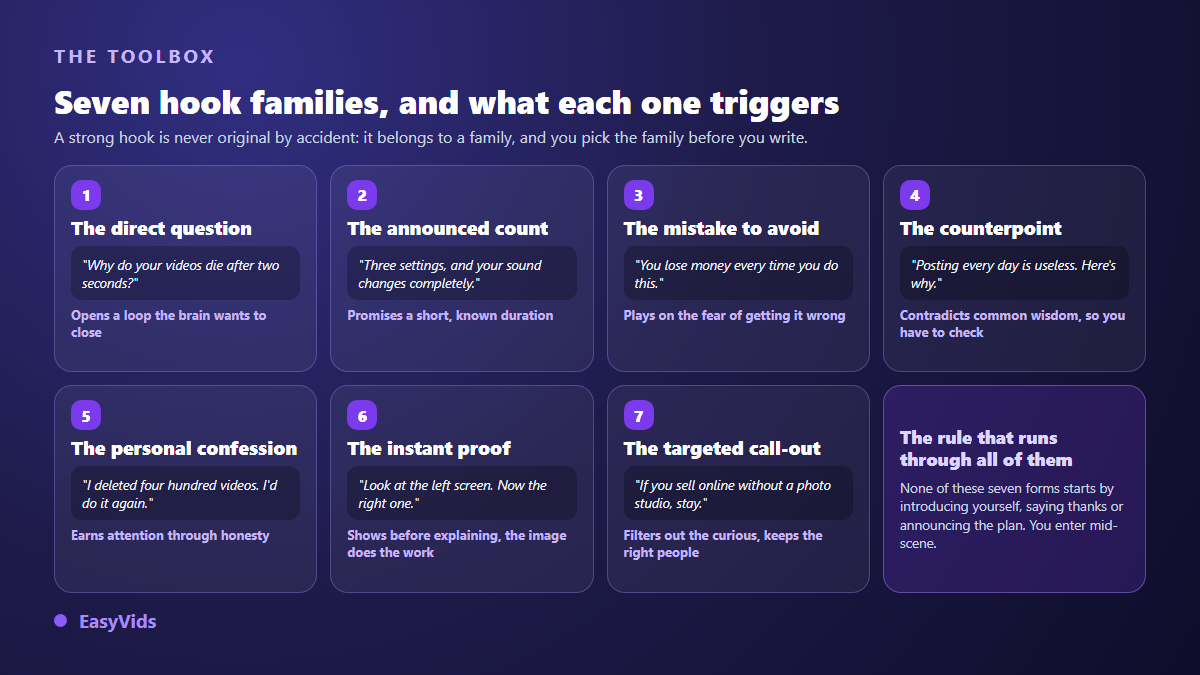
- The direct question. A question your target viewer genuinely wants answered, never a rhetorical one.
- The promised count. A number of items announced up front, so the viewer knows how long they are committing to.
- The mistake to avoid. It targets something they may already be doing, so it lands instantly.
- The contrarian take. A common belief taken apart in one sentence, provided you deliver within the next twenty seconds.
- The personal confession. A failure told plainly: the hardest shape to fake, therefore the most credible.
- The instant proof. The image carries the hook and the voice barely comments, because nothing needs explaining.
- The targeted address. A line that names the viewer you want, and deliberately sends everyone else away.
One note before the list: these hooks are moulds, not quotes to copy. Replace the generic detail with your own, the one nobody else could write. That detail is what makes a formula believable, and it is exactly what is missing when an opening sounds like a thousand others.
51 TikTok hooks sorted by niche
Business, freelancing and online income
- "I landed my first client with a skill I learned in three weeks."
- "Your price is not too high. Your offer is too vague."
- "Stop chasing clients. Here is what makes them come to you."
- "Three sentences to delete from your outreach messages tonight."
- "I reread the contract I signed as a beginner. It was indefensible."
- "If you work alone, this habit costs you one day every week."
Beauty, skincare and hair
- "Your routine does nothing because you do this step in the wrong order."
- "The product everyone recommends wrecks fine hair. Let me show you."
- "Three minutes at night, and you see the difference within a week."
- "Same technique, two hair textures. The results are nothing alike."
- "Look at my left hand. Now the right one. One single step separates them."
Fitness and nutrition
- "You train four times a week and you have stopped progressing. The gym is not the problem."
- "Almost everyone does this exercise wrong. Here is the version that protects your back."
- "I ate the same meal for thirty days. Here is what changed."
- "If your soreness lasts three days, stay until the end."
- "Nobody should start with abs. Start with this instead."
Cooking and recipes
- "Your rice sticks because you skip a thirty second step."
- "Three ingredients, one pan, and dinner is ready before this video ends."
- "I cooked this dish my grandmother's way, then a chef's way. Guess which won."
- "Stop throwing this part of the vegetable away. It has more flavour than the rest."
- "The recipe says twenty minutes. It takes forty. Here is the real timeline."
Online store and product demos
- "I ordered the best selling item in the shop. This is how it arrived."
- "If you sell online without a photo studio, this one is for you."
- "This detail on a product page separates a checkout from an abandoned cart."
- "Here is the product after a week of real use, no filter, no added lighting."
- "Three things in my bag I would not swap for anything."
Education, languages and studying
- "You revise for hours and forget everything. The method is the problem."
- "Almost everyone translates this sentence wrong. The correct version is three words."
- "I understood this rule in five minutes after failing it for years."
- "A simple test to know whether you really understood the chapter."
- "I write these two words on the board and half the class gets it wrong."
Stories and real cases
- "She signed the contract on a Friday. By Monday the company was gone."
- "This photo was taken twelve minutes before the accident. Nobody noticed a thing."
- "He bought the cheapest house in the village. He had no idea what was underneath."
- "The investigation ran for three years. The answer was in the first file."
- "They kept telling her it was impossible. She did it twice."
Technology and artificial intelligence
- "This tool does in one minute what used to take me a whole evening."
- "You have used this feature for years without knowing what it actually does."
- "I gave two models the exact same instruction. Look at the gap."
- "Three settings to change today if you care about your data."
- "This beginner habit shows in every generated image. Here is how to avoid it."
Travel and places
- "Everyone photographs this square. The real view is two streets away."
- "My flight cost less than my ride to the airport."
- "Do not book this hotel before you see the view from the room."
- "Three packing mistakes I will never make again."
- "This village is an hour from the capital, and nobody goes there."
Parenting and daily life
- "This sentence we say without thinking blocks a child for years."
- "Three minutes in the morning, and leaving the house becomes calm."
- "I tested the method everyone talks about for a month. Here is the verdict."
- "Your washing machine smells because of a spot nobody cleans."
- "If your evenings end in negotiation, try this tonight."
Turning a soft intro into a hook
Most videos that fail do not have bad content. They have a polite opening. Take one of your older posts, listen to the first five seconds only, and count the words spoken before the first useful piece of information. The number is usually a shock.
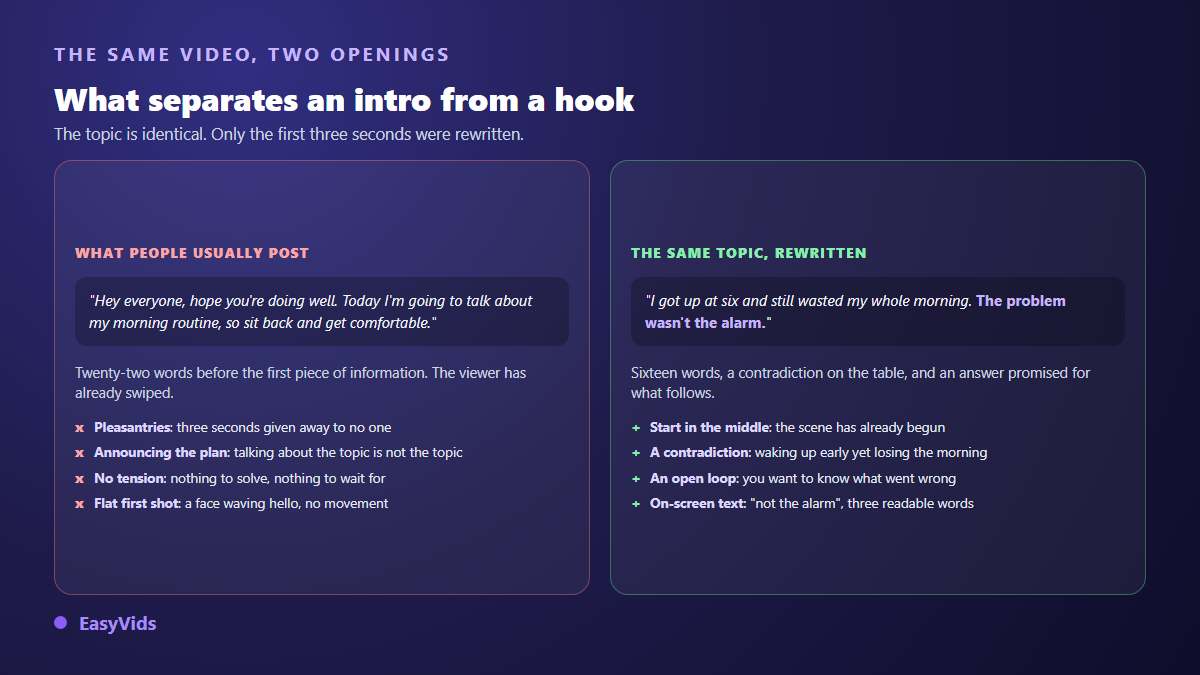
The rewritten version uses no clever vocabulary. It enters in the middle of the scene, states a contradiction in one sentence, and leaves a question open for the rest of the video to answer. Three elements, nothing more. Run that filter across your last ten posts and you will quickly see which ones deserved better than their opening.
Writing hooks with AI without sounding synthetic
Ask an AI to "write a TikTok hook" and you get a bland line, because the request itself is bland. What works is giving it the exact subject, the viewer you target and the hook family you want, then asking for several variants at once. Judging options is far faster than writing from a blank page.
In our AI studio, you start from a one sentence idea, pick the language, the tone and a length expressed in minutes of voice over or in words, and the text comes back written to be spoken rather than read. A personal instruction field stays saved on your account: write open with a hook under ten words, no greeting, no outline once, and it applies to every later draft. An optional review pass then goes back over the text to strip artificial phrasing. The same field can set how your videos end, the last line a viewer hears: our video call to action formulas gather the lines that earn an action without begging for it.
For a short video, ask for a very small word count and run the same idea several times: you get genuinely different openings for one subject. Keep two, discard the rest. Writing tiers are chosen at launch, and the plans are listed on the pricing page.
The opening shot carries as much as the sentence
A perfect line over an empty shot saves nothing. The opening frame must read on its own, contain movement, and show the subject close. Writing that frame is its own exercise: subject, action, framing and light, exactly as described in our five block video prompt method. Decide on the vertical frame before generating, never after, because a horizontal image cropped later always loses the element that carried the hook.
On screen text does half the job
A large share of viewers watch with the sound off, on public transport or in a shared room. Your three to five burned in words therefore have to convey the promise alone. They do not repeat the voice: they add what the voice had no time to say. For the rest of the video, word by word captions take over, a technique covered in our guide to animated captions.
The mistakes that kill a hook
- The greeting and the introduction: three seconds given to nobody.
- Announcing the outline: "today I am going to talk about" is not a subject.
- On screen text that copies the voice word for word: it adds nothing and tires the eye.
- A promise kept too late: if the answer lands at second thirty, the curve has already collapsed.
- An empty opening shot: a logo, a fade or a black frame burns the only second that mattered.
- A hook copied as is: a formula seen everywhere surprises nobody.
- An inflated promise: it wins the first second and loses the follower by the tenth.
Test two openings instead of guessing one
No writing method replaces measurement. Take one subject, write two hooks from different families, cut the same video with each, post them a few days apart and compare average watch time rather than view counts. Views depend on distribution, retention depends on you. Keep your winners in one document: within a few weeks you own a personal library, far more useful than any list found online, this one included.
Frequently asked questions
How long should a TikTok hook be?
Under ten spoken words, and three to five words on screen. The limit is not stylistic: at normal speaking pace, ten words already fill close to three seconds, which is all the time you have before the viewer decides.
Should I say hello at the start of a short video?
No. Greetings belong to long form, where the viewer has already chosen to watch. On a short video they arrive with no intention and leave at the first dead moment. Introduce yourself at the end if you want, once they have a reason to remember your name.
Can I reuse the same hook on several videos?
Reuse the structure as often as you like, but not the exact sentence. A formula repeated word for word feels automated, and your audience spots it faster than you expect. Change the concrete detail every time and keep the skeleton.
Are AI written videos penalised?
Using a writing tool is not penalised in itself. TikTok community guidelines do require you to label realistic content generated or edited with artificial intelligence, especially when it shows people or scenes that could pass for real. A script you drafted with assistance, reviewed and performed yourself does not fall under that duty, but a realistic synthetic visual does.
How do I know whether my hook worked?
Read the retention curve in your analytics rather than the view counter. If the early drop is gentler than on your usual posts, the hook did its job. If the curve collapses immediately on a video you know is good, rewrite the opening, not the subject.
A library of hooks never replaces the habit of starting in the middle of the story. Take your next idea, write three openings from three different families, and publish the one that makes you slightly uncomfortable: it is usually the most direct. To write, generate vertical visuals and edit in one place, create a free account and ship your first rewritten opening today.