You are looking for digital product ideas, and the appeal is obvious: one file, built once, sold as many times as you want, with no stock, no shipping and nothing to restock. Wanting to do it is rarely the problem. The problem is that two questions stay unanswered: what exactly should you build, and where do you sell it afterwards.
Production has stopped being the bottleneck. A structured text, an illustration, a voice, a track or a video now take minutes. What remains hard is picking a format your audience already buys, then actually finishing it. This guide lists seventeen ideas grouped by file type, each with the channel that suits it. For the wider picture of what people really earn around AI, our review of the serious ways to monetise it sets the scene.
The short answer
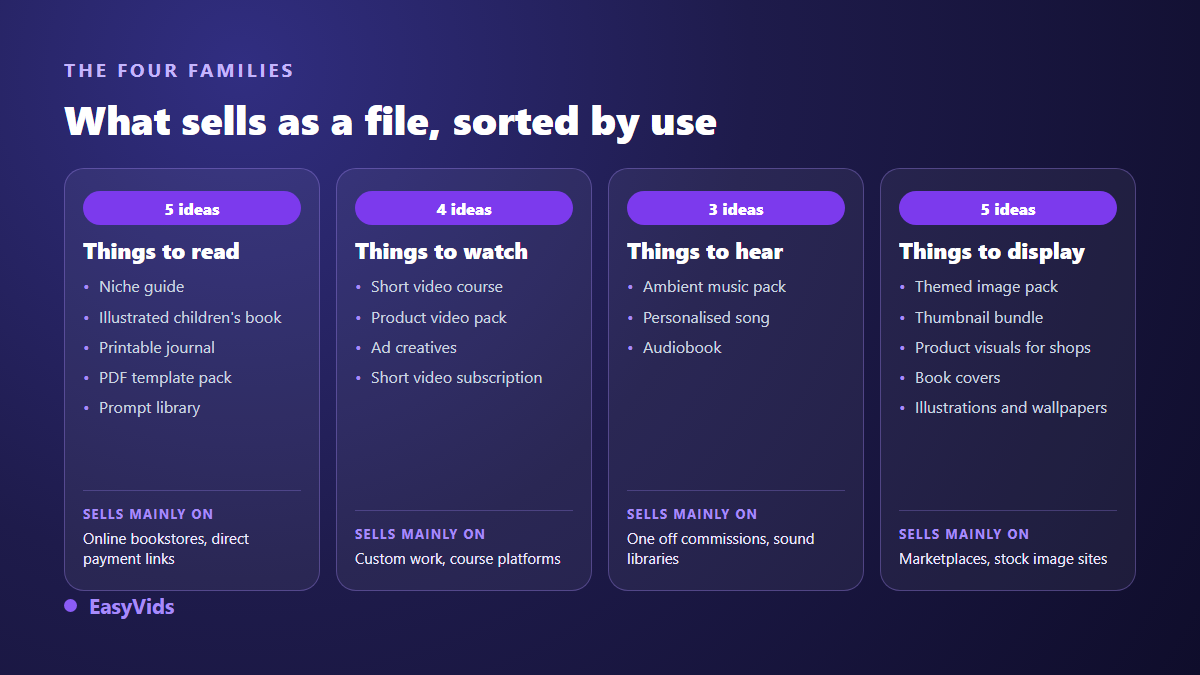
A digital product sells when it solves one precise problem, gets consumed quickly and ships as a file. Four families cover almost everything: things people read (ebooks, printables, templates), things people watch (courses, product videos, ad creatives), things people listen to (music packs, custom songs, audiobooks) and things people display (image packs, thumbnails, book covers). Pick one family, one niche you know from the inside, one sales channel, and ship a first version this week.
What turns a file into a product
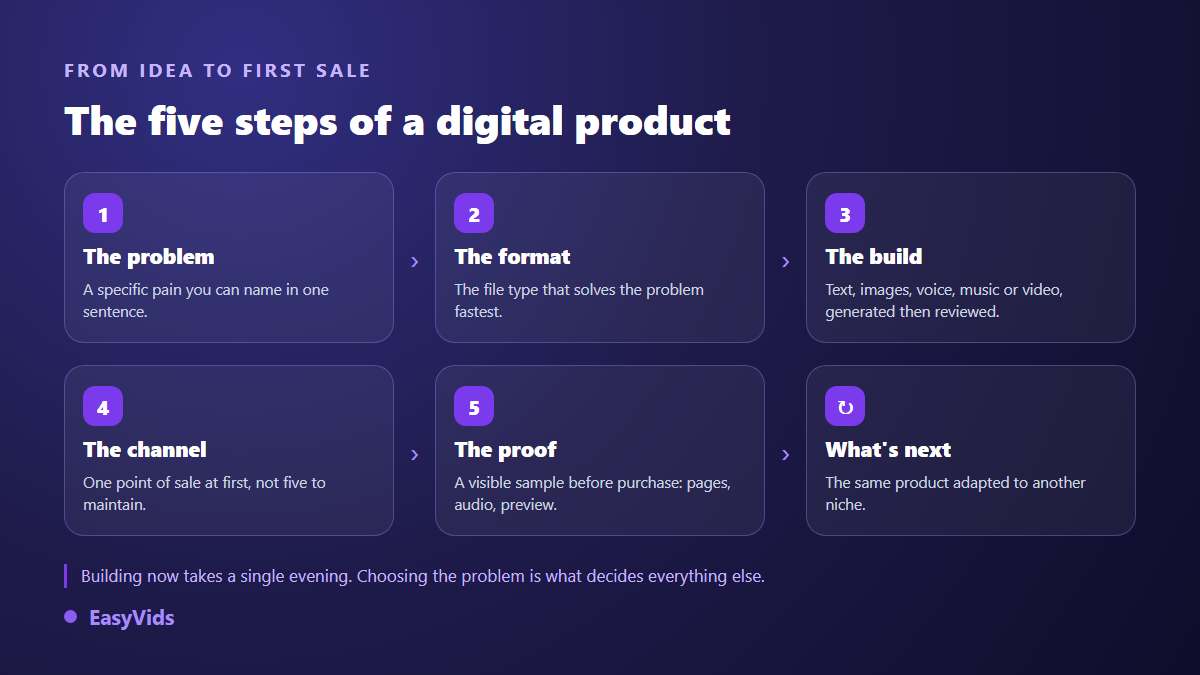
A file becomes a product the day it saves time for someone who already knows what they are looking for. That is the only test that matters at checkout. A two hundred page ebook about productivity sells badly. A tracking journal built for solo physiotherapists running their own practice sells, because the buyer recognises themselves in the title before opening the preview.
The second difference is less visible: your promise has to be verifiable before payment. Three sample pages, a ten second preview, an audio snippet. Without proof, your sales page is asking for an act of faith, and most buyers simply close the tab.
Things people read: five text based products
This is the usual entry point, because a document can be reread, corrected and updated without rebuilding it from scratch. One warning though: length is not a selling point, immediate usefulness is.
- The niche guide. An ebook that solves one problem end to end for an audience you can name. The most profitable format once a small following exists.
- The illustrated children's book. A short story, a character whose face stays the same page after page, a careful cover. The hard part is visual consistency, not the writing.
- The printable journal. Gratitude journals, habit trackers, training logs. Little writing, plenty of layout work, and a buyer looking for daily use.
- The PDF template pack. Checklists, tracking sheets, audit grids. Often easier to sell than a long ebook, because it becomes useful the minute after purchase.
- The annotated prompt library. Formulas sorted by profession, with an explanation of what each block changes in the output. The value sits in the commentary, never in the length of the list.
On EasyVids, the first four run through the ebook generator: you give the subject, it builds a custom outline, writes the chapters one by one, produces the illustrations and assembles a themed layout you download as a PDF. The full route from topic to first sale is covered in our guide to building an ebook with AI. One honest caveat: the tool makes the file, it does not take the payment for you.
Things people watch: four video products
Video sells better as a service than as a catalogue. An online store will happily pay for ten product videos delivered next week, while it will never buy a generic pack where none of the items look like its own. Keep that distinction in mind.
- The mini video course. Six to ten short lessons, a downloadable workbook, a sales page. This is the format that carries the highest positioning.
- The product video pack. Sold to a store: one video per item, built from their own photos, with no sample and no shoot.
- The ad creative batch. Several variations of the same advert, designed to be tested against each other. Your buyers are media buyers.
- The short form subscription. A monthly batch of vertical videos for a brand with no in house team. Recurring revenue in exchange for reliability.
Things people listen to: three audio products
Audio stays the least crowded family, probably because it looks intimidating. It has a rare advantage: a track or a voice is produced fast, and sells just as well one at a time as in bundles.
- The background music pack. Instrumentals cut for video, sold in themed bundles: calm, tension, tutorial, channel opener.
- The custom song. Birthdays, weddings, retirements, dedications. Made to order, with the recipient's name and message inside.
- The audiobook. Your ebook read by a synthetic voice, sold alongside the text or on its own to people who listen while walking.
The music studio covers the second case closely: you start from one of a dozen ready made occasions, add a name and a message, have the lyrics written, then launch the song. Generation runs server side, so closing the page costs you nothing. Before targeting streaming platforms, check what Spotify accepts from AI generated music, because disclosure rules there are stricter than on a direct sales page.
Things people display: five visual products
Visuals form the busiest family, and also the fastest to produce at volume. Two strategies compete: the catalogue, slow but cumulative, and the commission, which pays immediately. Nothing stops you from using the second to fund the first.
- The themed image pack. A consistent series on one narrow subject, delivered in high resolution for bloggers and social media managers.
- The niche thumbnail set. Ready to customise thumbnails for one channel category: cooking, gaming, personal finance.
- Product visuals for stores. Clean backgrounds, staged shots, format variations. Sold to merchants, never to consumers.
- Book covers. Steady demand among independent authors, with publishing sizes expected down to the pixel.
- Illustration and wallpaper packs. The most competitive item here, and the one needing the least preparation.
All five come out of the image generator, which accepts up to four reference visuals to hold a style across a series and includes a dedicated thumbnail mode. Two useful reads first: the platforms that accept AI images and their conditions, and how to build a thumbnail service if commissions appeal to you more than catalogues.
Where to sell: six channels and what each one changes
The channel decides almost everything: your margin, how fast the first payment lands, and who owns the customer relationship. None is better in absolute terms, each matches a starting position.
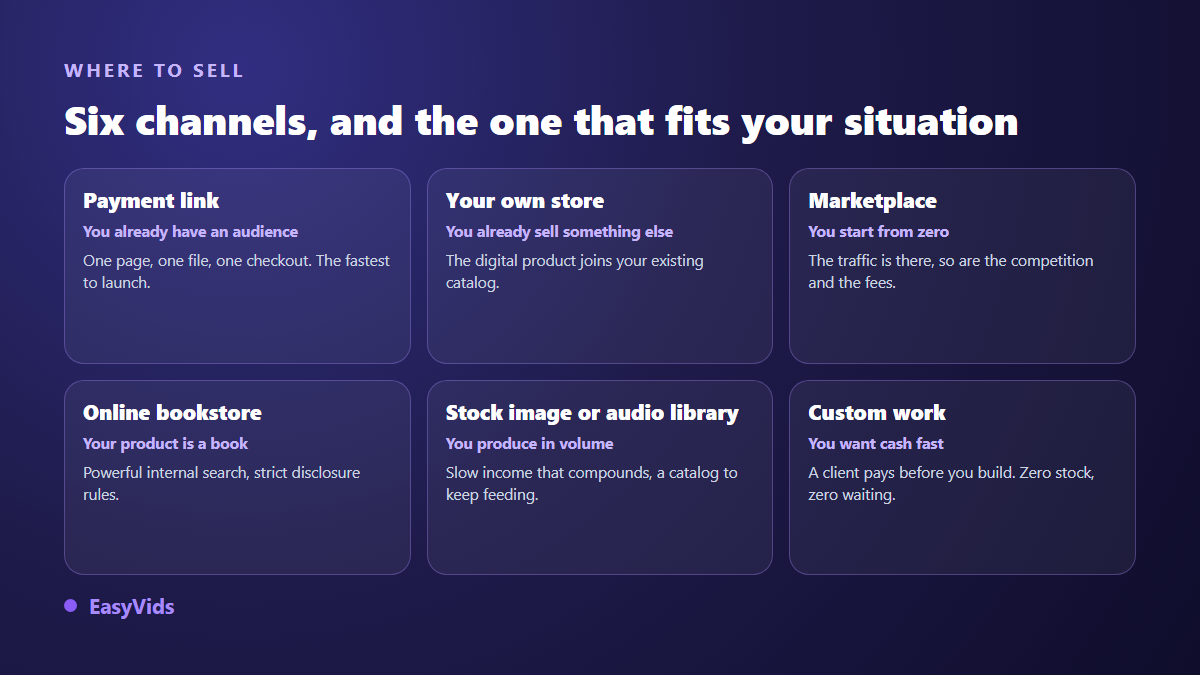
- The payment link. One page, one file, one payout. Live within an hour, ideal when an audience already follows you.
- Your own store. The digital product joins an existing catalogue and benefits from traffic that already passes through.
- The creator marketplace. Traffic is provided, so are the competition and the commission. Useful to test an idea without owning a site.
- The online bookstore. The natural home for a book: powerful internal search, in exchange for strict disclosure rules.
- The stock library. Slow revenue that compounds, provided you keep feeding the catalogue.
- Custom commissions. The client pays before production starts. The shortest path to a first payment, and the best way to validate an idea.
One rule applies to all six: open only one at the start. Five shops launched in the same month become five shops to maintain, so five neglected shops. If you have no website yet, five ways to get paid without one cover the ground. What production costs on our side is set out on the pricing page.
What you must disclose before selling
Selling AI built files is allowed in most cases, but every platform has its own disclosure rule, and that is where accounts get closed. Amazon KDP publishing guidelines ask you to state, at upload time, whether the text, the images or the translation were AI generated. The YouTube help centre has required since 2024 that you flag realistic synthetic elements in the upload form, and shows a corresponding notice to viewers.
On the visual side, Adobe Stock submission terms accept generated images provided they are labelled as such and contain no real person or registered trademark. Getty Images took the opposite route in 2022 by refusing that content in its library. Etsy creativity standards ask sellers to describe their actual role in making the item. Finally, the January 2025 report from the United States Copyright Office on machine assisted works confirms that output with no human creative contribution is not protected: you may sell it, but you cannot stop anyone else from reusing it.
Frequently asked questions
Which digital product should you start with?
The one you can deliver on request. A commission, a visual pack or a batch of videos for a merchant sells before it is produced, which settles the demand question immediately. Downloadable catalogues come later, once you know exactly who you are talking to.
Do you need an audience first?
No, but without one you need a channel that brings traffic on your behalf: a marketplace, an online bookstore, a stock library. With even a small audience, direct sales pay more and keep the customer relationship yours.
Are you allowed to sell AI generated ebooks and images?
In most cases yes, as long as you follow the platform disclosure rule and reuse no protected work, face or trademark. The January 2025 Copyright Office report does state that output without human creative input carries no copyright protection, so you can sell it, but you cannot prevent reuse.
How long does a first product take to build?
An afternoon for a printable or a visual pack, an evening for an illustrated ebook, a few days for a mini video course. Across our own generations, chapter writing and illustrations fit inside a single working session. Proofreading and the sales page take the rest.
Choosing among digital product ideas depends far less on the format than on how precisely you name the problem. Take the one you understand best, pick the family that answers it fastest, and give yourself a short deadline for an imperfect first version. To build the files themselves, creating an account opens ebooks, images, music and video in one place, and the EasyVids studio keeps those blocks under a single interface.