You are looking for a YouTube video idea, and the problem is almost never a lack of imagination. You already have a list. It has been sitting in a phone note for months, full of three word subjects you no longer know how to turn into anything. The notebook is full and the channel is empty.
What stalls is the jump from subject to video. A subject is a field. A video is a precise promise with an opening, a tension and an ending. Below you will find 75 ideas sorted into eight niches, each with what makes it work and what it costs to produce. If you also feed a vertical account, our ideas for videos you can make without filming yourself cover the other half of the calendar.
The short answer
A YouTube video idea that holds up has four things: a precise angle, a promise that fits in one sentence, a tension that makes people stay, and a format you can actually produce this week. Pick the niche first, take an idea from its list, write the title before the script. The 75 ideas below are sorted that way, and every niche states the production load it demands.
Why you run dry even with a list of subjects
Staring at a blank page rarely comes from a lack of knowledge. It comes from a subject that contains no decision. "Talk about SEO", "make a video about my routine", "explain AI": none of these say what the viewer sees in the first second, or what they know by the end. Nothing to write, so nothing to shoot.
The second cause is mechanical. An attractive but heavy idea, an outdoor shoot, a demonstration that needs several takes, gets pushed back week after week. The channel stops, not from lack of inspiration, but because the one subject you kept needed a full day. A good reserve therefore mixes light formats and expensive ones, and our guide to writing a video script shows how one subject bends to either.
What separates a vague subject from a workable idea
Take any line from your list and run it through the same filter. Either a sentence comes out that you can shoot, or you get proof that there was nothing in it. Both outcomes save you time.
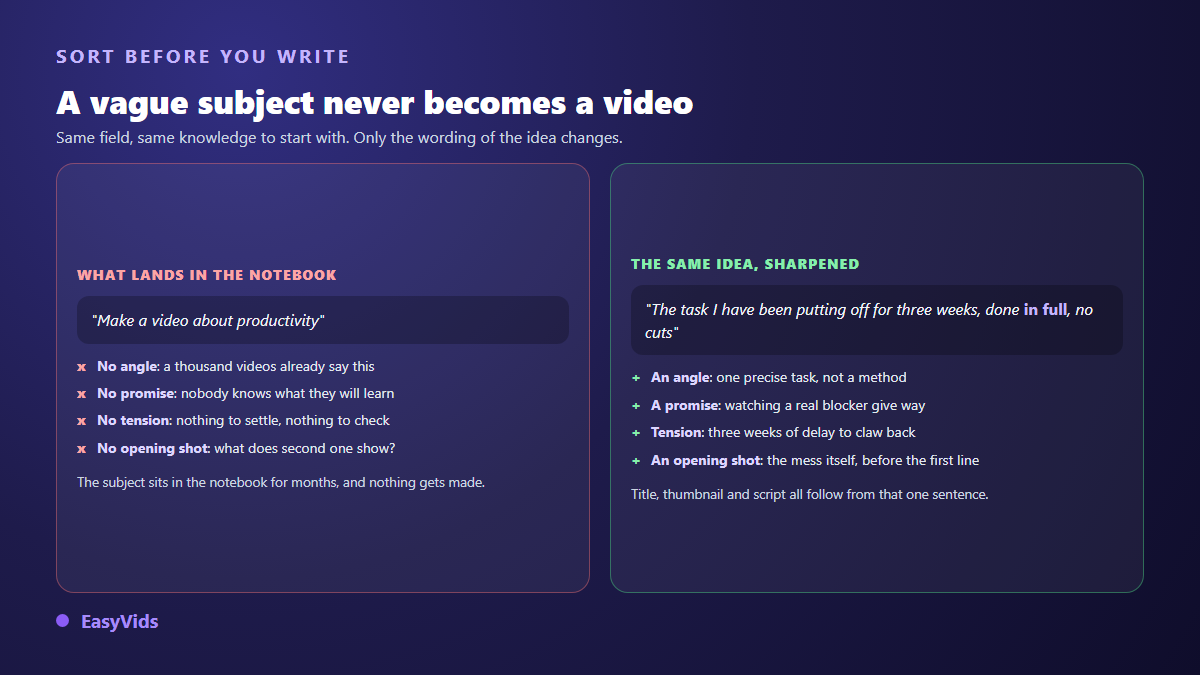
The test is five questions. They beat any ready made list, because they build ideas out of what you already know.
- What is the video about, exactly, in one sentence a neighbour would understand?
- What will the viewer know, or be able to do, in the final second?
- What makes anyone stay: a doubt, a before and after, a twist?
- What does the very first shot show, before the first line is spoken?
- How long will making it take out of your real week?
75 YouTube video ideas, niche by niche
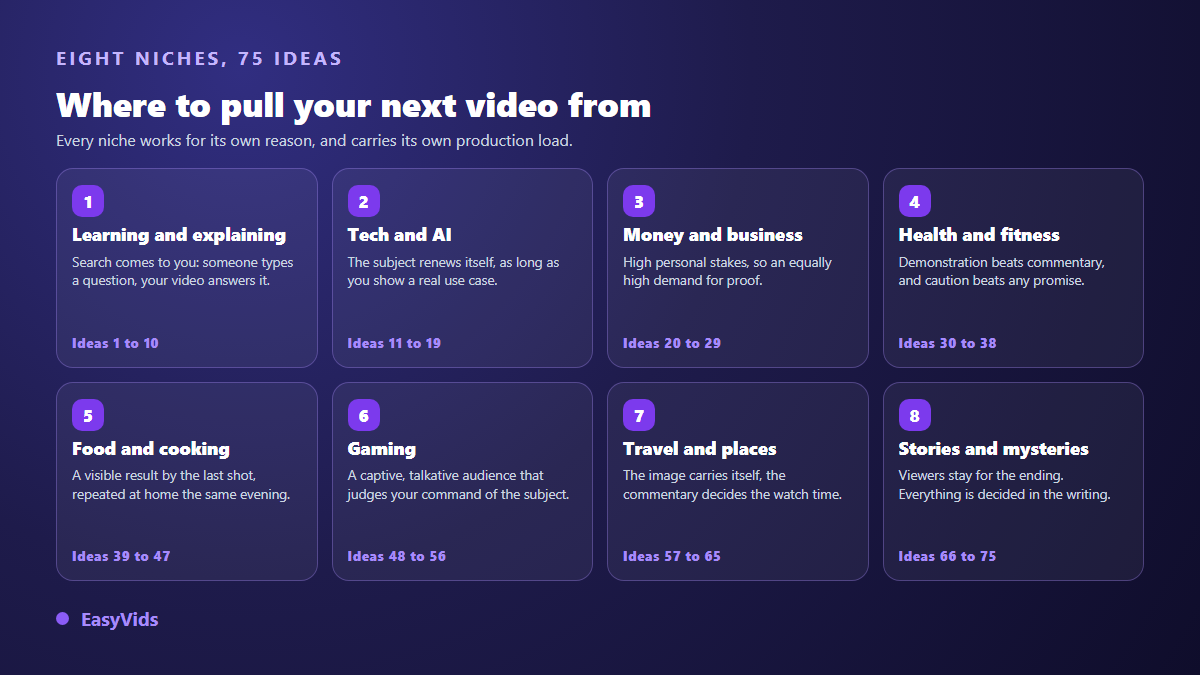
The eight niches below are not official platform categories. They are eight different ways of holding someone's attention. Each one opens with what makes it work and what it demands in production. Treat the ideas as moulds to fill with your own subject, never as titles to copy.
Niche 1. Learning and explaining: 10 ideas
This is the niche where search works for you. Someone types a question, your video answers it, and it keeps being watched months later. In exchange it demands precision: one video, one question, one complete answer. Production stays light, a voice over and illustrative shots are enough, unless the on screen demonstration is the subject itself.
- The task everyone postpones, done from start to finish with no convenient cuts.
- Ten pieces of jargon from your trade, explained one by one, without a dictionary.
- The same action done badly, then done well, with both results side by side.
- A getting started guide for someone who installed the tool five minutes ago.
- The long answer to a short question you get asked every single week.
- One concept explained three times: to a child, to an adult, to a specialist.
- The story of an ordinary object, the paper clip or the barcode, and what it changed.
- Two competing methods run on the same measurable task, with a verdict.
- The reason behind a rule everyone follows without ever having understood it.
- Your field's month in review: what changed, and what it means in practice.
Niche 2. Tech, AI and software: 9 ideas
The subject renews itself, which solves inspiration and creates the opposite problem: everyone posts the same announcement on the same day. What sets your video apart is a real use, taken all the way, including what failed. Expect a clean screen capture and an actual project to finish, so a medium production load.
- First hours with a tool released last week, on a real project with a deadline.
- Two apps set against each other on the same task, timer running.
- A whole job automated end to end, step by step, limits included.
- The settings nobody turns on that change daily use of a piece of software.
- What the free tier of a paid tool genuinely lets you finish.
- A famous outage explained by its actual technical cause, without caricature.
- A full migration from one service to another, with every trap you hit.
- Old hardware put back to work for one precise modern task.
- One technical word everyone repeats, taken apart in three minutes.
Niche 3. Money, business and careers: 10 ideas
The personal stakes are high, so the audience is demanding about proof. A claim with no demonstration gets dismantled in the comments within the hour. Show documents, screen captures, a calculation on screen, and say plainly what you do not know. Niches also differ widely on ad revenue, which our breakdown of YouTube RPM goes through.
- The full books of a real activity, income and costs, with nothing prettified.
- A well known company and the single decision that saved or sank it.
- A day in a job nobody understands, told hour by hour.
- A get rich quick promise taken apart piece by piece.
- One customer journey, from first contact to signature, seen from the inside.
- The business model of an everyday place: a cafe, a station, a gym.
- A portfolio or an application rewritten live, before version and after version.
- The invoicing mistakes of a beginner freelancer, one per video.
- The story of a commercial failure and the warning signs that were ignored.
- One negotiation played twice: the version that fails, then the one that lands.
Niche 4. Health, fitness and wellbeing: 9 ideas
Here demonstration replaces commentary: people watch a movement, not an explanation. Two rules apply. Film from an angle where the execution is actually visible, and stay careful with claims, quoting recommendations from official health bodies rather than your own experience alone. The production load is heavy, because your body is the set.
- A programme followed for thirty days, with an honest weekly log.
- One technical movement filmed from three angles, slowed down then at full speed.
- A badly executed exercise, its cause and its consequence, corrected on camera.
- A common belief tested against published guidance from a health authority.
- A practitioner's morning routine, in real time, no music and no cuts.
- Useful gear against useless gear for starting a discipline.
- What an injury taught you, and the recovery protocol you actually followed.
- Two training methods compared on the same measurable goal.
- A ten minute guided session, filmed to be followed live.
Niche 5. Food and cooking: 9 ideas
Cooking offers what few niches do: a visible result in the last second, repeated by the viewer that same evening. Pace matters more than beautiful shots, and the sound of the gestures holds attention as much as the image. The load stays heavy, best offset by shooting several recipes in one session.
- A one pan recipe, timed from the first gesture to the last.
- A restaurant dish rebuilt at home, with the gap owned and explained.
- One overlooked ingredient shown in five different preparations.
- The step by step of a base technique: an emulsion, a rise, a cut.
- A national recipe told through the history that produced it.
- Three versions of the same recipe tested to settle a family argument.
- A week of meals cooked in one session, container by container.
- Leftovers turned into a dish you would serve to guests.
- An industrial product label read line by line, without cheap outrage.
Niche 6. Gaming and entertainment: 9 ideas
The audience is captive and talkative: it watches long, comments a lot, and spots immediately anyone who does not command the subject. Screen capture supplies the image, which lightens production considerably, but the writing has to bring something the game does not, or the video blends into a thousand others.
- A constrained run: one level finished with a single weapon, one life, no interface.
- A level analysed through the design choices that make it readable without a tutorial.
- A saga's timeline reordered by the story rather than by release dates.
- An old game revisited ten years later, with no nostalgic indulgence.
- A fan theory tested against what is actually present in the game files.
- A tutorial on one precise mechanic most players get wrong.
- The documented backstage of a failed development, sources included.
- The three updates that changed a game, ranked by real effect.
- A beginner's session commented, with corrections given live.
Niche 7. Travel, places and culture: 9 ideas
The image carries itself, which fools many creators: beautiful shots with nothing to say give you a video people leave after a minute. The commentary decides the watch time. Shooting is heavy, but a good share of the subject, maps, archives, reconstructions, can be handled without leaving home.
- A district walked with one question in mind, asked in the opening seconds.
- The real cost of a trip, line by line, with nothing rounded down.
- A city explained through its map: why the streets sit where they sit.
- An abandoned place and the precise story of why it closed.
- The same tourist site filmed in high season and then in low season.
- A public transport journey filmed end to end and commented throughout.
- A local custom explained by someone who genuinely practises it.
- The country's most common street dish, followed from the seller to the plate.
- A hike cut into stages, with the decision points and the classic mistakes.
Niche 8. Stories, history and mysteries: 10 ideas
This is the cheapest niche to produce: no camera, no set, no schedule to clear. Everything is decided in the writing, and viewers stay to the end because they are waiting for one. The trade off is blunt: a badly built story cannot be rescued by any visual, however good.
- An unsolved case told strictly from public documents.
- A historical figure's day reconstructed hour by hour.
- A legend laid out first, then its documented explanation.
- A second person narrative where the viewer lives the scene.
- The minute by minute timeline of a disaster and the signals that were missed.
- The portrait of an unknown person who changed something for everyone.
- A letter or a diary read aloud, then placed back in its context.
- A bedtime story written to last an hour with no twist at all.
- A short horror story in three acts, with an ending that rereads the whole thing.
- A popular rumour verified piece by piece, all the way to a verdict.
What each idea actually costs to produce
A list of ideas is worth nothing without this. The real question is not whether an idea is good, but whether you will produce it before the month ends. Three loads stand apart, and a workable calendar mixes them on purpose.
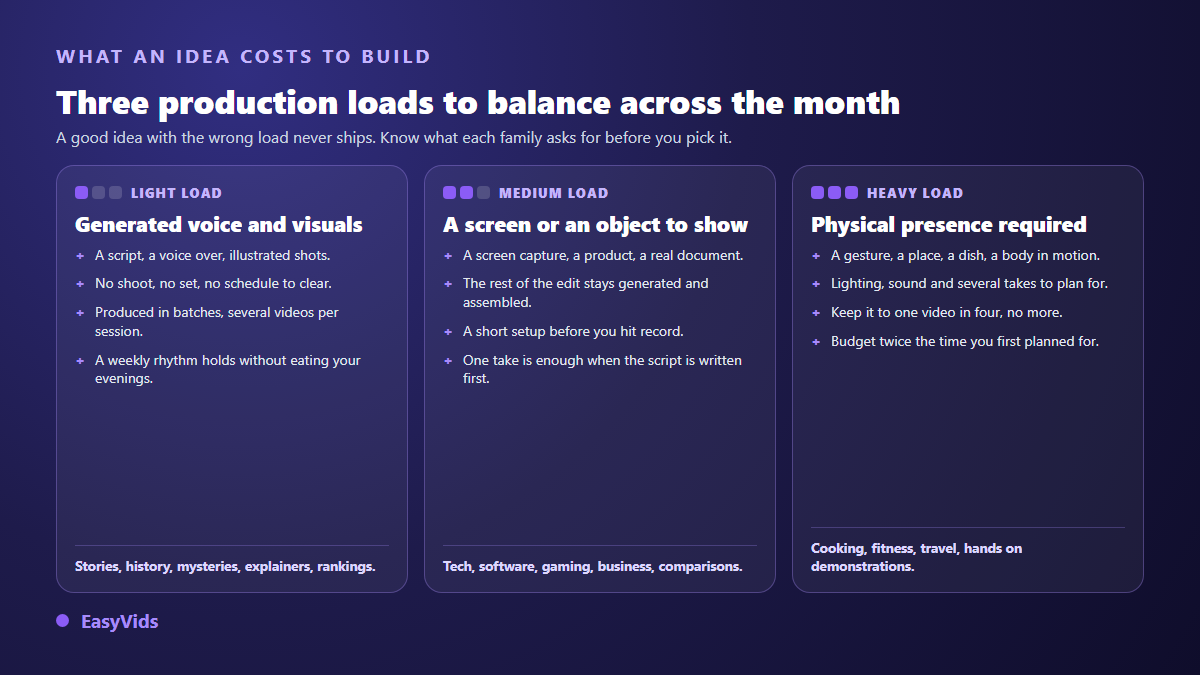
The habit that unblocks the most channels is two light ideas for every heavy one. Light videos keep the rhythm and hold the ground, the heavy video creates the appointment people wait for. A studio that chains script, voice over, visuals and editing in one place moves a share of your ideas from the heavy column to the light one, as our step by step guide to a YouTube video made with AI shows. The pricing page sets out what the free plan lets you test.
From idea to script without a blank page
A chosen idea is not yet a video. The title, the outline, the text written for the ear and the shot breakdown are all still ahead. That is where most idea lists stop, and it is exactly the part that eats the most time.
The method is three moves. Write the title first: it locks the promise and stops you drifting in four directions. Then write text meant to be heard, short sentences, one idea per sentence. Only then cut that text into shots, before hunting for a single image, otherwise you illustrate paragraphs instead of telling something.
That is precisely the work an AI script generator does in one pass: you give the idea in one line and the target length, it returns a calibrated, segmented text ready to be corrected. You keep control of every sentence, which matters more than it sounds, because your phrasing is what separates your video from the ten others on the same subject.
Holding the rhythm: one cycle per niche, not one idea a day
A reserve of 75 ideas is useless if you reread it every week from scratch. Work in cycles: pick a niche, write four ideas from that niche in a row, produce them in the same session. You stay in one register, writing goes twice as fast, and the videos start answering one another.
The thing to watch is regularity, not volume. One video a week for six months beats eight videos in ten days followed by a long silence. To lay those cycles across a full month, our content calendar method gives you a template to reuse as it stands.
The mistakes that waste a good idea
A solid idea is rarely lost in the edit. It is lost earlier, in five decisions made too fast.
- A title written after the video: the promise no longer matches the content. Per the YouTube Help Centre, a title gets 100 characters, but mobile display truncates part of it, so the weight sits at the start.
- A hook replaced by an introduction: thirty seconds of pleasantries before the first useful information.
- Three ideas stacked into one video: nothing is remembered, and the title cannot announce them all.
- A thumbnail decided at the end, from whatever is left: it decides the click before anything else does.
- An idea lifted as is from a competing channel, with no angle of your own: viewers have already watched that video.
Frequently asked questions
How do I find a YouTube video idea when I am starting out?
Start from what people already ask you. Questions from colleagues, clients or friends are pre validated ideas: someone genuinely wanted the answer. Take the last ten, make one video per question, and you have ten weeks of publishing without inventing anything.
How many ideas ahead should I keep?
One month of publishing ahead is enough to kill the Sunday night panic. Past two months, the list ages faster than you produce it. The right rhythm is to top the reserve up while you edit, rather than writing a hundred ideas in one sitting.
Should I stick to one niche or cover several subjects?
A new channel gains from holding one niche until the audience understands what it comes for. Nothing stops you widening later, since recommendations work on videos before they work on channels. Consistency mostly serves subscriptions and loyalty.
Can a video made with AI be monetised on YouTube?
Yes, provided it brings something. The monetisation policy update published by YouTube on 15 July 2025 replaced the notion of repetitious content with that of inauthentic content: what gets penalised is mass produced work with no contribution, not the tool you used. A written story, a considered voice and a deliberate edit stay within the rules.
How long should these videos be?
Set the length from the idea, never the reverse. An answer to a precise question runs a few minutes, a story needs more, a vertical format lives under a minute. Since October 2024, YouTube accepts Shorts of up to three minutes, which lets you treat the same idea in a short and a long version.
A channel does not die from a shortage of ideas. It dies from the time between the idea and the published video. Take three ideas from the niche that fits you, write their titles tonight, produce the first one tomorrow. To chain script, voice over, visuals and editing in one place, creating an account opens the full studio, and EasyVids brings those steps into a single path.