You have just generated a visual you like. An article illustration, a thumbnail, a mood shot for a product page. Then the question lands, usually at the worst moment, right before you publish or send an invoice: with AI generated images and copyright, is that file really yours, and how far can you take it?
The topic feels murky because two very different questions hide behind one word. Being allowed to use an image is not the same thing as owning it. This guide separates the two, names the texts and the authorities that actually decide, and gives the routine we run before every publication, alongside our complete guide to AI image generators. One note before the detail: this is general information, not legal advice. A specific situation belongs with a lawyer in your own country.
The short answer
In the vast majority of cases, you can publish, print and sell an image you generated, because the tool's licence grants you that right. What you do not automatically get is copyright you can enforce against others: several authorities hold that an output produced by prompting alone has no human author, so there is nothing to protect. Three prohibitions then cover most disputes: no identifiable real face without consent, no trademark or protected character, no reproduction of an existing work's form. A newer duty sits on top, disclosing that the image is synthetic whenever the law or the platform asks for it.
Two questions people constantly mix up
The first question is contractual: am I allowed to use this image? It is settled in the terms of service of whatever produced it, like any software licence. The second is proprietary: can I stop a competitor from reusing the very same visual? That one is copyright, and the answer depends on what you added, not on which model you picked.
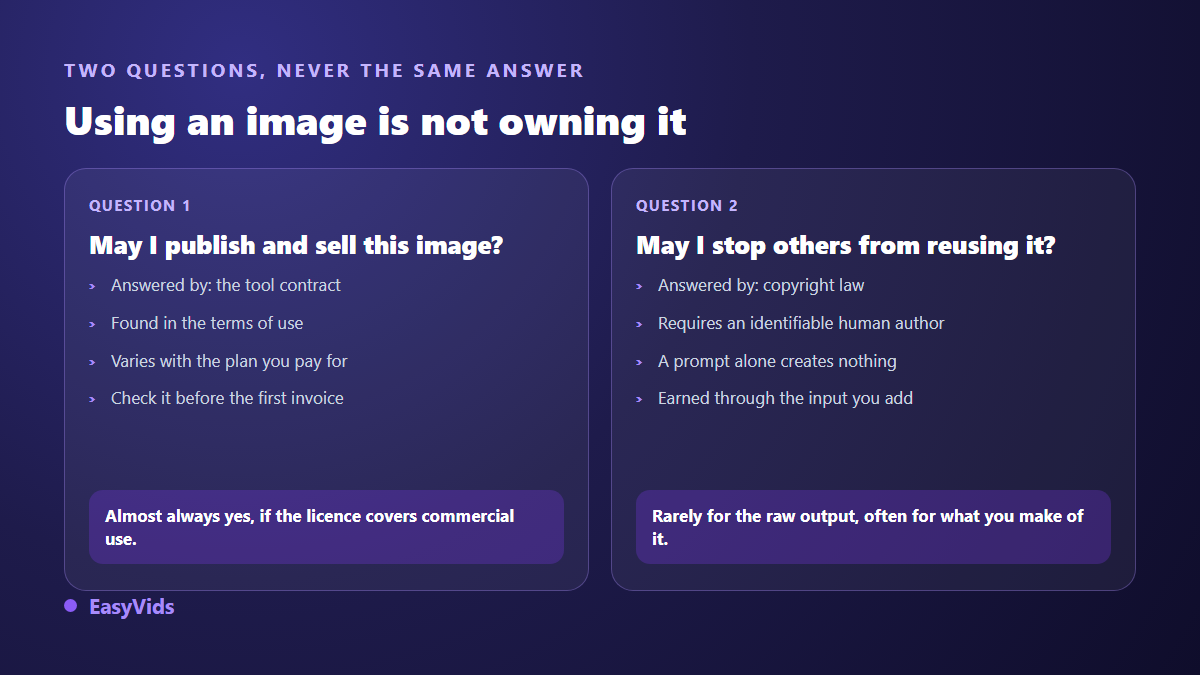
Confusing the two produces mirror mistakes. Some creators never dare invoice a visual they are perfectly entitled to exploit. Others hand over a generated logo while promising exclusivity they cannot deliver. Keep the distinction in mind on every project: it shapes what you write in a quote as much as what you publish.
Who is the author of a machine generated image
The point has been settled in several countries, always the same way. The United States Copyright Office published on 29 January 2025 the second part of its report on copyright and artificial intelligence, dealing precisely with what can be protected. Its conclusion comes in two moves: an output obtained by prompting alone is not protectable, because describing a result is not controlling how the machine executes it; an identifiable human contribution, on the other hand, is. A federal appeals court had followed the same reasoning in March 2025 in Thaler v. Perlmutter: a work produced autonomously by a machine, with no human author, cannot be registered.
Two decisions make this concrete for anyone producing visuals. In the Zarya of the Dawn file, the same Office decided on 21 February 2023 that the text and the arrangement of the pages remained protected, but not the images that came out of the generator. In September 2023 its review board refused to register the picture Théâtre D'opéra Spatial, a contest winner the year before, despite the hundreds of successive prompts its author described. The lesson is blunt: the number of attempts creates no protection.
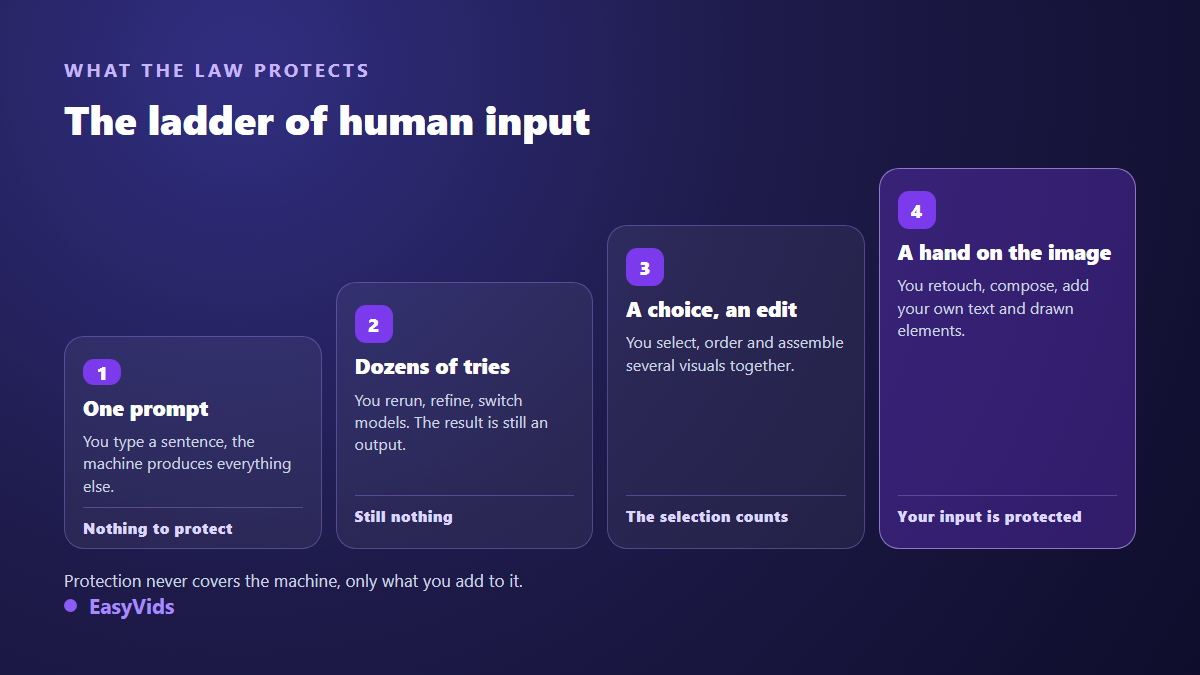
Europe reaches the same place by another road. Article L.112-1 of the French intellectual property code protects works of the mind whatever their genre or form, and case law requires the work to carry the imprint of its author's personality. The Court of Justice of the European Union has spoken since its 2009 Infopaq ruling of the author's own intellectual creation, refined in 2011 in the Painer case into free and creative choices. A personality implies a person. The practical upshot is more encouraging than it sounds: the more of yourself you put into the image, the more defensible it becomes. Compositing several outputs, retouching, adding your own graphic elements, placing the visual in an original layout, each of these adds a human layer, and that layer is what the law protects.
Your tool's licence is the document that decides day to day
Copyright answers the question of whether you can stop someone reusing your image. The licence answers the question you actually care about: can you publish, print and invoice this file? Terms of service set that, and they vary enormously between providers. The most common trap fits in one line: many free tiers grant personal use only, with commercial exploitation reserved for a paid plan. Read that clause before you invoice anything, and check on our pricing page what your plan covers.
Four clauses deserve attention with any provider, because they decide what your visual is really worth: a watermark on exports, explicit permission for commercial use, automatic publication of your creations in a public gallery, and reuse of your images to train future models. None of the four can be guessed from a landing page. Our own rule sits in article 4 of our terms: the content you generate belongs to you within the rights granted by the model providers, you may exploit it commercially, and we claim no ownership over your creations.
What you can actually sell
The question comes in many shapes: delivering a visual to a client, printing on an object, illustrating a cover, dropping an image onto a product page. In all of these, the licence decides, not the protection. You are selling a service and a file, exactly as a designer invoices a composition made in software they did not write. One difference is worth stating before signature: you cannot promise a client exclusivity that the law does not give you.
The ground hardens as soon as the image leaves your desk for a catalogue. Stock libraries apply opposite policies, and they move often. Adobe Stock accepts content produced with artificial intelligence provided it is declared as such at submission, with the releases needed for recognisable people and property. Getty Images announced as early as September 2022 that it would refuse generated images in its library. Shutterstock does not accept generated images submitted by contributors and routes them through its own generator. Open the contributor page on the day you submit, never a memory of an article you read.
Real faces come before everything else
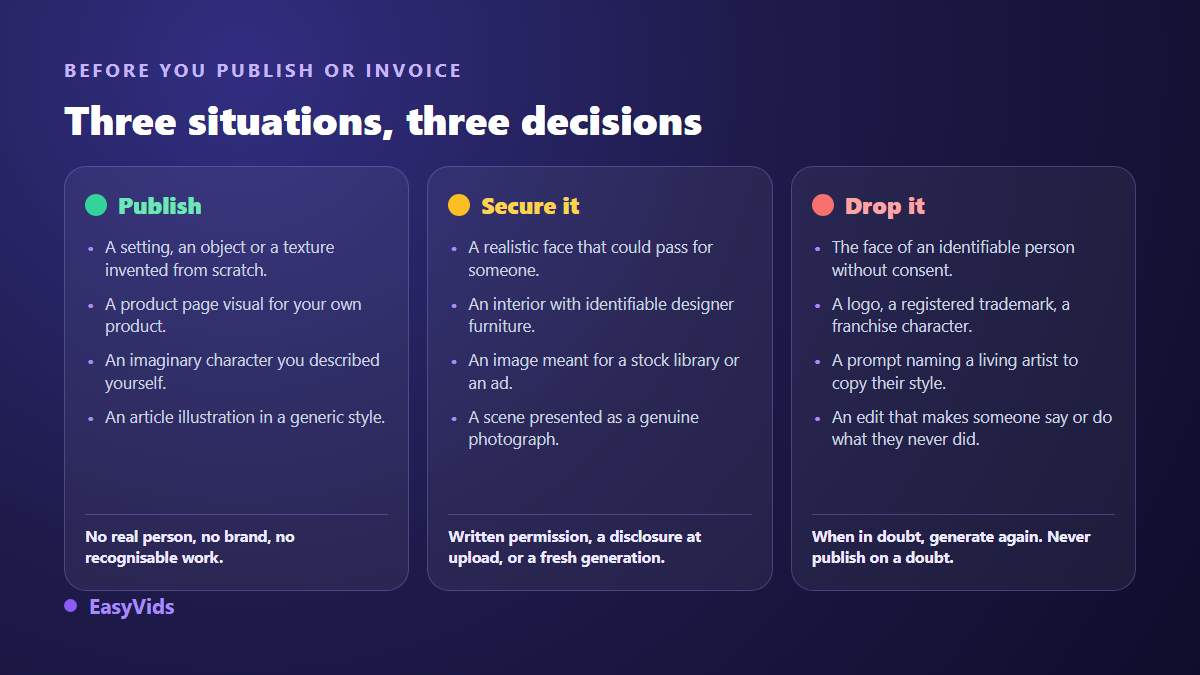
This is where creators get caught, because it is not a copyright question at all. In France, article 9 of the civil code states that everyone has the right to respect for their private life, and case law derives image rights from it: publishing the likeness of an identifiable person requires their consent. The French law of 21 May 2024 on securing and regulating the digital space went further, extending article 226-8 of the criminal code to montages produced by algorithmic processing. Many countries protect likeness through publicity or personality rights instead, and the practical instruction is identical everywhere: never prompt for the portrait of a named real person, famous or not.
Brands, logos and protected characters
A logo is a registered trademark, a cartoon character is a protected work, an object with a distinctive shape can be covered by design rights. Putting them in a generated image exposes you exactly as if you had drawn them yourself, and the risk rises when the visual serves a commercial message. Two cases are awkward without being obvious: designer furniture placed in an interior scene, and recent buildings whose architect holds rights. Generating an invented set costs less than a lawyer's letter.
Artist styles: what the law really protects
An old copyright principle protects you more than you think: ideas, techniques and styles cannot be owned, only form can. Asking for a luminous watercolour with soft edges harms nobody. Naming a living artist in your prompt moves you across the line for two reasons at once. You are trying to reproduce an identifiable signature, and a proper noun mechanically pushes the model towards imitating specific works, sometimes copying a whole composition. Describe the look instead of citing a person: the light, the material, the palette, the angle, the period. Our 21 image prompt examples are written that way, without a single artist name.
Disclosure: the European rule and the platform rules
The European regulation on artificial intelligence, in force since 1 August 2024, adds an obligation that touches synthetic images directly. Its article 50 requires providers of systems producing synthetic text, audio, image or video to mark those outputs in a machine readable format, and requires anyone publishing content imitating a real person to inform the audience that it is artificial. These transparency obligations have applied since 2 August 2026. Disclosure stops being an editorial choice and becomes one more box in the publishing routine.
Platforms moved first. The YouTube help centre asks creators to flag realistic content created or altered with synthetic tools at upload. TikTok requires a label on realistic generated content and applies it automatically when provenance markers travel with the file. Meta announced in 2024 that it would display a notice on content detected as generated from its metadata. The dividing line is the same everywhere: an obviously illustrated image needs no notice, a scene that could pass for a photograph does. On the technical side, the C2PA standard describes a provenance certificate attached to the file, and Google says it marks images produced by its models with its invisible SynthID watermark. The same reasoning applies to sound, as we detailed in our guide to AI music and copyright.
The evidence file
The day someone challenges your image, your good faith will not speak for you. Your archive will. It takes seconds per visual to build, and it proves both your creative contribution and your creation date.
- The exact wording of your prompts, with the generation date and the model used.
- The intermediate versions: they tell the story of the work, a final file tells nothing.
- The editing project, layers included, which puts your contribution on the record.
- Written permission from any recognisable person, obtained before publication.
- The plan you were on when you generated, since it sets what rights you hold.
- For client work, a contract naming the uses, the media and the duration.
What our studio does, and what it does not
Our image studio produces visuals from a prompt, accepts up to five reference images depending on the model chosen so a style or a character holds, and exports without a watermark. That last point matters most when the visual becomes a click thumbnail, and seven free ways to build a YouTube thumbnail compares which tools stamp their exports and which leave them clean. Your images belong to you and commercial use is covered by our terms, with image generation, voice over, music and editing gathered in one place inside the EasyVids studio. What we do not do deserves saying just as plainly. We do not check on your behalf whether a face resembles someone, whether a logo slipped into a background, or whether a prompt names an artist. We do not embed provenance certificates in exported files either: marking, where it exists, comes from the model provider. Disclosure at upload stays your move, on every platform.
Frequently asked questions
Is an AI generated image protected by copyright?
The raw output, almost never. Several authorities, including the United States Copyright Office in its report of 29 January 2025, hold that an image obtained by prompting alone has no human author. Your contribution is protectable: a composite, a retouch, a layout, an ordered selection. That layer is what you can defend, not the file the model returned.
Can I sell AI images in an online store?
Yes, as long as the tool's licence covers commercial use, which ours does. Check three things before listing: no identifiable face without consent, no trademark or protected character in the frame, and the marketplace's own rules, since several now require generated visuals to be declared.
Am I allowed to generate an image in the style of a famous artist?
Style itself is not protected, the form of a work is. In practice, naming a living artist in a prompt is a bad trade: the model drifts towards imitating specific pieces, and the result becomes hard to defend. Describe the look you want rather than the person, and you get a more original image with no grey zone.
Do I have to say an image was generated by artificial intelligence?
Yes as soon as it is realistic enough to pass for a photograph, and yes whenever the platform asks. The transparency obligations of the European regulation on artificial intelligence have applied since 2 August 2026, and YouTube, TikTok and Meta already require a label on realistic content. An obviously illustrated visual needs no particular notice.
What is the risk for a client I deliver generated visuals to?
The real risk is not the use, it is the exclusivity you promised. A generated visual can be used, printed and distributed, but you cannot guarantee that a competitor will never obtain something close. Put that in the contract, and offer a retouch or a custom composition when the client wants a visual identity that truly holds.
Copyright is not the wall people picture in front of a generated image. It turns into a routine: a licence read once, two prohibitions held on every visual, a disclosure at upload, an archive fed as you go. The rest of your attention goes back where it belongs, into the quality of the picture itself. To generate under those conditions, creating an account opens the full studio, no bank card required.