You search for the best AI music generator and you land on lists that contradict each other. Nine tools here, seven there, never the same name on top. Those rankings are not lying. The trouble is that music is judged by ear, against one specific need, and no list knows yours. A background bed for a three minute tutorial and a sung birthday song do not call for the same engine at all.
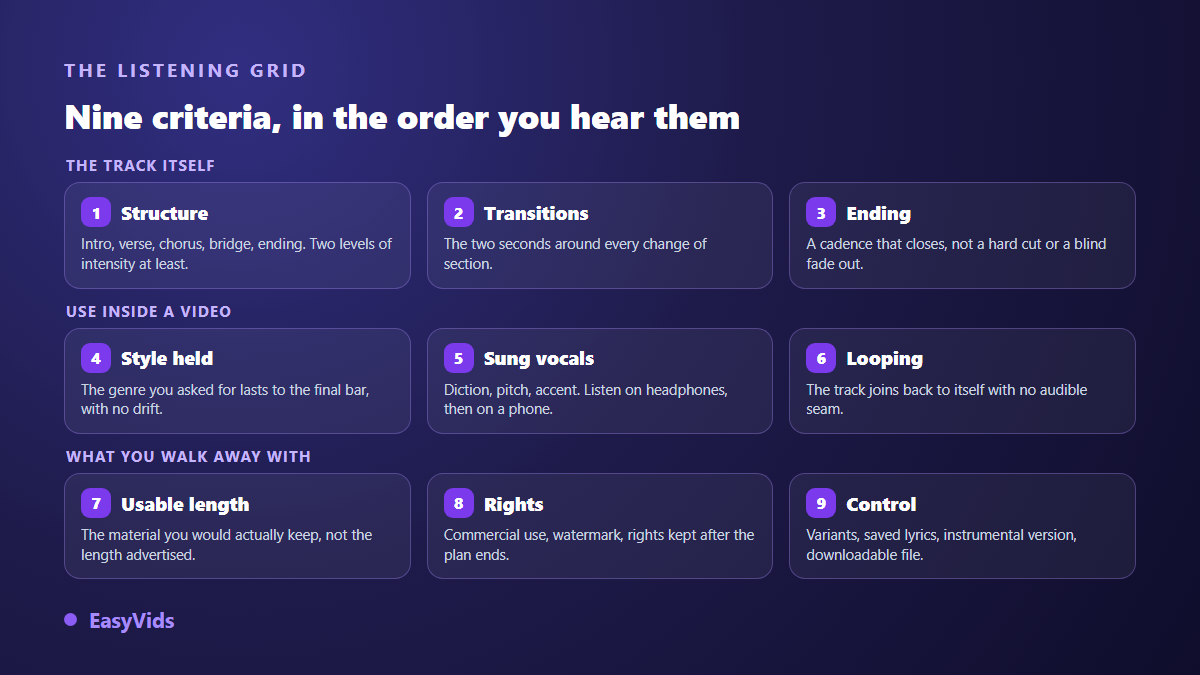
So this guide skips the ranking. It hands you the nine criteria that separate, on first listen, a track you can publish from a demo that only sounds good: structure, transitions, ending, style consistency, sung vocals, looping, usable length, usage rights and how easily you can take control again. Apply them to any tool, this year and next. If you first want to see how these engines build a track, our complete guide to the AI music generator walks through the full chain, from brief to file.
The short answer
The best AI music generator for you is the one that holds your style brief from the first bar to the last, ends on a real cadence instead of a hard cut, and licenses the use you actually need. Those three points remove most candidates within ten minutes of listening. Everything else, vocal quality, available length, number of variants, depends on your project. One rule applies to all of them: judge on your own briefs, never on the showcase clips, which were picked from dozens of takes.
Why a tool ranking ages within weeks
Music engines ship new versions several times a year. The same service can move from a metallic result to a convincing one between two updates, or lose vocal quality while gaining length. An article written last year therefore describes a product that no longer exists. That is the first reason to distrust a fixed order, especially one that crowns a single winner.
The second reason is how those comparisons are made. A published clip is almost always the best of a series, and nobody publishes the six failed takes before it. A roundup is useful for shortlisting, not for deciding: our review of five free music generators does exactly that shortlisting job. The decision happens afterwards, on your own material, with your own ears.
The nine criteria that decide for you
Take them in order. The first three concern the track itself, the next three its behaviour inside a video, the last three what the service leaves in your hands. A tool can shine on some and fail on others, which is precisely why no single ranking survives contact with a real project.
1. Structure: does the track go anywhere
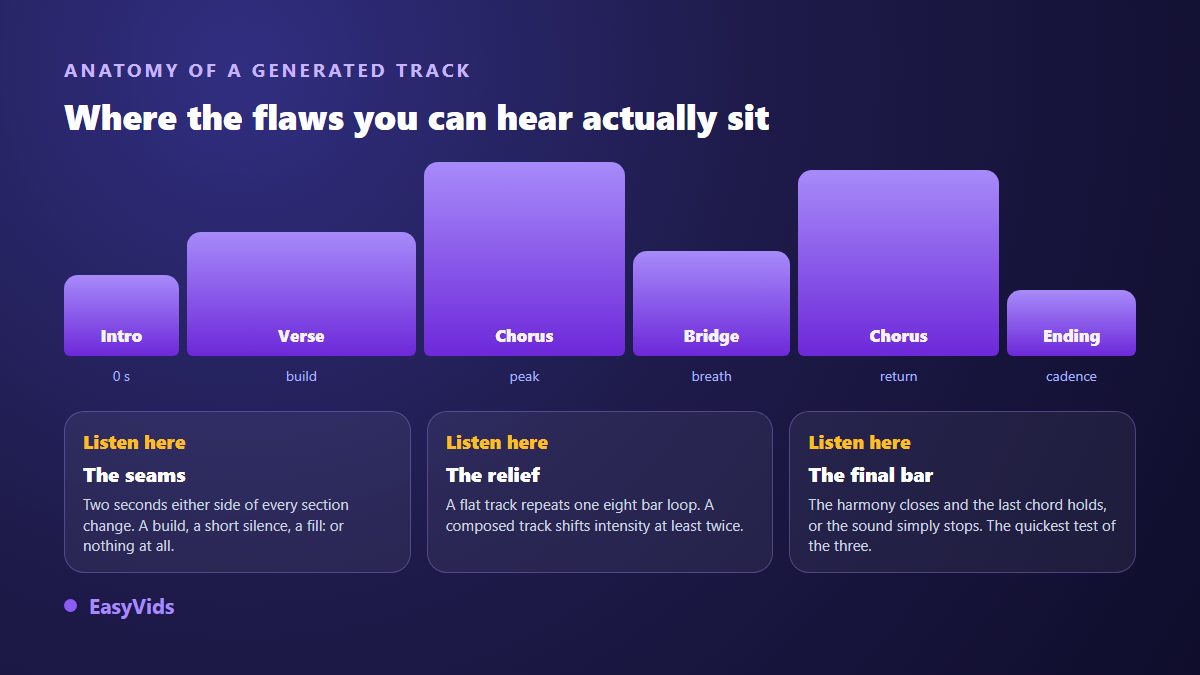
A good track moves. An intro sets the mood, a verse settles in, a chorus opens up, a bridge breaks the repetition, an ending closes. Weak engines instead repeat one eight bar loop until the requested duration is filled. Pleasant for twenty seconds, heavy after two minutes. The test is quick: if you cannot hear at least two levels of intensity between the start and the middle, the structure is flat, and no edit will rescue it.
2. Transitions: what happens between two sections
This is the most common flaw and the easiest to hear once you listen for it. Play the two seconds either side of every section change. A good engine brings the chorus in with a build, a drum fill or a short silence. A weak one simply glues two blocks together, and you hear the seam. In a video that seam often lands mid sentence, right under the voice over, and viewers notice it before they can say why.
3. The ending: a cadence, not a cut
Many generated tracks stop dead, or fade out blindly over the final seconds. That is the clearest sign of an engine filling a duration rather than composing. A real ending is recognisable without any musical training: the harmony closes, the intensity drops, the last chord holds for a moment. If you have to add a manual fade every single time, note it, because that is one more minute of work on every video you publish.
4. Style consistency, first bar to last
Ask for a soft bossa nova, then check that the track is still a bossa nova at the final bar. Drift is common: the tempo slides, a synth appears in the middle of an acoustic piece, the drums change character after the bridge. This criterion is easier to judge with a precise brief than with a vague request, which is why the wording matters. Our music prompt examples sorted by genre show which building blocks an engine really follows, and which ones it quietly ignores.
5. Sung vocals: diction, pitch, language
When your project has lyrics, the voice becomes the dominant criterion, because listeners judge it first. Three flaws show up fast. Swallowed or badly cut syllables, especially on long words. Line endings that drift off pitch. And accent, when the engine sings your language with foreign articulation. Listen on headphones first, then through a phone speaker: artefacts that hide in headphones become obvious on a small speaker, and that is where your audience will listen.
6. Looping: the forgotten criterion for background music
To score a video you will often need to extend the music beyond its original length. A track that loops cleanly joins back to itself with no audible seam: same key at the start and the end, no cut reverb tail, no stray silence. Test it by duplicating the clip end to end in your timeline, which takes thirty seconds. Plenty of tools that shine on songs fail here, because they compose pieces rather than loops.
7. Usable length, not advertised length
A service announcing three minutes sometimes delivers two minutes of material and one minute of repetition. What counts is the length you would actually keep if you had to cut. Measure it once, on a track that represents your typical need, and you will know what to expect from every later one. For video, use a simple rule: the music should cover the voice over plus two breaths, one at the start and one at the end.
8. Commercial usage rights, before anything else
A beautiful track you are not allowed to publish is worth nothing. Three questions settle it: is commercial use included in the plan you are on, does that right survive if you change plan or stop paying, and does the downloaded file carry an audible watermark. Our analysis of AI music and copyright breaks down the layers stacked inside a generated track, because the answer is finer than a simple yes or no.
One technical point deserves to be stated properly. The European regulation on artificial intelligence, whose article 50 has applied since 2 August 2026, requires providers of systems that generate audio, images or video to mark their output in a machine readable format. That marking cannot be heard, degrades nothing and forbids you nothing: the duty sits with the provider, not with you. An audible watermark is a different matter, and it shows up on the first listen.
9. Control: regenerating without losing everything
The last criterion cannot be heard, only lived. Can you request a variant without rewriting your brief? Recover the lyrics from an earlier take? Get an instrumental version of the same track? Download a file your editor accepts? A tool that sends you back to a blank page every time you are unhappy will cost you more hours than a slightly less brilliant engine that lets you step back. On an ongoing project, this often outweighs raw quality.
Three families of tools, three different jobs
Services differ in more than quality. They aim at different objects, and that is usually where the real choice happens. Identify the family you need first, and your shortlist shrinks by two thirds.
- Full songs: lyrics, sung vocals, instrumentation. The most impressive family and the hardest to judge, because the voice concentrates every flaw.
- Instrumental and sound design: no vocals, textures, pads, rhythms. The right pick for an intro theme, a meditation or a background bed.
- Music built for video: calibrated durations, clean loops, styles filed by mood rather than by genre. Less striking on its own, often the most useful in an edit.
A fourth situation exists, quieter than the others: composing where you edit. The track is then born at the right length, inside the right project, with no download, import and realignment. That is the approach we chose, and it mostly changes the time spent rather than the quality of the engine.
How to judge for yourself in twenty minutes
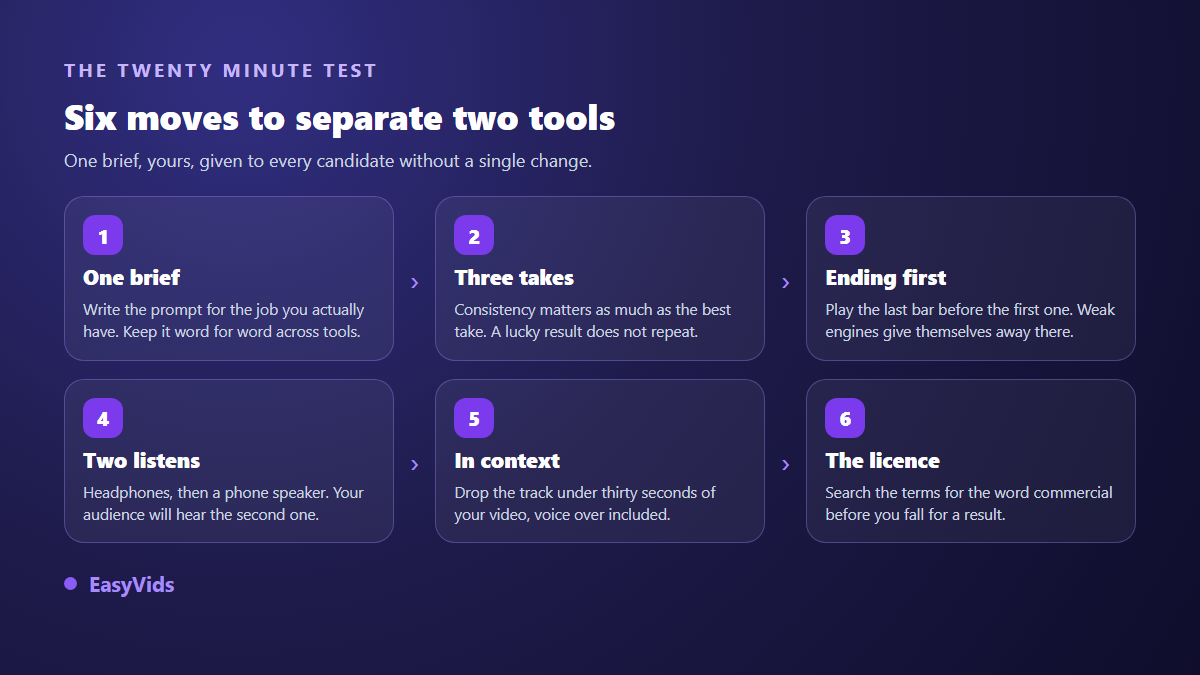
This method replaces no laboratory test and produces no ranking. It settles a choice between two or three candidates using your own material, which no list will ever do for you. Budget twenty minutes per tool, once.
- Write one brief, the one your project actually needs, and keep it word for word across every tool.
- Generate three times with that brief. Consistency matters as much as the best take, because luck does not repeat.
- Play the end of each track before the beginning: weak engines give themselves away there fastest.
- Listen to each candidate on headphones, then through a phone speaker.
- Drop the track under thirty seconds of your video, voice over included, and listen to the whole thing rather than the music alone.
- Open the terms of use, search for the word commercial, and read the full sentence before you fall for a result.
One last habit prevents a lot of disappointment. Judge a service on its free tier or its trial, not on its showcase page, and compare plans only once your two finalists are picked. The details of our own plans live on our pricing page, and they change far faster than the quality of an engine.
What the EasyVids Music Studio does, and what it does not
On EasyVids, music is composed in a dedicated studio, in the same place as voice over, visuals and editing. You start from an occasion, picked from a list of ready made situations or described freely. You add a name and a message when the track is meant for someone, then a genre and a mood. The writing engine can draft the lyrics, which you edit before composing, and they stay in a history you can reload without paying again. Two engines sit side by side: an instrumental without vocals, and a sung song whose instrumental version stays available.
What the studio does not do deserves the same candour. It does not deliver separate stems, it registers nothing on your behalf with a collecting society, and it cannot guarantee that a track will resemble no other. On the other hand no watermark is added to the output, the file downloads as MP3, and the terms of use leave you the ownership of your creations with the right to exploit them commercially, within the rights granted by the model providers. Those are exactly the sentences we invite you to look for elsewhere, ours included, before committing.
Frequently asked questions
Which AI music generator is the best in 2026 ?
No tool leads on every use, and distrusting anyone who claims otherwise is already good practice. The best one for you holds your style, finishes its tracks cleanly and grants the rights you need. Take two candidates, give them the same brief, listen to three takes from each: the answer arrives in twenty minutes, and it applies to your project rather than to a reviewer's.
How can you recognise AI music by ear ?
Four clues come up often: abrupt transitions between sections, an ending that is cut or drowned in a fade, choruses that repeat gesture for gesture, and sung diction slightly out of step on long words. None of them is conclusive, and they fade as engines improve. They mostly help you spot a rushed track, not condemn the technique.
Can AI music be used in a monetised video ?
It depends on the licence of the service, not on the technology. A tool whose free tier reserves commercial use for subscribers puts you at fault even if the video passes without a claim. Read the licence first, the platform rule second, and keep a written trace of what you accepted on the day you generated the track.
Do you need to write lyrics yourself ?
No. Most studios can draft lyrics from a theme, a name and a message. The point to watch is elsewhere: can you read and edit that text before composing? Two corrected lines in a chorus often change the result more than switching engines, because the voice sings whatever it is given.
How long does it take to get a usable track ?
Generation itself takes minutes. The real time goes before and after: sharpening the brief, listening, regenerating. In our own use, a track that reaches production rarely comes from the first take, more often from the third to the fifth. One more reason to choose a tool where launching a variant is immediate and where your lyrics are never lost.
Keep the grid, drop the ranking. Play the ending before the beginning, hunt for seams, check the licence, and run the test on your own brief: twenty minutes will tell you what no list can. To compose a track at the right length, straight inside the video project waiting for it, create your account and run a first take with the welcome credits.