You are looking for the best AI voice generator, and every page you open hands you a different ranking. One tool comes first here, fourth there, missing somewhere else. The reason fits in one line: nobody is listening to the same thing. A voice judged on a demo sentence has little in common with the same voice on an eight minute script full of numbers, acronyms, questions and a proper noun in the middle.
So this is not another leaderboard. It is the listening grid used before a voice goes into a video: the families of tools that really exist, the seven points your ear decides on, and a five sentence test you can run yourself in a few minutes. If the topic is new to you, our complete guide to AI voice over covers the ground first.
The short answer
The best AI voice generator is the one that holds your language, the real length of your scripts and your usage rights. Three questions almost always point to it: which language do you publish in, do your scripts run fifteen seconds or ten minutes, and do you need a catalogue voice or your own? The number of voices advertised, the length of a language list or a position in a ranking tell you nothing about what your listener will hear. Naturalness happens elsewhere: in the flow between words, the breathing, the melody of a question and the way a number is read.
Why a numbered ranking does not help you
A leaderboard rests on listening sessions you cannot reproduce. Most of them never say which script was read, in which language, or on which version of the engine. Those three details change everything. An engine that shines on a fifteen second ad can become tiring across an audiobook chapter, because small timing flaws pile up minute after minute.
Versions move as fast as opinions. A voice engine updates without notice, and a review written six months ago describes a product that no longer quite exists. Stable criteria age far better: a broken liaison stays a broken liaison whatever the version, and a listening method survives the next update.
A ranking also assumes a single winner. For voice, that idea collapses. The voice that reassures in a tutorial is not the one that sells in fifteen seconds, and the voice that carries a six hour audiobook is not the one that plays a cartoon character. Define the job first, compare second.
The four families of AI voice tools
Before comparing brand names, work out which family you are shopping in. Four types of tools coexist, and they aim at different jobs. Identifying your need beats reading twenty product pages.
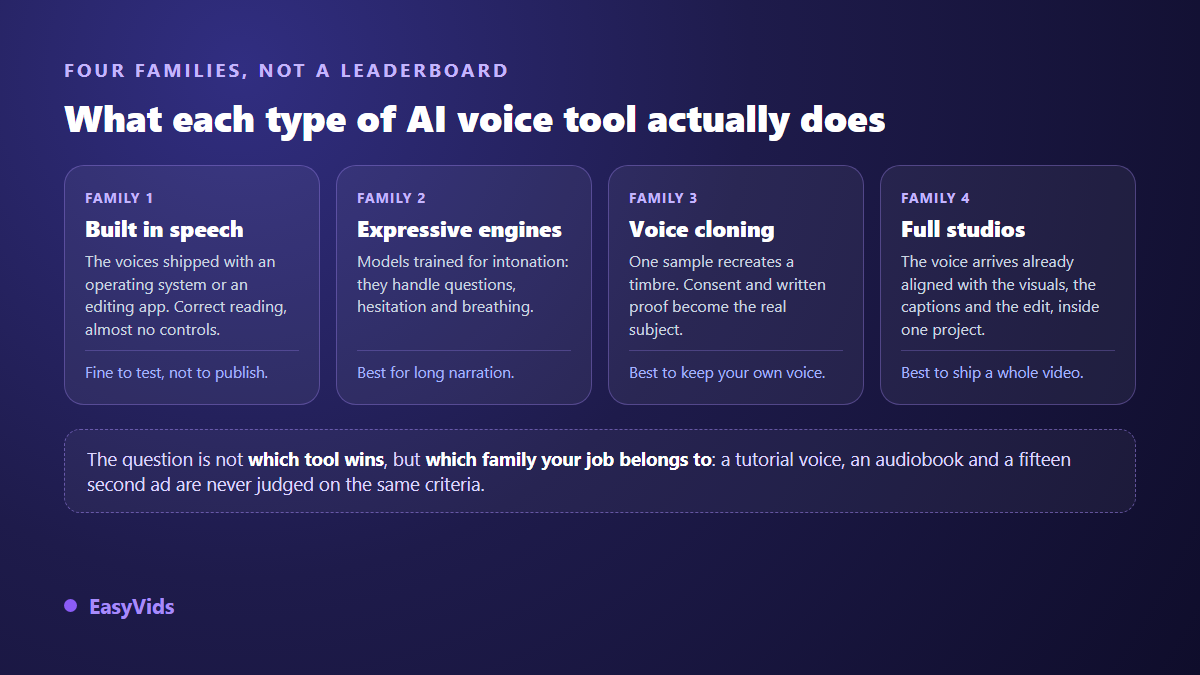
Built in speech is the one you already own: your phone, an editing app, a document reader. It reads correctly, it is instant, it costs nothing. It also gives you almost no control, and a trained ear identifies the timbre in three seconds. Expressive engines form the second family: trained for intonation, they mark questions, leave silences and accept tone instructions. That family moved synthetic voice from passable to publishable.
The third family is cloning: from one sample, the tool recreates a timbre, yours or that of someone who agreed to it. The fourth covers full studios, where the voice is one piece of a project: script, visuals, captions and edit live in the same place, and the voice arrives already aligned with the shots. A creator publishing every week rarely saves time by stitching four separate tools together. Singing runs on a separate mechanism altogether: setting your own words to music relies on composition models rather than reading ones, so it is not judged by the checklist that follows.
Seven criteria your ear decides on
This is the grid applied before a voice is cleared for production. Seven points, judged on headphones, never on a spec sheet.
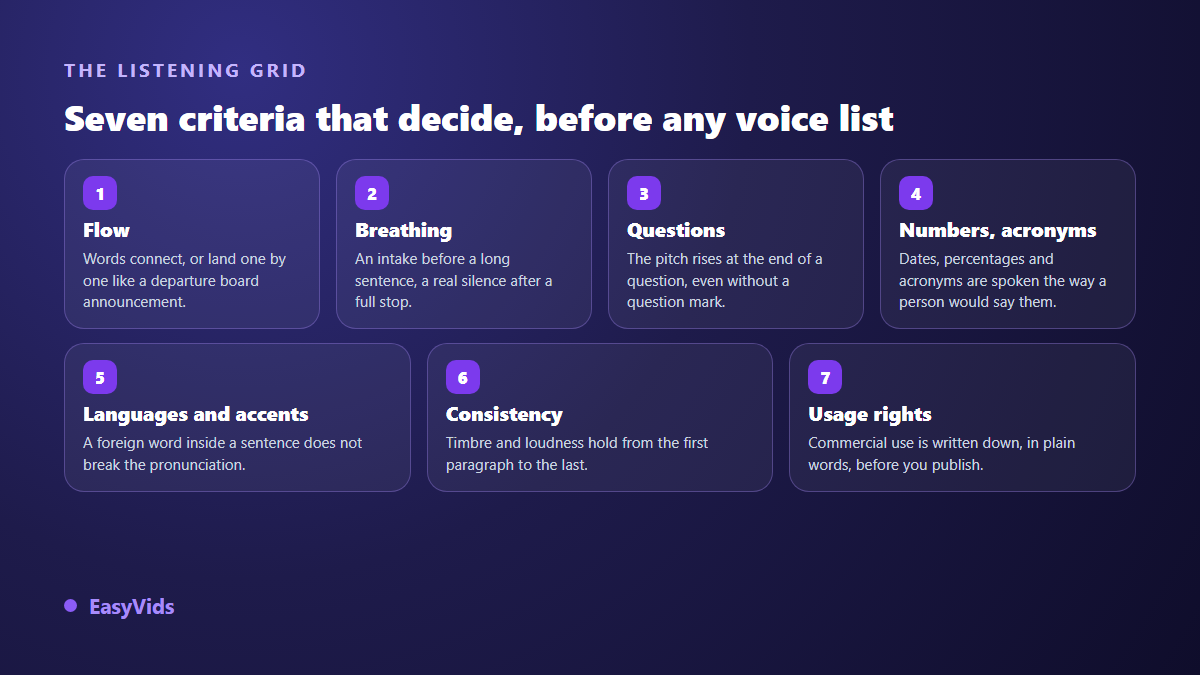
- Flow. A good voice connects words the way a person speaking does. A weak one lands each word separately, and your ear hears a departure board announcement.
- Breathing. An intake before a long sentence, a real silence after a full stop. With no breath, three minutes of narration become exhausting even when every word is correct.
- Question intonation. The pitch has to rise at the end of a question, including when the sentence carries no question mark. Many engines read a question as a statement.
- Numbers, dates and acronyms. This is the fastest filter. Listen to how the tool says a year, a percentage, a time and a three letter acronym.
- Languages and accents. A borrowed word inside a sentence must not break the pronunciation, and a voice advertised in your language should be native, not a foreign voice dragging its accent along.
- Consistency. Across a long script, timbre, pace and loudness must hold from the first paragraph to the last. Drift shows up over two straight minutes, never over one sentence.
- Usage rights. A perfect voice that bans advertising or monetisation is useless to you. Read that clause before the edit, not after.
Those seven points settle most decisions. When a voice feels mechanical and you cannot say why, the cause sits in the first three, and much of it is fixable without changing tools: the settings that make an AI voice less robotic walk through that punctuation and pacing work.
Naturalness lives in the flow and the breath
A synthetic voice rarely gives itself away through timbre. It gives itself away through rhythm. Your ear catches the missing breath and the mechanical evenness between words within a single sentence. That is why the same engine can sound perfect on a demo line and artificial across a full paragraph.
Part of that flaw is repaired from the script. A long sentence without a comma forces the engine to invent its own breathing: split it in two, and the result changes. Write the way people speak, one idea per sentence, with punctuation. A script written for the eye produces a voice for nobody, whichever generator sits behind it.
Numbers, acronyms and names: where many voices stumble
Feed this line to any tool: "On 3 March 2026 at 9:15, in room 4, the CSE meeting opens: 120 seats, 87 percent already booked." You will hear the level of the engine immediately. Some speak the numbers as words, some spell the digits one by one, some read an acronym as a word when it should be spelled out. One of those accidents is enough to break a professional video.
The second trap is proper nouns and brand names. An engine applies the pronunciation of its training language, and your brand name can come out unrecognisable. Two fixes work: spell the word phonetically in the script, or isolate the name in a short sentence and listen to it alone before approving. On a channel where your name returns in every episode, that detail carries the credibility of the whole thing.
The five sentence test, run by you
No ranking replaces ten minutes of listening to your own script. The protocol fits in five sentences, and the same text must pass through every tool you compare. It is the only honest comparison available, because official demos are chosen to flatter the engine that publishes them.
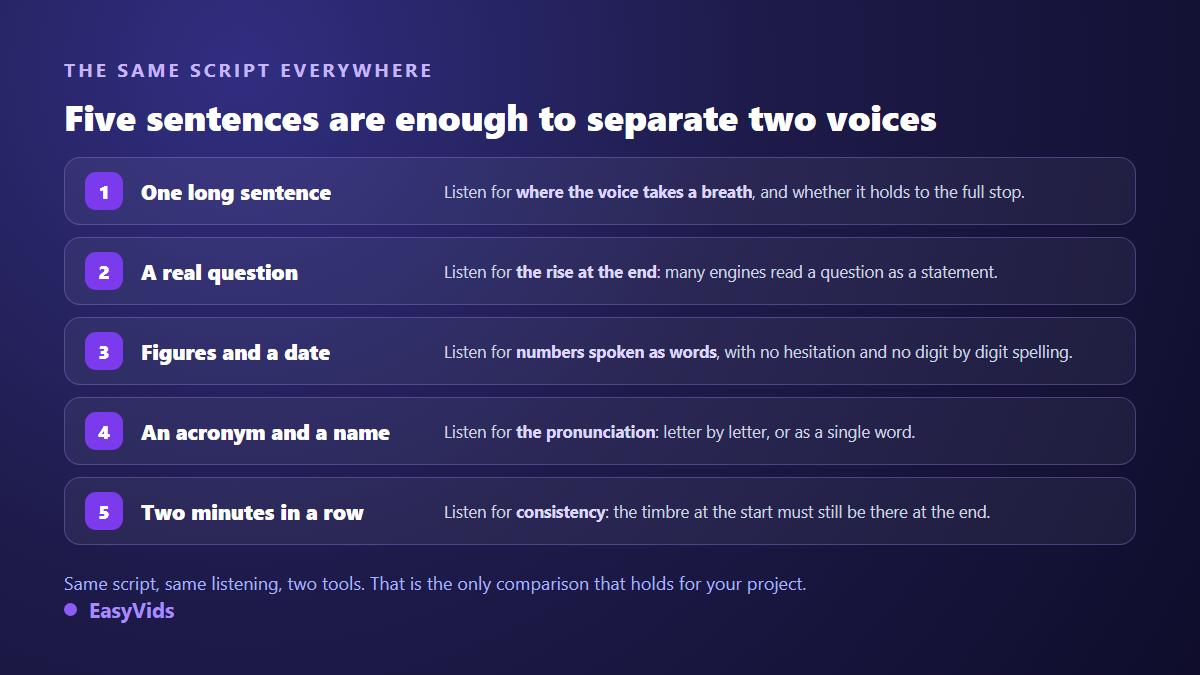
Listen on headphones, then in your audience's real conditions: most people watch on a phone, on the built in speaker, in noise. A voice that is too soft disappears, a voice that is too compressed tires. To see this listening carried through on a set of French voices, our comparison by ear of seven voice overs applies exactly this protocol.
Languages and accents: what multilingual really means
A list of thirty languages says very little. The real question is whether the voice is native to your language, or pronounces your language with someone else's accent. Check a borrowed word too, since technical vocabulary is full of them. If you publish the same video in several languages, demand the same listening pass for each version: one convincing track and one approximate track is enough to lose half of your audience.
Voice cloning: what to check before you send a sample
Cloning has become a deciding factor for many creators, because it keeps one sonic identity across every video. Three things matter before you hand over a sample: the recording quality expected, what happens to that file afterwards, and whether you can delete the clone. On sample length, the benchmark in our cloning guide is more useful than a marketing promise: cleanliness of the recording decides more than duration.
The second subject is the law, and it is not settled by ear. Cloning your own voice raises no question. Cloning someone else's requires their consent, kept in writing. In France, article 226-8 of the Criminal Code punishes publishing a montage made with a person's words without their consent, unless the montage is obvious or expressly stated. Since 2 August 2026, the transparency obligations of article 50 of the European Union AI Act also apply: synthetic audio must be marked as such, and content imitating a real person must be presented as artificial. Our article on the legality of voice cloning covers the concrete cases.
Commercial usage rights and production reality
A voice is rented more often than bought. Three lines deserve your attention in the terms: is commercial use allowed, does paid advertising count as commercial use, and what happens to a published video if you stop your subscription? At EasyVids, the terms of service state that the content generated by your account, voice over included, belongs to you within the limits granted by the underlying models, and that you may use it commercially. What each plan includes is listed on the pricing page, the only source kept up to date on that point.
Three more criteria only surface in production. Latency: a few seconds per sentence becomes a real brake when you test twenty versions of a hook. Length: many tools split beyond a certain script size, and the seam is audible when the engine does not hold the same voice state across chunks. Integration: a voice exported as a standalone file still has to be realigned with the visuals, which is the longest part of any edit.
What EasyVids does on the voice side
On easyvids.io, voice over is not a separate tool, it is a step of video production. Three voice models sit side by side, and the choice depends on the result you want, never on a scale from worst to best. Model V1 accepts a reading style written in plain language, such as "read it like a storyteller, slower on the last sentence". Model V2 offers a catalogue of French and English voices. Model V2.5 targets long narration.
The rest follows the chain: the real duration of the voice sets the duration of the shot, captions align to the same track, and you regenerate a single sentence without rebuilding the whole video. You can hear a voice on your own script before producing anything, which is the five sentence test run inside the tool that will edit your video.
Frequently asked questions
Which AI voice generator is the best?
No tool wins in every case. Start by checking whether the voice is native to your language, then take your own script, with your numbers and your proper nouns, and have two or three candidates read it. The decision takes ten minutes, and it holds for your project rather than for a general ranking.
Is a free AI voice good enough to publish?
For an internal test, a mock up or a personal video, yes. For commercial publishing, check two lines in the terms: whether commercial use is allowed, and whether an attribution is required. A free tier is judged on what it lets you do with the file, not only on the number of characters offered.
How do I know if my voice over sounds robotic?
Listen for two straight minutes, never one sentence. The flaw shows in accumulation: intervals that are too even, no breathing, sentence endings that are all identical. Split your long sentences, add punctuation, then listen again. Most mechanical results come from the script, not the engine.
Is voice cloning legal?
Cloning your own voice raises no issue. Cloning someone else's requires their written consent. In France, article 226-8 of the Criminal Code covers publishing a montage made with a person's words without consent. Using a public figure's voice in an advert exposes you to a claim, even without naming them.
Do I have to disclose an AI generated voice?
In several cases, yes. Since 2 August 2026, article 50 of the European Union AI Act requires synthetic content to be marked, and content imitating a real person to be presented as artificial. Platforms add their own rules: according to YouTube documentation, realistic synthetic content is declared at upload. When in doubt, a line in the description costs less than a dispute.
The best AI voice generator, for you, is the one that passes your five sentence test in your language and lets you publish without second thoughts. Spot the family that matches your work, apply the seven criteria, and keep the listening protocol for the next round of engine updates. To hear a voice on your own script before deciding, open an account and run a first test.