You post Shorts, the view counter climbs fast, and the earnings line stays flat. YouTube Shorts monetization runs on a mechanism that has almost nothing in common with long form video. No ad sits in front of your video, nothing is counted view by view. Revenue lands in a shared monthly pool instead, and that pool is split between channels. Two creators with the same view count can end up with very different amounts.
The second surprise is the expensive one: not all of your views enter that split. Some are removed before the calculation even starts, because of where the content came from or how the view was obtained. If your channel is not in the programme yet, the entry requirements for the Partner Program set out the gate. This page covers what happens after it, and which Shorts actually move the counter.
The short answer: how a Short earns
According to the YouTube Help Center, Shorts ad revenue is not assigned video by video. Revenue from ads shown between Shorts is first gathered into a monthly creator pool. A share of that pool pays the licences for the music creators use. What remains is allocated to monetizing channels based on their share of eligible views, and the creator keeps 45 % of the amount allocated to them, whether they used music or not. Three prerequisites: being in the Partner Program, posting original Shorts, and following the Shorts monetization policies. These rules change often, and we are writing on 11 September 2026: the official programme page is the authority on the day you read this.
The creator pool, and why earnings are not proportional to views
On a long form video the logic is easy to picture: ads run on the watch page, and the YouTube Help Center states that the creator receives 55 % of the net ad revenue. In the Shorts feed no ad belongs to anyone. It appears between two videos, in a continuous stream, and there is no honest way to attach it to one upload. So YouTube built a collective mechanism instead.
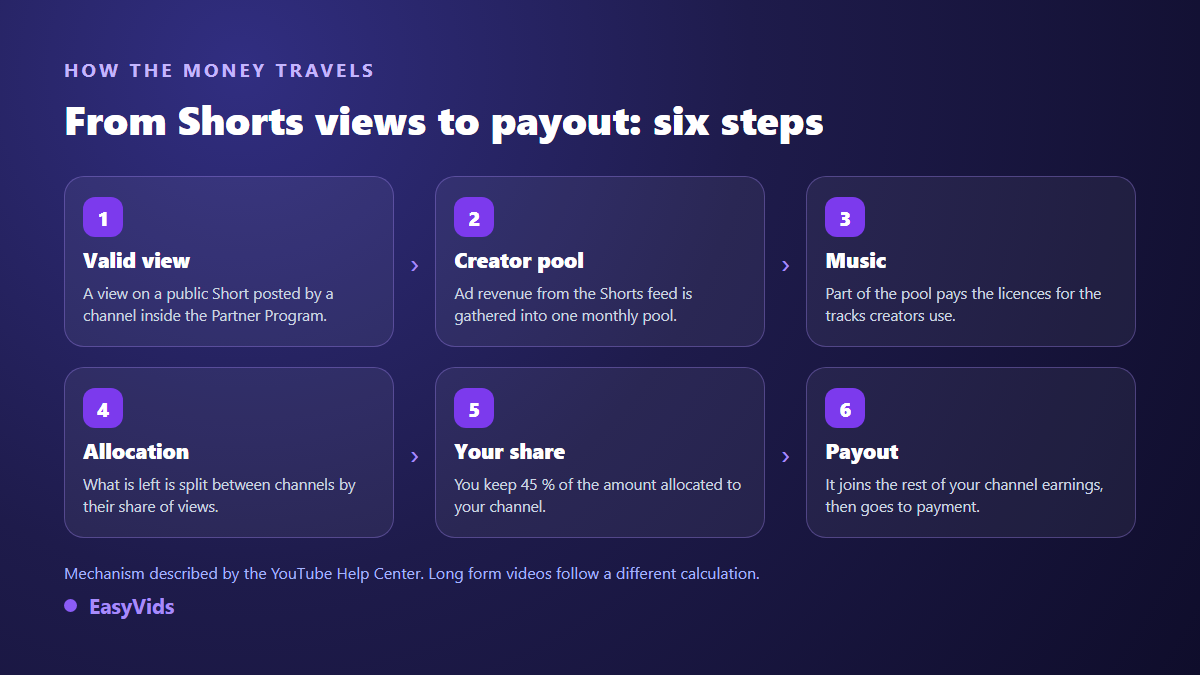
The practical consequence matters before you build a plan on it. Your earnings depend not only on your views, but on your views relative to every other monetizing creator that month. In a month when the whole platform surges, the same performance is mechanically worth slightly less. That is also why no per view earnings table you find online holds up: the value of a Shorts view is a ratio, not a constant.
Which Shorts actually count in revenue sharing
This is the heart of the matter, and the source of most disappointments. The Shorts monetization policies published in the YouTube Help Center reserve revenue sharing for views on original content, uploaded by the channel itself. A Short that reuses another creator's clip without real transformation, a compilation of clips assembled with nothing added, a recrop of a video found elsewhere: those views can inflate your public counter without ever entering the calculation.
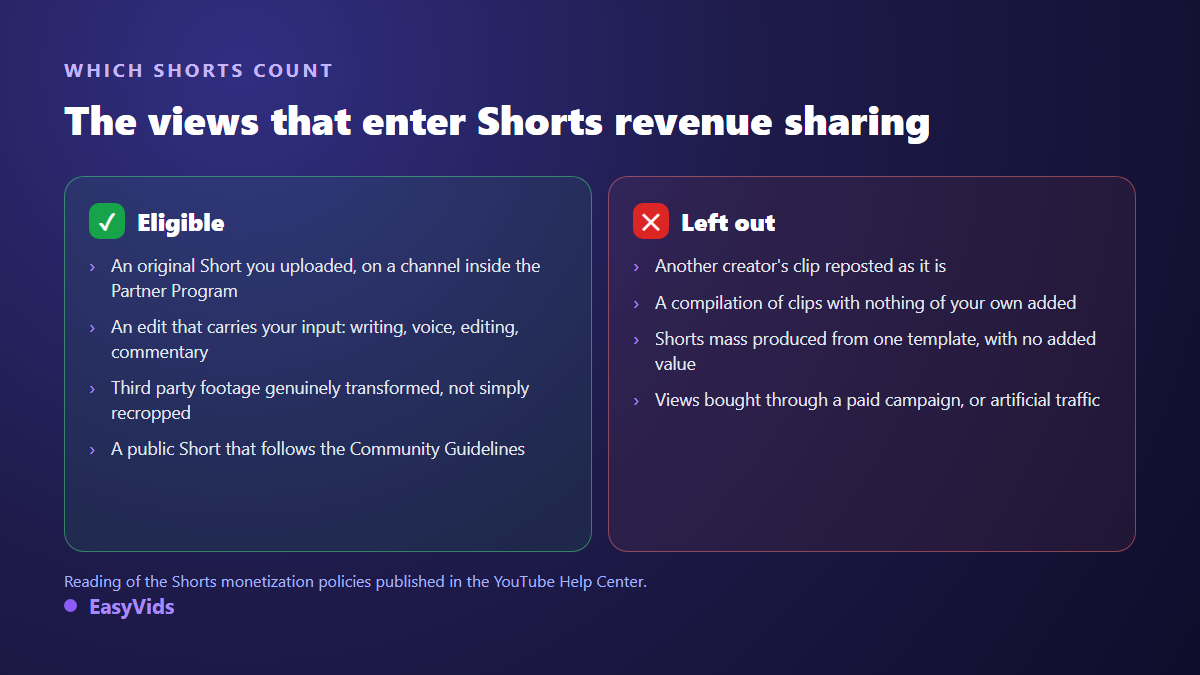
The word that keeps coming back in the documentation is original. It does not mean you must film everything yourself. It means the Short has to carry an identifiable contribution: your writing, your voice, your commentary, an edit that builds something new out of raw material. Third party footage genuinely reworked can stay eligible; the same clip merely reposted is not.
- Upload from your own channel: views on a Short re-uploaded from another account earn you nothing.
- Add a visible contribution in the first seconds: voice, on screen text, angle, editing.
- Keep the Short public: switching it to private or deleting it takes its views with it.
- Forget bought views: traffic from paid campaigns or artificial tools is stripped out of the calculation.
- Check each Short's monetization status in YouTube Studio instead of assuming it.
The rule on non original and mass produced content
Many creators mix up two separate things: whether a view is eligible for revenue sharing, and whether the channel complies with programme policy. The second sits at another level. According to the YouTube Help Center, the policy that used to target repetitious content became the inauthentic content policy in July 2025. It does not condemn the use of artificial intelligence as such, and the platform said so publicly at the time. It targets content mass produced from one template, and content simply lifted from elsewhere, in both cases with nothing of the creator's own.
That nuance decides everything for a Shorts channel, a format where mass production is a permanent temptation. Posting twenty Shorts a week is not a problem in itself; posting twenty interchangeable Shorts with the same structure, the same voice and the same background is. We mapped that line in our breakdown of the inauthentic content rule.
Shorts views and watch hours are two separate counters
Here is the point that costs diligent channels months. The YouTube Help Center says it plainly: time spent on your Shorts inside the Shorts feed does not feed the watch hour counter used for Partner Program eligibility. Shorts have their own route, measured in valid views over a rolling ninety day window.
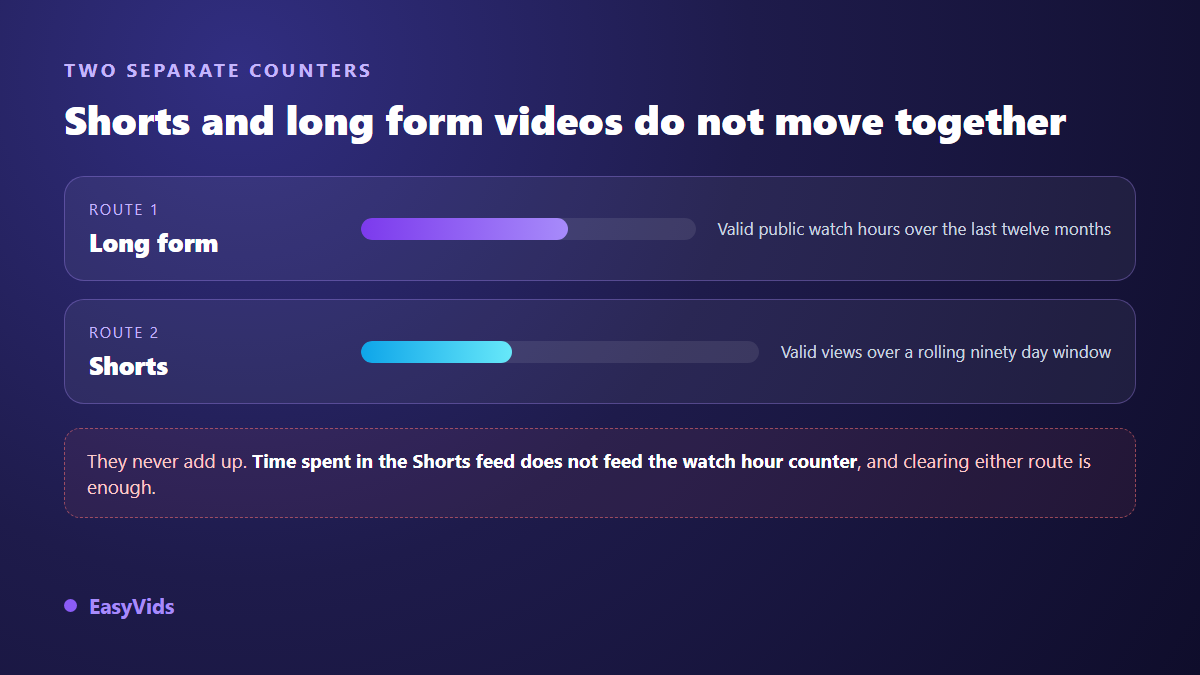
A channel that alternates evenly between both formats advances halfway on each counter, and takes far longer than a channel that picked its ground. The full conversion from watch hours into views sits in our analysis of the real payout threshold. The decision rule is simple: if your topic is told, the long route is safer; if it is shown in seconds, the Shorts route is faster, but it demands a pace few channels sustain.
Music: what it changes, and what it does not
Music holds a special place in this system, because it explains the pool structure. Licences for the tracks used in Shorts are paid out of that pool before allocation. The cost of music is spread across the platform instead of being charged to the creator who picked the song.
According to the YouTube Help Center, the creator's share stays the same whether licensed music was used or not. That is counter intuitive and worth knowing: adding a well known track to your Short does not shrink your percentage. What does create risk is a track used outside the catalogue YouTube provides, since a copyright claim can redirect the revenue to the rights holder. The safe rule fits in one line: use the built in library, or music you genuinely own the rights to.
Shorts income that never touches the pool
Reducing Shorts monetization to ad revenue sharing ignores half the subject. The YouTube Help Center describes several sources that do not depend on the pool: paid thanks from viewers, channel memberships, and, in countries where the programme is open, shopping affiliate links. That income often arrives earlier, and it does not suffer the monthly dilution described above.
Two more levers ignore thresholds entirely. Brand deals require no programme admission at all: a focused audience of a few thousand people already interests a specialist advertiser. And the Short itself can act as a door into a long form video, an email list or your own product. Creators who earn well from vertical video rarely treat it as an end in itself. The same logic applies elsewhere, as our look at what is monetizable in the TikTok rewards programme shows.
Producing enough original Shorts without losing your evenings
The short format sets a hard equation: the Shorts route runs on very high view volume, therefore on a high posting rate, while the policy demands an original contribution on every single video. Plenty of channels solve it by cutting corners on originality. That shortcut is what costs them monetization.
The other answer is to shorten production time without touching the contribution. That is exactly what an AI creation studio does: you keep the angle, the writing and the voice, the machine handles visuals, editing and captions. On EasyVids, the one shot mode turns a single written idea into an edited vertical video with voiceover, which suits the rhythm of a Shorts series. What each plan covers sits on the pricing page, with a free trial so you can measure the pace you can really hold.
What changes often, and how to check it yourself
Three parts of this subject have already changed several times: the Partner Program entry thresholds, the conditions attached to Shorts revenue sharing, and the wording of the non original content policy. They may change again. We deliberately left out of this page any announced figure we cannot verify at its official source, because an outdated threshold copied from blog to blog wastes more time than it saves.
Checking takes two minutes, in two places. The YouTube Help Center page on Partner Program eligibility gives the thresholds in force; the page on Shorts monetization policies gives the sharing conditions. Inside YouTube Studio, the Monetization tab shows your own counters, updated continuously, and flags Short by Short which videos were excluded. Trust those two sources over a screenshot passed around a forum.
Frequently asked questions
How much does one Shorts view pay?
No fixed value exists, and any page quoting one is wrong. A Shorts view does not pay directly: it buys you a share of a monthly pool split between all monetizing channels by their eligible view volume. The result depends on that month's ad revenue, on where your viewers are, and on how every other creator performed over the same period.
Do Shorts views count toward watch hours?
No. The YouTube Help Center excludes time spent on Shorts inside the Shorts feed from the watch hours used for Partner Program eligibility. Shorts feed a separate counter, measured in valid views over a rolling ninety day window. The two routes are alternatives, never cumulative.
Can an AI generated Short be monetized?
Yes. Using artificial intelligence is not banned by programme policy. What gets penalised, according to the YouTube Help Center, is content mass produced with no contribution of your own and content lifted from elsewhere, whatever the technique. A Short built on your angle, your script and your voice remains original content. The platform also asks creators to disclose realistic synthetic content that could mislead viewers.
Do you need music to earn from Shorts?
No, and it does not change your percentage. The YouTube Help Center states that the creator keeps the same share with or without licensed music, because licensing costs come out of the pool before allocation. The real risk lies elsewhere: a track used outside the catalogue can trigger a copyright claim and redirect the revenue.
Why are some of my Shorts not marked as monetizing?
Three causes come up most often. The Short reuses third party content without enough transformation, it breaks the advertiser friendly guidelines, or it is no longer public. YouTube Studio shows the monetization status video by video along with the reason, which is the only place that tells you exactly why. Check it before republishing a whole series built on the same template.
YouTube Shorts monetization rewards two things at once: a volume few creators reach alone, and an originality the platform checks video by video. Pick your route, read your counters in YouTube Studio this week, then set a pace you can hold for three months without dropping the editorial input. To produce that series without giving up your evenings, create your account and launch a first batch of Shorts with your angle and your voice.