You build your videos with AI, you post daily, the views are climbing. Then comes the question that decides everything: is AI-generated content allowed in TikTok Creator Rewards, or will the platform eventually shut the door? Confident opinions travel in both directions, usually built on a screenshot someone saw in a comment thread. The actual rules are written down, public, and far more nuanced than those opinions.
TikTok answers neither yes nor no. The platform separates AI used as a production tool from content that leaves a machine with no creative work applied to it. Your entire eligibility depends on which side of that line your videos land. The reasoning matches the other major video platform, and the YouTube monetisation rules for AI content show both houses converging on the same principle: what gets judged is human contribution, never the tool.
The short answer
According to the TikTok help centre, using AI does not by itself disqualify a video from the Creator Rewards Program. What disqualifies is content that is unoriginal, duplicated, recycled or published with no creative work. Three conditions stack up. Clear the entry thresholds. Publish videos over one minute that carry a real editorial intent. Label realistic content that was generated or altered by AI. A raw generation pushed out in bulk with no edit and no crafted voice falls on the wrong side. A video written, cut, narrated and edited with AI assistance stays eligible.
Creator Rewards: who can actually get in
The Creator Rewards Program is the mechanism that pays for views on TikTok. It replaced the older creator fund with a different logic: payout follows the quality of views and the time actually watched, not the raw counter. One change drives everything else. Only videos longer than one minute count toward rewards, which ended the bulk-published ultra-short format for this programme specifically.
Entry conditions sit on the TikTok help centre. They are identical for a phone-filmed channel and an AI-produced one. No separate door, no raised threshold, no extra observation period for generated content.
- Be an adult under the rules of your country of residence.
- Have at least 10,000 followers on a personal account.
- Have at least 100,000 video views across the last thirty days.
- Live in a country where the programme is open: the list stays narrow and changes, so the official page decides on the day you apply.
- Keep an account in good standing, with no active penalty for community guideline violations.
- Publish videos longer than one minute, the only format counted toward payout.
These thresholds are checked when you apply, then maintained afterwards. An account that stays below the bar loses access. None of it depends on how you produce your visuals: a creator who generates everything and a creator who films everything walk through the same door.
Where TikTok really draws the line
This is where it all plays out, and where creators get it wrong. TikTok publishes no rule saying AI videos cannot be monetised. It publishes a list of content types that do not qualify for rewards, and AI appears there in one specific shape only: content generated and posted as-is, with no editing and no added value.
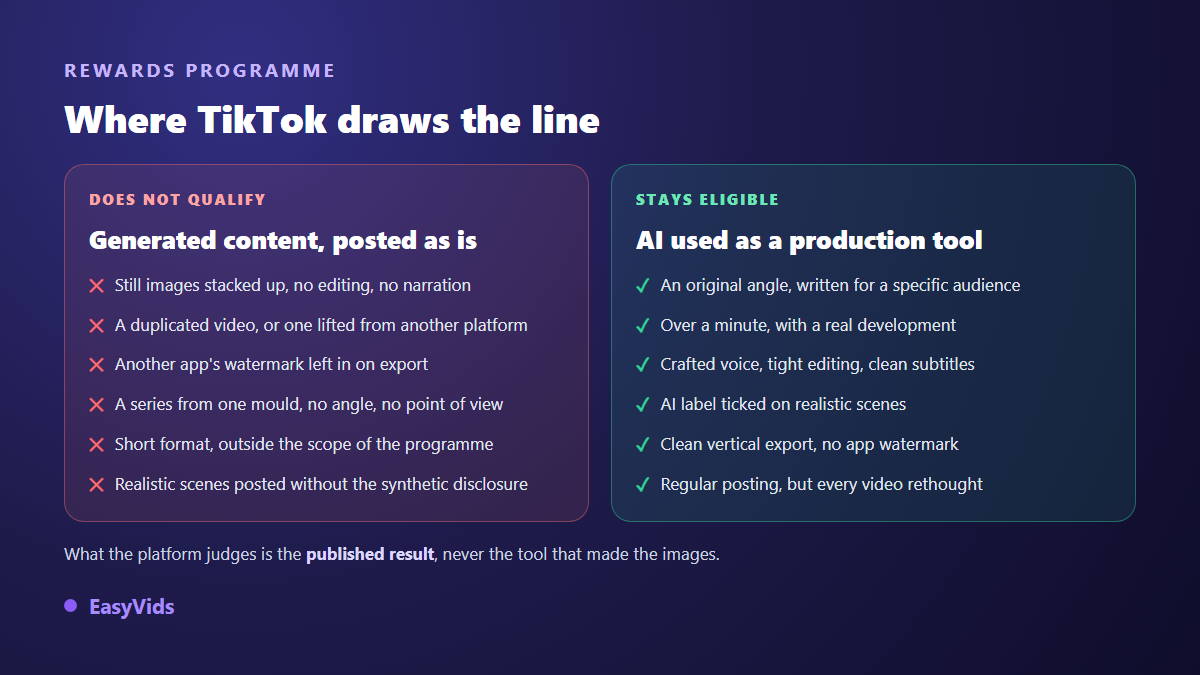
Put differently, AI is treated like a camera or an editing suite: a means. What faces the criteria is the result. An original narration illustrated with generated shots, carried by a crafted voice over and a paced edit, ticks the originality boxes. A stack of still images over royalty-free music, posted fifteen times a day, ticks none of them.
The categories TikTok excludes from rewards overlap heavily. Content duplicated from another platform, video carrying a rival app's watermark, slideshows of stills with no editing, blurry or low-resolution footage: all symptoms of the same missing work. That is the exact logic behind reused content and monetisation refusals, which hit automated channels long before generative AI arrived.
The AI-generated label: mandatory, and not a penalty
TikTok community guidelines require realistic AI-generated or AI-altered content to be disclosed. A scene that could pass for real footage, a synthetic face, a cloned voice: all of it needs the label. A clearly stylised cartoon or an obviously unreal backdrop does not sit in the same bucket, because no viewer risks mistaking it for reality.
Here is the part most creators miss: disclosure does not remove eligibility, it protects it. The problem case is realistic content published without a label, because it misleads viewers and becomes a guideline violation. And a violation is what actually pushes you out of the programme. Plenty of creators skip the toggle fearing a reach penalty, and end up taking the more expensive risk of the two.
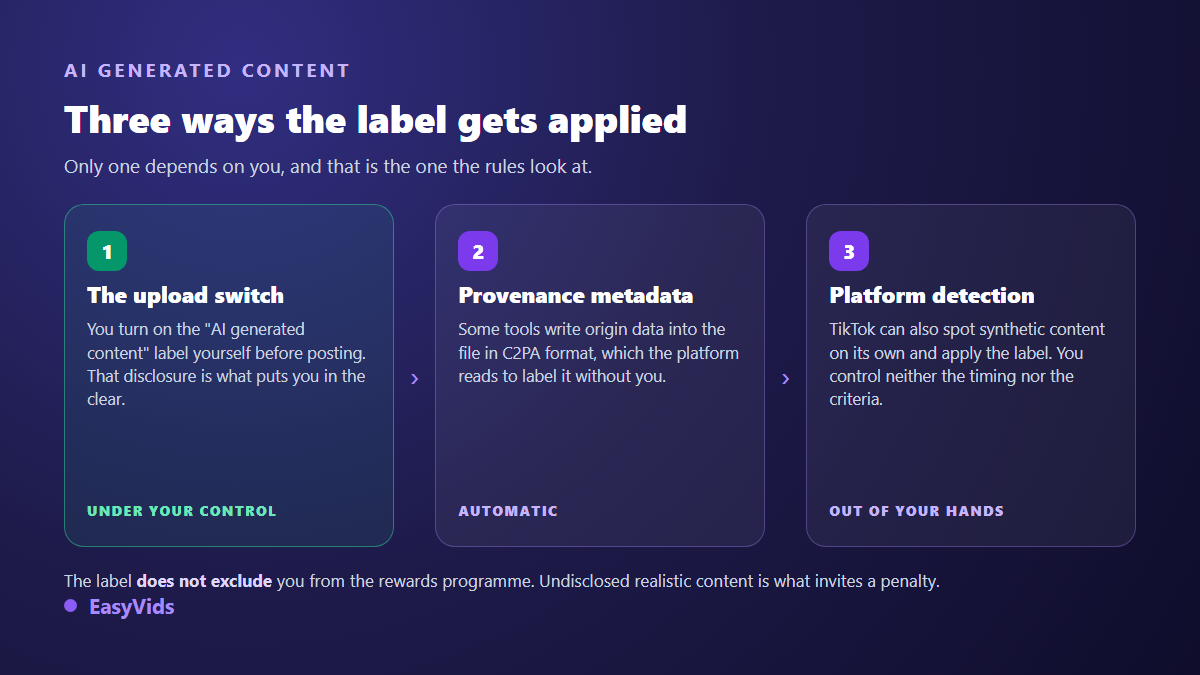
Three mechanisms run in parallel. The first is the manual toggle in the publishing options, which you switch on yourself: that is the one that keeps you compliant. The second is automatic. TikTok joined the C2PA coalition and reads Content Credentials, the provenance metadata some generation tools write into the file, to apply the label without you. The third is the platform's own detection, whose timing and criteria you do not control. Never rely on the last two: the disclosure remains your responsibility.
Other income streams, often easier to reach
Creator Rewards is not the only way to earn on TikTok, and for many creators it is not even the most profitable. The entry bar is high, the list of eligible countries stays limited, and payout tracks an audience that takes months to build. Other channels carry far less of that weight.
- Shop affiliate commissions: you feature a catalogue product and earn on attributed sales. The rules there concern commercial honesty and partnership disclosure, not the tool that produced the video.
- Brand partnerships: commercial content must be declared as such in the app, and AI labelling still applies. A brand buys an audience and a writing voice, never a camera.
- Outbound traffic: your own offer, your mailing list, your store. It is the least platform-dependent route, and the only one nobody can withdraw overnight.
- Live gifts: they assume a real presence during the stream and fit poorly with a fully automated channel.
These stack, and stacking them is the only sensible strategy. A single video can feed rewards, push an affiliate product and drive people toward your own offer. That is the approach behind our overview of serious ways to earn with AI, where cutting dependence on one platform sits at the top of the list.
How to make an AI video qualify
Here is the practical part: how to produce a video that meets the qualification criteria without giving up AI at any step. These six moves add a few minutes to production, and they separate a channel that gets paid from a channel that gets skipped.
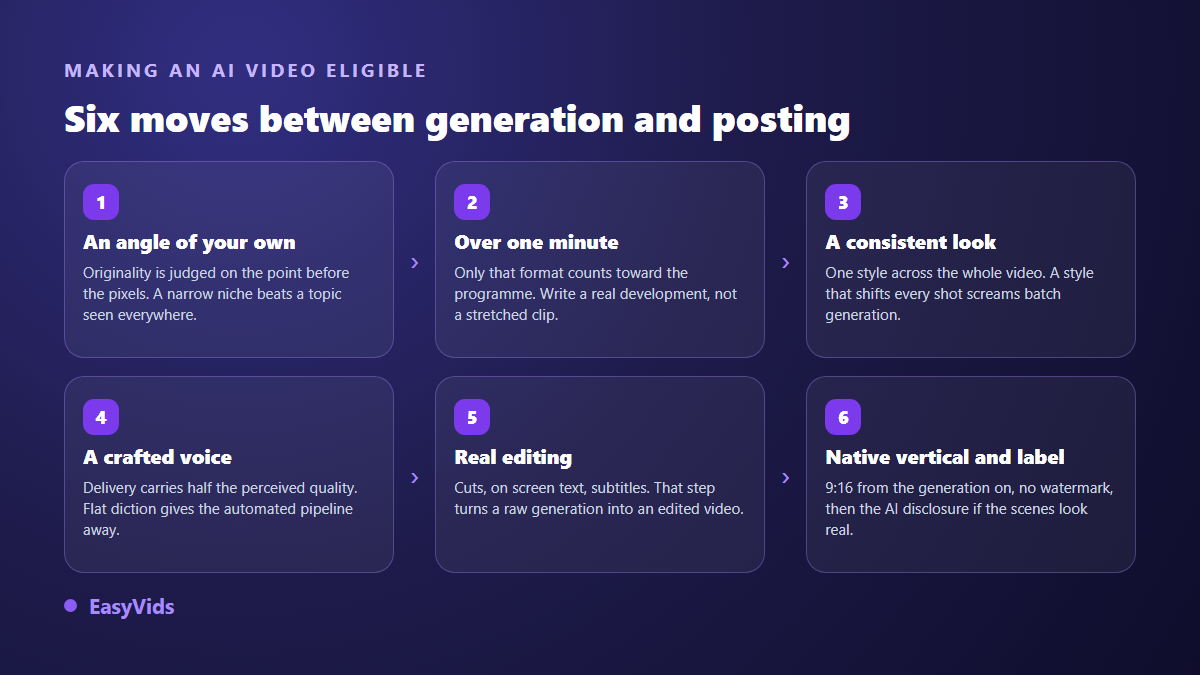
- Find an angle nobody else has. Originality is judged on the point first. A narrow niche taken seriously beats a topic seen everywhere, however good the visuals.
- Go long, with real development. Passing one minute is not stretching a fifteen-second clip, it is writing an idea that holds for the duration.
- Hold one visual direction throughout. A style that shifts every shot advertises bulk generation from a mile away.
- Work the voice over. It carries half the perceived quality. Flat delivery gives an automated channel away faster than an imperfect image.
- Actually edit. Cuts, on-screen text, captions, breathing room. This step is what turns a raw generation into an edited video.
- Publish vertical natively, watermark-free. The 9:16 frame is chosen at generation time, never by cropping later.
That last point deserves a note. A video produced in 16:9 and cropped afterwards loses its framing, leaves bars and signals content recycled from elsewhere. Aspect ratio is an upstream decision, and our method for turning a written idea into a TikTok video shows how to lock it at step one rather than at export.
Where the studio fits into that chain
Each of those six steps maps onto a concrete function. Instant generation builds a video from a single sentence, or animates a product photo, straight into vertical, with a choice of model, duration and resolution. The voice over is tuned through a reading style, which is exactly what prevents the mechanical delivery that gives automated channels away. The online editor then takes over: timeline editing, sounds, animated text, stickers, and a transcription that builds captions from the video's own audio.
Two details matter for monetisation. Exports carry no watermark, which removes one of the non-qualifying signals TikTok lists. And editing is not cosmetic here: it is the step that moves a raw generation into edited-content territory. To give speech some texture, word-by-word animated captions remain the highest return per minute spent. The EasyVids studio keeps those steps in one place, and the available plans open with a free trial.
Mistakes that cost eligibility
Accounts that lose access look remarkably alike. These are the recurring faults, roughly in order of frequency.
- Posting the same video across several accounts, or reusing content already seen elsewhere.
- Leaving another app's watermark on the exported file.
- Stacking still images with no editing and no narration: the platform files that format separately.
- Publishing only short videos while waiting for a payout that will not come.
- Skipping the AI label on realistic content, which risks a penalty far heavier than a reach dip.
- Shipping twenty videos a day from one template: mechanical repetition is precisely what the rule targets.
That last one surprises the most productive creators. The inauthentic content rule on the other major platform targets the very same behaviour, and what that rule changes for automated channels transposes line for line here. Mass production without a point of view is the real target. AI is only the tool that made it easy.
Frequently asked questions
Does TikTok ban AI-generated videos?
No. TikTok community guidelines allow AI-generated and AI-altered content, provided it follows the same rules as everything else and realistic scenes carry their label. The prohibitions target specific uses, such as misleading depictions of real people, not the technology itself.
Do I need the AI label if I only use a synthetic voice?
The requirement covers realistic content that could be taken for reality. A synthetic voice narrating a story over clearly illustrative visuals is not the same case as a voice imitating an identifiable person. When in doubt, switch it on: the label does not cost you monetisation, a violation does.
Can a video under one minute earn anything?
Not through Creator Rewards, which only counts videos longer than one minute. Short form still earns its keep for affiliate sales, brand deals or traffic to your own offer. Many channels run both formats side by side for exactly that reason.
Does the AI label reduce reach?
TikTok does not present the label as a recommendation signal, and we have seen no reliable public data establishing that it is. What decides reach is retention in the first seconds: a hook that stops the thumb weighs far more than a disclosure badge, and our hooks sorted by niche give you something to test on the next upload.
How long does it take to reach the thresholds with an AI channel?
No honest typical timeline exists, and be wary of anyone promising one. Channels that get there share three traits: a narrow niche, a steady posting rhythm, and a format held long enough for recommendation to find its audience. The cadence AI allows genuinely helps, as long as it does not replace editorial work. Publishing the wrong content faster only speeds up the failure.
The real question is not whether TikTok tolerates AI video, but whether yours gives a viewer something an anonymous generation cannot. An angle, a voice, an edit: three things that stay in your hands whatever model draws the pixels. To work that way without juggling five tools, create an account and build a first one-minute vertical video, script, voice over and edit included.