A theme has been sitting with you for weeks. A thanksgiving after a hard season, a verse that keeps returning, a choir working the same repertoire for three years. Writing an original worship song and actually hearing it sung used to mean a writer, a pianist, a choir and a studio. An AI gospel music generator removes that step: you describe the song already playing in your head, you rewrite the lyrics, and an audio file lands a few minutes later.
You still need to know what to ask for. The word gospel covers at least four musical families with different instruments, different tempos and different uses. Left without instructions, an engine decides for you, and it almost always lands on the same postcard gospel. This guide gives the method, descriptions you can paste as they are, and the honest limits of the exercise. How these tools work in general is covered in our guide to AI music generators; everything here is set on worship.
The short answer
Open the Music Studio and pick the Praise and gospel occasion. Then name the family you want, traditional gospel, contemporary worship, urban gospel or afro praise, rather than the bare word gospel. Add the choir, the lead voice, three instruments and a tempo. Have the lyrics written, read them out loud, fix the lines that will not sing, and start the composition. Allow one to four minutes of processing and you walk away with a downloadable MP3, named after the title you typed.
Gospel is four families, not one style
Asking for "a gospel track" is like ordering "a dish" in a restaurant. Something arrives, and it is not what you pictured. A four part choir over a Hammond organ and a slow piano led worship song carry the same label, but they do not serve the same moment, are not sung at the same point in a service, and do not sit under the same videos.
So settle that question before you write a single line: which family, for which moment. The answer then drives the tempo, the instruments, the place of the choir and even the length of the chorus. It costs thirty seconds and it shapes everything after it.
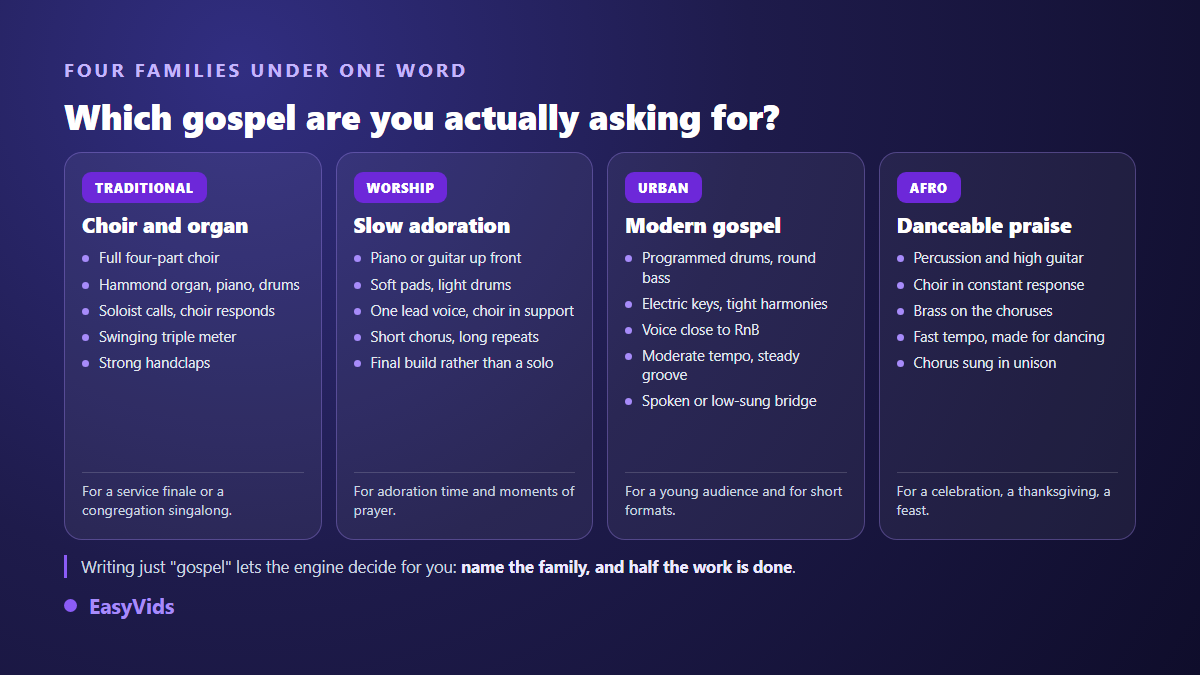
The studio offers Gospel among the one click styles, next to afrobeat, RnB, zouk and acoustic. The field stays open, and that is where precision is won: nothing stops you writing contemporary worship, urban gospel, traditional hymn or danceable afro praise when that is closer to the truth. The engine reads that text, not the label on the button.
The description that actually brings the choir in
Gospel is recognised by one thing above all others: the choir. A description that fails to mention it produces a decent ballad with a single voice, and you hear straight away that something is missing. Six building blocks are enough to frame the track, and they fit in one sentence.
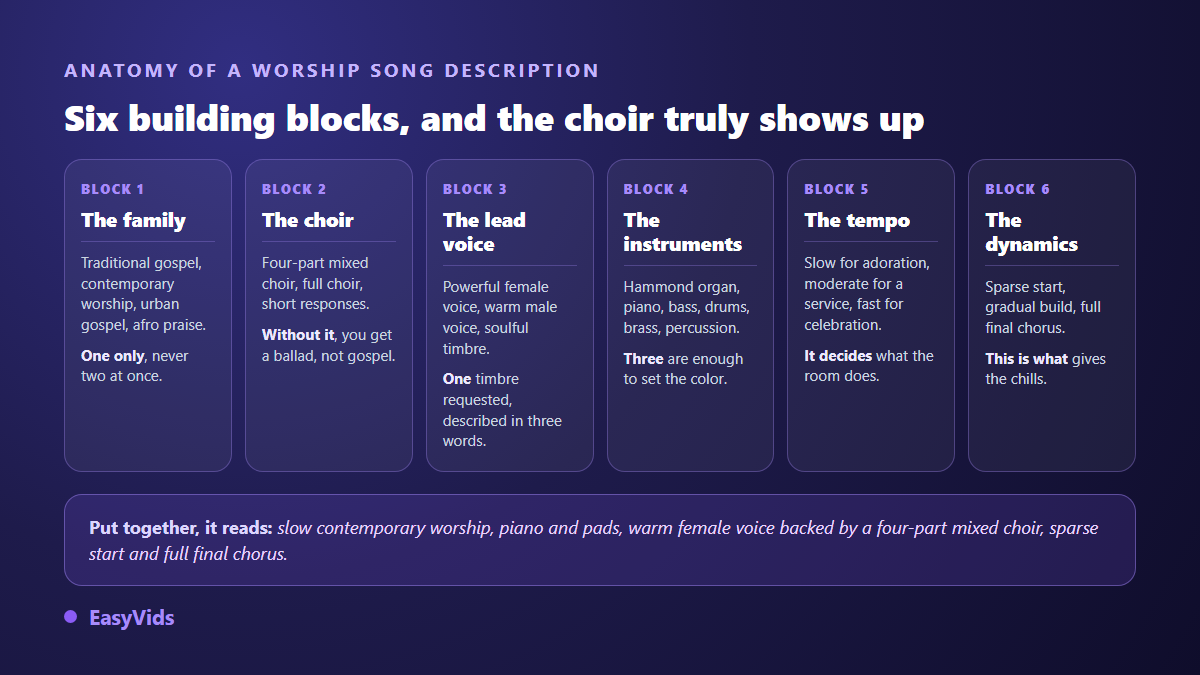
- The family. Traditional gospel, contemporary worship, urban gospel, afro praise. One only: an engine asked for two at once returns a lukewarm blend.
- The choir. Mixed four part choir, full choir, short answers behind the lead. Without this line the choir does not show up, or only by accident.
- The lead voice. Powerful female voice, deep warm male voice, lived in tone. Three words are enough, and one timbre at a time.
- The instruments. Hammond organ, piano, bass, drums, horns, percussion. Three names set the colour better than a list of eight.
- Tempo and metre. Slow for adoration, medium for a service, fast for celebration. Triple metre, that three beat sway, is the signature of traditional gospel.
- The dynamics. Bare opening, gradual build, full final chorus. It is the only block that produces goosebumps, and almost nobody writes it.
Two habits spoil the result faster than anything else. The first is stacking adjectives: powerful, moving, majestic, inspiring describe nothing musical and the engine treats them as noise. The second is asking in the negative. Writing no drums guarantees nothing; describing what you want instead, piano and voice only, works far better.
Nine prompts to copy, sorted by use
These are written to be pasted straight into the style field, then adjusted. Keep the one that gives you the best result: a personal library of three or four proven descriptions beats starting from scratch every time.
- Service opener. Joyful traditional gospel, Hammond organ, piano and drums, mixed four part choir answering the lead, hand claps, triple metre, medium tempo.
- Worship set. Slow contemporary worship, piano and synth pads, warm female voice, discreet choir in support, gradual build into the final chorus.
- Danceable thanksgiving. Fast afro praise, percussion, bright guitar, round bass, horns on the choruses, choir answering throughout, celebration mood.
- Younger audience. Medium tempo urban gospel, programmed drums, electric keys, round bass, RnB leaning vocal, tight harmonies, spoken low bridge.
- Song of comfort. Very slow gospel ballad, solo piano at the start, deep lived in male voice, discreet strings from the second verse, no drums.
- Instrumental meditation. Worship instrumental, soft piano and organ, slow tempo, long pads, reflective mood, no vocals.
- Channel theme. Short uplifting gospel instrumental, organ and drums, clean lift in the closing bars.
- Children's choir. Simple joyful worship, medium tempo, melody on few notes, children's choir in unison, piano and light percussion.
- Prayer vigil. Slow gospel in triple metre, Hammond organ, round bass, powerful female voice, full choir on the last chorus only.
Lyrics: one idea, not ten
One button asks the AI to write the lyrics from your brief. The text comes back structured, with bracketed section labels, a suggested title if you left that field empty, and a length calibrated for roughly one and a half to three minutes of singing. It is a starting point, never a finished text. Title and lyrics stay fully editable until you launch the composition.
A worship song written too fast rarely fails on language. It fails on stacking: grace, victory, light, deliverance and faithfulness in the same verse, and nothing lands any more. Give the writer a single idea, and make it concrete. Thank you for everything says nothing. The night I could not pray says something, and the rest of the song finds its axis around that line.
On scripture, one precaution saves trouble. Modern Bible translations are protected by their publisher's copyright, and the copyright page of those editions sets how many verses may be quoted without permission. An older translation in the public domain does not raise the question. Paraphrasing is safest: a song that restates a passage in your own words belongs to you, while one that copies a recent translation borrows a translator's work.
The chorus a room can sing back
A worship song is not a song people listen to, it is a song people join. So the test is simple: can a room that has never heard the track sing the chorus on second listen? Three rules cover it. Five to nine words, held in one breath. Few notes, in a range untrained voices reach without straining. And no variation: the chorus returns identical, because repetition is what installs it.
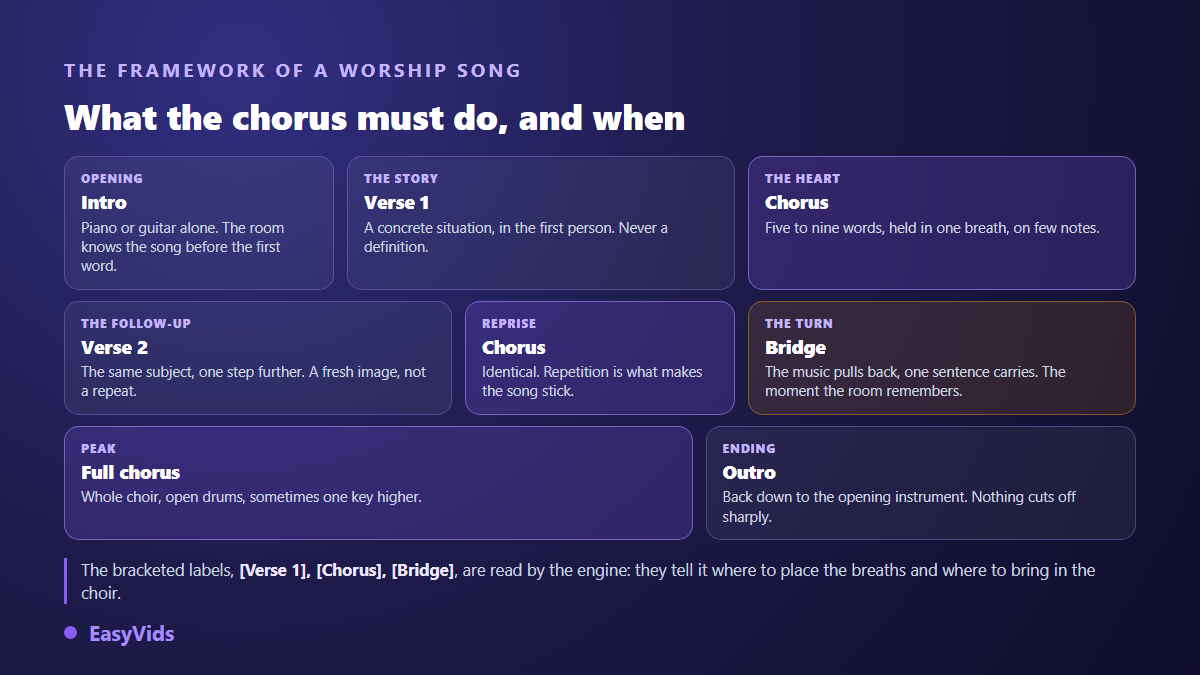
Those bracketed labels are not decoration. The composition engine reads them: they tell it where to breathe, where the choir comes in and where to lift. If you write your own lyrics, structure them the same way, with verse, chorus and bridge markers. The studio takes a fully hand written text and sings it as it stands, which is the right answer when someone in your community has already written the words and you only want to hear them in music.
Step by step in the Music Studio
The page runs through four numbered steps, and you can leave at any point: the composition keeps going on the server and you find it again when you return.
- Pick the Praise and gospel occasion from the dozen situations offered. It steers both the lyricist and the composition.
- Name the person or the congregation if the song is dedicated. A name entered here comes back in the chorus and in at least one verse.
- Write the message or the story in a line or two: the specific testimony, the circumstance, what you want to say. It is the only input no tool can invent.
- Describe the style with the six blocks, starting from one of the prompts above.
- Set the mood and the tempo. Solemn and slow for adoration, joyful and fast for celebration, moving and medium for a testimony.
- Have the lyrics written, then read them out loud. Lyrics are judged by ear: the line that runs long and the word that falls off the beat are audible instantly.
- Give it a title and compose. The title names the downloaded file and the history entry. A checkbox produces an instrumental version when you only need the music.
The page keeps a memory of your work. Finished songs stay playable and downloadable at the bottom of the screen, and lyrics already written reload in one click, with no new writing and no new charge. That is what lets you test several musical treatments on one text, a traditional take then a contemporary one, and choose afterwards. Cost is counted in credits and depends on the engine, the detail sits on the pricing page, and a failed generation is not charged. All of it lives alongside video, voice over and images inside the EasyVids creation studio.
What the model still handles badly
An honest article names the limits. The generated choir stays an ensemble sound: it does not improvise the shouts and call backs of a living choir, and a long run held on one syllable sometimes comes out blurred. Uncommon words, proper nouns and liturgical terms can be mispronounced. The fix takes ten seconds: respell the word phonetically inside the lyrics and compose again on the same text.
Second habit worth keeping: generate two or three versions rather than one. Two compositions from the same brief never sound quite alike, and the evening favourite is not always the morning one. Listen on a speaker, not only on headphones, especially if the song is heading for a room's sound system. For a song dedicated to one person, the mechanics of placing a name in the chorus are covered in our method for a personalised birthday song, and they apply word for word to a thanksgiving song.
Instrumentals: services, preaching and videos
A checkbox produces a track with no vocals, composed from the same brief. It is often the most useful version day to day. Under preaching, under a reading, behind a filmed testimony or during prayer, sung words compete with what is being said. A worship instrumental slides underneath without ever pulling attention. A short opening theme follows the same logic, and our method for composing a brand jingle explains how to hold a sound identity in a few seconds, which transposes directly to the opening of a worship broadcast. Two or three instrumentals kept for your own use are enough to build a sound signature: the same piano theme opening every video becomes recognisable within weeks. If you publish regularly, our guide to running a Christian YouTube channel shows how those tracks sit with narration and storytelling.
Rights, covers and transparency
Creating an original song removes the thorniest question, the cover. Adapting or re recording an existing hymn requires permission from the rights holders; many congregations cover that use through a blanket licence, the CCLI one for instance, whose principle is to authorise projection and performance of a declared catalogue. By composing something that did not exist, you are covering nothing.
On protecting what you create, the rule needs nuance. According to the report of the United States Copyright Office on the protection of works made with artificial intelligence, published in January 2025, a fully automatic output receives no protection, while the parts genuinely written by a human, your lyrics for example, remain protectable. A transparency duty comes on top: the European Union regulation on artificial intelligence, in its article 50, has required since 2 August 2026 that providers of systems producing synthetic audio mark those outputs in a machine readable format. If the song then goes to a public platform, our article on AI music and copyright sets out what to declare, and our guide to monetising AI music on YouTube explains what the claim systems check, comparing every upload against reference recordings supplied by rights holders according to the YouTube help centre.
Frequently asked questions
Can I get a real gospel choir rather than a single voice?
Yes, as long as you ask for it explicitly. Write mixed four part choir, full choir, or choir answering behind the lead, in the style field. Without that line the engine usually returns one accompanied voice, which gives you a ballad rather than a gospel track.
Do I need to sing or play an instrument?
No. Writing, voice and arrangement are all handled. Your job is to supply a true idea, choose the musical family and cut the lines that ring false. That is careful proofreading, not composing.
Can I write the lyrics myself and have them sung?
Yes. Paste your text into the lyrics box and compose: it is sung as it stands. Structure it with bracketed labels for verse, chorus and bridge so the engine knows where to breathe and where the choir enters.
Can we sing this at a Sunday service?
Nothing stands in the way on the rights side, since the song is original and borrows from no existing catalogue. Two practical precautions help: play it to the worship team a week ahead, and carry the file on a stick as well as a phone. Being open about how it was made is a community matter rather than a legal one, and saying so plainly avoids misunderstandings.
How long does a finished song take?
Around twenty minutes of actual work: five for the brief, ten to review and adjust the lyrics, one to four minutes of composition. If the song is tied to a date, start one or two weeks ahead so you have time to live with it and change your mind.
A worship song no longer needs an available choir, a booth or a studio budget. It needs a true idea, a musical family named clearly, a choir written into the description, and a chorus people can join without having learned it. To compose yours, create your account and open the Music Studio: the Praise and gospel occasion is waiting, with its field for the name and the testimony you want set to music.