You just generated a track you like. A birthday song with a name in the chorus, a pad to sit under a video, an instrumental to open a podcast. Then the question lands, and it stops a lot of creators right at the upload button: AI music copyright, who owns what, and what are you risking by putting that file online?
The answer rarely fits in one word, because two questions hide inside one. Being allowed to exploit a track is not the same as being its protected author. This guide separates them, names the texts and the bodies that actually decide, and sets out the habits we apply in our guide to AI generated music. One caveat first: this is general information, not legal advice, and a specific case belongs with a qualified lawyer in your jurisdiction.
The short answer
In the vast majority of cases, you may publish and commercially exploit a track you generated, because the tool's licence grants you that. What you do not automatically get is copyright you can enforce against others: several authorities hold that an output produced by prompting alone has no human author, so there is nothing to protect. Three limits sit on top, and they cover most disputes: do not reuse an existing work, do not imitate an identifiable artist's voice, and disclose the synthetic nature of the content when the platform asks for it.
A song is not one object: three rights stack up
This is where most misunderstandings start. The music industry never reasons about « a song », but about three distinct legal objects that can belong to three different people. Lyrics are a text. The composition is a musical work: melody, harmony, structure. The recording is something else again, what the trade calls the master, protected by neighbouring rights for the producer and the performers.
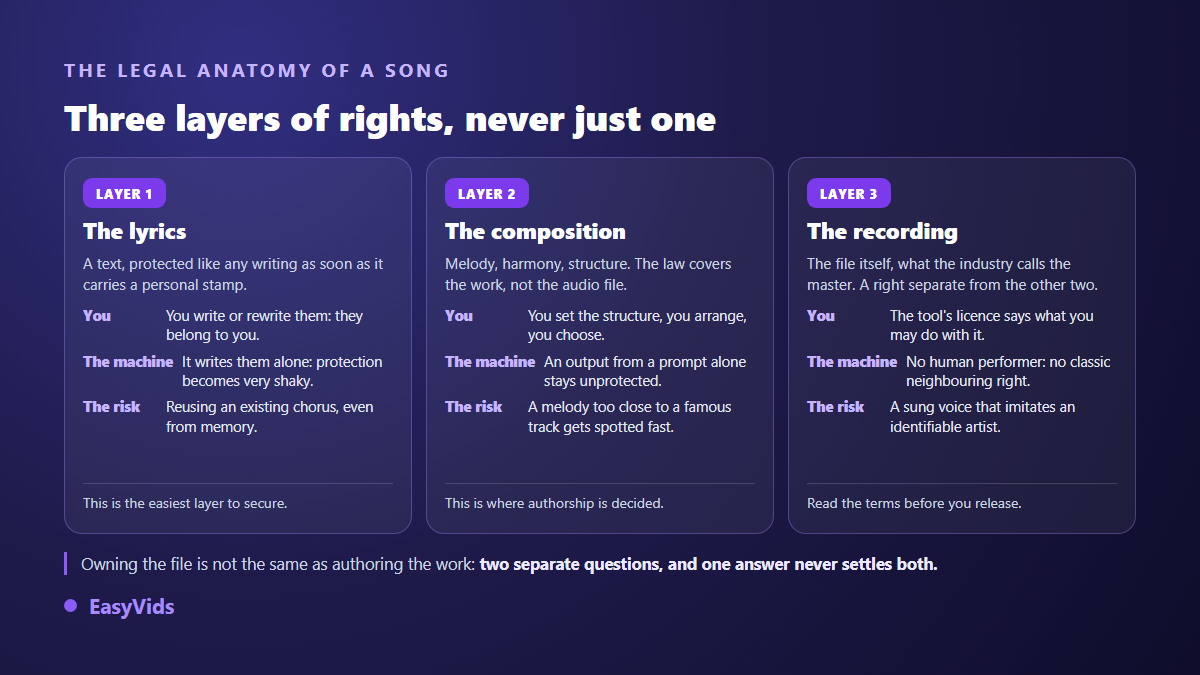
That split changes everything when a model is in the loop. Your lyrics, if you write or seriously rewrite them, stay your text and your property. The composition coming out of a machine runs into the human authorship question. And the audio file is not assigned to you by an author: it is licensed to you by a supplier. Three questions, three answers, never the same one.
Who is the author of a machine generated track
The point has been settled in several countries, and always the same way. On 29 January 2025 the United States Copyright Office published the second part of its report on copyright and artificial intelligence, dealing precisely with what can be protected. Its conclusion came in two parts: existing law is enough, an output obtained by prompting alone is not protectable, but an identifiable human contribution is, whether that is a text written by a person, a creative selection or arrangement, or edits made to the result. The federal courts had followed the same logic in March 2025 in Thaler v. Perlmutter: a work produced autonomously by a machine, with no human author, cannot be registered.
European law reaches the same place by a different road. Article L.112-1 of the French intellectual property code protects works of the mind whatever their genre or form of expression, and case law requires the work to carry the imprint of its author's personality. A personality implies a person. A file obtained by typing two lines of instruction does not carry one, and no European text has created automatic copyright over machine outputs.
The practical consequence is more encouraging than it sounds. The more of yourself goes into the track, the more defensible it becomes. Writing the lyrics, choosing and ordering the takes, re recording a vocal, arranging, mixing: each of those adds a human layer, and that layer is what copyright protects. Under the registration guidance the Copyright Office published on 16 March 2023, an application must in any case disclose the machine generated portion and describe the human contribution.
Your tool's licence is the one that matters day to day
Copyright answers the question « can I stop someone else from reusing my track? ». Your tool's licence answers the one you actually care about: « can I publish, monetise, sell this file? ». The service terms decide that, and they vary enormously between suppliers. The common trap fits in one line: many free tiers grant personal use only, with commercial exploitation arriving with a paid plan. Read that clause before you invoice anything, and check on the pricing page what your plan covers.
Our own rule sits in article 4 of our terms of service and it is short: the content you generate, music included, belongs to you within the limits of the rights granted by the underlying model providers, you may exploit it commercially, and EasyVids claims no ownership over your creations. We keep only the technical rights needed to host and display your files inside the service. Article 5 states the other side just as plainly: producing content that infringes third party rights is forbidden, and that covers copyright as much as image rights.
The real risk is resemblance, not the machine
An old copyright principle protects you more than you think: ideas and styles cannot be owned, only expression can. Asking for « a melancholic acoustic piano ballad at a slow tempo » harms nobody. Asking for « the same song as that title » or « in the style of that artist » moves you across the line, because you are then chasing an identifiable expression, and because a proper name in a prompt mechanically pushes the model towards imitation.
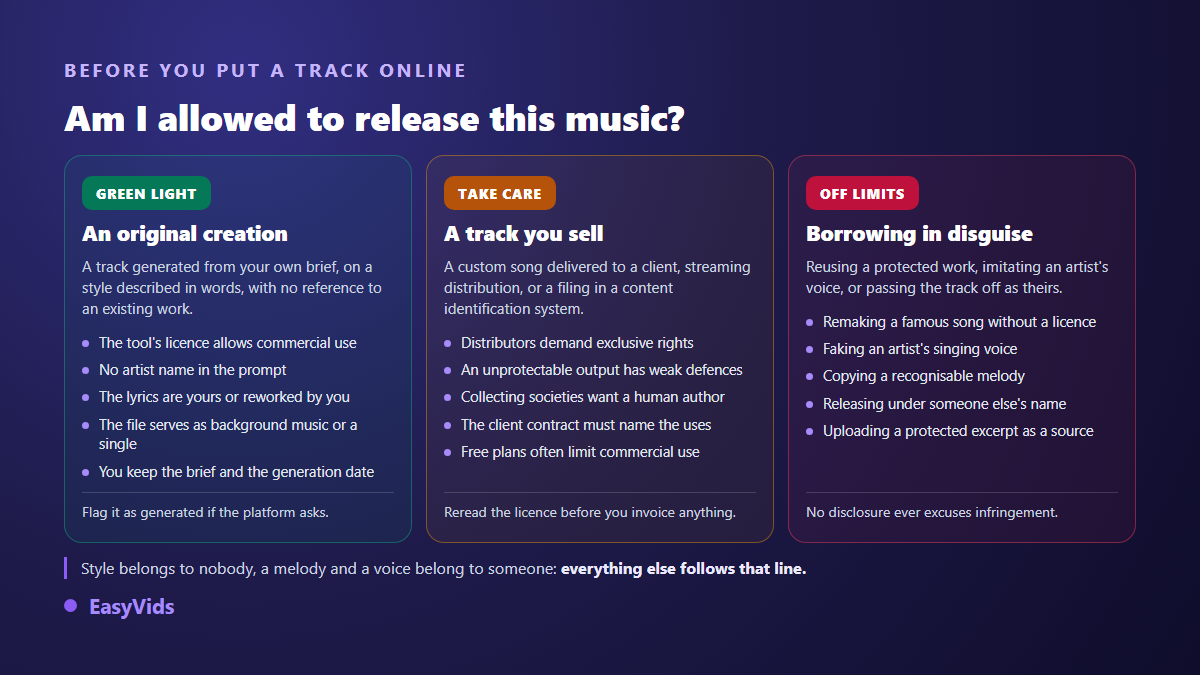
Sung vocals are the second sensitive point, and the most closely watched. A voice identifies a person, it carries commercial value, and platforms moved on it before legislators did. In November 2023 YouTube announced that its music industry partners would be able to request removal of content reproducing an artist's singing or rapping voice through artificial intelligence. The topic goes beyond music, and we handle it separately in our article on celebrity AI voices.
What platforms expect you to disclose
Above the law, every distribution service sets its own requirements, and they converge. The YouTube help centre asks creators to flag realistic content created or altered with synthetic tools at upload, through the altered content setting. TikTok requires a label on realistic AI generated content and applies it automatically when provenance markers are present in the file. The logic mirrors synthetic narration, covered in our analysis of voice cloning and consent rules: clearly artificial music that imitates nobody usually falls outside the duty, while anything that could pass for a genuine recording has to be flagged.
In music streaming the shift is recent and fast. In September 2025 Spotify announced three measures that work together: a policy against imitating an artist's voice, a filter aimed at mass uploads of artificial tracks, and the display of AI usage disclosures supplied by distributors through the DDEX industry standard. Deezer began labelling fully generated albums in its app during 2025. The survival rule when you publish across several channels: align on the strictest platform, never on the most permissive one.
- Disclose the track as generated content as soon as it could pass for a real recording.
- Never let an artist name, an existing title or a protected excerpt into your prompt.
- Check what the licence allows in paid advertising, which is often carved out separately.
- Keep the brief, the lyrics and the generation date: that is your evidence file.
- For a cover of an existing song, clear the licence before generating, never after.
- For a track delivered to a client, name the permitted uses, the media and the duration in the contract.
Monetising a generated track: what works and what blocks
Publishing a video with generated music and monetising it raises no issue of principle. YouTube Partner Programme rules target repetitive mass produced content with no contribution of its own, not the use of artificial intelligence as such. A soundtrack written for a specific project, with worked lyrics and a deliberate edit, sits well within the rules, exactly like the music under the images of a memory slideshow.
Three doors close faster than people expect. The first is automated content identification: the YouTube help centre reserves Content ID for owners of exclusive rights to a substantial body of original material, which a non protectable output does not give you. The second is streaming distribution: every distributor makes you warrant that you hold the rights to what you deliver, and that warranty turns against you if it is inaccurate. The third is registration with a collecting society, which splits royalties between authors, meaning between people. None of those three doors blocks the most common use, the short theme that opens every one of your videos: it works as a sound signature without ever being registered anywhere, and our guide to YouTube intro music covers how to compose one that is recognisable from the first notes.
Marking becomes mandatory in Europe on 2 August 2026
The European regulation on artificial intelligence, in force since 1 August 2024, adds a duty that lands directly on synthetic music. Its article 50 requires providers of systems producing artificial audio, images, video or text to mark those outputs in a machine readable format, and requires anyone deploying content that imitates a real person to inform the audience it is artificial. Those transparency obligations apply from 2 August 2026. For a creator, that means disclosure stops being an editorial choice and becomes one more box in the publishing routine.
The same regulation handles the other end of the chain, model training. Since 2 August 2025 its article 53 has required providers of general purpose models to run a policy for complying with Union copyright law, taking account of the rights reservation that article 4 of the 2019 directive on copyright in the digital single market allows rightsholders to express, and to publish a sufficiently detailed summary of the content used. SACEM, the French collecting society, announced in October 2023 that it was exercising that reservation across its entire repertoire. None of this is theoretical: the labels grouped in the Recording Industry Association of America filed suit in June 2024 against two music generation services, and several of those proceedings ended in licensing agreements in late 2025.
Five habits that make a release safe
A short method beats permanent anxiety. These habits take two minutes, get set up once, and cover most of what anyone publishing generated music runs into.
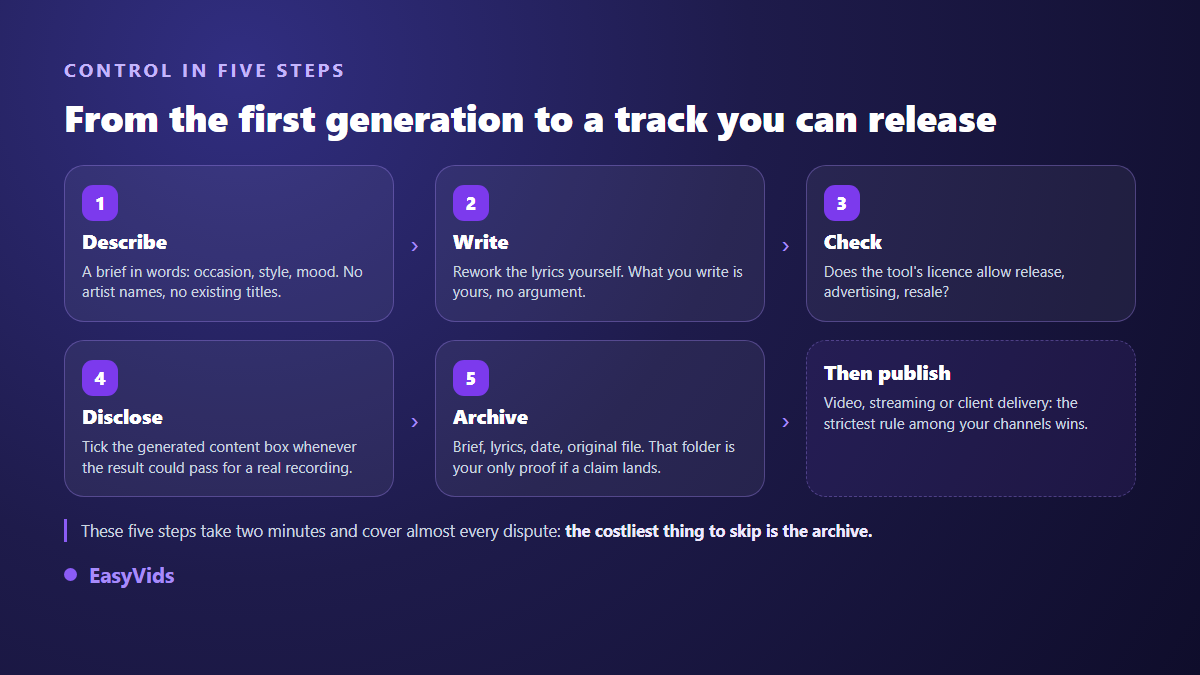
- Describe a style in words: instruments, tempo, mood, era. Never an artist name or a title.
- Rewrite the lyrics by hand, even lightly: what you write is unarguably yours.
- Read the commercial use clause of your tool before the first paid delivery.
- Listen back and ask whether it recalls a specific track, then regenerate at the slightest doubt.
- Disclose generated content wherever the platform provides for it, including when you hesitate.
- Archive the brief, the lyrics, the date and the original file with the project.
- On paid work, put the permitted uses, the media and the duration in writing.
What our music studio does, and what it does not
No tool checks on your behalf that you may publish what you generate, and ours is no exception. What the EasyVids creation studio brings is a flow that pushes you to the right side of the line. You start from an occasion picked among ten ready made ones, birthday, wedding, birth, tribute or dedication, from the name of the person being celebrated and a personal message, then from a genre and a mood described in words. At no point does the flow invite you to name an artist or an existing title, which removes the main risk factor up front.
The writing engine can draft the title and the lyrics from that brief, but both stay editable before the audio is generated, and that is the part that matters legally: lyrics you rewrite are a text of yours, a human layer the law recognises. Past drafts are kept and reload without a new charge, generation continues server side even if you close the page, and every finished track can be played then downloaded as an audio file with no sonic watermark. An instrumental mode covers video beds, where lyrics would only get in the way.
Frequently asked questions
Can I sell a song generated by AI?
Yes, if your tool's licence allows commercial use, which many free tiers reserve for paid plans. Sell a service, not exclusivity: you cannot promise that no similar track will ever exist, nor assign a copyright whose existence is not established. A clear contract on permitted uses is enough in practice.
Can AI generated music be monetised on YouTube?
Yes. Partner Programme rules target repetitive mass produced content with no contribution of its own, not the technology used. A video with a generated soundtrack stays monetisable as long as it gives the viewer something. Just remember the altered content disclosure when the result could pass for a genuine recording.
Can I register a generated track with a collecting society?
A collecting society splits royalties between authors, meaning between people. A track that came out of a machine with no identifiable human contribution has no author to declare. Lyrics you wrote, an arrangement you designed or a performance you recorded are human contributions, and those are what you describe. Ask the society directly before filing anything.
Am I allowed to ask for a track in the style of a famous artist?
That is the most common mistake, and it costs. A style cannot be owned, but a prompt naming a person pushes the model towards recognisable imitation, in the melody or in the voice. You then expose yourself to takedowns, to a claim from the artist and, on music services, to account termination. Describe the style in words, never with a name.
Do I have to say a track was generated by AI?
Yes wherever the platform provides for it, and the duty is spreading. YouTube and TikTok already require disclosure for realistic content, music streaming services display notices supplied by distributors, and the European AI regulation makes marking mandatory from 2 August 2026. The label does not penalise your content; its absence can get the content removed.
Hold on to the dividing line and the rest follows: your tool's licence decides what you may publish, copyright decides what you may defend, and the two never fully overlap. Describe a style rather than an artist, rewrite your lyrics, disclose what needs disclosing, keep your evidence filed. A doubt about a specific case gets settled before publication, not after. Creating an account opens the music studio so you can build your first personalised song, lyrics included, knowing exactly what you can do with it.