You made a track with a generator, it sounds good, and one question lands straight away: can you upload AI music to Spotify? Two wrong answers circulate. The first says the platform bans anything a machine produced. The second promises that pushing out hundreds of tracks turns into income. Neither describes what actually happens when a release goes into distribution.
Spotify does not sort music by how it was made. It penalises three specific behaviours, it expects a disclosure about the role of AI, and it applies the same payment rules to everyone. The rest is logistics: a file, metadata, a distributor, a stream counter. This guide follows that path from end to end. If your first question is what you are allowed to release at all, our piece on AI music and copyright covers the ground upstream of distribution.
The short answer
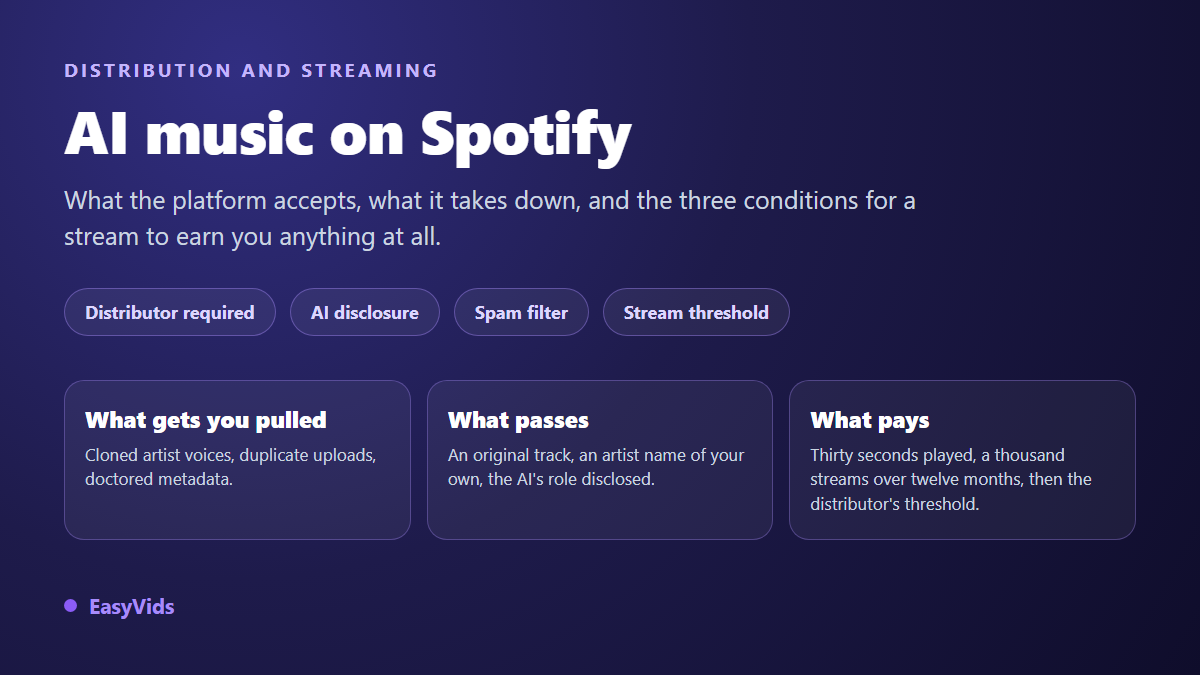
Yes, AI generated music can be released and monetised on Spotify. Three conditions frame the operation. You must go through a distributor, because the platform does not accept direct uploads from an artist account. You must not imitate the voice of a recognisable artist, flood the catalogue with near duplicates, or game your metadata. And you only get paid past a certain volume: a play counts as a stream after thirty seconds, and a track must reach a thousand streams over a rolling twelve month window to enter the recorded royalty pool, according to Spotify's support page on track monetisation eligibility.
Spotify judges behaviour, not tools
On 25 September 2025, Spotify published a set of measures dedicated to AI generated music. The text is clear on a point many summaries distorted: using AI is not treated as a fault in itself. Assisted composition tools have been standard in studios for years, and drawing a border between a software process and a generative model would make no sense across a global catalogue. What is targeted is a set of practices.
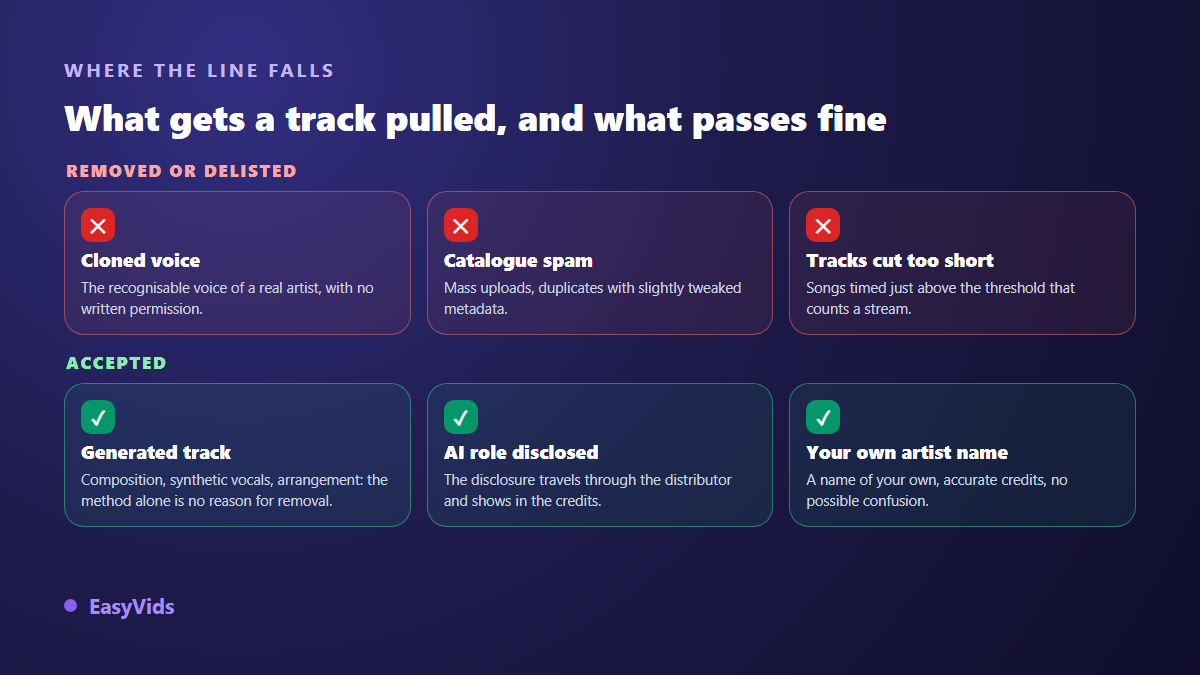
The first practice penalised is impersonation. Spotify's impersonation policy, reinforced on that occasion, covers tracks whose vocals are clearly recognisable as another artist's voice without documented consent. The removal does not hinge on your intention, nor on the word tribute dropped into the title. An unauthorised voice clone takes the track down, and a repeat offender loses the account behind it.
The second practice is industrialisation. Spotify runs a music spam filter that stops recommending tracks and uploaders showing certain patterns: mass uploads from one account, duplicates multiplied with barely altered metadata, keyword manipulation in the metadata fields, and tracks engineered to sit just above the minimum length of a countable stream. The platform said it had removed more than seventy five million tracks judged spammy over the twelve months preceding the announcement. A catalogue produced on an assembly line ticks several of those boxes mechanically, with no bad intent from its author.
Nobody uploads straight to Spotify
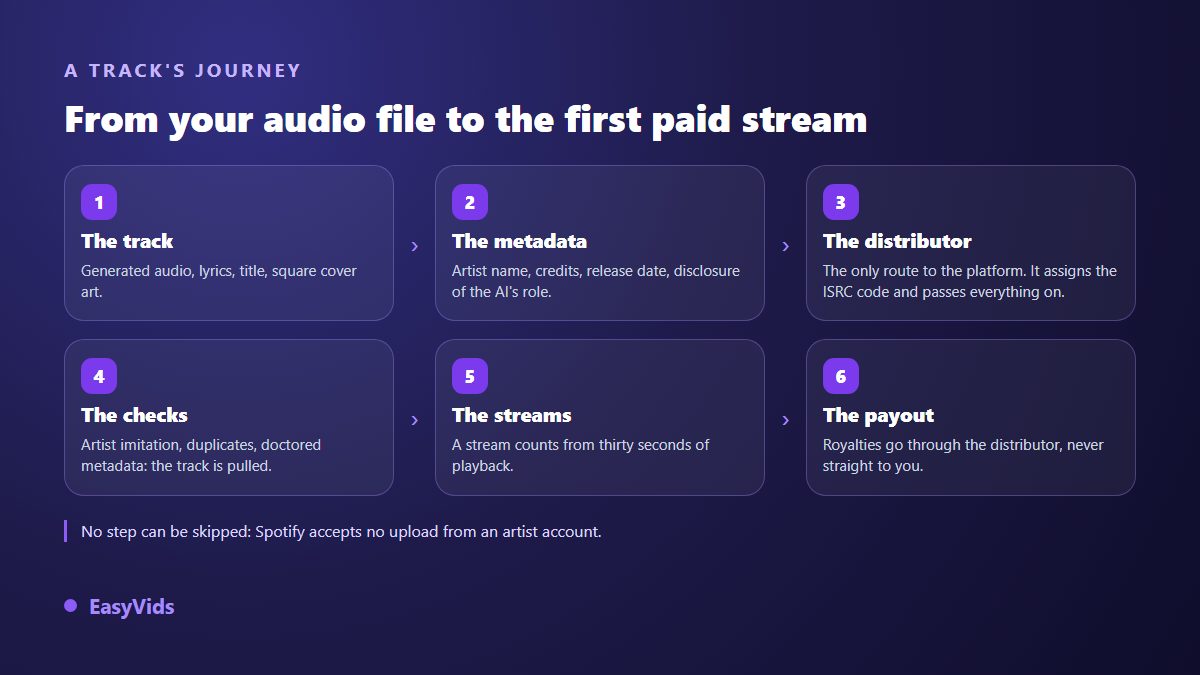
This is what most creators discover late, and it has nothing to do with AI. Spotify does not offer direct uploads to independent artists. The trial that allowed it closed in 2019, and since then the Spotify for Artists help pages point systematically to a distributor or a label. A distributor is a technical intermediary: it receives your file, your metadata and your artwork, formats them, delivers them to dozens of services, then collects royalties and pays them out to you.
That choice matters for a generated track. Some distributors accept AI assisted music without restriction, some require an explicit declaration, and some refuse high cadence catalogues outright. Read their terms before paying for an annual plan: a rejection after the fact costs time and a release date. This intermediary logic shows up in nearly every serious income stream built on AI, which we mapped in our overview of realistic ways to earn money with AI.
- File format: most distributors ask for high quality audio, often uncompressed. Check their help page and convert before uploading rather than discovering a rejection at delivery.
- Artwork: a square image with no platform logo, no web address and no promotional wording.
- ISRC code: your distributor assigns it, and it identifies the recording worldwide in any dispute.
- Artist name: pick one that is yours. A name too close to an existing artist causes merged profiles and claims.
- Release date: allow a few weeks ahead if you hope for editorial placement, because platform teams work far in advance.
AI disclosure in song credits: what changed in 2026
Spotify chose transparency over a punitive label. The platform worked with DDEX, the body that standardises data exchange between the music industry and streaming services, to define a field describing the role of AI in a recording. Since 16 April 2026, those credits appear in a track's information panel, provided the distributor passed the data through in its delivery.
Two features deserve your attention. The disclosure is granular: it separates vocals, instrumentation and post production treatment instead of a blunt yes or no. And it stays voluntary at the standard level, which does not make it optional for you. If the field stays empty because nobody filled it, no information travels and the release looks opaque. A false declaration, on the other hand, is grounds for removal. Spotify has also stated that disclosing AI use does not penalise a track in recommendations. Disclosing costs little and protects a lot.
In practice the box is ticked at upload, inside your distributor's interface. Several services, DistroKid, CD Baby, Amuse and Believe among them, were announced as partners in the rollout. If yours offers nothing of the kind, take note: it signals tooling that lags behind, and it leaves you exposed on every platform that adopts the same standard next.
The spam filter targets catalogues, not creators
A creator releasing a handful of carefully finished tracks has no reason to meet that filter. It catches volume behaviour. The trap with a generator is that volume costs almost nothing: fifty variants of the same song take one evening, and that ease pushes people towards exactly the patterns the platform wants out of the way.
- Releasing the same song under several titles, changing only the word order.
- Stuffing the artist name or the title with popular keywords to catch searches.
- Publishing runs of tracks barely over thirty seconds to multiply countable streams.
- Uploading dozens of titles on the same day, with no audience, no campaign and no artist page filled in.
- Copying the structure and melody of a hit in the hope of riding its search traffic.
A slow, identifiable project crosses those checks without ever noticing them. One artist name, a sound direction held over time, consistent artwork, a steady release rhythm: the same signals that other platforms reward, where consistency outweighs quantity, as our analysis of monetisation rules applied to AI content shows.
How you actually get paid
Three gates stand between a listener and money in your account, and they close independently. The first is duration. A play only becomes a countable stream after thirty seconds. That rule has a direct consequence on how a generated track should be written: a forty second instrumental intro loses you whole streams, because a hesitant listener skips before the threshold. On a track built for streaming, the vocal or the main motif has to arrive early.
The second gate is eligibility. Since 2024, a track must have reached at least a thousand streams over the previous twelve months to enter the recorded royalty pool, according to Spotify's support page on track monetisation eligibility. The track stays online, stays playable and can still be added to playlists: it simply generates nothing until the bar is crossed. That rule, designed against dilution by millions of dormant tracks, hits hastily generated catalogues hardest.
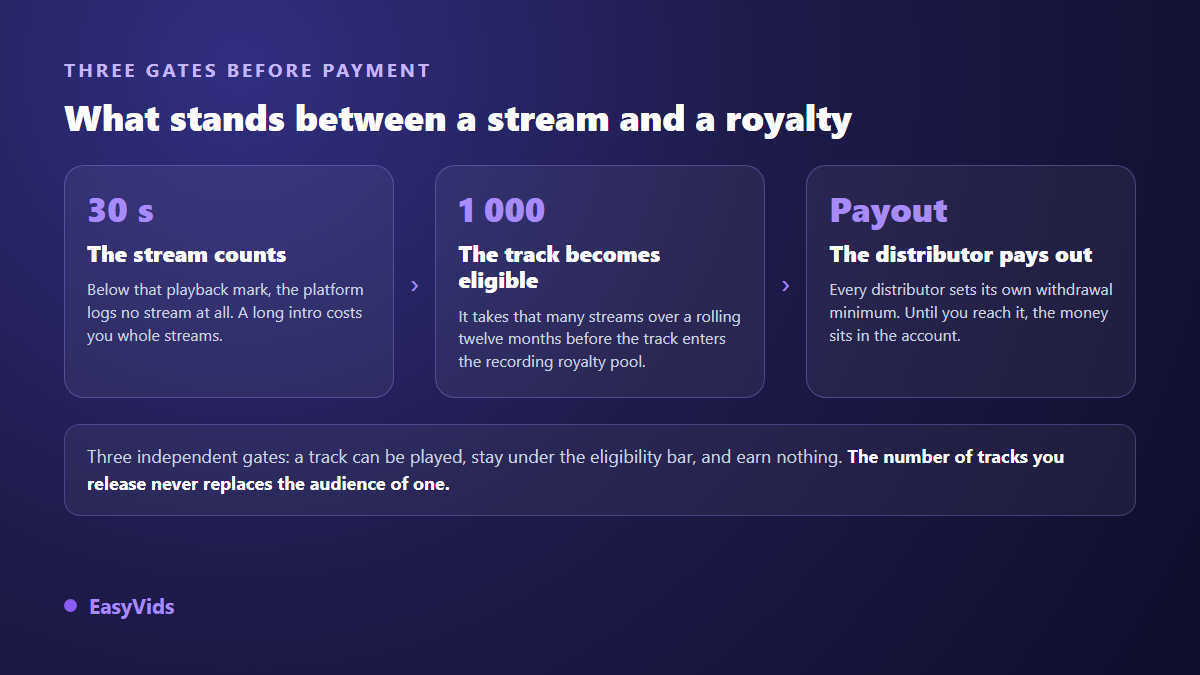
The third gate is your distributor. It collects the money, takes its share according to its model, then applies its own payout minimum. Until that minimum is reached, the balance sits in your account with them. Compare this alongside the commission before committing: two distributors can advertise near identical terms and pay out at very different rhythms.
Preparing a generated track before you send it
A file that comes out of a generator is not yet a distributable product. A few habits close the gap, and none of them requires studio skills. Order matters: each step prevents either a rejection at delivery or a flat performance once the track is live.
- Listen to the whole track on headphones, then on a small speaker. Generators sometimes produce an abrupt ending or a swallowed syllable.
- Trim whatever drags at the start. A song that gets going within five seconds clears the thirty second bar far more often.
- Read the lyrics word by word. A model can sing a distorted name or slip in a phrase that means nothing.
- Convert to the format your distributor asks for, without adding another compression pass.
- Fill in the AI disclosure even when the service does not require it.
- Keep a trail of your work: brief, lyrics, successive versions, dates. That is what answers a claim.
What the EasyVids music studio gives you
The EasyVids creation studio includes a space dedicated to songs. You pick an occasion from around ten ready made situations or describe your own, add a name and a message when the song is dedicated, then choose a genre, a mood and a tempo. Lyrics can be written by the writing engine and stay fully editable before composition. One option produces a purely instrumental piece. The delivered file is an MP3 at 44.1 kHz, downloadable directly, and the history keeps both your songs and your lyrics so you can pick them up later.
Two honest caveats. Composition runs on our servers, so you can close the page and find the track waiting on your return. Article 4 of our terms of use leaves you ownership of what you generate, with commercial usage rights, within the limits granted by the underlying model providers. We are not a distributor, though: putting a release on streaming services goes through the provider of your choice. How credits work and which plans exist are set out on the pricing page.
Streaming alone is rarely enough
One closing note on income. The eligibility threshold, the share passed on and competition from a global catalogue make streaming a slow revenue stream that rewards audience far more than output. Creators who genuinely live off generated music treat it as one brick among several: sound beds for video, custom songs on request, brand licensing, content for their own channels. Video remains the best engine for streams, and our guide to monetising AI music on YouTube shows how the two channels feed each other.
Frequently asked questions
Does Spotify remove AI generated tracks?
Not for being generated. Removals happen for impersonating an artist's voice, for spam behaviour, or for a false disclosure. An original track released under your own name and correctly declared stays online like any other recording.
Can you upload to Spotify without a distributor?
No. The platform does not open direct uploads to independent artists, according to the Spotify for Artists help pages. You go through a distributor or a label, which delivers the file and the metadata, then handles collection and payout.
Do you have to disclose that a song was made with AI?
It is strongly advised, and it happens at your distributor, in the field defined by the DDEX standard. Spotify has been showing that information in song credits since April 2026 and says it does not penalise reach. An empty field blocks nothing mechanically, but a false declaration is grounds for removal.
How many streams before you earn anything?
A track needs at least a thousand streams over a rolling twelve month window to enter the recorded royalty pool. Your distributor then applies its own payout threshold before releasing anything to you. Two successive barriers, crossed at different times.
Can you release a generated instrumental on Spotify?
Yes, and the case is simpler: with no vocals, the impersonation question disappears. Delivery, disclosure and payment rules stay identical. Just avoid runs of very short instrumentals released back to back, which look exactly like the profile the spam filter is built to catch.
Releasing music on a streaming service asks for fewer permissions than people assume, and far more care than they expect. One finished track, an artist name of your own, an honest disclosure and a distributor chosen deliberately beat fifty titles pushed out in a rush. To compose that first track and download it ready to send, create an account and start a song from the music studio. What happens next depends on audience, not on volume.