You are editing a video, you need a background track, and you search for royalty free AI music because the phrase sounds safe. An hour later you have four downloaded files, two pages of contradictory terms, and no clear answer on whether you can publish on a monetised channel, let alone run the video as a paid ad.
The confusion is not your fault. Royalty free is a commercial shorthand describing how you pay, not a legal status. A track can carry that label and still forbid resale, client work or theatrical release. Another can be paid and allow everything. This guide takes the label apart, lists what you are actually allowed to do, and shows where generated music changes the equation. If the subject is new to you, our guide to AI music generation explains how a track is built in the first place.
The short answer
Royalty-free music is music whose licence lets you broadcast without paying a fee for every play. It is still protected by copyright, and your freedom stops exactly where the licence stops. Music you generate yourself moves the problem rather than removing it: there is no catalogue to interrogate, but two things to check, what the tool's terms grant you, and what your destination platform demands. At EasyVids, article 4 of the terms of use settles the first point: content you generate belongs to you, within the limits of the rights granted by the underlying model providers, and you may use it commercially.
Royalty free does not mean free of rights
A royalty is the fee paid to an author each time a work is exploited: every radio play, every broadcast, every copy sold. A royalty-free licence removes that recurring fee, and nothing else. The author keeps their rights, the work stays protected, and what you buy is a defined right of use.
Three labels get mixed up constantly, and price tells you nothing about any of them. A free track can be far more restrictive than a paid one.
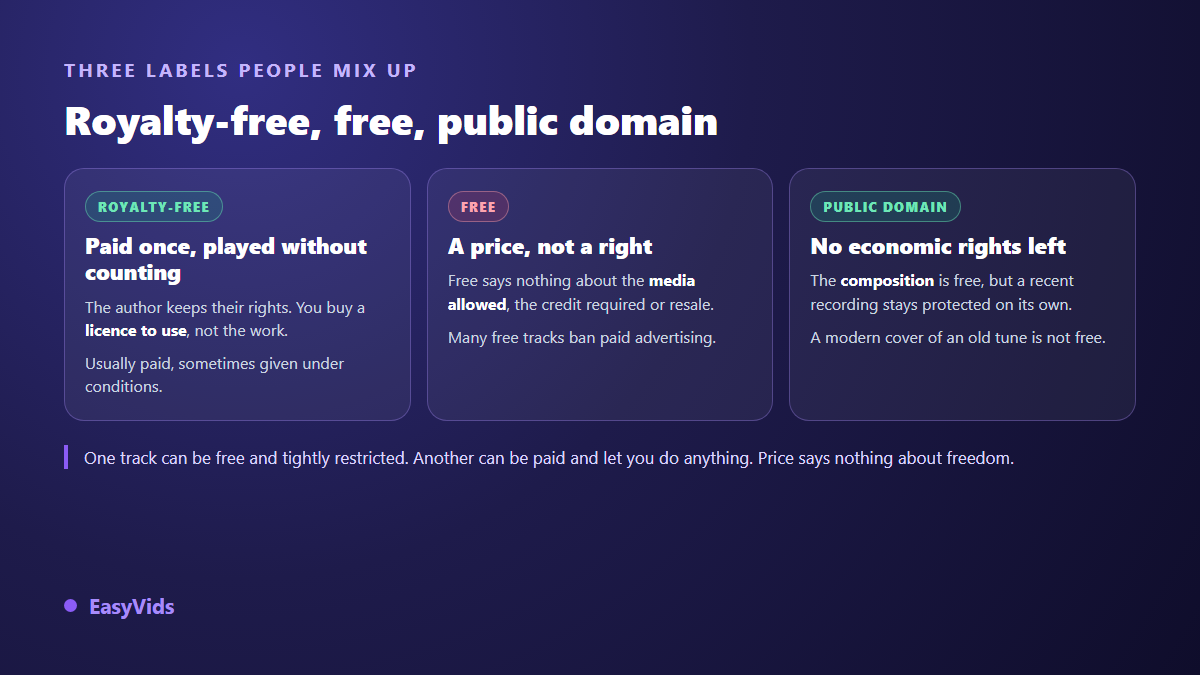
Public domain deserves an extra warning. In the European Union, the term directive sets copyright on a composition at seventy years after the author's death. Once that period ends the score is free, but the modern recording you found online carries its own neighbouring rights. Using an old melody never entitles you to use any recording of it.
Four questions that decide your freedom of use
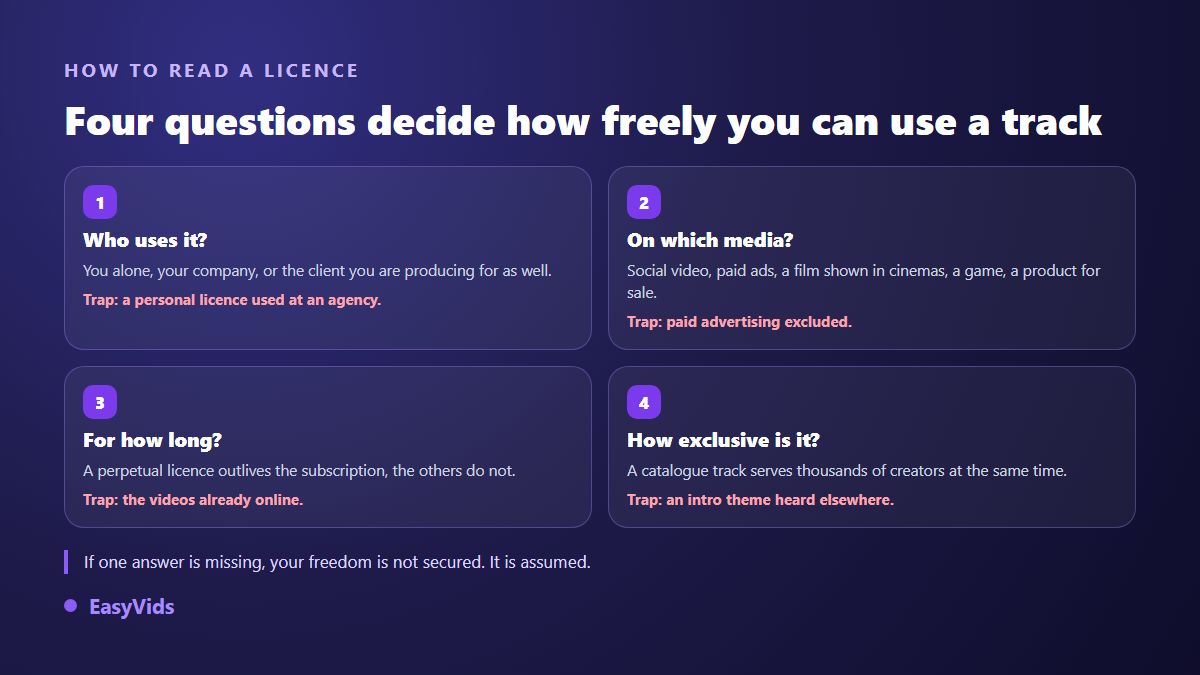
Rather than hunting for a magic phrase in a terms page, ask any track four questions. If you cannot find all four answers in writing, your freedom is assumed rather than granted.
- Who exploits the track? You personally, your company, or the end client you produce for. A personal licence used inside a paid client project is the most common agency mistake.
- On which media? Social video, paid advertising, theatrical release, a game, a product you sell. Many licences allow the first and exclude the rest.
- For how long? A perpetual licence outlives your subscription. A subscription-bound licence ends with it, including for videos already online.
- With what exclusivity? A catalogue track is licensed to thousands of creators at once. That is not a flaw, unless you are building a sound signature.
- With what obligations? Required credit in the description, no editing of the track, no registration in a fingerprinting system: read those clauses before, not after.
Trap one: the licence that dies with the subscription
This is the expensive one, because it triggers months later. Many libraries grant a licence for as long as your subscription runs. You publish thirty videos over a quarter, you cancel, and those thirty videos are technically unlicensed. Some offers include a survival clause covering already published content. Others do not. The difference sits in a paragraph nobody reads at signup.
The useful habit is to keep a dated copy of the licence text at download time, not just a link to the page. Terms change and pages get rewritten. When you generate your own tracks the question does not vanish: read the tool's terms and check what happens to your creations if you leave. Ours are public, and the plans are on the pricing page.
Trap two: the track ten thousand creators already use
A non-exclusive licence is perfectly legal and increasingly uncomfortable as your brand grows. The best ranked tracks in large libraries run on thousands of channels. Your viewer will not name the track, but will have the vague feeling of having seen your video before. For one-off content that costs nothing. For a sound identity it is a wall, and a channel intro or a brand jingle exists precisely to be recognised within three seconds.
Trap three: the automatic claim
A properly licensed track can still trigger an automatic claim, because fingerprinting systems compare acoustic signals and read no contracts. According to the YouTube help centre, a Content ID claim is not a copyright strike: it affects monetisation or availability, and it can be disputed from YouTube Studio by stating your reason and providing proof of your rights. That is exactly where a dated licence copy, or the generation record of your own track, earns its keep. We covered the full procedure in our guide to monetising AI music on YouTube.
What generating your own music actually changes
Generating from your own brief removes three uncertainties at once: no third-party licence to interpret, no involuntary sharing with ten thousand channels, no mandatory credit line in your descriptions. Above all you regain something libraries never offer: control over the commission. You set the genre, the mood and the tempo, and you rebuild a version when the first one does not sit on the picture.
One honest caveat. Being able to exploit a track does not mean you can stop someone else from using something similar. According to the guidance published in March 2023 by the United States Copyright Office, confirmed by part two of its artificial intelligence report in January 2025, output produced by a machine without sufficient human authorship is not registrable: only the elements a person genuinely authored are. Writing your own lyrics and directing the production is therefore not just an artistic gesture, it is what gives protection something to hold on to. The full breakdown sits in our article on AI music and copyright.
What the Music Studio does, and what it does not
The EasyVids Music Studio composes from a short brief. You pick an occasion among a dozen ready-made situations or describe your own, add a first name and a message when the song is dedicated, then set the style, the mood and the tempo. Lyrics can be written by the writing engine, billed in credits, and stay editable word by word before composition. An instrumental checkbox produces a track without vocals, which is what a background bed needs.
- Production runs server side: you can close the tab and the track waits for you.
- Every finished song arrives as a downloadable MP3 file, named after the title you gave it.
- History keeps your past songs and written lyrics with their dates: that is your record of authorship.
- Lyrics reload from history in one click, with no new charge, so you can produce a variant.
- The online editor also ships an in-house sound library, useful for transitions and short musical stings.
What it does not do matters too. It issues no named licence certificate, guarantees no worldwide exclusivity on a track, and registers nothing on your behalf with a collecting society or a fingerprinting database. Your safety rests on the terms of use, on the dated history of your generations, and on the checks below.
Five checks before you publish
The list takes a few minutes and prevents almost every unpleasant surprise. Apply it to any track, generated or downloaded.
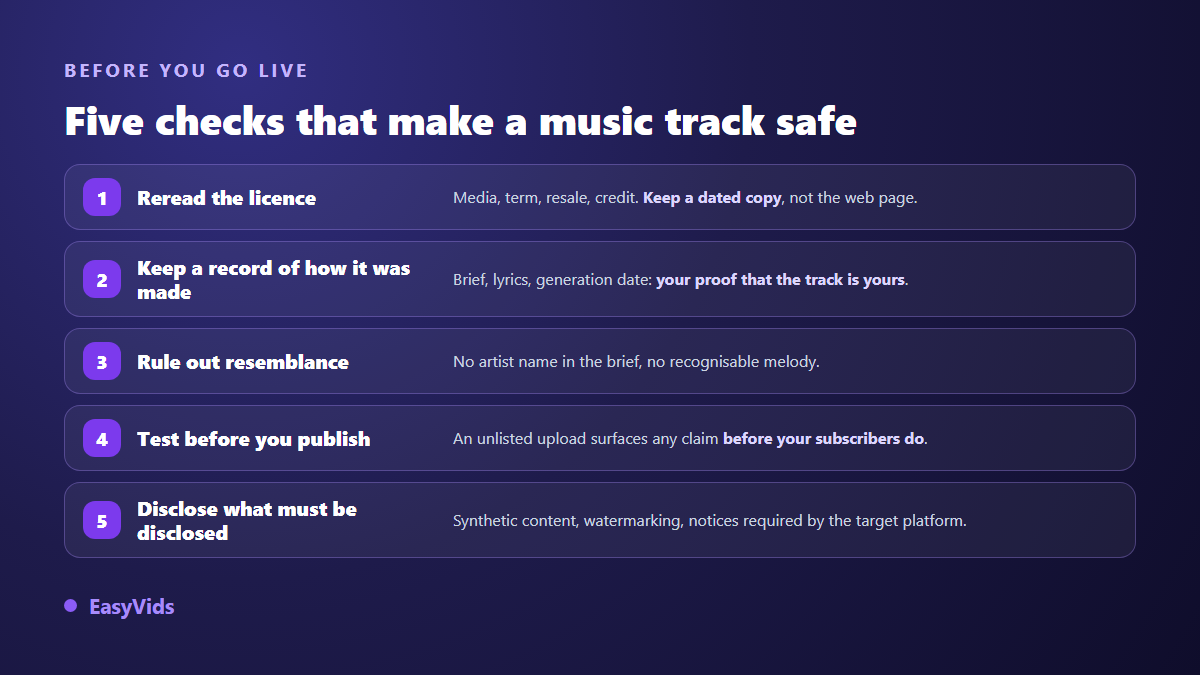
- Read the commercial use clause and the paid advertising clause: in most contracts these are two separate permissions.
- Archive your proof: a dated licence text for a purchased track, a capture of your generation history for one you produced.
- Keep artist names and existing titles out of your brief: asking for music in the style of someone is the fastest route to a contestable resemblance.
- Publish the video unlisted first and watch whether a claim lands in the following minutes, before your subscribers see it.
- Fill in the disclosures your target platform asks for, synthetic content in particular, rather than waiting to be asked.
Frequently asked questions
Is AI generated music really royalty free?
It is free of royalties, which is not the same thing. Nothing is owed per play, and you exploit the track within the limits set by the terms of the tool that produced it. At EasyVids those terms recognise your ownership of generated content and its commercial use, within the rights granted by the underlying model providers.
Can I use generated music in a paid ad?
Yes on the licence side, provided you check two things: that the tool's terms do not reserve advertising use for a particular plan, and that the ad platform accepts generated content. Advertising policies move faster than editorial ones, so reread them before a large campaign.
Can I deliver the music to a client as part of paid work?
With a library track, check that the licence covers the end client, otherwise they have to buy it themselves. With a track you generate, you pass on what you hold, and professional practice is to state it in the service contract, mentioning that the piece was produced with a generative tool.
Can royalty-free music still be claimed by a fingerprinting system?
Yes, and it happens regularly. The system compares audio signals and knows nothing of your contract. A claim is not a penalty: it is disputed with proof, a dated licence or a generation record. That is why you should never delete the history of a track you exploit.
Can I resell the track itself to a music library?
That is a separate use, and most licences forbid it outright: you buy the right to include a track in a work, not to redistribute it as it stands. For a track you generate, the limit comes from distributors instead, who increasingly require an AI disclosure and reject mass produced catalogues.
Keep the logic rather than the list: the freedom of a piece of music is never printed on its label. It lives in the contract and it is proven with a record. Generating your tracks gives you that record, along with a sound that belongs to your channel alone. To compose your first track and hear it over your footage, create an account and open the Music Studio.