You are putting together a breathing session, a sleep video or a background track for a yoga class, and the one thing you cannot find is a piece of music that holds ten minutes without ever pulling attention towards itself. Stock libraries offer thousands of them. Choice is not the problem. Control is. The perfect track runs three minutes, the hour long one hides a string swell in the middle, and the third is already playing on forty competing channels.
Composing the atmosphere yourself solves all three at once, provided you know what an ear expects during a session. That is less obvious than it sounds, because the vocabulary that works everywhere else turns against you here. This guide covers the whole method: the brief that produces a genuinely calming pad, the instrumental setting almost everyone forgets, the jump from a short piece to a full session, and the rights questions worth settling before you upload. If AI composition is new to you, our complete guide to the AI music generator lays the groundwork.
Short answer: describe an atmosphere, not a song
To get usable meditation music, write a description that states one use, two instruments, a very slow tempo and a list of what you refuse: no drums, no vocals, no dramatic build. Turn the instrumental mode on before you generate, run the same brief two or three times, and keep the most discreet result. The EasyVids Music Studio follows exactly that path: pick the custom occasion, write your atmosphere, set the tempo to slow, tick instrumental. Generation then runs on the server, so you can close the page while it works.
Relaxation music follows inverted rules
Every piece of music you know is built to capture attention. A chorus lands, a bass enters, drums push forward. Meditation music aims for the opposite: it should be forgotten after twenty seconds and only noticed when it stops. That inversion changes everything, from instrument choice to structure. What would count as flatness anywhere else becomes the main quality here.
The direct consequence lands in your prompt: words that usually help become harmful. Uplifting, powerful, epic, energising all push the engine towards a progression, therefore a surprise, therefore a listener opening their eyes. You are not after a track that tells a story. You are after a texture that lasts.
The five part brief
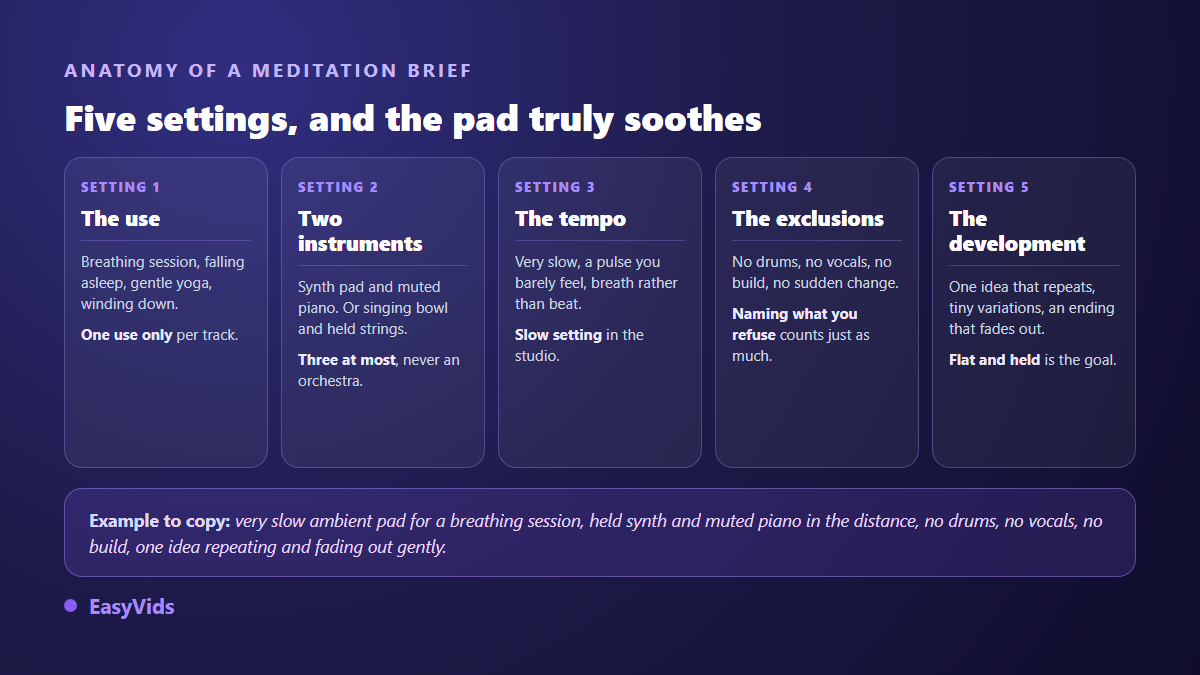
A workable description fits in one sentence and states five things in the same order. The use first, because it carries much of the atmosphere on its own. Then the instruments, two or three at most. The tempo. Then the exclusions, which matter at least as much as the rest. Finally the kind of evolution you expect, which should stay minimal.
- Guided meditation: very slow ambient pad for a breathing session, sustained synth and distant muted piano, no drums, no vocals, no build, one idea repeated.
- Deep sleep: low continuous texture for falling asleep, soft bass and light air, no instrument in the foreground, no change, slow fade out.
- Gentle yoga: warm slow atmosphere for a yoga class, occasional singing bowl and sustained strings, very slow tempo, no percussion, no progression.
- Focus and study: neutral steady pad for working, discreet electric piano over a stable bed, no memorable melody, no marked variation.
If you want to sharpen that vocabulary, the general mechanics of a music description are covered in our library of music prompts sorted by genre and mood. One rule from it counts double here: one precise word beats three stacked adjectives.
Instrumental mode, the box everyone forgets
This is the most common and most expensive mistake in time lost. Without an explicit instruction, a composition engine very often adds a voice, sometimes distant, sometimes just choir pads. On a relaxation video that voice kills the track: it draws the ear, and someone meditating starts following lyrics instead of their breath. Tick the box before you generate, not after.
The Music Studio offers two engines. The first, AI instrumental, never produces vocals: it composes roughly thirty seconds from your description, which makes it the ideal building block for a session you will assemble afterwards. The second, AI song, can sing lyrics but also accepts an instrumental mode, and returns a longer piece. For meditation, start with the first and keep the second for a single continuous track. What each engine consumes is listed on the pricing page, which stays the only up to date reference.
From thirty seconds to a full session
A short piece is raw material, not a limitation. The method takes six steps, and a clean assembly is more reliable than one long generated block, because you control every junction instead of discovering a surprise halfway through.
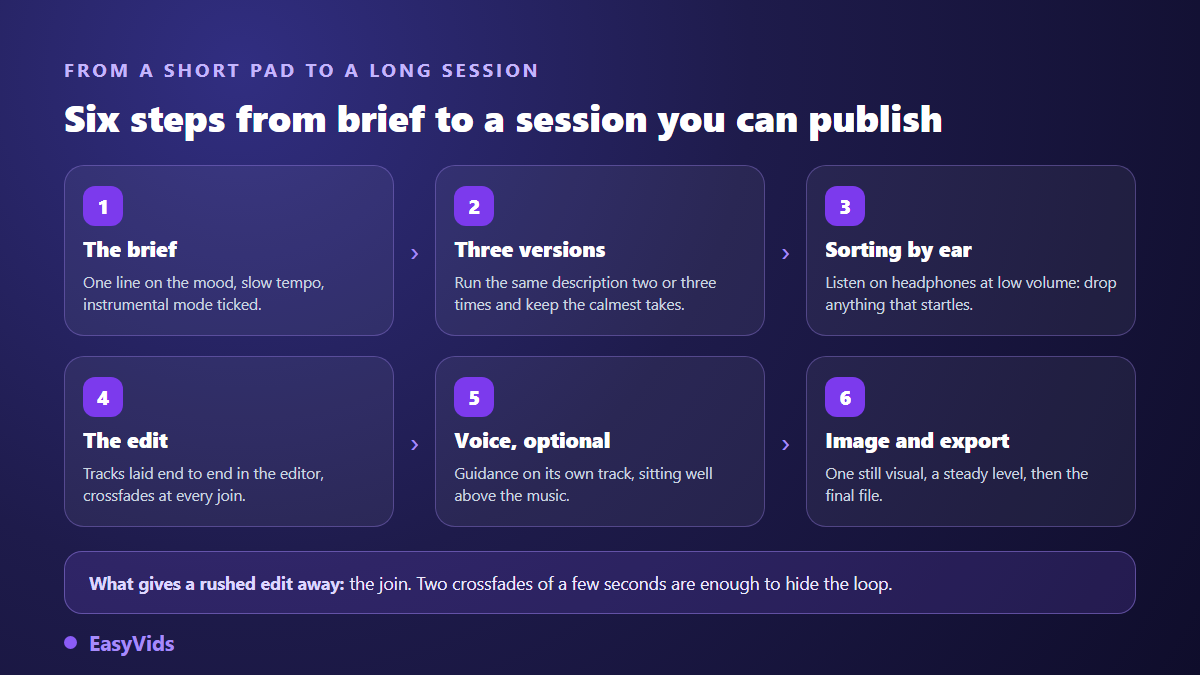
- Run the same description two or three times: the variants resemble each other without being identical, which is exactly what you want.
- Listen on headphones at low volume, in your listeners' conditions. Any sonic surprise eliminates the take.
- Lay the takes end to end on the same timeline, overlapping them by a few seconds.
- Apply a fade out on the outgoing take and a fade in on the incoming one: the crossing becomes inaudible.
- Check each take's level in decibels so none stands above its neighbours.
- End with a progressive fade, never a hard cut.
The junction is the only place an assembly gives itself away. Two fades overlapping across several seconds are enough to erase the seam, and the ear stops counting loops. Vary the order of the variants too: three well shuffled takes hold far longer than two in strict alternation.
Do you need a guiding voice?
It depends on the format. Sleep and study videos do fine without speech. A guided meditation rests entirely on the voice, with the music reduced to the floor it stands on. The delivery is specific: slower and lower than standard narration, with real pauses between sentences. The same principle drives whispered relaxation content, which we cover in our guide to AI generated ASMR voices.
One mixing rule holds: the voice dominates clearly, the music sits far below it, around a fifth of its level. Write the script in short sentences with generous punctuation, because synthesis engines read punctuation the way an actor reads a score. The silences you leave in the text become the silences of the session, and they are what creates the sense of space.
Rights, Content ID and monetisation
This is where relaxation channels break most often, and rarely for the expected reason. The risk does not come from the music you generate but from the music you would have taken elsewhere. A piece composed from your own description, in a studio whose terms allow commercial use, is not the same situation as a track lifted from an ambient channel. We covered the legal status of these compositions in our file on AI music and copyright.
Two different mechanisms are often confused. According to the YouTube help centre, Content ID compares every upload against a database of reference files supplied by rights holders, and a match triggers an automatic claim with no human involved. It is a detection system, not a judgement on where the track came from. The inauthentic content policy, in force since the summer of 2025 according to the same help centre, targets repetitive mass produced content with no contribution of its own, not the use of AI as such. A meditation channel publishing distinct sessions, each written on its own, sits on the right side of that line.
Mistakes that break the calm
Most failed tracks do not fail on sound quality. They fail because one detail reminds the listener that they are hearing something manufactured. These are the flaws we see most often, each with its matching habit.
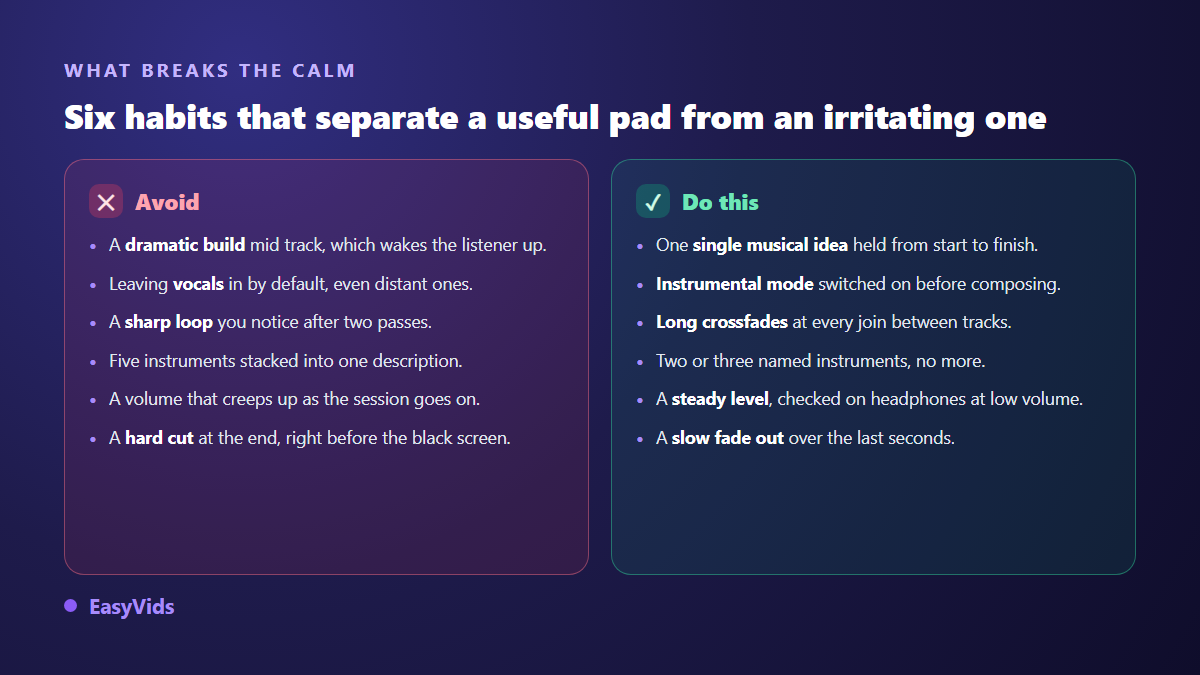
- Stacking five instruments in one description: the engine favours two and the rest turns into noise.
- Skipping the exclusions: whatever you do not refuse explicitly will eventually show up.
- Generating once and settling for it: two more runs cost little and almost always improve the result.
- Cutting the ending in the edit instead of letting it fade.
- Mixing on loud speakers when your audience listens on headphones at low volume.
- Reusing one single take across every video, which makes the channel monotonous and easy to spot.
Frequently asked questions
How long should a meditation video be?
Ten to twenty minutes covers most uses: a breathing session, a reset, a short nap. Hour long formats mainly serve sleep and demand a careful assembly, because a single flaw repeats dozens of times. Start short, watch how much is actually listened to, then extend.
How do I keep the loop from being heard?
Work with three variants instead of one, alternate them in an irregular order, and overlap the takes by a few seconds with a fade out on one and a fade in on the other. Strict repetition is spotted on the second pass, a crossed transition is noticed much later, often never.
Music only, or music with a voice?
Both work, for different audiences. Music alone serves sleep, study and ambience. A guiding voice serves directed meditation, where the listener follows breathing instructions. Do not mix the two intentions in one video: a session that speaks intermittently disturbs anyone who wanted to sleep.
Can AI generated meditation music be monetised?
Yes, as long as the studio's terms allow commercial use and your channel brings something of its own: distinct sessions, real editing work, an editorial intent. Platforms penalise mass produced content with no contribution, not the technology used to compose it.
Can I create these tracks from a phone?
Yes, as long as the tool runs in the browser: composition happens on servers and your device only displays the interface. A phone is plenty to write the brief, launch generation and download the file. Assembling the long session stays more comfortable on a wider screen.
Meditation music is one of the rare formats where restraint pays better than display. A short brief, two instruments, a slow tempo, clear exclusions, then careful work at the junctions: within minutes you have an atmosphere nobody else has heard. To compose your first pad, creating an account opens the Music Studio, where the brief, any lyrics and the composition live in one place. The rest of the chain, from visuals to export, sits in the EasyVids studio.