You have the tool, the evening hours and the urge to publish. What stops you is the first decision: which faceless channel niche to pick when you never plan to appear on camera. That choice locks in a name, a visual identity and dozens of hours of production, and you pay for it for months. The worst outcome is not failure. It is a channel that piles up views and never earns, because no advertiser wants its subject.
Most niche lists have been recycling the same headings for four years, without ever saying which ones a newcomer can no longer enter. This page does the opposite: fifteen niches still open in 2026, five to leave alone, and the method that settles a choice between two ideas. If the faceless model itself is still fuzzy, our guide to running a YouTube channel without showing your face lays the ground before this one.
The short answer
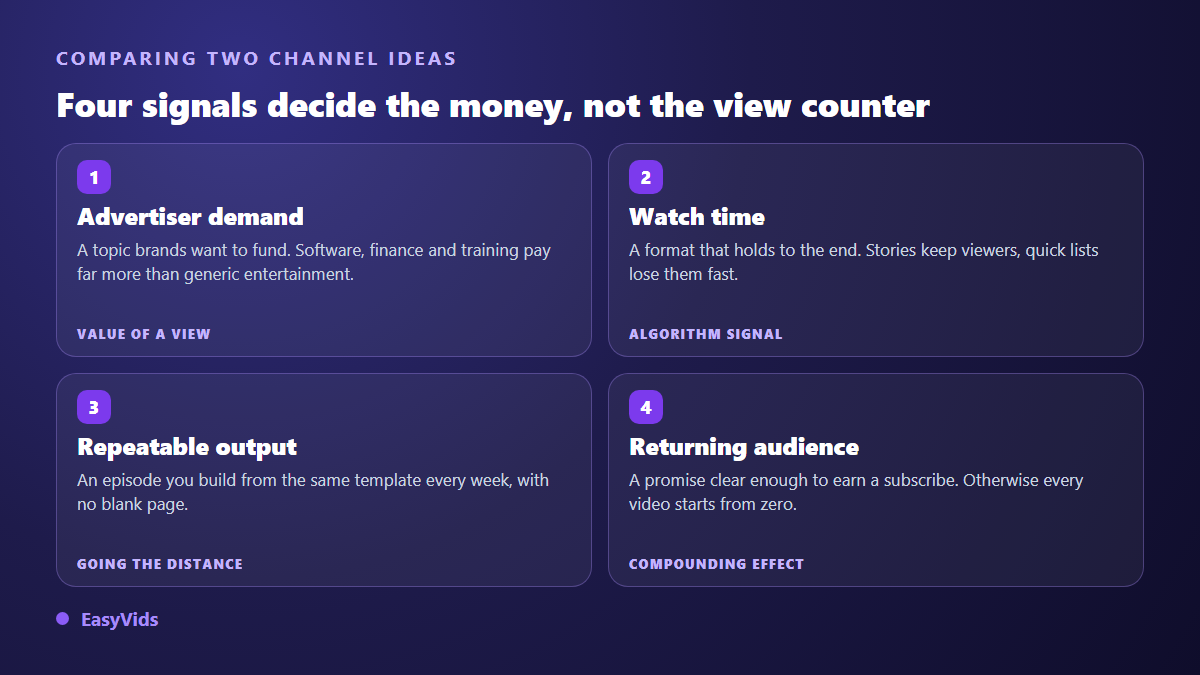
A profitable niche meets three conditions at once: a subject advertisers are willing to fund, a format that holds attention, and a production you can repeat every week without burning out. Three families tick all three boxes in 2026, stories, explained knowledge and personal progress. The niches that fail rarely lack an audience. They lack advertisers, or they demand work nobody sustains past three months.
What actually decides whether a niche pays
The view counter is not a profitability signal. Two channels with the same audience can earn very differently, because the value of a view depends on the subject, on how much of the video is watched and on where viewers live. A channel explaining professional software attracts brands that sell software. A channel of funny compilations attracts advertisers hunting for cheap volume, and the revenue per view shows it.
A fifth criterion decides everything that follows, and it cannot be measured: your stamina. A niche that looks perfect on paper but bores you stops at episode eight. That is exactly the strength of the faceless model: the channel does not depend on your face, so it survives your busy weeks.
Family 1: stories, the fuel of watch time
Stories lead because they hold. A well cut narrative keeps the viewer to the end, and watch time remains the first signal recommendation looks at. It is also the easiest family to automate: one narrator voice, illustrative shots, a steady edit. Three of these formats already have a full method here, including forum story channels and documented true crime channels.
- Forum stories and confessions: short episodes, an endless series, a format that works vertical and long.
- True crime and investigations: very high retention, but verified sources and real caution about named people.
- Horror and folklore: old legends give you infinite material, and sound design does half the work.
- Bedtime stories: long episodes, a slow voice, calm visuals. Little editing, a lot of consistency.
- Myths and legends: mythology, folk tales and founding narratives. No rights to clear, and a visual world that holds together.
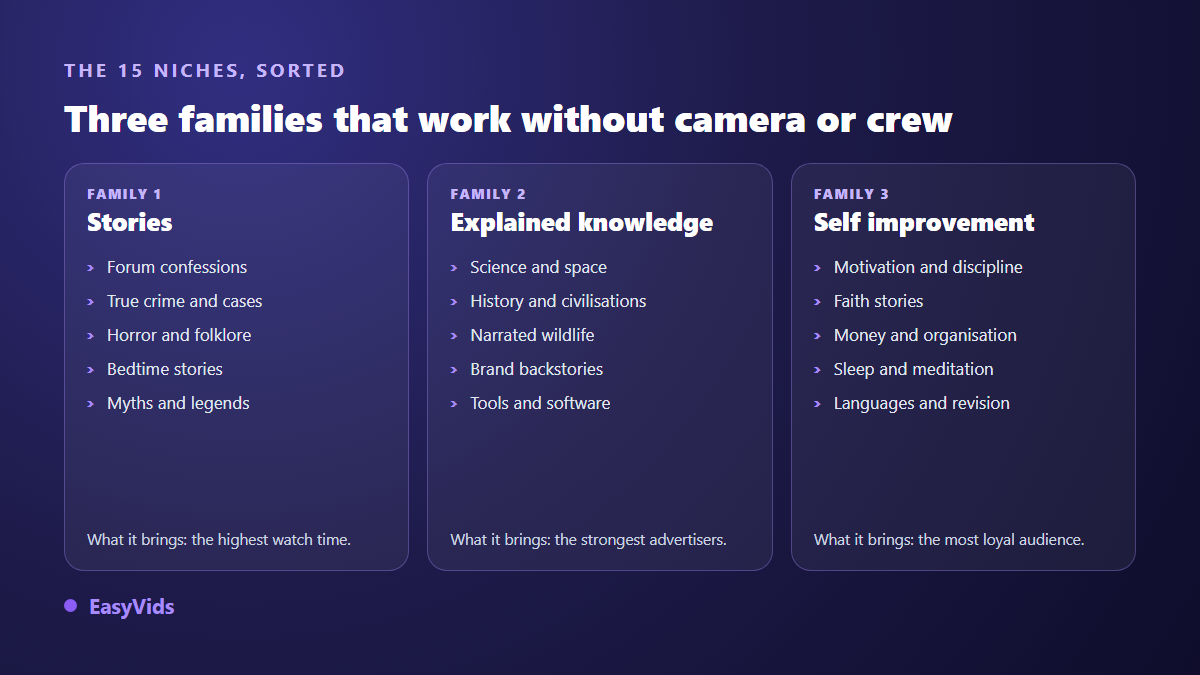
Family 2: explained knowledge, the one advertisers fund
This family demands more research and pays more for the same audience. A viewer who came to learn accepts long videos, comes back for the next part, and sits in sectors where brands genuinely spend: professional tools, training, technology. The writing rule is short. One idea per episode. A promise kept within the first thirty seconds. A diagram on screen as soon as the subject turns abstract.
- Science and space explainers: highly visual subjects, an international audience, almost endless material.
- History and civilisations: documented narratives that age well and keep being watched years later.
- Narrated wildlife: the footage can be generated, the commentary makes the difference, the family audience is wide.
- Business case studies: strategies, failures, brand stories. A professional audience attracts the strongest advertisers.
- Tools, software and applied AI: the most contested niche of the family, but every new release opens a door.
Family 3: personal progress, the loyal audience
These channels live on loyalty rather than discovery. Viewers return because the appointment does them good, not because a title intrigued them. The practical consequence is that the first hundred videos earn little, then the subscriber base carries everything else. Two of these formats have their own guide, including the AI motivation channel, and they share one engine: a voice, a music bed, a promise repeated.
- Motivation and discipline: the fastest format to produce, therefore the most crowded. The voice makes the difference.
- Faith and spirituality: a very loyal community, busy comment sections, high tolerance for long episodes.
- Money, organisation and productivity: solid advertisers, but real caution required as soon as you discuss investing.
- Sleep, meditation and breathing: long sessions, passive listening, considerable watch time per video.
- Languages and revision: useful content, searched all year, with a natural progression into series.
Five niches to avoid in 2026
Avoid does not mean forbidden. These areas stay open to anyone bringing a genuinely new angle. For an automated channel starting out, they cost more than they return, and three of them run straight into the reused content rule, which our analysis of reused content rejections covers case by case.
- Compilations of other creators' clips: the most common monetisation rejection, and the hardest to recover from.
- Quotes over stock landscapes: mass produced, with no commentary or structure, and no perceived value left.
- Auto generated news recaps: sensitive subjects, limited monetisation, and a speed race you will lose.
- Fast money promises: volatile audience, nervous advertisers, and closer scrutiny from the platform.
- Endless music streams with unclear rights: one claim is enough to sink the revenue of the whole channel.
The four signal test before you commit
A niche idea can be tested in one hour, before the first line is written. Open YouTube search, filter on videos published this year, and look at who holds the ground. You are not looking for an absence of competition, which almost always means an absence of audience. You are looking for young channels, still small, already placing videos ahead of established ones.
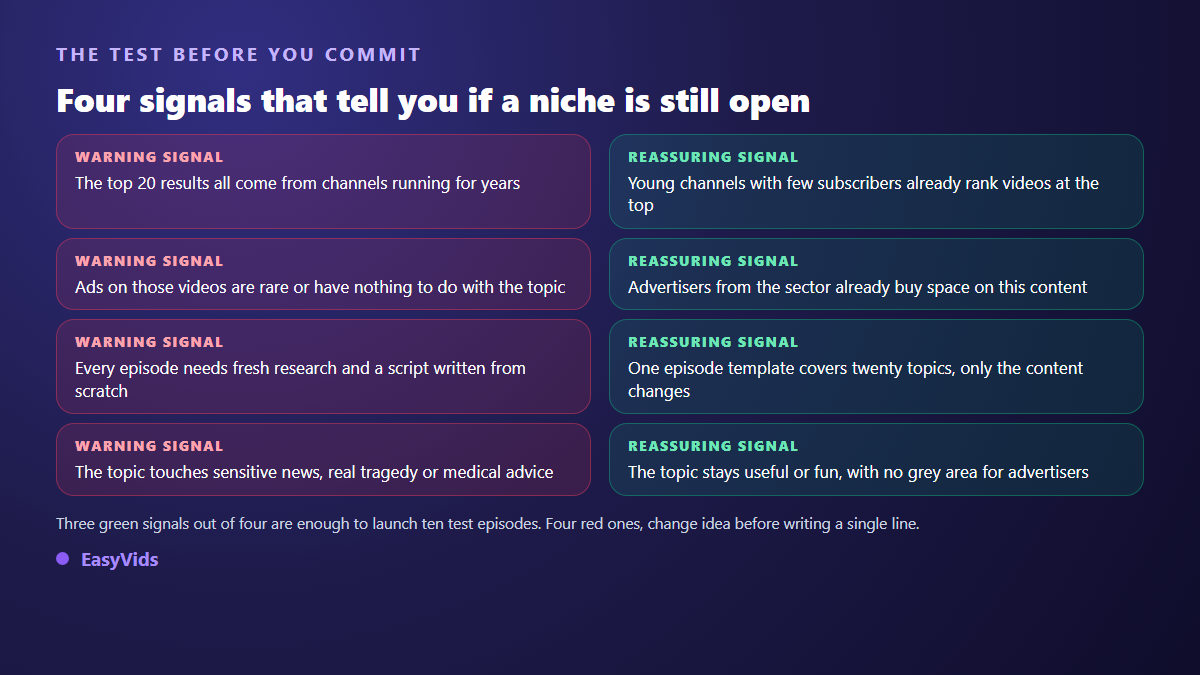
Then play two or three videos from the niche without an ad blocker and watch who buys the space. Recognisable advertisers from the sector, on average videos, is a good sign. No ads at all, or ads with no connection to the subject, means the niche gets views rather than revenue.
Producing the niche without a camera
The niche decides the format, and the format decides the production chain. A story is cut into short scenes, an explainer needs diagrams, a relaxation session mostly needs length. The principle stays the same: you start from an idea, the AI writes for the ear, splits it into shots, builds the visuals, records the voice, then assembles. The EasyVids studio brings those steps together in one place. Two details matter for a series: stable visual references so a recurring character keeps the same face, and batches that keep running on the server after you close the tab.
What YouTube asks of an automated channel
A faceless channel monetises like any other. According to the YouTube Help Centre, the Partner Programme requires 1,000 subscribers with either 4,000 valid public watch hours over twelve months, or 10 million valid public Shorts views over ninety days. None of those conditions mention how the visuals were made. In July 2025 YouTube renamed its repetitious content policy as the inauthentic content policy, stating in the announcement that this was a clarification rather than a new restriction. The principle to remember is simple: an original script, a considered voice and an angle of your own pass without trouble.
Frequently asked questions
Which faceless niche is the most profitable in 2026?
No niche is profitable in itself. For the same audience, professional tools, training and personal finance attract the strongest advertisers, while long narratives generate the most watch time. The strongest combination is telling a story inside a sector brands care about.
Can you still break into a crowded niche?
Yes, and it is usually preferable. An empty niche almost always signals an absent audience. What matters is finding an angle established channels do not serve: a language, a region, a level of detail, a different episode format. Comment sections on the biggest videos often tell you what is missing.
How many videos before you know a niche works?
Around ten episodes published on a steady schedule. Below that you are mostly measuring the randomness of recommendation. Then look at two numbers only: the share of the video actually watched, and the proportion of viewers who come back. View count comes after, not before.
Can a fully AI generated channel be monetised?
Yes. The published conditions concern audience and creator contribution, never the production tool. A carefully written story, consistently illustrated and narrated with a considered voice, sits within the rules. Repetitive output with no original writing is rejected, with or without AI.
Choosing a niche is not about picking from a list. It is an intersection: what you can stand to produce every week, what advertisers fund, and what keeps a viewer to the end. Spend an hour on the four signal test, decide, then publish ten episodes before asking any other question. To build those ten episodes without a camera, creating an account opens the full studio and its free trial.