You type « a beautiful happy song », you hit generate, and you get something that has nothing to do with what you were hearing in your head. You run it again. New track, same miss. The engine is rarely the problem. The problem is that your AI music prompt carries no information a machine can follow. « Happy » says nothing about the genre, the instruments, the tempo, or the job the music is supposed to do.
This page is a starting library: twenty five descriptions written to be copied as they are, then edited word by word. Ten by genre, seven by mood, eight by use case. Before the examples comes the structure that makes all of them work. If the tool itself is new to you, our guide to the AI music generator explains what the machine actually builds, and how.
The short answer: a five part formula
A prompt that works fits in one sentence and sets five things, always in the same order: genre, two or three instruments, tempo, mood, voice. A full example: slow acoustic ballad, fingerpicked guitar and quiet upright bass, slow tempo, nostalgic mood, close male vocal. Twenty words, five decisions. Each one is a dial you can move on its own, without rewriting the rest. That surgical control is what separates a prompt library from a string of random attempts.
Word order matters more than people think
Put the genre first. It sets the whole palette: the drums, the bass, the way chords land. An engine that reads « gospel » at the head of the sentence builds everything around it, while a « gospel » buried in eighth position dissolves into the noise of the other words. Instruments come next because they shape the colour, then tempo and mood, which set the energy.
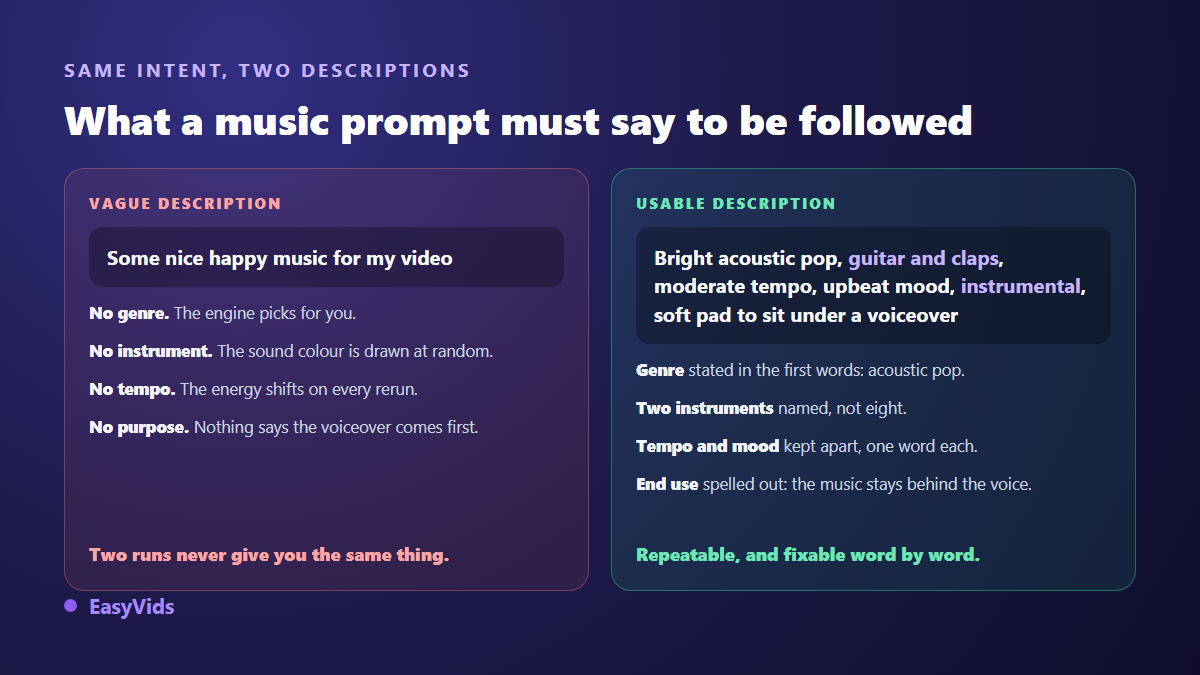
One word beats three. « Happy, festive, upbeat and full of energy » does not make the track happier. It hands the engine four directions and it commits to none of them. Pick the truest word and drop the rest. The same discipline applies to instruments: two or three named give a readable mix, eight give a mush where nothing stands out.
10 prompts by genre
These ten cover the styles requested most often in the Music Studio. Copy the one you need, swap the voice or the mood if you have to, and leave the rest untouched on the first run.
- Afrobeat: mid tempo afrobeat, log drum and round bass, palm muted guitar, light backing vocals, sunny mood, warm male vocal.
- Gospel: warm gospel, piano and organ, four part choir, gradual build into the last chorus, grateful mood, powerful female vocal.
- RnB: slow smooth RnB, electric piano, deep bass, restrained drums, wide reverb, intimate mood, soft female vocal.
- Rap: melodic rap, dark piano loop, deep bass, fast hi hats, mid tempo, determined mood, steady male vocal.
- Zouk: romantic zouk, crystalline guitar, round bass, light percussion, slow tempo, tender mood, male and female duet.
- Afro dance: festive afro dance, bright percussion, short horn stabs, bouncy bass, fast tempo, party mood, energetic male vocal.
- Pop: bright pop, acoustic guitar, claps and solid drums, wide chorus, mid tempo, optimistic mood, clear female vocal.
- Acoustic: acoustic ballad, fingerpicked guitar and quiet upright bass, no drums, slow tempo, nostalgic mood, close male vocal.
- Reggae: roots reggae, offbeat guitar, wide bass line, organ pad, mid tempo, calm mood, deep male vocal.
- Jazz: late night smooth jazz, piano, upright bass and brushes on the snare, slow tempo, instrumental, elegant mood.
7 prompts by mood
When you are chasing an emotion first, flip the formula: the mood opens the sentence and the genre moves to second place. These seven are deliberately instrumental, because that is the common case when you are scoring a video. Add a voice if you want a real song.
- Joyful: joyful mood, sunny acoustic pop, ukulele, claps and whistling, brisk tempo, instrumental.
- Moving: moving mood, solo piano, strings entering in the second third, slow tempo, no drums, instrumental.
- Danceable: danceable mood, warm house, round bass, steady hi hats, short piano chords, fast tempo, instrumental.
- Romantic: romantic mood, fingerpicked guitar and string pad, slow tempo, soft reverb, whispered female vocal.
- Solemn: solemn mood, small orchestra, low strings, spaced timpani, slow tempo, instrumental, no modern percussion.
- Epic: epic mood, wide strings, cinematic percussion, wordless choir, a build in three steps, mid tempo, instrumental.
- Tense: tense mood, dark pad, low steady pulse, one sustained note underneath, slow tempo, instrumental, no melody.
Those mood words also open a song written for an occasion. A love message, a birthday or a tribute does not change the structure of the prompt: it changes the emotion and the name you slip into the chorus, exactly as in our method for a personalised birthday song.
8 prompts by use case
The third grouping is the most useful in production. You are not after a genre, you are after music that plays a precise role in an edit. Say that role in the prompt. Almost nobody writes it, and it changes the result more than anything else.
- Tutorial bed: discreet electronic pad, steady pulse, no marked melody, instrumental, built to sit under a voice over.
- Channel intro: short sharp intro, wide synth chord, quick build, clean final hit, instrumental, no vocals.
- Product ad: rhythmic guitar, claps, solid bass, fast tempo, confident mood, instrumental, building to the last beat.
- Travel vlog: airy acoustic pop, ukulele, light percussion, mid tempo, carefree mood, instrumental, even dynamics.
- Podcast theme: smooth electric piano, quiet bass, brushed drums, slow tempo, instrumental, a loop that runs under an intro.
- Relaxation bed: very slow pad, spaced piano notes, no percussion, instrumental, calm mood, almost flat dynamics.
- Brand jingle: four rising synth notes, one snare hit, instrumental, modern and clean, no long pad.
- End credits: the main theme in an acoustic version, guitar then strings, slow tempo, instrumental, fading out.
A soundtrack for a photo slideshow follows the same logic: it has to support the pictures without ever asking for attention, and the prompt has to say so. We cover that setting in our guide to the photo slideshow with music.
Song, instrumental, background bed: three different prompts
Many failed descriptions come from a confusion of object. A sung song, an instrumental and a background bed are not requested the same way, and the prompt does not carry the same weight in the three cases. For an instrumental it carries everything, because there is no other text to read. For a song it describes the style while the lyrics live in their own field.
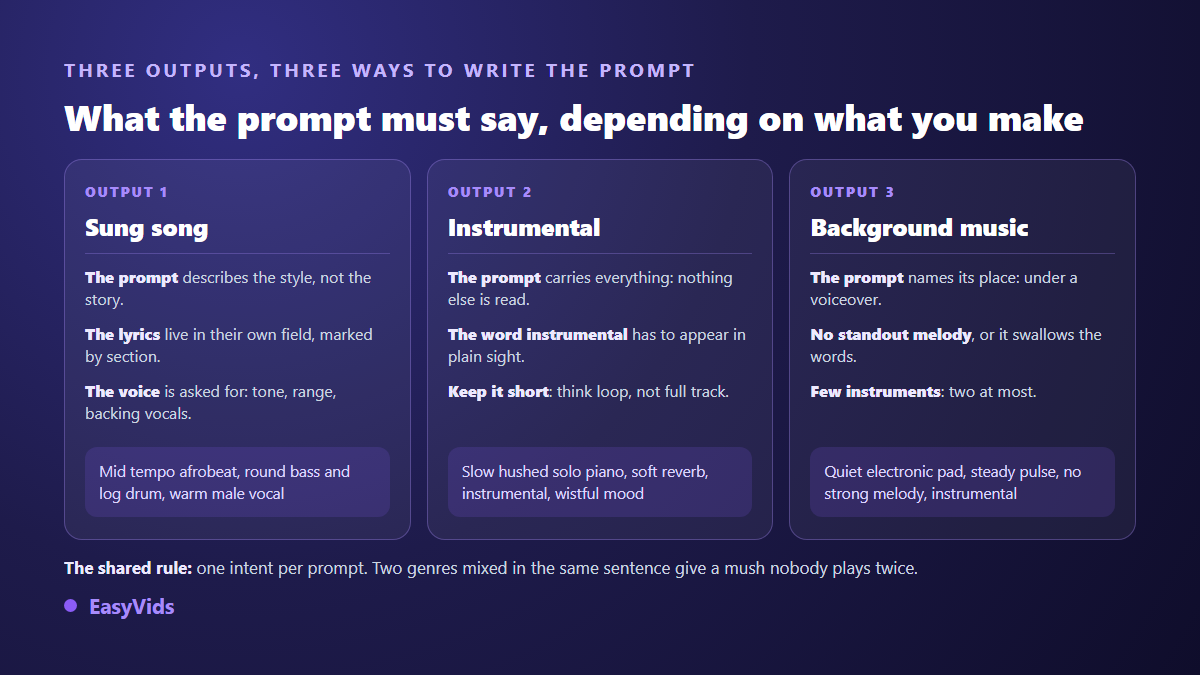
In the EasyVids Music Studio, that choice happens before generation: one engine composes a short instrumental, in the region of thirty seconds, meant to loop under a video, while the other produces a full song with vocals and still offers an instrumental box if you want the same richness without the singing. The style, mood and tempo fields you fill in next to the description are appended to it before sending: they do not override your text, they complete it. Writing the tempo twice, once in the menu and once in the sentence, is wasted effort.
Lyrics are not a prompt
This is the most expensive mistake of all. Typing « a song about a father proud of his daughter graduating » into the description field does not produce those lyrics. It produces a track whose style vaguely resembles that sentence. The sung text has its own field, and it follows different rules.
Structure your lyrics with section tags in square brackets: [Verse 1], [Chorus], [Verse 2], [Bridge]. They tell the engine where the melody has to come back, and that return is what makes a chorus memorable. Some repertoires rest entirely on it, gospel first among them, and our method for composing a praise song shows how to write the build into the final chorus. In the Music Studio you can have those lyrics written from your brief, then read them over and edit them before composing: they stay in an editable field, never locked. Past drafts are kept in a history and reload in one click, with no new charge.
Fixing a prompt: change one word, not the sentence
When a track misses, the temptation is to rewrite everything. That is the worst method: you lose what already worked and start from zero. Name the flaw in one sentence first, then touch only the word responsible for it.
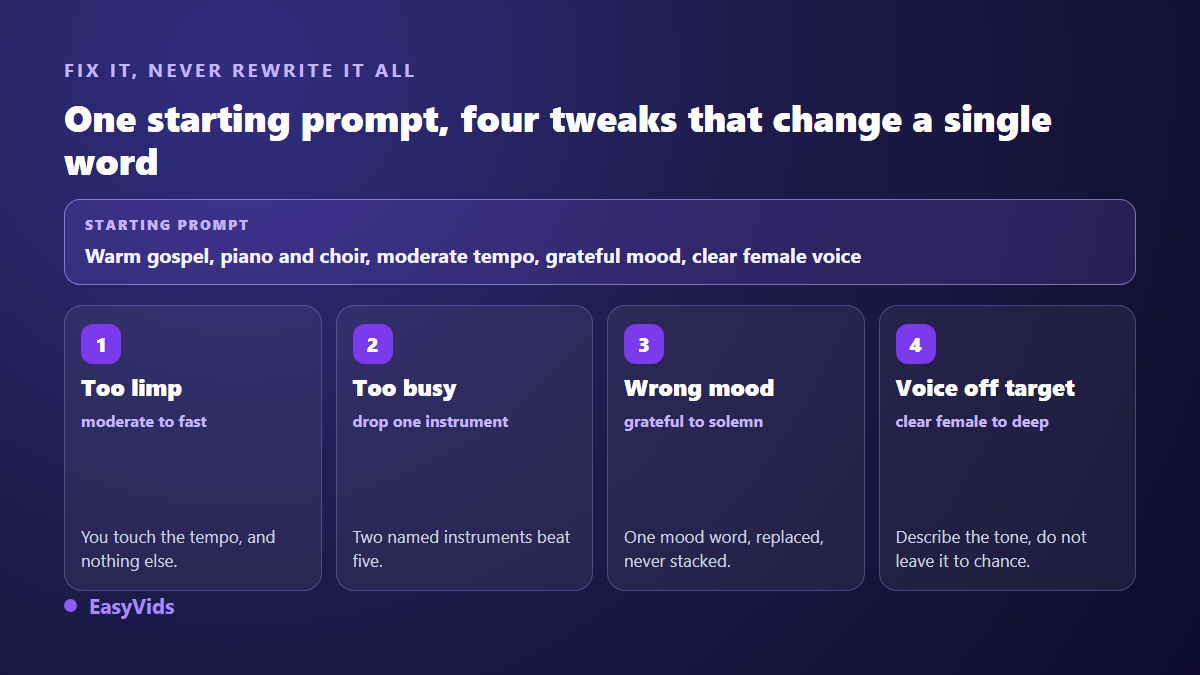
Track drags? Tempo, nothing else. Mix is muddy? Remove an instrument. Emotion rings false? Replace the mood word instead of adding a second one. Voice is off? Describe the timbre, it cannot be guessed. Keep your prompts in a text file with a one line note beside each on what came back. After ten attempts you own a library tuned to your ear, and you never start from a blank page again.
Six words that add nothing to a music prompt
A short dense prompt beats a long vague one. The description field takes far more text than you will ever write, but padding it does not improve the output, it dilutes the useful information. Here is what takes up room without deciding anything.
- « Beautiful », « amazing », « stunning »: none of these describe a sound, and they take the place of an instrument.
- « Professional », « high quality », « studio grade »: the output depends on the engine, not on a polite request.
- The name of a known artist or band: often blocked by provider filters, and legally uncomfortable.
- Three emotions in a row: happy, nostalgic and energetic give a track that is none of the three.
- A list of eight instruments: past three, the engine forgets some and the mix turns unreadable.
- The subject of the lyrics: a style prompt does not write a text, lyrics have their own field.
What a prompt does not control
Worth saying plainly, because this is where most of the frustration comes from. A prompt does not set a duration to the second: you steer length through the format you request, not through a number. It does not drive the structure bar by bar, and it does not guarantee an eight beat verse. It also will not reproduce the same track twice: two identical runs give two different versions, which is good news when the first one disappoints and bad news when you wanted it back. Download what you like straight away.
The prompt does not settle the rights question either, which arises at publication rather than at writing time. Before putting a generated track on a channel, check what you are allowed to do in our article on AI music and copyright, and what happens on the platform side in our guide to monetising AI music on YouTube.
Frequently asked questions
Do AI music prompts have to be written in English?
No. A description in your own language is understood without loss. Two caveats: genre and technique names are proper nouns and stay as they are (afrobeat, mid tempo, palm mute), and the language you write the lyrics in is the language the voice will sing. Style in your language, singing follows your lyrics.
How long should a music prompt be?
Between fifteen and thirty words in most cases. Below that, at least one of the five parts of the formula is missing. Above it, you start stacking adjectives that contradict each other. If your description runs past two lines, read it again and cut everything that names neither a genre, nor an instrument, nor a tempo, nor a mood, nor a voice.
Can I name an artist or a known track in a prompt?
Better not to. The request is frequently blocked by provider filters, and openly imitating an identifiable artist invites claims. The fix is technical: describe what you like about them rather than their name. Tempo, instruments, the grain of the voice and the way the chorus arrives are almost always enough to land the colour you were after.
Does the same prompt give the same track twice?
No. Music generation stays random from one run to the next, even with identical text. Regenerating is a variation tool, not a correction method. To get a result back you must have kept the file: the Music Studio stores your tracks in a history you can replay and download again.
How do I get music with no vocals?
Write the word instrumental in the description and leave the lyrics field empty. Add what the music has to allow: « built to sit under a voice over » or « no marked melody ». Without that, an engine happily adds a vocal line or a melody that will compete with your narration.
A music prompt is worked like a recipe: keep the base, change one ingredient, listen. Start from one of the twenty five formulas above, keep the ones that suit you, note your variants. Within a few sessions you will own a personal library worth more than any ready made list. To put it to the test, create your account and compose your first track in the Music Studio.